• العربية
  • فارسی
BrandBrand
  • Iran Insight
  • Politics
  • Economy
  • Analysis
  • Special Report
  • Opinion
  • Podcast
  • Live TV
  • Iran Insight
  • Politics
  • Economy
  • Analysis
  • Special Report
  • Opinion
  • Podcast
  • Live TV
  • Theme
  • Language
    • العربية
    • فارسی
  • Iran Insight
  • Politics
  • Economy
  • Analysis
  • Special Report
  • Opinion
  • Podcast
  • Live TV
All rights reserved for Volant Media UK Limited
volant media logo

Oman reviews response to grounded tanker near Strait of Hormuz

Nov 12, 2026, 12:08 GMT+0

Oman’s National Emergency Management Committee reviewed operations to deal with the cargo of an oil tanker grounded off Al Qibliyah Island, the committee said Thursday.

It also discussed emergency incidents in Omani territorial waters off Musandam Governorate, which borders the Strait of Hormuz, and monitoring for possible environmental pollution.

Most Viewed

Workers in Iran sell organs to pay debts and cover living costs
1

Workers in Iran sell organs to pay debts and cover living costs

2
VOICES FROM IRAN

Missile city unveiling sparks anger over poverty, lack of shelters

3
INSIGHT

Trump wants to keep Iran blockade. Can the Persian Gulf sustain the standoff?

4
VOICES FROM IRAN

Students shiver in classrooms as Iran government warns of gas cuts

5
ANALYSIS

US targets Iran's land trade routes, but Tehran may hold firm

Banner
Banner
Banner
Banner
Banner
Banner
Banner

Spotlight

  • Iran state TV panelists urge tougher action against US blockade

    Iran state TV panelists urge tougher action against US blockade

  • France's cyberattack allegations against Iran should wake up Europe
    OPINION

    France's cyberattack allegations against Iran should wake up Europe

  • Trump wants to keep Iran blockade. Can the Persian Gulf sustain the standoff?
    INSIGHT

    Trump wants to keep Iran blockade. Can the Persian Gulf sustain the standoff?

  • Iran state TV debate signals cautious openness to nuclear talks

    Iran state TV debate signals cautious openness to nuclear talks

  • The price Iranians paid for 47 years of revolutionary promises
    ANALYSIS

    The price Iranians paid for 47 years of revolutionary promises

  • Trump’s Iran diplomacy faces a test: Can both sides claim victory?
    ANALYSIS

    Trump’s Iran diplomacy faces a test: Can both sides claim victory?

  • Food, medicine, hope: what Iran's economic crisis is costing its people
    VOICES FROM IRAN

    Food, medicine, hope: what Iran's economic crisis is costing its people

•
•
•

More Stories

Two men convicted in London of helping Iran target Iran International journalists

Nov 12, 2026, 11:33 GMT+0
100%
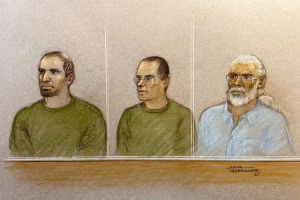
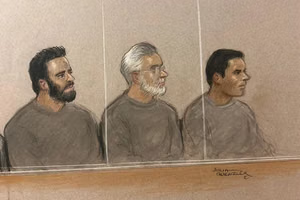
Court sketch from Woolwich Crown Court. Credit: SWNS/Julia Quenzler

Two Iranian men were found guilty on Thursday of assisting Iranian intelligence operations targeting Iran International journalists in Britain, following a six-week trial at London’s Woolwich Crown Court.

Mostafa Sepahvand, 41, and Farhad Javadi Manesh, 46, were unanimously convicted of engaging in conduct likely to assist a foreign intelligence service under Britain’s National Security Act.

A third defendant, Shapoor Qalehali Khani Noori, 57, was acquitted of all charges and discharged by the court.

Sepahvand was also unanimously convicted of conducting surveillance and reconnaissance with the intention of committing serious violence against a person in Britain.

Javadi Manesh was acquitted of a separate charge alleging that he conducted surveillance intending to facilitate serious violence by others. Noori was also acquitted of that charge.

The judge had told jurors that the court would accept majority verdicts of 10 or 11 out of 12, although they should continue striving for unanimity. The guilty verdicts were unanimous.

Sepahvand and Javadi Manesh are scheduled to be sentenced at London’s Old Bailey on December 17.

Iran International journalists among targets

Prosecutors said the men conducted surveillance on behalf of Iranian intelligence between August 2024 and early 2025, gathering information about individuals in Britain whom Tehran regarded as opponents.

The targets included Iran International journalists Kambiz Hosseini and Mojtaba Pourmohsen, as well as British barrister Jonathan Turner.

  • Three men helped IRGC prepare attacks on journalists, UK prosecutor says

    Three men helped IRGC prepare attacks on journalists, UK prosecutor says

  • Prosecutor says defendants filmed journalists' addresses to plan attacks

    Prosecutor says defendants filmed journalists' addresses to plan attacks

  • Iran plot suspect says he discussed journalists at London embassy

    Iran plot suspect says he discussed journalists at London embassy

During the trial, prosecutor Bill Emlyn Jones told jurors that the defendants visited addresses, photographed buildings and vehicles, and recorded videos to help Iran’s Revolutionary Guards identify potential targets.

The prosecution said Sepahvand was expected to carry out an attack and recruited the other two men to assist in locating and monitoring the individuals.

The court heard evidence of communications with contacts in Iran, including discussions about surveillance, payments and Sepahvand’s efforts to resolve a criminal case against him in Iran.

Defendants disputed knowledge and intent

Sepahvand acknowledged conducting surveillance but said he acted under threats against himself and his family and deliberately tried to frustrate the operation.

Prosecutors challenged that account, arguing that his repeated demands for more accurate information about the targets showed he was actively trying to help locate them.

Javadi Manesh denied knowing that his activities were assisting Iranian intelligence. He did not give evidence during the trial.

Noori also denied knowing that his actions were connected to Iranian intelligence operations.

The convictions come as concern grows in Britain over suspected Iranian intelligence activity targeting dissidents and journalists.

British authorities have repeatedly warned of threats against Iran International staff, while Tehran has previously denied involvement in plots targeting critics overseas.

Slain protesters' families in Iran threatened with 'terrorist' label

Nov 12, 2026, 11:31 GMT+0
•
Farnoosh Faraji
100%
Women dressed in black hold portraits of slain protesters during a gathering at a cemetery in Iran.

Iranian security agencies have threatened to label families of slain protesters "terrorists" unless they accept the government's account of their relatives' deaths, sources told Iran International ahead of the first anniversary of the January killings.

Security agents have summoned relatives and demanded they describe those killed as "martyrs," a designation that would place their deaths within the Islamic Republic's official narrative of the protests.

Families refusing the designation and instead using the Persian term "Javidnam," meaning "forever remembered," have been warned they could be placed on lists of "terrorists," according to sources close to them.

The term is used by bereaved families to commemorate those killed during protests without accepting the authorities' account of their deaths.

Authorities have also offered certain benefits to families willing to accept the official designation and instructed relatives not to hold anniversary commemorations.

Bereaved family faces repeated security summons

Security agencies have continued summoning and threatening a bereaved family despite serious health problems affecting several of its members, one of them told Iran International.

The family member, whose identity is being withheld for security reasons, said their mother developed heart problems after suffering severe psychological distress while searching for the body of a loved one at Kahrizak.

Their father suffered a stroke in October, while the family member has an autoimmune disease.

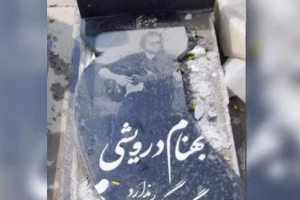
  • Iran crackdown reaches cemeteries as graves of slain protesters defaced

    Iran crackdown reaches cemeteries as graves of slain protesters defaced

Despite these circumstances, the individual has been detained several times in recent months and was summoned to a security agency in November.

During the latest summons, agents demanded that the family describe their slain loved one as a "martyr" and abandon plans for any anniversary ceremony.

Other families have faced similar restrictions.

Iran International previously reported that authorities opened a case against Sanaz Banisaeed, the wife of Mohsen Rashidi-Khaniabadi, who was killed during the January protests, and blocked her Instagram account.

The family of Iman Asadi, another person killed during the protests, has also been summoned repeatedly and warned against posting on social media, according to information received by Iran International.

Pressure continues after protest victim's mother dies

Security pressure on the family of Behboud Hassanzadeh has continued even after the death of his mother, Afrouz Eslampanah, a source close to the family told Iran International.

Authorities have blocked the SIM cards belonging to Hassanzadeh's brother and summoned him several times in recent weeks.

Security agents also warned him against holding memorial gatherings or anniversary ceremonies and demanded that the family recognize Hassanzadeh as a "martyr," according to the source. Eslampanah died on October 30.

Hassanzadeh, 37, a father of two daughters, was shot while helping an injured person during protests on January 8 in Kuhchenar, Fars province. He died two days later.

Pressure to accept official account

Efforts to secure families' acceptance of the government's account of the protest deaths began months before the approaching anniversary.

Authorities had, in some cases, made the return of protesters' bodies conditional on families signing undertakings accepting the official account of how their relatives were killed.

In one case, representatives of the Revolutionary Guards, the governor's office and the education department visited the family of Bahar Shahmehri, a 17-year-old student killed during protests in Neyshabur, northeast of Iran.

The representatives told the family that accepting the official "martyr" designation would be in their interests, a source close to the family told Iran International. Shahmehri's family refused.

Earlier reports also documented damage to and destruction of gravestones belonging to several people killed during the protests.

  • Families across Iran defy pressure to honour January protest victims

    Families across Iran defy pressure to honour January protest victims

Bereaved families regard such actions as attempts to prevent them from preserving the memory of their loved ones.

Despite repeated summons and security warnings, families continue to demand accountability and answers about the deaths of their relatives, according to sources close to them.

Iranian commanders threaten to kill Trump, strike US targets worldwide

Nov 12, 2026, 09:30 GMT+0
100%
FILE PHOTO: People visit the Islamic Revolutionary Guard Corps (IRGC) Aerospace Force Museum in Tehran, Iran, November 4, 2026.

Senior Iranian military and Revolutionary Guards officials issued a series of threats against the United States and Israel on Wednesday, including a pledge to kill their leaders and warnings of attacks on American bases in Europe and targets worldwide.

“We are determined to kill Trump and Netanyahu as long as we live,” Keyoumars Heydari, deputy chief of staff of Iran's armed forces, told state television, referring to US President Donald Trump and Israeli Prime Minister Benjamin Netanyahu.

Heydari also claimed that American forces had been driven out of the Persian Gulf and that US warships had retreated hundreds of kilometers from Iranian territory.

His remarks followed threats from senior Revolutionary Guards adviser Mohammadreza Naqdi, who said Iran's armed forces had received authorization from Supreme Leader Mojtaba Khamenei to retaliate without geographical restrictions.

“If the enemy makes another wrong move and seeks to act aggressively again, it will certainly receive deadly blows in different parts of the world,” Naqdi said.

He was referring to Khamenei's October 31 instructions to military commanders to respond immediately to threats, expand their potential targets and disregard geographical limitations.

Iran's top security official, Mohsen Rezaei, meanwhile, threatened to extend retaliatory strikes beyond the Middle East if Washington resumed attacks.

“We may even target some American military bases in European countries,” Rezaei, secretary of Iran's Supreme National Security Council, told Lebanon's Al Mayadeen television.

He said American bases in Europe and on distant islands could become targets if US aircraft used them to attack Iran. The extent of Iran's ability to strike such distant locations remains uncertain.

Revolutionary Guards spokesman Hossein Mohebbi separately told the Guards-affiliated Tasnim news agency that Iran's aerospace forces had developed sufficient military capabilities to confront a global superpower and bring it to a standstill.

Mohebbi credited the late supreme leader Ali Khamenei and military commanders, particularly Hassan Tehrani Moghaddam, regarded as the architect of Iran's ballistic missile program, for developing those capabilities.

The increasingly confrontational rhetoric accompanied continuing disagreements over negotiations with Washington.

Parliament Speaker Mohammad Bagher Ghalibaf told Al Jazeera on Wednesday that Iran was determined to end its prolonged state between war and peace through sustained military deterrence, potentially without negotiations.

He said Washington had yet to formally respond to Tehran's seven conditions for reopening the Strait of Hormuz and resuming talks.

The statements followed months of US-Israeli military operations and a continuing American naval blockade, with Tehran insisting on its conditions for ending the confrontation while Washington maintains economic and military pressure.

Seven-man Iran-linked network helped orchestrate wave of attacks across Europe - ITV

Nov 12, 2026, 08:01 GMT+0
100%
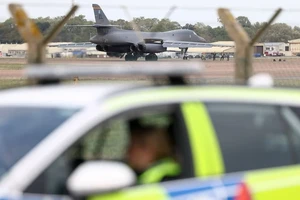
A police officer blocks a road near the RAF Fairford airbase, which hosts United States Air Force (USAF) personnel, in Fairford, Gloucestershire, Britain, September 27, 2026.

A network of seven men allegedly working on behalf of Iranian intelligence services helped coordinate a wave of attacks across Europe, using local criminals and AI-generated propaganda to target Jewish communities and spread fear, ITV News reported on Wednesday.

The British broadcaster identified two previously unnamed brothers with suspected ties to organized crime in the Netherlands as alleged members of the network, which Western security officials believe was involved in attacks across several European countries and a suspected plot against a British military base used by US forces.

ITV named Mustafa Mter Rassoul Alkyaui, who was arrested in Turkey and remains in detention, and his brother, Rassoul Mter Rassoul Alkyaui Mohsen, who remains at large.

The broadcaster said the brothers' contacts in Europe's criminal underworld were believed to have helped the network recruit local operatives to carry out attacks for money, sometimes without knowing whose instructions they were following.

The findings build on a November 10 US Justice Department indictment charging three other alleged members of the network: Mohammad Baqer Saad Dawood al-Saadi, a dual Iranian-Iraqi national; Mohsen Mohajeri, an Iranian national; and Mohammad Ali al-Hassani, an Iraqi national.

100%
Credit: ITV News

US prosecutors linked the three men to nearly 20 attacks and attempted attacks across Europe and the United States, including a September plot targeting RAF Fairford, a British air base housing American forces.

  • Iran-backed operative plotted attack on US base in Britain from NY prison

    Iran-backed operative plotted attack on US base in Britain from NY prison

  • US moves aircraft out of second British base over Iran threat - WSJ

    US moves aircraft out of second British base over Iran threat - WSJ

Investigators suspect rival Iranian agencies funded network

According to ITV, Western security officials believe the network operated from a control room in Baghdad, selecting targets and recruiting criminals to carry out attacks as Iran sought ways to retaliate following the outbreak of war with the United States and Israel in February.

Investigators suspect the network received funding from both the Islamic Revolutionary Guard Corps (IRGC) Quds Force and Iran's Ministry of Intelligence, with neither agency apparently aware of the other's involvement.

100%
An image released by the US Justice Department shows al-Hassani (left) and Mohajeri (right) allegedly meeting in April to plan terrorist attacks.

ITV reported that the group operated as a loose circle of associates rather than a conventional militant organization, using artificial intelligence to produce propaganda videos that made the network appear larger and more sophisticated.

The broadcaster publicly identified five alleged members, including the three men charged in the United States and the two brothers. The other two were not named.

Attacks targeted Jewish communities across Europe

The suspected campaign began in March with an explosion outside a synagogue in Liège, Belgium, followed by an arson attack on four ambulances belonging to the Jewish emergency medical service Hatzola in north London.

A previously obscure organization calling itself the Islamic Movement of Companions of the Right, also known by its Arabic initials HAYI, said it was responsible for the attacks.

ITV reported that al-Saadi was suspected of personally producing and distributing some of the group's AI-generated propaganda, including material relating to the March 23 ambulance attack.

100%
A drone view of four ambulances belonging to Hatzola, a Jewish community organisation, that were set on fire in an incident that the police say is being treated as an antisemitic hate crime, in northwest London, Britain, March 23, 2026.

US prosecutors said the network was involved in approximately 18 attacks in Europe during the spring, seven of them in Britain. The incidents included arson, explosions and a near-fatal stabbing of two Jewish men in London.

The Justice Department alleged that HAYI served as a front for Iran-backed Kataib Hezbollah and other US-designated terrorist organizations, helping conceal those directing the attacks.

US prosecutors detail RAF Fairford plot

The alleged network subsequently turned its attention to RAF Fairford, an air base in Gloucestershire that housed US military aircraft and personnel.

According to the Justice Department, al-Hassani directed preparations from Iran, paying contacts in Britain to conduct surveillance and obtain vehicles and materials for the September operation.

British police recovered three vans linked to the alleged plot on September 27 and arrested their occupants, according to US prosecutors.

Prosecutors also alleged that al-Saadi, who had been in US custody since May, continued coordinating with other members of the network through coded messages passed during calls with relatives in Iraq.

100%
Police officers guard an area as roadblocks remain in place near RAF Fairford airbase, after police declared a major incident at the base and arrested several men on suspicion of offences under the Explosives Act, who have since been released on bail, in Fairford, Gloucestershire, Britain, September 29, 2026.

ITV reported that Western officials believe the decision to target RAF Fairford probably received approval from senior figures within the Revolutionary Guards, unlike other attacks that the network was thought to have selected independently.

"This eight-count indictment shows the determination of Iran to commit terrorist attacks in Europe and the US," FBI Director Kash Patel said, citing the suspected plot against RAF Fairford.

  • Two charged over alleged Iran intelligence operation at RAF Fairford

    Two charged over alleged Iran intelligence operation at RAF Fairford

  • US Treasury chief moves to military base after Iranian threats

    US Treasury chief moves to military base after Iranian threats

Security officials warn of further attacks

The ITV investigation suggested the network's operations were designed not only to cause physical damage but also to generate widespread fear, particularly within Jewish communities.

Western security officials told the broadcaster that networks operating under the HAYI name could carry out further attacks.

The report came as Iran's security chief Mohsen Rezaei renewed warnings Wednesday about military bases stretching "from West Asia to Europe," according to ITV.

The allegations concerning the network, including the suspected involvement of Iranian intelligence agencies and the newly identified brothers, have not been established in court. The three men indicted in the United States are presumed innocent unless proven guilty.

Trump vows ‘total victory’ as Iran rejects concessions and threatens wider war

Nov 12, 2026, 00:41 GMT+0
100%
US President Donald Trump attends a Veterans Day ceremony at Arlington National Cemetery in Arlington, Virginia, US, November 11, 2026. REUTERS

US President Donald Trump predicted Wednesday that the war with Iran would end soon, but Tehran rejected nuclear concessions and threatened US bases as far away as Europe, while Washington intensified economic pressure and tensions persisted in the Strait of Hormuz.

Speaking at a Veterans Day ceremony at Arlington National Cemetery, Trump declared that US forces had already defeated Iran militarily and suggested Washington could decide when to end the conflict.

“We won. It’s just a question of when we end it,” Trump said.

“I want to make sure we have a total victory, not a 93 percent victory,” he added, predicting that the conflict would end soon.

Tehran, however, showed little willingness to accept Washington's terms. Parliament Speaker Mohammad Bagher Ghalibaf said Iran was determined to end its prolonged state between war and peace through military deterrence, potentially without negotiations.

In an interview with Al Jazeera, Ghalibaf said Washington had not formally responded to Tehran's seven conditions for reopening the Strait of Hormuz and resuming talks. He insisted that those conditions must be fully implemented before either could proceed.

His remarks followed comments by President Masoud Pezeshkian on Monday that Supreme Leader Mojtaba Khamenei had ordered an end to the country's “no war, no peace” situation. Pezeshkian said Iran could resolve the dispute through negotiations but would not yield to pressure.

The impasse extends to Iran's nuclear program, one of the central disputes between the two countries.

Mohsen Rezaei, secretary of Iran's Supreme National Security Council, said Tehran would not transfer any of its enriched nuclear material abroad, rejecting a possible arrangement involving Russia.

“We have informed our Russian friends that the enriched material will remain in Iran, and we will use it ourselves,” Rezaei told Lebanon's pro-Hezbollah Al Mayadeen television.

Russia's Foreign Ministry said Wednesday that its offer to receive the material remained available, while emphasizing that Tehran alone would decide what happened to its stockpile.

The disagreement highlights the obstacles facing any diplomatic settlement, even as Pakistan continues efforts to mediate between Washington and Tehran.

Pakistani Prime Minister Shehbaz Sharif, who met Pezeshkian on the sidelines of the COP31 climate summit in Turkey, called for restraint and sustained diplomacy, saying negotiations offered the only path to lasting peace.

The Wall Street Journal reported Wednesday that US Vice President JD Vance was considering face-to-face talks with Iran's Supreme National Security Council Secretary Mohsen Rezaei, citing US and Middle Eastern officials and people familiar with the negotiations.

Trump has authorized Vance to negotiate with Iran, according to the report. Vance sent Rezaei a letter in October requesting a meeting, but no date has been set, with Doha under consideration as a possible venue.

But prospects for direct talks appeared uncertain. Mehdi Mohammadi, an adviser to Ghalibaf, said Tehran had rejected a request from US Vice President JD Vance for direct negotiations before Washington delivered its final response to Iran's proposal.

The Wall Street Journal, meanwhile, reported that Trump had privately questioned whether a Pakistan-brokered agreement reached in June had allowed Tehran to regroup before the United States imposed its naval blockade.

With negotiations stalled, Washington is seeking to intensify the economic pressure already imposed through maritime restrictions and sanctions.

The New York Times reported Wednesday that US officials had spent weeks unsuccessfully pressing Iran's neighbors, particularly Iraq, Turkey and Pakistan, to restrict trade across their land borders.

The effort gained a new dimension with the establishment of Task Force Iron Gate, a US Central Command initiative aimed at disrupting the movement of weapons, sanctioned goods and illicit revenue across Iran's land borders and the Caspian Sea.

But neighboring governments have resisted measures that could damage their own economies and provoke unrest in communities dependent on cross-border trade.

According to the Times, Iraq rejected a US request to close all but two crossings with Iran, while Turkey has largely declined to change its border policies.

The Group of Seven foreign ministers pledged Wednesday to maintain economic and political pressure if diplomacy failed to address Iran's nuclear program and regional security concerns.

Iran's response has combined diplomatic resistance with increasingly expansive military threats.

Rezaei warned Wednesday that any US military base involved in a renewed war against Iran could be targeted, including facilities in Europe.

“NO SAFE DISTANCE. NO SAFE HAVEN. NO IMMUNITY,” he wrote on X.

Other senior Iranian military figures issued similar warnings. Deputy armed forces chief Keyoumars Heydari said Iran had prepared an expanded list of potential targets beyond the Middle East, while Revolutionary Guards adviser Mohammadreza Naghdi said the armed forces had authorization to retaliate without geographical restrictions.

Mohammadi, the adviser to Ghalibaf, also warned that Iran could consider preemptive military action if Washington continued tightening economic pressure. He claimed the United States was preparing for a limited strike, although there was no independent confirmation of such a plan.

An adviser to Supreme Leader Mojtaba Khamenei also warned that countries helping enforce a blockade against Iran could be treated as participants in an act of war.

Those threats came as the Strait of Hormuz remained a flashpoint, complicating efforts to restore commercial shipping and energy exports from the Persian Gulf.

Reuters reported Wednesday, citing three sources familiar with the matter, that Iran had attacked navigation infrastructure on Oman's Didamar island used to support shipping through the waterway. The extent of any damage was unclear.

Iran's navy also said a tanker had caught fire after striking a mine east of the strait, describing the area as unsafe and restricted and urging shipowners to coordinate passage with Iranian forces.