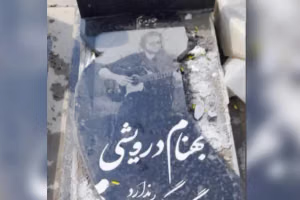
Women dressed in black hold portraits of slain protesters during a gathering at a cemetery in Iran.
Iranian security agencies have threatened to label families of slain protesters "terrorists" unless they accept the government's account of their relatives' deaths, sources told Iran International ahead of the first anniversary of the January killings.
Security agents have summoned relatives and demanded they describe those killed as "martyrs," a designation that would place their deaths within the Islamic Republic's official narrative of the protests.
Families refusing the designation and instead using the Persian term "Javidnam," meaning "forever remembered," have been warned they could be placed on lists of "terrorists," according to sources close to them.
The term is used by bereaved families to commemorate those killed during protests without accepting the authorities' account of their deaths.
Authorities have also offered certain benefits to families willing to accept the official designation and instructed relatives not to hold anniversary commemorations.
Bereaved family faces repeated security summons
Security agencies have continued summoning and threatening a bereaved family despite serious health problems affecting several of its members, one of them told Iran International.
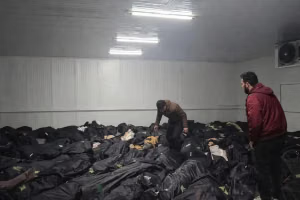
The family member, whose identity is being withheld for security reasons, said their mother developed heart problems after suffering severe psychological distress while searching for the body of a loved one at Kahrizak.
Their father suffered a stroke in October, while the family member has an autoimmune disease.
Despite these circumstances, the individual has been detained several times in recent months and was summoned to a security agency in November.
During the latest summons, agents demanded that the family describe their slain loved one as a "martyr" and abandon plans for any anniversary ceremony.
Other families have faced similar restrictions.
Iran International previously reported that authorities opened a case against Sanaz Banisaeed, the wife of Mohsen Rashidi-Khaniabadi, who was killed during the January protests, and blocked her Instagram account.
The family of Iman Asadi, another person killed during the protests, has also been summoned repeatedly and warned against posting on social media, according to information received by Iran International.
Pressure continues after protest victim's mother dies
Security pressure on the family of Behboud Hassanzadeh has continued even after the death of his mother, Afrouz Eslampanah, a source close to the family told Iran International.
Authorities have blocked the SIM cards belonging to Hassanzadeh's brother and summoned him several times in recent weeks.
Security agents also warned him against holding memorial gatherings or anniversary ceremonies and demanded that the family recognize Hassanzadeh as a "martyr," according to the source. Eslampanah died on October 30.
Hassanzadeh, 37, a father of two daughters, was shot while helping an injured person during protests on January 8 in Kuhchenar, Fars province. He died two days later.
Pressure to accept official account
Efforts to secure families' acceptance of the government's account of the protest deaths began months before the approaching anniversary.
Authorities had, in some cases, made the return of protesters' bodies conditional on families signing undertakings accepting the official account of how their relatives were killed.
In one case, representatives of the Revolutionary Guards, the governor's office and the education department visited the family of Bahar Shahmehri, a 17-year-old student killed during protests in Neyshabur, northeast of Iran.
The representatives told the family that accepting the official "martyr" designation would be in their interests, a source close to the family told Iran International. Shahmehri's family refused.
Earlier reports also documented damage to and destruction of gravestones belonging to several people killed during the protests.
Bereaved families regard such actions as attempts to prevent them from preserving the memory of their loved ones.
Despite repeated summons and security warnings, families continue to demand accountability and answers about the deaths of their relatives, according to sources close to them.
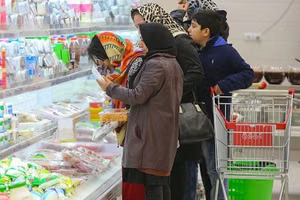
Shoppers walk through a market in Iran, where rising living costs and shrinking purchasing power reflect the economic toll of 47 years of Islamic Republic rule.
Nearly 47 years after Iran's 1979 revolution, a former football chief has asked what Iranians got for its promises, pointing to officials’ children living abroad, oil wealth that never reached wages and a state that answered protests with bullets.
“You haven’t done anything for 47 years. All you talk about is dignity, dignity, dignity. What dignity?” Mohammad Dadkan, former president of Iran’s Football Federation, said in an interview on the Persian-language podcast Tak be Tak.
The cost of confronting US
"What would we have to talk about if it weren't for 'Death to America'? What would we use to keep people occupied?" Dadkan asked.
The slogan has been at the heart of the Islamic Republic’s identity since 1979, when students loyal to Ayatollah Khomeini seized the US embassy and held its diplomats hostage.
Decades of confrontation, and the dispute over the nuclear program, brought broad US sanctions on oil, banking and trade.
They have deterred investment and raised the cost of imports, and the state’s own mismanagement has done the rest. Iranian households live with high inflation, falling purchasing power and few jobs.
Officials call resistance to Washington the measure of national independence. Iranians have paid for it in prices.
Shoppers crowd a bazaar in Iran, where decades of economic hardship, rising prices and declining purchasing power have taken a toll on everyday life.
Privilege at home, children abroad
"What have you done other than fill your own pockets, send your children abroad and take all the privileges for yourselves?" Dadkan said.
The children of senior officials living in the countries their parents denounce have long drawn anger.
Fatemeh Ardeshir Larijani, daughter of Ali Larijani, the former secretary of the Supreme National Security Council killed in an Israeli strike in March, worked as a cancer specialist at Emory University in the United States until January, when Emory said her employment had ended after protests by Iranian Americans. A government spokesman said she had already returned to Iran.
Issa Hashemi is the son of Masoumeh Ebtekar, a former vice president who was spokeswoman for the students who seized the US embassy in 1979.
He lived in Los Angeles with his wife and son until April, when US immigration authorities detained the family and Secretary of State Marco Rubio revoked their permanent residency over their connection to Ebtekar.
For most Iranians, a falling currency and closing visa doors have made studying or settling abroad ever harder.
Oil wealth and shrinking wages
"We have stone, gold, oil, the best resources and an excellent geographical position for attracting tourists. We haven't done anything," Dadkan said.
Iran has some of the world’s largest oil and gas reserves. Its people have not seen the benefit.
Annual inflation reached 76.8 percent in October, according to the Statistical Center of Iran, and prices were 88.7 percent higher than a year earlier.
The dollar traded at about 2.63 million rials in November, against about 1.6 million in early April: the rial lost nearly 40 percent of its value in seven months.
The base minimum wage for the Iranian year that began in March was set at about 166 million rials a month. At today’s rate that is about $63.
'National dignity’
Dadkan also turned the officials’ favorite word back on them, pointing to Iranian women driven into prostitution in neighboring countries.
The US State Department’s 2019 Trafficking in Persons Report cited growing numbers of young Iranian women in prostitution in Dubai, some controlled by networks that took their passports and threatened violence, and possible links between traffickers and members of the police, the Revolutionary Guards and the Basij militia.
Its 2022 report identified Iranian women as vulnerable to sex trafficking in Turkey, especially near the border.
Resilience, salaries and missiles
"They've come up with something new, and apparently they all say the same thing," Dadkan said, criticizing officials' repeated use of the term resilience.
The Persian term tabavari, meaning resilience or the ability to withstand hardship, has increasingly featured in speeches by Iranian officials urging the public to cope with economic and social pressures.
Shoppers browse fresh produce at a market in Iran.
The appeals have come as households struggle with persistent inflation, declining purchasing power, electricity outages and water shortages. Power cuts have disrupted businesses and industrial production, while water shortages have affected daily life in several provinces.
Dadkan's criticism focused on the expectation that citizens should repeatedly adjust to worsening conditions, with officials emphasizing their capacity to endure hardship rather than explaining how the underlying problems would be addressed.
Dadkan also challenged demands for higher parliamentary salaries.
"Why should your salary get increased? What have you done?" he asked.
He contrasted lawmakers' benefits with the struggles of retirees who have repeatedly demonstrated for pensions that keep pace with inflation.
Military priorities drew similar criticism.
"You come on television in the morning and say the missiles' range should be increased. Why is that your concern? Go take care of people's lives, their welfare and their security," Dadkan said.
Iranian officials have made expanding the country's missile capabilities a priority, even as power cuts disrupt homes and factories, water shortages worsen and basic infrastructure falls into disrepair.
The right to protest
"Now tell those who don't agree with your policies to come out. See if you can contain the crowds. Then you'll find out whether people want you," Dadkan said.
His challenge followed years of anti-government demonstrations, including protests in 2017–18 and 2019, the Woman, Life, Freedom uprising of 2022 and the nationwide protests of January 2026.
The January crackdown, particularly the killings on January 8 and 9, became central to questions about the system's treatment of dissent.
On January 25, Iran International's editorial board announced that more than 36,500 people had been killed during those two days, citing confidential security documents, field reports and testimony from medical workers, witnesses and victims' families.
One generation lived through revolution, war and one economic crisis after another. The next grew up with falling incomes and few prospects, and many left. Others buried relatives killed in the streets.
Forty-seven years is a chapter in a state’s history. For Iranians it is a lifetime of youth spent getting by, futures abandoned and families split by emigration or death. None of it can be given back.
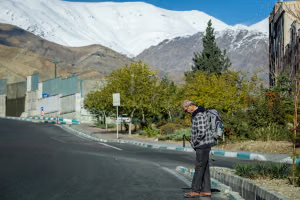
A street view of Iranshahr Street in central Tehran, a popular cultural and social gathering place that has recently faced security crackdowns, arrests and the closure of bookstores and cafes.
Iranian authorities have arrested several people accused of encouraging women to defy mandatory hijab rules on a popular cultural street following a series of security operations and business closures in the area, the judiciary said on Tuesday.
The arrests on Tehran's Iranshahr Street followed instructions from judiciary chief Gholamhossein Mohseni Ejei to identify and confront what authorities described as organized efforts to promote violations of compulsory hijab and public morality rules, the judiciary's Mizan news agency reported.
Several people accused of promoting "immodesty and indecency" were detained following the intervention of the Tehran Prosecutor's Office, Mizan said.
Prosecutors also warned that individuals accused of encouraging women to appear without hijab or promoting conduct deemed inappropriate would face legal action in coordination with security and judicial enforcement agencies.
The judiciary did not disclose the number of detainees or provide details about their identities.
Crackdown follows bookstore and cafe closures
The arrests mark the latest enforcement action on Iranshahr Street, a popular gathering place for young Iranians near Artists Park that has faced growing scrutiny from authorities and supporters of compulsory hijab.
Two bookstores, Dey Bookstore and Arsa Book House, were reportedly sealed on November 7, days after security forces dispersed Halloween celebrations in the neighborhood.
Journalist Yaghma Fashkhami reported the closures on X, while Dey separately announced it would suspend operations and book deliveries until further notice.
The bookstore had previously been shut down in October 2023 over alleged violations of mandatory hijab regulations.
The latest closures followed an October 30 operation in which police blocked Iranshahr Street before Basij militia members and plainclothes security personnel moved against Halloween gatherings.
Witnesses told Iran International that security personnel beat and detained people, ordered families out of Artists Park and forced nearby cafes to close.
The operation followed a nationwide directive prohibiting businesses from organizing or advertising Halloween celebrations, with authorities warning of closures and prosecution.
Supporters of compulsory hijab had previously called for intervention against women appearing without headscarves on Iranshahr Street.
Iranian human rights lawyer Amirsalar Davoudi suffered a heart attack in detention and was hospitalized in Isfahan before being returned to prison a day later following a court appearance, Norway-based Iran Human Rights (IHR) said on Monday, citing an informed source.
Davoudi was taken to Al-Zahra Hospital on Sunday after nearly a month in solitary confinement following his October 11 arrest while representing a protest detainee at the Isfahan Revolutionary Court, the rights group said.
An informed source told IHR that Davoudi was unconscious when he was transferred to the hospital under tight security.
The source disputed an explanation attributed to authorities that a change in medication had caused his deteriorating health, saying Davoudi had not been taking medication when he was arrested.
Davoudi was discharged from the hospital on Monday morning and taken to court, where his arraignment was postponed because the investigation was incomplete, before being returned to prison, IHR said, citing an informed source.
Tehran-based news outlet Emtedad separately reported, citing Davoudi’s lawyer, Seyed Mehdi Karimi-Farsi, that he had attended an investigative hearing with his client at Branch 11 of the Isfahan prosecutor’s office on Monday and that Davoudi appeared to be in good health.
"Today, my client was in good health and personally defended himself," Emtedad quoted Karimi-Farsi as saying, without addressing the reported heart attack.
Karimi-Farsi said Davoudi faced two separate proceedings, with bail granted in one and a temporary detention order issued in the other.
He said the one-month detention order had expired on Monday and expressed hope that it would be replaced with bail, although no judicial decision had been announced.
"A lawyer's place is not in prison," Karimi-Farsi said, expressing hope that his client would be released.
Separately on Monday, UN human rights experts cited Davoudi's arrest as an example of what they described as escalating persecution and judicial harassment of independent lawyers in Iran.
The experts said Davoudi was arrested on October 11 after appearing before the Isfahan Revolutionary Court on behalf of Taraneh and Romina Rahimi, who were prosecuted in connection with January's anti-government protests.
Taraneh was sentenced to death on charges of moharebeh, or "enmity against God," while Romina received a 25-year prison sentence for aiding and abetting moharebeh, according to the UN statement.
"Independent lawyers are increasingly being prosecuted and intimidated for their professional work and for defending human rights," the experts said.
Iran Human Rights said Davoudi had also represented Mahshad Keshani, the partner of Alireza Sepahi, a protest detainee executed on October 5.
Iranian judicial authorities have accused Davoudi of spreading false information online, inciting violence and propaganda against the state, according to the rights group.
Mahmood Amiry-Moghaddam, director of Iran Human Rights, called for Davoudi's immediate release and access to medical care, saying Iranian authorities bore responsibility for his safety.
“We call on the EU and all governments maintaining diplomatic relations with the Islamic Republic to intervene urgently to secure Mr Davoudi’s release. Iranian and international bar associations must raise their voices today for a colleague who has been silenced while defending the rights of others,” Amiry-Moghaddam added.
Davoudi previously received a 30-year prison sentence and 111 lashes over his human rights activities and criticism of Iran's judiciary. Enforcement of that sentence was suspended in 2024 following a judicial review.
Mai Sato, UN Special Rapporteur on the situation of human rights in Iran
UN human rights experts called on Iran to end what they described as escalating persecution of independent lawyers, warning that restrictions on legal representation were leaving defendants vulnerable to arbitrary detention, coerced confessions and unfair trials.
“Independent lawyers are increasingly being prosecuted and intimidated for their professional work and for defending human rights,” the experts said in a statement.
At least 135 lawyers faced judicial or security measures in Iran between September 2025 and September 2026, including arrests, summonses, imprisonment, professional suspensions and travel bans, according to figures documented by the US-based Human Rights Activists News Agency (HRANA) and cited by the experts.
A separate report by the Netherlands-based Lawyers for Lawyers and the London-based Centre for Supporters of Human Rights documented the arrests of at least 23 lawyers across eight Iranian provinces following nationwide anti-government protests.
The experts said Iranian authorities had reportedly instructed lawyers not to take protest-related cases and obstructed independent lawyers from representing defendants in politically sensitive proceedings.
Defendants were often restricted to court-appointed lawyers during initial investigations, while independent lawyers faced limited access to clients and case files, they added.
Iranian human rights lawyer Amirsalar Davoudi was arrested on October 11, 2026.
The statement cited the October 11 arrest of human rights lawyer Amirsalar Davoudi after he appeared before the Isfahan Revolutionary Court on behalf of two clients, Taraneh and Romina Rahimi.
Taraneh was sentenced to death on charges of moharebeh, or “enmity against God,” while Romina received a 25-year prison sentence for aiding and abetting moharebeh in connection with the January 2026 protests, according to the experts.
The experts also raised concerns about pressure on women lawyers, including warnings, suspensions and disciplinary action over alleged violations of compulsory hijab requirements, as well as intimidation and smear campaigns.
They warned that the independence of Iran's bar associations was increasingly under threat, citing interference in elections, the disqualification of candidates critical of the authorities and the expansion of judiciary-controlled licensing outside independent bar associations.
The statement was issued by five UN special rapporteurs, including Mai Sato, the expert on human rights in Iran, and Margaret Satterthwaite, the expert on the independence of judges and lawyers, along with members of UN working groups on arbitrary detention and discrimination against women and girls.
“When independent lawyers are arrested or intimidated for defending their clients, the consequences extend far beyond the legal profession,” the experts said.
“The right to an effective defence, fair trials and the rule of law itself are at stake.”
Tehran prosecutors have opened a criminal case against a gynecologist who spoke publicly about what she described as a growing trend of unmarried Iranian women choosing to raise children without fathers, Iranian media reported Monday.
The physician, Zohreh Amiri, said single motherhood was becoming increasingly common among young Iranian women, particularly those born in the 2000s.
“The newest thing that has become fashionable, and has become very common, is the phenomenon of single mothers,” Amiri said, before questioning whether raising children without fathers should be regarded entirely as a personal choice or warranted broader social discussion.
She described encountering several young women who had decided to continue their pregnancies despite knowing that the children's fathers would not participate in raising them.
Her observations, however, were based on her medical practice, and it remains unclear whether they reflect a broader demographic trend.
Before prosecutors intervened, the Revolutionary Guards-affiliated Sabereen News channel circulated a video of Amiri's remarks, denouncing what it described as the normalisation of a new social abnormality and demanding judicial action.
“This is the normalization of a new social abnormality. The judiciary must address this matter as soon as possible,” the channel wrote.
On Monday, Tehran prosecutors announced that Amiri had been summoned for questioning after allegedly failing to provide evidence supporting her claims. The judiciary said she had been formally accused of spreading falsehoods and that her social media account was no longer accessible.
The case touches on a sensitive issue in Iran, where the Islamic Republic has long promoted marriage and childbearing within traditional family structures while maintaining legal and social restrictions on relationships outside marriage.
Researchers prosecuted over sensitive social issues
The case recalls previous instances in which Iranian authorities pursued medical professionals and researchers whose work brought sensitive social issues into public discussion.
In 2008, physicians Arash and Kamiar Alaei were arrested after pioneering HIV/AIDS prevention programmes addressing drug use, sexual health and the spread of infection.
Authorities accused the brothers of cooperating with an enemy government. They received prison sentences of six and three years, respectively, before being released.
A decade later, population researcher Meimanat Hosseini Chavoshi was arrested in 2018 amid espionage allegations linked to her demographic research. Authorities also summoned fellow demographer Mohammad Jalal Abbasi for questioning about population and fertility studies.
Sociologist Saeed Madani, whose studies examined poverty, prostitution, domestic violence and child abuse, was arrested in 2022 and sentenced to nine years on national security and propaganda charges. His sentence was subsequently reduced, and he was released in April 2026.
Although the circumstances and charges differed, the cases illustrate the risks faced by researchers examining aspects of Iranian society that challenge official narratives about family, morality and social order.