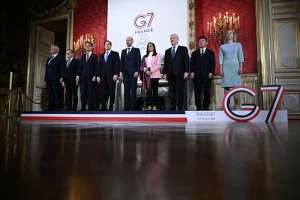
In a joint statement following their November 9–10 meeting in Paris, the ministers expressed support for regional mediators seeking a lasting diplomatic settlement while reiterating that Iran must never be allowed to develop or acquire a nuclear weapon.
"Absent a diplomatic solution, we committed to continuing our coordination to economically and politically constrain the Iranian regime's ability to sow instability in the region and around the world," the ministers said.
The foreign ministers of Canada, France, Germany, Italy, Japan, Britain and the United States, alongside the European Union's foreign policy chief, called on Tehran to resume full cooperation with the International Atomic Energy Agency (IAEA) to restore transparency over its nuclear activities.
They also reaffirmed their commitment to enforcing UN sanctions reinstated against Iran in September 2025 through the snapback mechanism and urged other UN member states to implement the measures.
G7 raises alarm over alleged Iranian plots abroad
The ministers expressed grave concern over Iran's alleged involvement in violent plots targeting citizens and territories of G7 countries, specifically citing a September incident at a British military air base used by US forces.
"We also expressed grave concern over Iranian involvement in violent plots against many of our citizens and territories," the statement said.
The ministers acknowledged Britain's attribution of Iranian involvement in a September 27 incident at RAF Fairford, an air base in Gloucestershire that has hosted US bombers.
"Iran should be in no doubt that we are united and remain committed to safeguarding our sovereignty," they said.
British counterterrorism police arrested several suspects following a security alert at RAF Fairford after reports of suspicious vehicles approaching the base.
Two British nationals were subsequently charged under Britain's National Security Act, including one accused of assisting a foreign intelligence service believed to be Iranian.
On November 10, the US Justice Department separately announced charges against three men over an alleged network linked to Iran's Islamic Revolutionary Guard Corps (IRGC) and implicated in attacks and attempted attacks in Europe and the United States, including the suspected RAF Fairford plot.
Iran has denied involvement, and the allegations have not been established in court.
Separately, US military aircraft were relocated from RAF Mildenhall, another British air base, amid security concerns.
The Associated Press reported Tuesday that 13 American aircraft, including aerial refueling tankers, had departed the base in eastern England for other military facilities in Europe.
A US official told AP the move was a precaution in response to a threat but did not identify its source. The Wall Street Journal reported that the threat was linked to Iran, citing people familiar with the matter.
There has been no public confirmation that the incidents involving the two bases were connected.
G7 rejects Iranian restrictions on Strait of Hormuz
The ministers strongly condemned Iranian attacks on neighboring countries and civilian vessels, as well as disruptions to international trade and energy supplies caused by restrictions on maritime traffic through the Strait of Hormuz.
They called on Tehran to cease attacks against commercial shipping and respect its obligations under international humanitarian law.
The G7 reaffirmed its opposition to "any tolls, fees, illegal costs, discriminations or any limitation imposed on maritime transit through the Strait."
The ministers also emphasized the importance of US Central Command's operations to clear naval mines and escort civilian vessels through the waterway.
They recognized a separate French-British initiative aimed at facilitating the resumption of commercial shipping, including by helping verify the removal of mines.
The statement underscored the importance of restoring safe and unrestricted passage through the strategic waterway, a major route for global energy exports that has faced severe disruption during the conflict involving Iran, the United States and Israel.
G7 demands end to Iranian support for armed groups and Russia
The ministers urged Tehran to stop supporting nonstate armed groups across the Middle East, specifically calling for an end to Iranian weapons supplies and other assistance to Yemen's Houthis.
They condemned continued Houthi strikes against Saudi Arabia, including attacks affecting civilians and infrastructure, and called for an immediate halt to military operations.
On Lebanon, the G7 reiterated that the disarmament of Hezbollah and other nonstate armed groups was essential to bringing all weapons under the authority of the Lebanese state.
The ministers also condemned Iran's military assistance to Russia in its war against Ukraine, alongside North Korean military support and Chinese supplies of weapons-related materials and equipment.
They said G7 members intended to continue taking action against countries enabling Russia's military campaign.