Iran’s vice president says confrontation will continue with or without peace
Iran’s confrontation with its adversaries will continue whether or not peace is reached, the country’s vice president said on Tuesday.
“Whether peace is achieved or not, confrontation with the enemy will continue,” Mohammadreza Aref said, adding that Iran should pursue advanced technologies more seriously to gain an advantage over its adversaries.
“The Islamic Republic is not seeking war, but it defends itself well,” he said.
Aref also said that scientific achievements had strengthened Iran’s defense capabilities and that the country’s defensive position had improved each week.
A street view of Iranshahr Street in central Tehran, a popular cultural and social gathering place that has recently faced security crackdowns, arrests and the closure of bookstores and cafes.
Iranian authorities have arrested several people accused of encouraging women to defy mandatory hijab rules on a popular cultural street following a series of security operations and business closures in the area, the judiciary said on Tuesday.
The arrests on Tehran's Iranshahr Street followed instructions from judiciary chief Gholamhossein Mohseni Ejei to identify and confront what authorities described as organized efforts to promote violations of compulsory hijab and public morality rules, the judiciary's Mizan news agency reported.
Several people accused of promoting "immodesty and indecency" were detained following the intervention of the Tehran Prosecutor's Office, Mizan said.
Prosecutors also warned that individuals accused of encouraging women to appear without hijab or promoting conduct deemed inappropriate would face legal action in coordination with security and judicial enforcement agencies.
The judiciary did not disclose the number of detainees or provide details about their identities.
Crackdown follows bookstore and cafe closures
The arrests mark the latest enforcement action on Iranshahr Street, a popular gathering place for young Iranians near Artists Park that has faced growing scrutiny from authorities and supporters of compulsory hijab.
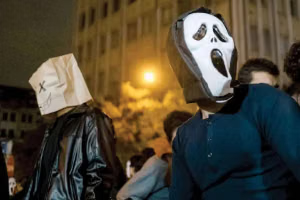
Two bookstores, Dey Bookstore and Arsa Book House, were reportedly sealed on November 7, days after security forces dispersed Halloween celebrations in the neighborhood.
Journalist Yaghma Fashkhami reported the closures on X, while Dey separately announced it would suspend operations and book deliveries until further notice.
The bookstore had previously been shut down in October 2023 over alleged violations of mandatory hijab regulations.
The latest closures followed an October 30 operation in which police blocked Iranshahr Street before Basij militia members and plainclothes security personnel moved against Halloween gatherings.
Witnesses told Iran International that security personnel beat and detained people, ordered families out of Artists Park and forced nearby cafes to close.
The operation followed a nationwide directive prohibiting businesses from organizing or advertising Halloween celebrations, with authorities warning of closures and prosecution.
Supporters of compulsory hijab had previously called for intervention against women appearing without headscarves on Iranshahr Street.
View of the closed frozen food aisle at a supermarket near Nantes after a cyberattack targeted refrigeration systems at French supermarket chains, causing food losses and fires at several stores, France, October 12, 2026.
France is weighing measures against Iran, some of which it may never make public, over cyberattacks it blames on the Revolutionary Guards that made refrigerators and freezers overheat in about 700 supermarkets, Foreign Minister Jean-Noël Barrot said on Tuesday.
“We rule nothing out and will take all measures, including those we may not disclose publicly, that we deem proportionate and necessary to deter any further attacks,” Barrot told Franceinfo television. The aim, he said, was to deter anyone “in Iran or elsewhere” from trying the same.
France summoned Iran’s ambassador on Tuesday morning, a day after announcing that it had identified the Revolutionary Guards as responsible, and said it would seek European Union sanctions against those behind the attacks.
Barrot called the hacking “unprecedented in both its scale and its level of aggression” and the first large-scale cyberattack aimed at sabotaging infrastructure on French soil.
700 stores, one weekend
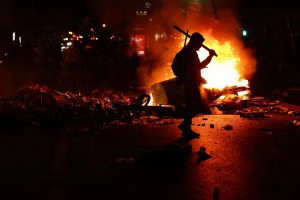
The attacks on October 11 and 12 hit refrigeration systems at about 700 supermarkets and other businesses across France, according to French authorities.
The hackers took remote control of temperature settings and let fridges and freezers warm up. Some stores had to throw out their entire stock of fresh and frozen food. French officials said the attacks caused heavy financial losses and, at some sites, fires.
Reuters has reported that some of the systems were obsolete or ran outdated software, which may have left them open to intrusion.
Paris prosecutors have opened an investigation into Shahid Kaveh, an offensive cyber unit of the Revolutionary Guards, on suspicion of sabotage in the interests of a foreign power.
A joint report by French intelligence and cybersecurity agencies named the unit as responsible and identified three alleged members: Hamid Reza Lashgarian, Mahdi Lashgarian and Reza Salarvand.
It said they worked behind front groups posing as independent hacker collectives, among them “CyberAveng3rs” and “Cyber Isnaad Front.”
Paris prosecutor Laure Beccuau said France had requested international arrest warrants for suspects.
Iran routinely denies carrying out cyberattacks.
Freezers across Europe
On November 2, supermarkets in at least nine European countries, including Belgium and Luxembourg, reported suspected cyberattacks that sent fridge and freezer temperatures soaring and forced units to shut down.
French authorities have not said whether the same group was behind those incidents.
The attacks are among several on civilian infrastructure since the war began on February 28. There other suspected cyber operations against US transit systems, water treatment plants and shipping.
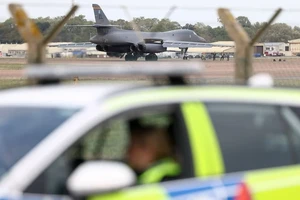
A police vehicle parked at RAF Mildenhall airbase, amid reports that US military aircraft are being moved from bases in Britain following a reported threat from Iran, near Mildenhall, Britain, November 10, 2026.
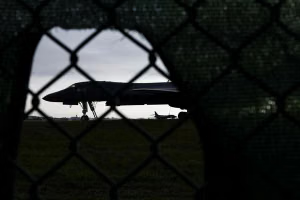
The US military moved tankers and tiltrotor aircraft out of RAF Mildenhall in eastern England on Monday over a threat from Iran, the Wall Street Journal reported, the second British base it has thinned out since a suspected Iran-linked plot at RAF Fairford in September.
Flight-tracking data showed nine KC-135 refueling tankers and three V-22 Ospreys leaving Mildenhall in Suffolk on Monday afternoon and evening, Sky News reported. Most of the tankers went to bases in Germany and Spain and one to Prestwick in Scotland. The Ospreys moved to nearby RAF Lakenheath.
The exact nature of the threat was still under discussion among US officials, the Journal said. Washington raised the security level at Mildenhall and Lakenheath to FPCON Charlie, the second-highest on the Pentagon’s scale, which applies when intelligence indicates that some form of terrorist action is likely.
A military vehicle stationed at RAF Lakenheath, which hosts US Air Force personnel and units, amid reports that US military aircraft are being moved from bases in Britain following a reported threat from Iran, in Lakenheath, Britain, November 10, 2026.
US European Command said aircraft move between locations “for a variety of reasons” and that it could not discuss force protection measures.
Britain’s Ministry of Defense said it did not comment on other nations’ activity. “We’re constantly keeping the security of our bases under review,” cabinet minister Lucy Powell told Sky News, “and as we’ve seen with other cases recently, we take firm and quick action where we need to.”
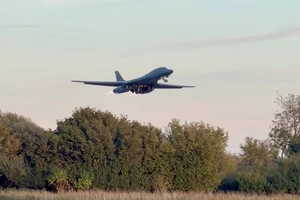
The move comes six weeks after police arrested five men in the early hours of September 27 near RAF Fairford in Gloucestershire, which US bombers used to strike Iran during the war, after a local farmer reported three white vans and a group of men, some with their faces covered. The United States pulled all 12 of its B-1B bombers from Fairford on October 4.
Two men were charged last month under the National Security Act. Prosecutors said one, a British-Iranian dual national, had arranged for the men to drive to the base on the instructions of a man known only as “Ali,” and accused him of assisting a foreign intelligence service; police said they believed that country to be Iran. Six others remain on bail. Prime Minister Andy Burnham said the plot was “almost certainly” directed by the Revolutionary Guards.
Iran’s ambassador in London has denied any involvement. The Revolutionary Guards warned Britain in July that Fairford and any other base used to attack Iran would be a legitimate target.
US President Donald Trump speaks to the media before boarding Air Force One en route to Joint Base Andrews, Maryland, at President Donald J. Trump International Airport in West Palm Beach, Florida, US, November 8, 2026. REUTERS/Eric Lee Purchase Licensing Rights
President Donald Trump’s talks with Qatar’s prime minister come amid a renewed diplomatic push to end the Iran war, but securing terms both Washington and Tehran can present as a victory remains a central obstacle, analysts told Iran International.
Trump and Sheikh Mohammed bin Abdulrahman Al Thani met behind closed doors in the Oval Office on Monday, and Axios reported that their discussions focused on Iran. The Qatari prime minister also met Vice President JD Vance earlier in the day.
An Iranian official told Al-Monitor on Friday that the country’s nuclear program was “under discussion” with mediators. Tehran has said negotiations depend on Washington meeting its demands, including sanctions relief and the release of billions of dollars in frozen assets.
Trump needs a nuclear achievement to justify the war, not just the reopening of the Strait of Hormuz, said Aaron David Miller, a former US Middle East negotiator now at the Carnegie Endowment for International Peace.
“It’s the nuclear issue. He needs a win to justify this war,” Miller told Iran International.
“And I don’t know whether the Iranians are prepared to make that concession or what Trump would consider to be a win that they could accept. So I think that’s a huge problem.”
Who moves first?
The new round of diplomacy has not settled the basic dispute: whether economic and military concessions should come before progress on Iran’s nuclear program, or after.
Danny Citrinowicz, a former head of the Iran branch of Israeli military intelligence and now a senior researcher at the Institute for National Security Studies in Tel Aviv, said an interest in ending the war should not be mistaken for an agreement in sight.
“I believe both sides genuinely want to find a way to end this war, but that does not mean they are close to an agreement,” he told Iran International.
Iran wants Washington to meet its conditions on Hormuz, the naval blockade, oil exports and other economic restrictions before nuclear talks begin. Washington wants movement on the nuclear issue much earlier, he said. “The problem is not simply what each side wants, but who moves first.”
A breakthrough was possible, Citrinowicz said, if Washington accepted a different sequence of reciprocal steps. “Without meaningful American flexibility, however, I see little reason to expect Iran to abandon its red lines.”
Miller criticized the interim memorandum of understanding reached in June, which was meant to open the way to nuclear talks but collapsed soon afterward. It committed Washington to a sequence that favored Iran, he said, calling it “one of the worst negotiated documents in the history of US diplomacy.”
Two definitions of victory
Even if negotiators settle the order of steps, both governments would have to defend the concessions at home as achievements.
Trump could claim victory by reopening Hormuz, lowering energy prices, ending the fighting and securing an Iranian commitment not to build nuclear weapons, Citrinowicz said. Tehran would need an outcome it could present as a success too.
“After surviving months of attacks, the Iranian leadership is not going to accept an agreement that looks like surrender,” he said.
Iran could reopen Hormuz, stop attacks on shipping and regional infrastructure, return to nuclear talks and possibly accept tighter international monitoring, he said. In return it would expect real steps on sanctions, oil exports, frozen assets and guarantees against further attacks.
Miller doubted Trump’s wish to end the war would outweigh his fear of looking beaten. “I think he’d want to be done with this, but I don’t know if he’s prepared to spend the next three years being called a loser,” he said.
Eric Mandel, founder of the Middle East Political Information Network, said a deal could let Trump declare victory while leaving the nuclear dispute open.
“The president would like to have a diplomatic solution. The president is looking for victories. He may claim victories where there aren’t,” Mandel told Iran International.
Tehran was drawing out the talks to wait Trump out, Mandel said, and economic relief in exchange for promises of future nuclear concessions could throw the Islamic Republic a lifeline without securing lasting limits.
A meeting is not a breakthrough
Conflicting reports over a possible meeting between Vance and Iran’s security chief show how uncertain direct contact remains.
Turkey’s intelligence chief, Ibrahim Kalin, said Qatar would host Vance and Mohsen Rezaei, secretary of Iran’s Supreme National Security Council, next week, the Turkish newspaper Türkiye reported. The Tasnim news agency, which is affiliated with the Revolutionary Guards, then quoted a senior Iranian security official as denying any meeting was planned and saying Washington must first act on Iran’s seven conditions.
Foreign Minister Abbas Araghchi said on Tuesday there were no plans for Rezaei to meet Vance. The war, he said, would end neither through military action nor through more sanctions. “The only way to end it is diplomacy and acceptance of the Islamic Republic’s conditions.”
Citrinowicz said Rezaei should not be expected to break with the Islamic Republic’s established positions. “He is deeply rooted in the Iranian political and security establishment,” he said. “He is not someone who can simply be persuaded to abandon the regime’s fundamental positions in exchange for an American offer.”
Rezaei is the subject of an Interpol Red Notice over his alleged role in the 1994 bombing of the AMIA Jewish community center in Buenos Aires, which killed 85 people. He and Tehran deny involvement. As commander of the Revolutionary Guards during the Iran-Iraq war, he led the failed Karbala-4 offensive of December 1986, in which Iran suffered heavy losses.
The decisive question, Citrinowicz said, is whether Vance has Trump’s authority to offer something substantially different.
“A failed meeting could be more dangerous than no meeting at all,” he said. Trump might conclude that diplomacy had run its course and order more strikes to force concessions.
Continued economic pressure, indirect talks and a limited interim deal would remain options, he said, but failure to close the gaps could raise the risk of a return to war.
A man stands along a street in Tehran after rainfall, with clear skies and snow-covered mountains in the background, November 9, 2026
More than 70% of respondents to an Iran International survey on household finances said they had either reduced food purchases or postponed medical treatment to cope with rising prices, illustrating the difficult choices facing families struggling with Iran's economic crisis.
The survey, conducted between October 30 and November 3, 2026, collected responses from 404 people, alongside personal accounts of mounting debt, unpaid wages, depleted savings and the psychological toll of financial hardship.
Of the 374 respondents who answered a question about coping with rising prices, 230, or 61%, said they had reduced food purchases, particularly meat and dairy products. Another 177, or 47%, reported postponing medical treatment or medication.
A total of 142 respondents had done both, while 265, or 71%, had taken at least one of these measures over the previous year. Cutting spending on recreation, clothing and education was even more common.
The survey was voluntary and conducted among Iran International's audience, rather than a randomly selected sample of the population. Its findings therefore cannot be considered representative of Iranians as a whole.
‘Can’t afford potatoes’
One participant, who identified themselves as a Social Security pensioner, described receiving 32 million tomans a month, of which 25 million went on rent, five million on loan repayments, 1.2 million on building charges and 200,000 on electricity.
That left just 600,000 tomans for other monthly expenses.
“I don't have money for potatoes and onions,” the pensioner wrote.
The respondent also described having diabetes but being unable to afford medical appointments or medication.
Another participant described the cost of sending three children to school.
“My first-grader went to school with a schoolbag his brother used several years ago and the shoes he wore for Nowruz,” the parent wrote.
“I sewed his coat and trousers myself to save a little money so I could buy them school supplies … Thank God I have children who are content with little. They understand.”
In another message, a respondent described buying barbari bread for 25,000 tomans one day and 40,000 the next. The participant said a local baker had warned that flour was running out and production might stop if more supplies did not arrive.
Food prices have risen particularly sharply as the rial's collapse drives up costs across the economy.
Official figures showed food and beverage prices in September were more than 120% higher than a year earlier, compounding the impact of years of inflation, US sanctions and economic mismanagement.
‘Living in name only’
The survey also examined employment and the number of income earners in each household.
Of the 387 participants who reported their number of jobs, 177, or 46%, said they held one job. Another 95, or 25%, reported two jobs, while 23, or 6%, held three or more.
In total, 118 respondents, or 30.5%, held at least two jobs. Another 92, or 24%, said they had no income-generating employment.
A separate question found that 47% of respondents lived in households with only one income earner, while 6% said nobody in their household earned an income.
For some, even holding multiple jobs was not enough to cover basic expenses.
One participant, the sole income earner in their household, said they worked two jobs but had fallen behind on rent and three loan installments, had unpaid electricity and gas bills, and had not received their wages for a month.
“I borrowed about 60 million tomans from people, and I haven't been able to pay back even one million,” the respondent wrote. “Our life is only a life in name.”
Another participant, who reported holding three or more jobs, said their motorcycle had been taken and they could not afford to retrieve it. The respondent had also reduced food purchases and postponed medical treatment or medication.
A worker living with a spouse and three children described similar pressures despite holding two jobs.
“I can't manage even the simplest things,” the worker wrote, adding that low wages and unemployment had made “anger and arguments an inseparable part of life.”
The war has added to an already weak labour market, damaging factories and infrastructure, disrupting trade and forcing businesses to scale back or close.
US sanctions and restrictions on banking and imports have further constrained businesses, while years of underinvestment and mismanagement have left the economy poorly equipped to absorb the shocks.
‘Getting poorer before my eyes’
As rising prices eroded purchasing power, many respondents reported relying on resources accumulated in better times or taking on new financial obligations.
Of the 374 people who answered the question about coping with inflation, 171 reported spending savings and 86 said they had sold possessions.
After accounting for overlap between the two groups, 200 respondents, or 53.5%, had used at least one of these measures. Another 128 had borrowed money, while 97 had postponed rent or bill payments.
Nearly two-thirds of respondents to the question reported taking at least three different measures to cope with rising prices over the previous year. Almost 30% had taken five or more.
The questionnaire did not measure how much money respondents had borrowed, the value of possessions sold or the amount of savings spent. But drawing on savings and selling assets can provide only temporary relief, leaving households with fewer resources to withstand future financial shocks.
The rial has lost more than half its value against the dollar over the past year. The war and US blockade of Iranian ports have sharply curtailed oil exports and government revenues, intensifying pressures on an economy already weakened by sanctions and systemic corruption.
One respondent began a message with a direct appeal: “If you can, please help me a little.”
The participant said their workshop had closed, leaving them without income for six months. They had three children and reported that nobody in the household earned an income, describing the circumstances as “the hardest moments of my life.”
Another participant, who was employed and lived in a household with two income earners, said: “I can see myself getting poorer before my eyes.”
The psychological toll
The financial pressures described by participants were accompanied by widespread anxiety and pessimism about the future.
Of 398 people who answered a question about their household finances over the previous year, 375, or 94%, said their situation had worsened. Three-quarters described the deterioration as severe.
Expectations for the coming year were similarly bleak, with 91% anticipating further financial deterioration. Separately, 90% said inflation and economic uncertainty had significantly affected their psychological well-being, including their sleep and peace of mind.
The prolonged conflict with the United States and Israel has deepened uncertainty over jobs, prices and access to essential goods, while repeated disruptions to everyday life have compounded the strain of years of economic instability.
One participant described being unable to afford dental treatment despite holding two jobs and living in a household with two income earners.
Another message described medical treatment that had been interrupted for three years. The respondent said they suffered from depression, had been dismissed from a government job because of illness-related absences and were living with an ailing mother in a household without an income.
“I'm exhausted right now, and I'm writing this while crying,” the message said.
Another participant, the sole income earner in a household with a disabled daughter, said they worked two jobs but had still postponed medical treatment or medication and sold possessions.
Among the 142 respondents who had both reduced food purchases and postponed treatment or medication, 135 reported a significant or very significant psychological impact.
Three participants expressed thoughts of suicide or a wish to die in their written messages. The questionnaire was not designed to clinically assess depression or suicide risk, and the prevalence of such conditions cannot be determined from these accounts.
Little hope of improvement
The survey also examined the relationship between respondents' experiences over the previous year and their expectations for the future.
Of those who described the previous year as having been much worse, nearly 85% expected similarly severe deterioration in the coming year.
Respondents reporting greater financial hardship also tended to describe more severe psychological distress and to have adopted more measures to cope with rising prices.
These findings show an association between financial hardship, psychological pressure and pessimism about the future among respondents, but do not establish cause and effect.
Prospects for recovery remain clouded by the unresolved confrontation with Washington, continuing sanctions and the damage inflicted on Iran's productive capacity.
Even an end to the fighting would leave the country confronting longstanding structural problems, including corruption, weak investment and economic mismanagement.
One participant wrote: “I wish tomorrow wouldn't come,” explaining that they expected each new day to bring greater hardship.
The survey was conducted among Iran International's audience from October 30 to November 3, 2026, and received 404 voluntary responses. Not all participants answered every question, and percentages were calculated from valid responses. Personal accounts were drawn from written messages submitted by respondents and reviewed without identifying information.