Iran International’s Maryam Rahmati wins UN correspondents association award
Maryam Rahmati, the UN correspondent of Iran International and its sister channel Afghanistan International
Iran International’s New York correspondent Maryam Rahmati has won bronze in the broadcast journalism category of the 2026 United Nations Correspondents Association awards, the association announced.
Rahmati was named a recipient of the Ricardo Ortega award, which recognizes excellence in television and radio coverage of the United Nations, its agencies and field operations.
Alongside covering developments at UN headquarters in New York, Rahmati has regularly reported on public protests and human rights violations in Iran and Afghanistan, particularly restrictions on women and the suppression of their rights.
Commenting on the award, Rahmati said she had consistently sought to amplify the voices of women and victims of human rights violations, while covering international and UN responses to developments in both countries.
The award honors the Spanish journalist who was killed while covering the crisis in Haiti in 2004. It celebrates broadcast reporting that sheds light on global crises and the work of the UN.
The awards will be presented at the association’s 30th annual ceremony at the New York Public Library on December 3, with UN Secretary-General António Guterres attending as guest of honor.
Katsiaryna Abromchyk of the Human Rights Center in Belarus won gold in the broadcast category, while Felippe Coaglio of Brazil’s TV Globo took silver.
The association also announced awards for print and online coverage of the UN and its agencies, environmental reporting, and journalism examining the impact of digital innovation and artificial intelligence on sustainable development and public service.
Actress and UN Development Programme Goodwill Ambassador Michelle Yeoh will receive the 2026 UNCA Global Citizen Award at the ceremony.
Actor Mark Ruffalo and chef Jordi Roca, a UNDP Global Ambassador, will also attend to receive the association’s Global Advocate Award.
People look out over Tehran from the Mellat Cinema Complex, with Milad Tower rising in the distance, October 19, 2026
Repeated economic and political crises are eroding Iranians' belief that their lives can improve, with official figures showing declining social capital, widespread perceptions of injustice and deepening distrust of the government.
Sara, a 40-year-old graphic designer, says she was satisfied with her personal life and optimistic about the future until a year or two ago. But losing her job after the 12-day war in June 2025, followed by January crackdown and another round of war have left her deeply pessimistic.
“Thinking about the future and planning for it causes severe anxiety not only for me but also for many people I know,” she said. “There is no hope because everything is extremely unstable, and any good news can be denied moments later.”
The sense of despair is also reflected in public commentary. Sociologist Amin Parvin wrote on X that repeatedly seeing expectations go unmet had replaced “the pleasure of being hopeful” with “living in despair.”
Economic uncertainty has become a persistent feature of everyday life. People with savings or assets worry about losing their value, while others struggle with the rising cost of food, rent and services.
Foreign currency exchange rates, gold and car prices—cars being widely regarded as investment assets in Iran—frequently rank among the most-read topics on Iranian news websites, sometimes attracting more attention than reports about war and negotiations.
Food prices, which fluctuate alongside exchange rates, are another major focus.
Inequality grows
At a recent seminar on social hope in Iran, Mehdi Malmir, a sociology professor at Shahid Beheshti University, presented figures indicating a substantial decline in public satisfaction over the past two decades.
According to Malmir, social satisfaction stood at about 76% in 2000, while 15% expressed absolute dissatisfaction. By 2023, satisfaction had fallen to 49.8%, while dissatisfaction had risen to nearly 40%.
Indicators relating to welfare, the economy and what he described as the moral condition of society had also declined, he said.
Malmir warned that growing poverty and inequality could further undermine hope. People need to see their circumstances improving and believe upward mobility remains possible, he said, adding that available statistics offered little evidence this was happening.
At the same meeting, sociologist Ensieh Jalalvand pointed to repeated protests, declining electoral participation and the spread of emigration across increasingly broad sections of society.
People need to see that their concerns are heard and can lead to tangible change, she said. “The issue is establishing a genuine mechanism through which people can be heard and acknowledged.”
The reformist newspaper Shargh similarly argued that hope depends on people seeing the future as at least partly predictable, believing rules apply equally and trusting that their efforts today can improve their lives tomorrow.
Official figures
The 2025 National Social Capital Report, prepared by the Interior Ministry's Social Affairs Organization and published in June, found that Iran's social capital index fell from 43.5% in 2015 to 36.6% in 2025.
The report found that 75% of respondents were dissatisfied with what they perceived as a lack of justice in society. Three-quarters felt they lived amid discrimination, inequality and the preferential distribution of opportunities through patronage.
The survey covered the period from early 2025 until the outbreak of the 12-day war in June of that year.
Sixty percent of respondents said they had no hope that conditions would improve, while the same proportion said they could no longer tolerate additional economic pressure, according to the findings cited by the Rouydad24 news website.
Rouydad24 said the consequences included the mass emigration of skilled workers, capital flight and a shift from productive activity toward short-term speculation.
The report also pointed to widespread dissatisfaction with the country's political direction. Seventy percent of respondents said changes to the country's overarching policies were necessary to improve their satisfaction.
Mohammad Bat’haei, a deputy interior minister and head of the Social Affairs Organization, described the findings as a serious warning.
The decline in social capital at the national level, reflecting citizens' trust in the country's governing system and institutions, was more pronounced than declines at intermediate and local levels, Bat’haei said.
For Sara, such questions are less abstract. Having once expected her life to improve, she now finds planning for the future itself a source of anxiety.
Mostafa Sepahvand, Shapoor Noori, and Farhad Javadi-Manesh, in a court sketch / Credit: SWNS
A man accused of plotting an attack on Iran International journalists told a London court Wednesday that he met an alleged Revolutionary Guards contact at the Iranian embassy while he was gathering information on the journalists.
Mostafa Sepahvand told Woolwich Crown Court that he visited the embassy on February 15, 2025, where he met a man he identified as Navid Emami.
Sepahvand said he told Emami that addresses provided for the journalists were incorrect but that he was still pursuing the matter. According to Sepahvand, Emami asked whether his co-defendant Farhad Javadi Manesh was working with him.
Later in his testimony, Sepahvand said Emami had supplied addresses to people he described as connected to the Revolutionary Guards. He also alleged that Emami had threatened him.
Sepahvand, 41, is on trial alongside Manesh, 46, and Shapoor Qalehali Khani Noori, 57. All three deny charges under Britain's National Security Act.
Prosecutors say the men gathered information for Iranian intelligence in preparation for serious violence against Iran International journalists Mojtaba Pourmohsen and Kambiz Hosseini.
Sepahvand accepts that he conducted surveillance but says he acted under duress and deliberately tried to undermine the operation.
The court was shown phone and vehicle location data placing Sepahvand near addresses linked to the alleged targets, as well as messages in which he passed Manesh information about Hosseini, including references to his dog and a blue Volkswagen Golf.
Sepahvand said he asked Manesh to make a video of the car. On one occasion, he said, he travelled to an address specifically so his phone's GPS would show his Iranian contacts that he had been there.
He said he was trying to convince the Revolutionary Guards that he was cooperating while actually frustrating the alleged operation.
“I played them,” Sepahvand told the court.
Sepahvand also testified that £30,000 had been sent to a money exchange in Finchley after an address linked to Pourmohsen was raised, but said he did not collect it because he did not want to carry out the task.
Asked who had sent the money and what it was for, Sepahvand named a man called Ruhollah and said it was to “go after the journalists.” Asked which journalists, he said that had not been specified.
Sepahvand said he had initially asked for £150,000. When he denied telling his Iranian contacts that he would attack a journalist if they paid him, his barrister, Tyrone Smith, pointed him to an earlier message in which he appeared to say he would carry out the attack if paid.
Sepahvand said he had no choice but to make such claims because he believed the Revolutionary Guards were monitoring his communications and waiting for him to say he would not carry out the attack.
He said he had been under duress from the beginning, citing the arrest of an associate and his younger brother, a raid on his mother's home and pressure over a criminal case against him in Iran.
“I didn't want anyone to be hurt,” Sepahvand said toward the end of his testimony. “I wanted to protect everyone.”
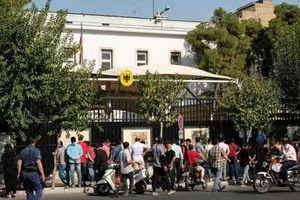
Iranian applicants for German work and vocational-training visas protest outside the German Embassy in Tehran over delays in securing appointments.
Iranians seeking German work and vocational-training visas protested outside the German Embassy in Tehran on Tuesday over lengthy delays in securing appointments, with some saying they had already lost job offers or training places while waiting.
Some applicants told Iran International they had been waiting since July for appointments despite already receiving preliminary approval from German authorities. They included healthcare and nursing professionals seeking work visas, as well as applicants using Germany’s fast-track procedure for skilled workers.
Some said the delays had caused language certificates or preliminary approvals to expire, forcing them to repeat parts of the process and pay additional costs.
Applicants say delays are costing them jobs
The protesters also include applicants for Germany’s Ausbildung system, which combines workplace training with classroom instruction and typically lasts between two and three-and-a-half years.
Applicants told Iran International that appointments had been released only in small numbers despite repeated protests and correspondence with German authorities. Some said they had lost job offers or places on vocational programs because they could not complete the visa process in time.
Thousands of people are reported to be waiting for appointments to submit German visa applications in Tehran.
Family reunification applicants have also protested
The latest gathering follows repeated protests by Iranians seeking other types of German visas.
Family reunification applicants have demonstrated outside the embassy in recent weeks, with some saying they have waited as long as two years for appointments or decisions.
Videos sent to Iran International showed applicants calling for faster processing and an end to prolonged uncertainty.
Students have faced similar delays, with some saying they risk losing university places because they cannot complete the visa process before their courses begin.
Embassy remains on emergency operations
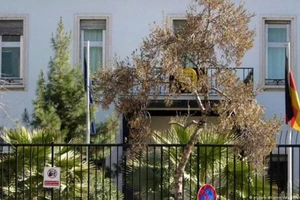
Germany’s Foreign Office told Iran International in August that its embassy in Tehran remained open but that its consular and visa section was operating in emergency mode because of the security situation.
“The visa section is closed to regular visitors until further notice; no regular visa appointments are being issued,” the ministry said at the time.
Applications already submitted through the embassy or an external service provider were continuing to be processed where capacity allowed, and visas already approved could still be issued.
Berlin said the latest crisis had worsened problems that had already affected the visa section since June last year, when conflict between Iran and Israel forced several foreign embassies to reduce or suspend consular operations.
Germany also said staffing had been affected by restrictions imposed by Iranian authorities on diplomatic accreditations.
Germany offers limited alternatives for some visa applicants
Germany’s Foreign Office told Iran International in August that it had introduced alternative arrangements for some Iranians affected by the reduced visa services in Tehran.
Family reunification applicants who had already joined the embassy’s waiting list were being contacted to submit applications in Istanbul through the International Organization for Migration’s Family Assistance Programme. Priority was being given to people whose appointments in Tehran had been canceled because of the war.
The ministry also said visa provider TLScontact was issuing appointments to some applicants with preliminary approval under Germany’s fast-track skilled-worker procedure.
Since July, new waiting lists have also been opened for several national visa categories, including students and doctors, although German authorities had not said when those applicants would receive appointments.
Asking for a divorce, refusing a marriage, speaking to a man she did not know: in Iran, each has preceded the killing of a woman or girl by her own family, according to a Shargh daily investigation that counted at least 38 dead in two months.
The Shargh daily documented at least 38 women and children killed in 28 cases over a two-month period from late August to late October in an investigation published Wednesday. Thirteen of the victims were under 18.
In most cases, the perpetrators were men close to the victims, including husbands, fathers, brothers and other relatives. Some women were killed after seeking separation, while girls were murdered after resisting decisions imposed on them by their families.
Femicide is not confined to disadvantaged areas, less educated households or traditional communities, Pegah Banihashemi, a senior legal researcher at the University of Chicago, told Iran International.
Banihashemi pointed to cases involving educated couples and professional households, saying educational achievement alone does not necessarily eliminate attitudes that treat women as subject to male authority.
Figures compiled by rights organizations indicate the wider scale of the violence. The Norway-based rights group Hengaw documented at least 207 femicides in Iran in 2025 and another 45 during the first six months of 2026.
When personal choices become grounds for killing
One of the cases examined by Shargh involved a 16-year-old girl in the western Iranian city of Kermanshah whose father shot her dead while she slept.
The girl had resisted a forced marriage and had previously been prevented by her family from continuing her education beyond the fourth grade.
In another case, a man strangled his 70-year-old wife after she spoke to an unfamiliar man. A 26-year-old woman was killed by her 50-year-old husband over what was described as her failure to carry out household duties.
In a Tehran neighborhood, a woman who had requested a divorce died in a deliberately set house fire.
Two women were beheaded by their husbands in separate cases in Mashhad and Isfahan. In the Mashhad case, two young children were also killed before the perpetrator died by suicide.
Shargh found that four killings followed requests for divorce or separation, while five cases involved previous disputes or domestic violence.
Although the motives were not established in every case, several involved women resisting demands or attempting to make independent decisions about their lives.
Education alone does not prevent violence
Whether higher levels of education and economic independence can protect women from violence remains an important question.
A 2025 review published in BMC Women's Health examined 81 Iranian studies involving more than 42,000 participants and identified a range of economic, social, psychological and cultural factors associated with domestic violence.
The review considered education and employment alongside family relationships and patriarchal attitudes, indicating that violence cannot be explained by poverty or limited schooling alone.
Another study of women who had experienced domestic violence in Ardebil, northwestern Iran, included participants whose education extended to postgraduate qualifications, while their husbands' education reached the doctoral level.
The findings do not mean that violence occurs equally across all social groups, but they show that university education does not necessarily prevent abusive relationships.
Beliefs surrounding male honor, authority and the right to control women's decisions can persist even in highly educated households, Banihashemi said.
Changing those attitudes requires public education alongside social support and effective mechanisms to prevent violence, she added.
Children among the victims
Children accounted for a substantial share of those killed in Shargh's investigation, sometimes alongside their mothers and sometimes directly at the hands of fathers or brothers.
In Dehloran, a city in western Iran's Ilam province, a 57-year-old man killed his second wife and three children, including nine-year-old twins and a 13-year-old boy, before taking his own life.
In Tabriz, a man killed his wife and their two children. Other cases included a two-year-old girl beaten to death by her father and a 13-year-old girl shot by her brother.
An October 2026 study published in Children and Youth Services Review examined the experiences of 10 Iranian girls aged 12 to 18 who had suffered domestic violence and were living in shelters.
The researchers identified patterns of parental humiliation, coercion and control, with the girls responding through silence, seeking assistance or running away from home.
Although the study did not directly examine femicide, it highlighted how unequal power relationships and limited access to support can expose girls to continuing abuse.
Violence that begins before the killing
Repeated death threats, restrictions on communication, confinement at home and isolation from relatives can signal an escalating risk of violence, women's rights lawyer Fatemeh Babakhani told Shargh.
Babakhani emphasized the importance of establishing networks of trusted people and arranging discreet emergency signals to seek help.
Social worker Leila Arshad called for expanded access to shelters, social workers in schools and earlier intervention to prevent violence.
Femicide should not be attributed solely to psychiatric illness, Amirhossein Jalali, spokesperson for the Iranian Psychiatric Association, told Shargh.
Jalali identified previous threats, coercive control, stalking and escalating violence during separation as factors that deserve attention when examining such killings.
The problem extends beyond Iran. Around 50,000 women and girls worldwide were killed by intimate partners or other family members in 2024, according to a joint report by UN Women and the United Nations Office on Drugs and Crime.
That represented approximately 60 percent of all women and girls intentionally killed worldwide that year.
Legal deterrence and demands for protection
Insufficient legal deterrence and difficulties accessing effective protection leave women in Iran particularly vulnerable when threatened by men close to them, Banihashemi said.
"If there is no deterrence, and people are certain that the cost to them will not be high, they will commit these crimes again," Banihashemi told Iran International.
Legislation intended to strengthen protections for women against violence has remained unresolved despite more than a decade of debate.
Public demands for action have continued. Sixty-three campaigns addressing femicide, domestic violence and related issues have collected more than 360,000 signatures, Hamed Bidi, chief executive of the petition platform Karzar, told Shargh.
Reports of femicide, research into domestic violence and warnings from specialists show that violence against women is neither confined to a particular social class or educational background nor simply the result of personal disputes. In many cases, it is linked to patriarchal attitudes, attempts to control women's lives and inadequate protection, factors that continue to threaten the safety and autonomy of women and girls in Iran.
At least 15 women and girls have been reported killed across Iran over the past month, many allegedly by husbands, brothers or other male relatives, Iranian news outlet Rokna reported, as legislation aimed at protecting women from violence remains stalled.
The killings come amid renewed calls to pass legislation aimed at protecting women from violence, which has remained stalled for more than a decade.
Rokna documented cases in Tehran, Isfahan, Tabriz, Kermanshah and Qeshm, among other locations, with victims ranging from teenage girls to elderly women.
The cases included suspected so-called “honor” killings and killings reportedly linked to disputes over separation and family finances. The motives behind several deaths remain unclear, and investigations are ongoing.
Yeganeh Hosseinzai, a 16-year-old victim of child marriage, who was killed in Bakharz, northeastern Iran.
Among the victims was 16-year-old Yeganeh Hosseinzai, who died on October 9 in Bakharz, in northeastern Iran's Razavi Khorasan province, with signs of severe physical assault.
Hosseinzai had been married to a relative at the age of 10 and began living with him at 14. Her husband was arrested on suspicion of her murder.
Mina Soltani, who was killed by her husband in Isfahan, central Iran.
In the central city of Isfahan, 40-year-old Mina Soltani, a mother of two, was killed by her husband on October 8. Before the killing, the man reportedly sent their 21-year-old son out of the house and locked their younger child, aged 10, in a room.
Maryam Yarmohammadi, who was killed by her brother on Qeshm island, southern Iran.
On Qeshm island in southern Iran's Hormozgan province, 28-year-old Maryam Yarmohammadi, a mother of two, was stabbed to death by her brother on October 5. Reports cited a suspected so-called "honor" motive.
An 18-year-old woman was shot dead in Shahroud, in north-central Semnan province, on October 4. Her 19-year-old brother confessed to killing her the following day, with financial and family disputes cited as possible motives.
In Tehran's Majidiyeh neighborhood, a man confessed to strangling his 70-year-old wife, citing suspicions about her as the motive.
In another incident in the capital's Khak-e Sefid neighborhood, a 47-year-old man set fire to a building where his mother-in-law lived after his wife refused to resume their marriage. The September 30 attack killed four people, including two women. The perpetrator also died.
Fereshteh Yousefzadeh and her two daughters, who were killed in a family shooting in Dehloran, western Iran.
In Dehloran, in western Iran's Ilam province, 38-year-old Fereshteh Yousefzadeh and her three children, aged nine and 14, were shot dead by her husband, Mohammad Mohammadi, who subsequently died by suicide.
In the western city of Kermanshah, 46-year-old Fatemeh Lotfi and her 26-year-old daughter, Zahra Shahbazi, were shot dead. The family's 18-year-old son was identified as the main suspect.
A woman and her two children were killed by the father of the family in Tabriz, northwestern Iran.
In Tabriz, northwestern Iran, a 45-year-old man killed his wife and two children before dying by suicide. The children's genders were not disclosed.
In a separate case in the same city, a man killed his wife and moved her body onto a street in an attempt to make her death appear to have resulted from a traffic accident.
Fatemeh-Sadat Tabatabaei was killed in Bam, southeastern Iran.
In Bam, in southeastern Kerman province, the husband of Fatemeh-Sadat Tabatabaei was arrested in connection with her killing. Investigators were also reportedly examining the possible involvement of her father-in-law.
Not all the reported killings involved relatives.
In Tehran, a 27-year-old woman was shot dead at her workplace on October 10 by a man with whom she had previously been in a romantic relationship.
In Saravan, in southeastern Iran's Sistan and Baluchestan province, Mahsa Bozorgzadeh, a young mother, died on October 11 after unidentified assailants poured gasoline over her and set her on fire. The perpetrators and their motive remain unknown.
Rokna said it had excluded additional reported killings because investigations were ongoing or details about the victims and circumstances could not be confirmed. The exact dates of some of the killings it documented were also unavailable.
Separate report highlights wider toll
Separately, the Iranian newspaper Sazandegi reported Friday that at least nine women and girls had been killed by family members or people close to them since September 23.
The newspaper warned that the true scale of femicide in Iran remained unknown because of the lack of comprehensive and transparent official statistics.
The two reports should not be treated as separate tallies, as the extent of overlap between them is unclear
The human rights organization Hengaw documented at least 207 femicides across Iran in 2025, including 31 involving suspected so-called "honor" motives.
According to Hengaw, at least 13 women were killed after rejecting marriage proposals, 10 after seeking divorce, and 10 victims of child marriage were killed by their husbands during the year.
The organization said many of the killings were committed by people close to the victims, including husbands, former husbands, fathers, brothers and other family members.
Lawmaker urges action on stalled protection bill
The reported killings come as legislation intended to protect women against violence remains stalled after more than a decade of disagreements between the government and parliament.
Iranian lawmaker Ahmad Bigdeli, a member of parliament's Social Affairs Committee, called for the bill's passage on October 14, saying it could help prevent killings of women by family members.
"We should not wait for an incident to occur before thinking about legislation or amending the law," Bigdeli told Iranian news outlet Jamaran.
He said the legislation had been moving between parliament and the government for 12 years, with disagreements over its name and wording, including the use of terms such as "violence" and "crime," contributing to delays.
Bigdeli said the proposed law included measures aimed at prevention, criminalization and punishment, arguing that disputes over wording should not stand in the way of its passage.
Iran has no comprehensive domestic violence law to prevent abuse and protect survivors, according to Human Rights Watch, which has criticized discriminatory legal provisions affecting women.
Under Iranian law, fathers and paternal grandfathers who kill their children or grandchildren are exempt from qisas, or retaliatory punishment, although other penalties may apply.