• العربية
  • فارسی
BrandBrand
  • Iran Insight
  • Politics
  • Economy
  • Analysis
  • Special Report
  • Opinion
  • Podcast
  • Live TV
  • Iran Insight
  • Politics
  • Economy
  • Analysis
  • Special Report
  • Opinion
  • Podcast
  • Live TV
  • Theme
  • Language
    • العربية
    • فارسی
  • Iran Insight
  • Politics
  • Economy
  • Analysis
  • Special Report
  • Opinion
  • Podcast
  • Live TV
All rights reserved for Volant Media UK Limited
volant media logo

Death toll from Iran-backed Houthi attack on Yemen training camp rises to 73

Oct 21, 2026, 01:26 GMT+1

The death toll from an attack by Yemen’s Iran-backed Houthis on a security forces training camp in the southern province of Shabwa has risen to 73, the provincial governor said Tuesday.

Governor Awad bin al-Wazir said 14 others remained missing following the attack on a camp for new security recruits, according to Yemen’s state-run Saba news agency.

Bin al-Wazir announced the updated toll after receiving a report from a committee overseeing the treatment of those wounded in the attack.

He condemned the attack and called for those responsible to be held accountable, Saba reported.

Most Viewed

Iran threatens stronger response to new US attack as Lavrov visits Tehran
1

Iran threatens stronger response to new US attack as Lavrov visits Tehran

2

Russia vows continued Iran ties as Trump welcomes limits on support

3
VOICES FROM IRAN

Iranians report mass security warnings over social media activity

4
ANALYSIS

Iran deal remains elusive amid risk of renewed strikes

5
VOICES FROM IRAN

Soaring medical costs and staff shortages strain Iran’s hospitals

Spotlight

  • Iran in Israeli election: Netanyahu all-in on regime change, rivals want more
    INSIGHT

    Iran in Israeli election: Netanyahu all-in on regime change, rivals want more

  • Saudi Arabia should join US-led push for change in Iran, analyst says
    ONE-ON-ONE

    Saudi Arabia should join US-led push for change in Iran, analyst says

  • Ex-president's remarks expose divide over costs of Iran’s Palestine policy

    Ex-president's remarks expose divide over costs of Iran’s Palestine policy

  • Teenager killed by gunshot to eye after arrest in Iran, source says

    Teenager killed by gunshot to eye after arrest in Iran, source says

  • Soaring medical costs and staff shortages strain Iran’s hospitals
    VOICES FROM IRAN

    Soaring medical costs and staff shortages strain Iran’s hospitals

  • Architect of Guards' missiles becomes Iran's defense minister

    Architect of Guards' missiles becomes Iran's defense minister

Banner
Banner
Banner
Banner
Banner
•
•
•

More Stories

Iran hardliners split over role of mediators in US tensions

Oct 20, 2026, 23:39 GMT+1
100%
Iranian President Masoud Pezeshkian meets with chief of Defence Forces of Pakistan, Field Marshal Asim Munir, in Tehran, Iran, August 24, 2026.

Renewed efforts to avert another war with the United States drew conflicting responses in Tehran, with hardliners questioning mediators’ motives while officials defended keeping diplomatic channels open.

The contrasting positions were reflected in Sedaye Iran (Voice of Iran), the internet daily of Iran’s supreme leader. Discussing Pakistani army chief Asim Munir's latest visit to Tehran, it praised Pakistan's relations with Iran and Oman's longstanding role in mediating with Washington.

Yet the publication said that although the mediators' efforts were appreciated, there were “serious and profound doubts” about their effectiveness because “the United States is not seeking an agreement.”

The daily accused Washington of combining negotiations with military threats and argued that intermediaries must persuade President Donald Trump to abandon what it called unrealistic demands.

100%
The front page of Sedaye Iran (Voice of Iran), an online publication of the office of Supreme Leader Mojtaba Khamenei, features an article titled “What's Holding Up Mediation?” about efforts to revive US-Iran negotiations, October 2026.

Hardliners question mediators' motives

Others were far less welcoming. Conservative commentator Ali Gholhaki portrayed visits to Tehran this week by Russian Foreign Minister Sergei Lavrov and Pakistan's General Munir as diplomatic failures. In posts on X Tuesday, he pointed to Tehran's public refusal to send any enriched uranium abroad, which he presented as evidence that Russia's proposed nuclear arrangement had failed.
Gholhaki said Tehran’s reiteration of the same position during Munir’s visit meant both men had “returned empty-handed.”

Ebrahim Rezaei, a member of parliament's National Security and Foreign Policy Committee, went even further, accusing an unnamed mediator of blaming Iran for the recent war, keeping Iranian assets frozen and participating in Washington's economic pressure campaign against Tehran.

Such a mediator was “part of the enemy's hybrid warfare machine,” he wrote on X as Munir visited Tehran. Rezaei did not explicitly identify the country or person he meant.

Suspicion also extended to the timing of the visits. The Revolutionary Guards-affiliated Fars news agency cited an unnamed source linking Munir's hastily arranged trip to a rise in oil prices to around $110 a barrel. It said past mediation announcements had helped lower prices without producing significant negotiating progress for Tehran.

In a separate report, the Iranian news agency IMNA questioned whether mediators were appearing whenever higher oil prices increased pressure on Washington, potentially weakening Tehran's economic leverage by raising hopes of negotiations.

Officials defend continued diplomacy

Iranian officials, however, defended continued diplomacy. Foreign Ministry spokesman Esmail Baghaei called Pakistan an important partner and said diplomatic efforts should continue wherever they could prevent escalation. Abandoning diplomacy, he said, would leave the ministry open to criticism for failing to pursue available options.

Munir met senior Iranian officials Tuesday, including Parliament Speaker Mohammad Bagher Ghalibaf and Supreme National Security Council Secretary Mohsen Rezaei. They repeated Tehran's conditions for new talks, including refusing to transfer enriched nuclear material abroad.

Sedaye Iran ended its editorial by again calling for mediation despite its doubts about the prospects for an agreement. The publication urged intermediaries to convince Washington to change course. Iran had already shown perhaps more flexibility than necessary, it said, before concluding about the negotiations: “It is not easy, but there is no other way.”

Iran in Israeli election: Netanyahu all-in on regime change, rivals want more

Oct 20, 2026, 22:24 GMT+1
•
Negar Mojtahedi
100%
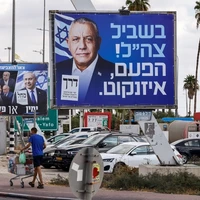
Billboards featuring Israeli Prime Minister Benjamin Netanyahu of the Likud party (left) and former Israeli military chief Gadi Eisenkot, leader of the Yashar party (right), at the entrance to Kiryat Malachi, Israel, October 20, 2026. The writing on Netanyahu's billboard reads "Right or Palestine". The writing on Eisenkot's billboard reads "for the IDF! This time, Eisenkot".

Israeli Prime Minister Benjamin Netanyahu is making regime change in Iran an explicit goal ahead of Israel’s election, while political rivals advocate tough measures against Tehran and criticize his failure to eliminate the Iranian threat.

The debate puts competing promises of security before voters whom analysts describe as exhausted by years of conflict, raising questions about what would constitute victory and how far Israel would go to achieve it.

“We must complete the elimination of the Iranian regime — that is the primary objective,” Netanyahu said Tuesday at Tel Hai University in Kiryat Shmona, near the Lebanese border.

Netanyahu has long welcomed the prospect of the Islamic Republic’s collapse. Now, with Israelis voting on October 27, he is placing the removal of Iran’s leadership at the forefront of his message.

Netanyahu argued that weakening Iran militarily would not guarantee Israel’s security. As long as the Islamic Republic remains in power, he said, it will attempt to rebuild its nuclear capabilities and regional network.

“Finishing the job means bringing down the terrorist regime in Iran,” Netanyahu said, describing Tehran as the head of a “poisonous octopus” whose removal, he argued, would also bring down Hezbollah in Lebanon.

The declaration followed discussions with US President Donald Trump and an unannounced visit by US Defense Secretary Pete Hegseth. Washington, however, has not publicly committed to regime change, emphasizing instead the prevention of a nuclear-armed Iran.

Why emphasize regime change now?

Netanyahu’s declaration comes as he seeks another term following three years of war and repeated military confrontations with Iran and its regional allies.

Itai Reuveni, director of communications and outreach at NGO Monitor, said the prime minister was articulating what many Israelis had already understood to be the broader ambition behind military operations against Tehran.

“I think he just summarized all the things that everyone meant,” Reuveni told Iran International.

Making regime change the declared objective raises questions about whether weakening Iran’s military and nuclear capabilities would be sufficient for Netanyahu to claim victory.

Yaakov Katz, former editor-in-chief of The Jerusalem Post and author of four books on Israel’s military, said repeated strikes alone cannot permanently eliminate the Iranian threat.

“You can bomb them, you can destroy facilities, you can set back nuclear programs, but they will rebuild,” Katz told Iran International.

Netanyahu is presenting regime change as the route to lasting Israeli security, a message delivered in Kiryat Shmona, a historically Likud-supporting community repeatedly targeted by Hezbollah.

Vivian Bercovici, Canada’s former ambassador to Israel and founder and editor-in-chief of State of Tel Aviv, said the location allowed Netanyahu to appeal directly to voters who have experienced the consequences of Iran’s regional influence.

But she questioned whether the declaration would persuade Israelis beyond his existing supporters.

“I really think that people have tuned him out,” she said.

A shared concern, a public tired of war

Those interviewed described opposition to the Islamic Republic as extending across much of Israel’s political spectrum, while drawing a distinction between agreement on the threat and enthusiasm for another military confrontation.

“It’s the one issue on which there’s no daylight in Israel,” Bercovici said.

Yet she described a public exhausted by years of fighting.

“I don’t think that Israel has any appetite for war,” she said. “We’ve had way too much war in the last three years.”

Reuveni described a similar tension. Many Israelis believe Iran’s immediate military threat has diminished following Israeli and American strikes, he said, complicating the case for further military action.

“People are tired from the war,” he said.

Katz said the election ultimately comes down to which leader Israelis trust to protect them, rather than any single declaration about Iran.

“What is important is the belief in which leader do Israelis think can keep them safe,” he said.

Does Netanyahu’s declaration set him apart?

Netanyahu’s explicit objective does not necessarily distinguish him from his political rivals, several of whom have advocated aggressive measures against Tehran and criticized his failure to eliminate the Iranian threat.

Former prime ministers Naftali Bennett and Yair Lapid are contesting the election together under the joint list Together (Beyachad).

Lapid has advocated striking Iran’s energy infrastructure, including Kharg Island, while Bennett has long promoted confronting Tehran directly rather than focusing on its regional proxies.

Gadi Eisenkot, the former military chief who leads the centrist Yashar party, has questioned whether regime change is achievable through military action, emphasizing the permanent dismantling of Iran’s nuclear capabilities.

Avigdor Lieberman, leader of Yisrael Beiteinu, has also advocated overthrowing the Islamic Republic and criticized previous Israeli efforts as insufficient.

Eric Mandel, founder and director of the Middle East Political and Information Network, said the broad agreement on Iran means a change of government in Israel would not necessarily produce a fundamental shift in policy.

“I think most Israelis know that it doesn’t matter who’s going to get elected, they’re going to have the same policy in Iran,” Mandel told Iran International.

But agreement on the threat is different from agreement on how to eliminate it.

Mandel said achieving regime change would require American involvement, underscoring the gap between Netanyahu’s declared ambition and Washington’s publicly stated objectives.

“Israel is a regional power, America is a superpower,” he said. “Israel could be very helpful, but Israel can’t do it on its own.”

Pakistani mediator leaves Tehran after Iran doubles down on demands

Oct 20, 2026, 20:30 GMT+1
100%
Pakistan's Chief of Army Staff Field Marshal Asim Munir is welcomed by Iran's Interior Minister Eskandar Momeni in Tehran.

Pakistan’s army chief Asim Munir left Tehran on Tuesday after Iranian leaders reiterated their conditions for negotiations with Washington and ruled out transferring enriched nuclear material abroad, as regional mediators continue efforts to ease the standoff.

Iranian state media reported that a Qatari delegation also visited Tehran after Munir’s departure, extending a flurry of regional visits that included Russian Foreign Minister Sergei Lavrov’s talks in Tehran and US War Secretary Pete Hegseth’s unannounced trip to Israel.

Qatar and Pakistan have played key roles in mediating Iran-US negotiations in recent months. Munir helped broker talks that led to a memorandum of understanding in June.

Iran reiterates conditions

President Masoud Pezeshkian told Munir that Washington must lift pressure, threats and sanctions before any negotiations, according to Iranian state media.

“Our nation does not trust America today and believes that if we negotiate, they will attack us again,” Pezeshkian said, referring to US attacks during earlier negotiations.

He thanked Pakistan for its diplomatic efforts while warning that another war would bring destruction and losses across the region.

Parliament Speaker Mohammad Bagher Ghalibaf separately told Munir that Iran had nothing new to tell Washington, which must fulfill Tehran’s seven conditions presented in New York to regain its trust.

Ghalibaf accused the Trump administration of violating the Islamabad memorandum and said military threats would not change Iran’s strategic decisions.

Supreme National Security Council Secretary Mohsen Rezaei also ruled out sending Iran’s enriched nuclear material abroad.

“Not even a particle of enriched nuclear material will leave Iran,” he told Munir, describing the stockpile as a national asset intended for domestic use.

Rezaei also said negotiations would not begin until Washington took steps to build trust, starting with fulfilling Iran’s conditions.

Mediation efforts continue

Al-Araby Al-Jadeed reported Tuesday that Qatar and Pakistan had proposed giving Iran interest on $6 billion in frozen assets held in Qatari banks in exchange for access to its nuclear facilities.

The outlet’s sources said Washington had approved the proposal and Iran had responded positively, with Munir conveying it during his visit.

Earlier Tuesday, a spokesman for Iran’s parliamentary national security committee had described Munir’s trip as solely focused on bilateral relations and border cooperation, denying it involved a new mediation initiative.

Regional visits amid military pressure

Munir’s visit followed Lavrov’s meetings with Pezeshkian and Foreign Minister Abbas Araghchi on Monday. Pezeshkian said Iran remained ready to resolve regional disputes through dialogue while rejecting attempts to impose terms by force.

Hegseth also met Israeli Prime Minister Benjamin Netanyahu on Monday at Uvda air base in southern Israel.

Netanyahu’s spokesman Doron Spielman told Reuters they discussed regional threats and US-Israeli cooperation in responding offensively and defensively. Hegseth later said he had visited US forces serving under Central Command.

Fox News reported Tuesday, citing two US officials, that a third US aircraft carrier and about 10,000 military personnel were heading to the Middle East, with arrival expected by the end of November.

The diplomatic contacts and military movements come amid mixed signals from President Donald Trump, who told a campaign rally in Kansas on Monday that the United States could already leave the war.

“Somebody said you could leave right now. It’s true. We could leave right now,” Trump said, adding that Iran would not obtain a nuclear weapon.

Toppling Iran’s regime is ‘primary objective,’ Netanyahu says after US talks

Oct 20, 2026, 18:27 GMT+1
100%
File photo: U.S. President Donald Trump and Israeli Prime Minister Benjamin Netanyahu greet the media and wave outside the White House on April 7, 2025.

Israeli Prime Minister Benjamin Netanyahu said on Tuesday that toppling Iran’s regime was Israel’s “primary objective,” a day after discussing Iran with US War Secretary Pete Hegseth during an unannounced visit to Israel.

Netanyahu said he had also discussed bringing down Iran’s leadership with US President Donald Trump on Sunday, placing the issue at the center of his latest contacts with Washington.

“We must complete the elimination of the Iranian regime — that is the primary objective,” Netanyahu said at the opening of the academic year at the new Tel Hai University in Kiryat Shmona, near the Lebanese border.

“I have spoken about this with President Trump more than once, including the day before yesterday.”

His remarks did not indicate whether Trump had agreed to pursue that objective or committed to further military action.

Danny Citrinowicz, an Iran specialist and former head of the Iran branch in Israeli Defense Intelligence, told Iran International that while the two leaders might agree on military targets, their strategic objectives could diverge.

"Netanyahu seeks to topple the regime, and Trump seeks to reach a good agreement with the same regime that Netanyahu seeks to topple," he said.

Hegseth discussed Iran with Netanyahu on Monday, three Israeli officials told Reuters. Netanyahu’s spokesman, Doron Spielman, confirmed that they met at Uvda air force base in Israel’s southern Negev desert.

Spielman said the talks covered regional threats and US-Israeli cooperation in confronting them through offensive and defensive measures.

Hegseth also thanked Israel for hosting US forces, which Spielman said numbered in the thousands, and discussed Trump’s support for Netanyahu.

‘Finishing the job’

Speaking on Tuesday, Netanyahu linked his stated objective in Iran to Israel’s campaign against Hezbollah, saying the military had made major progress against the Lebanese group but pledging to “finish the job.”

“Finishing the job means bringing down the terrorist regime in Iran. It is the head of this poisonous octopus. You cut it off, and it will fall. We will also have peace with Lebanon,” he said.

Netanyahu argued that Iran’s leadership, even “battered, wounded and beaten,” would seek to pursue nuclear weapons and rebuild its regional network of allied armed groups.

“Therefore, the only way to prevent this is to bring down this regime, and then the elimination of Hezbollah will follow,” he said.

The Hegseth meeting came eight days before Israel’s October 27 election. Trump endorsed Netanyahu on Sunday, ahead of the country’s first parliamentary vote since the October 7, 2023, Hamas attack.

In his endorsement message, Trump praised Netanyahu’s role in confronting Iran and warned that Washington might have to act alone if another leader took office.

US and Israeli forces launched joint strikes against Iran in late February, setting off a wider regional war. The latest consultations come amid renewed tensions between Washington and Tehran over the Strait of Hormuz and intensifying attacks by Yemen’s Iran-aligned Houthis on Saudi Arabia.

Iran-Pakistan border trade halt leaves trucks and cargo stranded

Oct 20, 2026, 14:16 GMT+1
100%
Pakistani border guards and officials gather at the Jalgai border crossing between Pakistan and Iran, with cargo trucks lined up in the background.

Trade between Iran and Pakistan remained suspended at two major border crossings on Tuesday, leaving trucks and cargo stranded, with Pakistani authorities citing security and anti-smuggling measures and Iran pointing to technical difficulties.

Commercial traffic through the Gabd-Rimdan and Taftan crossings was halted as of October 20, although passenger movement reportedly continued at Gabd-Rimdan.

Pakistan described the suspension as a temporary measure to strengthen security and combat smuggling, while Iran attributed the disruption to technical issues and precautionary measures.

The two countries remain in contact to resolve the problem, Iranian Foreign Ministry spokesman Esmail Baghaei said on Tuesday.

The closures come as Iran increasingly relies on land routes to sustain foreign trade following restrictions on maritime shipping during the war.

  • Iran looks for escape routes as US sanctions close in

    Iran looks for escape routes as US sanctions close in

Before the conflict and the US military blockade of Iran's southern ports, more than 80 percent of the country's foreign trade passed through the southern ports of Rajaei and Khomeini.

The diversion of shipments to road networks has increased transport costs and congestion, although land crossings lack the capacity to replace maritime trade.

Thousands of trucks stranded

Iranian media had already reported queues of approximately 3,000 trucks at Rimdan before the latest suspension, with some drivers waiting between 20 and 30 days to cross.

Limited processing capacity on the Pakistani side and requirements to transfer cargo from Iranian trucks to Pakistani vehicles have contributed to the delays.

An industry circular issued in August also described difficulties unloading Iranian trucks in Pakistan and transferring their cargo.

“I urge all truck drivers not to bring cargo toward the borders. The situation is so bad that since last night and throughout October 20, huge queues of trucks have been turning back. The border is closed and is being cleared. Do not come!” a person affected by the disruption told Iran International.

Another person contacted the broadcaster with a similar warning, urging drivers to avoid sending additional shipments until the crossings reopen.

  • Land routes cannot replace Iran’s blocked sea trade, chamber official warns

    Land routes cannot replace Iran’s blocked sea trade, chamber official warns

The latest suspension has increased the risk of prolonged vehicle inactivity and financial losses for transport operators and cargo owners.

Talks continue on reopening

Negotiations with Pakistani authorities to remove obstacles at Rimdan were continuing, border market director Abdolsalim Hoot said on October 18, adding that perishable goods were receiving priority.

An official in Pakistan's Balochistan province also described progress in negotiations and the possibility of reopening the crossings soon.

No timetable for resuming commercial traffic had been announced by Tuesday.

Iran and Pakistan had previously set a target of increasing annual bilateral trade to $10 billion, but border disruptions, banking difficulties and limited freight capacity have complicated efforts to reach that goal.

The suspension also coincides with Washington's efforts to increase economic pressure on the Islamic Republic, including warnings of sanctions against countries and companies maintaining financial and commercial dealings with Iran.