• العربية
  • فارسی
BrandBrand
  • Iran Insight
  • Politics
  • Economy
  • Analysis
  • Special Report
  • Opinion
  • Podcast
  • Live TV
  • Iran Insight
  • Politics
  • Economy
  • Analysis
  • Special Report
  • Opinion
  • Podcast
  • Live TV
  • Theme
  • Language
    • العربية
    • فارسی
  • Iran Insight
  • Politics
  • Economy
  • Analysis
  • Special Report
  • Opinion
  • Podcast
  • Live TV
All rights reserved for Volant Media UK Limited
volant media logo

Israeli jets flew to Iran border in ‘power projection’ operation - Axios

Oct 21, 2026, 22:07 GMT+1

Dozens of Israeli fighter jets flew as far as Iran’s border Monday in a large-scale operation intended to project military power and deter Tehran, Axios reported Wednesday, citing Israeli and US officials.

The exercise involved fighter jets and refueling aircraft that flew more than 800 miles from Israel along a route consistent with a potential strike on Iran, passing through Syrian and Iraqi airspace, according to the report.

The aircraft turned around as they approached Iran’s border and returned to Israel. Israel notified the United States in advance and described the operation as a training exercise aimed at deterring Iran from attacking Israel ahead of the Oct. 27 Israeli elections, Axios reported.

US officials said Israel knew Iranian air defenses would detect the aircraft. Some US sources told Axios they had the impression Israel hoped Iran would fire at the jets, potentially providing justification for Israeli strikes.

Other Israeli and US officials described the sortie as not unusual and said it was intended as a deterrent.

Most Viewed

Toppling Iran’s regime is ‘primary objective,’ Netanyahu says after US talks
1

Toppling Iran’s regime is ‘primary objective,’ Netanyahu says after US talks

2

Iran-Pakistan border trade halt leaves trucks and cargo stranded

3

Pakistani mediator leaves Tehran after Iran doubles down on demands

4

Iran Air chief says 30 to 40 operational aircraft destroyed in war

5
ANALYSIS

IRGC threatens undersea cables, but can it disrupt global internet?

Spotlight

  • Russia steps between Iran and US, but how far can it go?
    INSIGHT

    Russia steps between Iran and US, but how far can it go?

  • Iran in Israeli election: Netanyahu all-in on regime change, rivals want more
    INSIGHT

    Iran in Israeli election: Netanyahu all-in on regime change, rivals want more

  • Saudi Arabia should join US-led push for change in Iran, analyst says
    ONE-ON-ONE

    Saudi Arabia should join US-led push for change in Iran, analyst says

  • Teenager killed by gunshot to eye after arrest in Iran, source says

    Teenager killed by gunshot to eye after arrest in Iran, source says

  • Soaring medical costs and staff shortages strain Iran’s hospitals
    VOICES FROM IRAN

    Soaring medical costs and staff shortages strain Iran’s hospitals

Banner
Banner
Banner
Banner
Banner
•
•
•

More Stories

War warnings and talk of diplomacy compete in Tehran

Oct 21, 2026, 21:26 GMT+1
•
Behrouz Turani
100%
Iranian lawmakers and military officials attend a parliamentary session to confirm Mehrdad Akhlaghi as Iran’s new defense minister, October 17, 2026

Iranian leaders raised the conditions for negotiations with the United States and issued fresh warnings of a wider military response on Wednesday, even as signs persisted that Tehran was leaving room for diplomacy.

President Masoud Pezeshkian said threats and sanctions must be lifted in practice before conditions for negotiations could be established, while Revolutionary Guards spokesman Hossein Mohebbi said Iran would launch offensive operations against any country that attacked it as part of a shift toward asymmetric warfare.

An unnamed senior security official also told state-run Press TV that Iran was prepared for an all-out war and would respond “without restraint” to renewed attacks or assassinations.

The rhetoric coincided with high-level discussions in Tehran. Iranian media reported Wednesday that Parliament Speaker Mohammad Bagher Ghalibaf had met Supreme Leader Mojtaba Khamenei to discuss the latest military and economic developments in the confrontation with the United States and Israel.

The meeting also addressed strengthening Iran's national capabilities, maintaining social cohesion, tackling economic difficulties and “advancing relations with strategic partners,” according to the reports.

Yet diplomatic channels remain active. Russian President Vladimir Putin told US envoy Steve Witkoff on Wednesday that there was still room for diplomacy over Iran and that an agreement with Tehran was needed, according to the Kremlin.

The competing signals leave open whether Tehran is raising the price of a negotiated pause or preparing for another phase of confrontation.

Talk of a negotiated pause

The conservative daily Jomhouri Eslami reported, citing “informed sources,” that discussions mediated by Qatar and Pakistan could take place this week around a framework for halting military clashes and securing reciprocal concessions.

The report followed Pakistani Field Marshal Asim Munir's visit to Tehran on Tuesday and came amid a flurry of diplomatic activity involving Russia and other regional powers.

According to Jomhouri Eslami, the framework would seek to halt military clashes, address outstanding disputes and sequence concessions in a way that reduced the risk of fighting resuming.

The newspaper said it expected that “the region will not see an escalation of tensions under current conditions.”

The prominence given to the prospect of an agreement by a conservative establishment newspaper is notable at a time when Iranian officials publicly deny that substantive nuclear negotiations with Washington are under way.

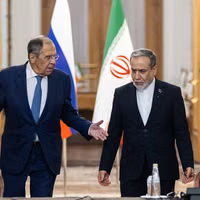
Sobh-e No, a newspaper aligned with Parliament Speaker Ghalibaf, also linked renewed discussion of talks to diplomatic contacts involving Pakistan and Russian Foreign Minister Sergei Lavrov, who visited Tehran on Tuesday.

The newspaper reported on a Russian proposal for a joint Iranian-Russian-Chinese initiative concerning the Strait of Hormuz, although Tehran has continued to insist on maintaining its authority over the waterway.

The Pezeshkian administration's Iran newspaper argued that the country's security depended on exercising sovereignty over the strait rather than sharing responsibility with outside powers.

“To preserve our security, we have no option but to exercise sovereignty over the Strait of Hormuz,” it wrote.

That position points to one of the difficulties facing any potential agreement: Tehran wants the Strait of Hormuz and broader maritime security addressed alongside the conflict, while Washington has continued to prioritize Iran's nuclear program.

Pressure in the other direction

Hardline lawmaker Hassan Nataj called for Supreme Leader Khamenei to reconsider the religious prohibition on nuclear weapons in response to the conflict.

“We should ask the Supreme Leader to revise the fatwa prohibiting nuclear weapons in light of the current situation,” he told the Didban Iran website.

The comments come amid a wider debate among Iranian politicians and commentators over whether the country's nuclear posture still provides sufficient deterrence against further US or Israeli attacks.

The simultaneous emphasis on diplomacy and escalation does not establish which course Tehran ultimately intends to pursue.

But the pattern has become clearer: diplomatic channels remain open while Iranian officials publicly raise the conditions for negotiations and stress that renewed attacks could bring a broader military response.
Israel bars United Airlines pilot over alleged Iran links - Ynet

Oct 21, 2026, 21:04 GMT+1
100%
Sina Amjadian

Israel has barred a United Airlines pilot of Iranian descent from serving on flights to the country over unverified social media allegations that he supported Iran's government, the Revolutionary Guards and Hezbollah, Ynet reported Wednesday.

Israel's Diaspora Affairs and Combating Antisemitism Ministry alerted security and transportation officials on October 19 to allegations circulating on X about the pilot, Sina Amjadian, according to a ministry letter obtained by Ynet.

The letter included two posts from X. One alleged that Amjadian, who was said to have previously worked for flydubai, had shared content supporting Iran's government, including a video in which he purportedly kissed and saluted its emblem.

The other alleged that he had expressed support for the Islamic Revolutionary Guard Corps and Hezbollah and called on United Airlines to investigate his conduct.

Ynet said it could not independently verify the allegations and that the material submitted to Israeli authorities did not include original statements or social media posts by Amjadian.

The allegations nevertheless prompted a security review and a decision to prohibit Amjadian from serving as a crew member on flights to Israel, senior Transportation Ministry officials told Ynet.

Security review follows flydubai incident

The Diaspora Affairs Ministry said the warning followed an attempted attack aboard a flydubai flight bound for Israel in late September, during which a co-pilot attacked the captain and attempted to seize control of the aircraft.

The incident prompted Israel's National Command and Control Center for Combating Antisemitism to expand its monitoring to people who might pose a threat to aviation security, according to the ministry.

It said the allegations concerning Amjadian warranted security scrutiny because of the responsibilities of an international airline pilot and the potential risks to passengers and crew.

Transportation Ministry officials told Ynet that the ministry did not independently monitor social media or gather intelligence but coordinated with security agencies when information raised aviation safety concerns.

They said preventing a pilot from operating flights to Israel was separate from denying the individual entry to the country, which falls under the authority of border control officials.

Ynet said it remained unclear whether Amjadian had previously flown to Israel, had been scheduled to operate a flight to Ben Gurion Airport or was qualified to fly aircraft used by United Airlines on its Israel routes.

There was no indication that any flight had been canceled or prevented from reaching Israel because of the restriction.

Iraq plays down Iran border disruption as more closures reported

Oct 21, 2026, 19:53 GMT+1
100%
Iraqi security forces stand at the Shalamcheh border crossing with Iran after Iraq closed the crossing following airstrikes on the Iranian side that security sources said killed an Iraqi citizen, Iraq, April 4, 2026.

Conflicting accounts emerged Wednesday over Iraq's plans for its border with Iran, as Baghdad attributed the closure of one major crossing to technical shortcomings while reports said more could be shut amid US pressure to restrict trade routes with Tehran.

Iraqi government spokesperson Haider al-Aboudi said the Sheeb crossing, known as Chazabeh in Iran, was closed because it lacked sufficient technical, technological and developmental readiness, according to the official Iraqi News Agency.

He said trade was proceeding normally through several other crossings with Iran.

But Al Jazeera cited an Iraqi government official on Tuesday as saying Prime Minister Ali al-Zaidi had ordered Sheeb closed indefinitely and several other crossings gradually shut in the coming days. No reason was given for the planned closures.

Separately, AFP reported Wednesday, citing two Iraqi political sources, that Washington was pressing Baghdad to close crossings with Iran as part of efforts to increase economic pressure on Tehran.

One source said the US Treasury Department raised the issue with Zaidi during his visit to New York for the UN General Assembly last month and that the proposed restrictions would leave only two crossings open, one in federal Iraq and another in the Kurdistan region.

The second source said Washington had asked other countries bordering Iran to take similar measures.

Reuters reported that Sheeb had been closed to passengers, vehicles and commercial trucks. An Iraqi border official told the agency the closure would allow security arrangements to be reviewed and detection equipment installed to prevent the smuggling of prohibited materials.

Tehran seeks reopening

Iranian officials said they had received no advance warning of the closure.

Valiollah Hayati, a security official in Iran's southwestern Khuzestan province, said consultations were under way with Iraqi authorities to reopen Sheeb and advised passengers and commercial trucks to use the nearby Shalamcheh crossing.

Iranian Interior Ministry spokesperson Ali Zeinivand said Iraq was required to notify Tehran of extended border closures but had not done so.

Foreign Minister Abbas Araghchi also criticized disruptions at Iran's borders on Wednesday, saying they had become places where traffic was held up rather than allowed to pass. He said the Foreign Ministry would seek to resolve obstacles originating in neighboring countries.

The uncertainty comes days after Pakistan suspended commercial activity at two major crossings with Iran, Taftan-Mirjaveh and Gabd-Rimdan, on October 17.

Iranian authorities said the border reopened on Tuesday, although the resumption of normal commercial traffic at both crossings has not been independently confirmed.

Iran and Iraq share a border of more than 1,400 kilometers (870 miles) and have extensive political, religious and economic ties.

US sanctions law firm, shipping operators over Iran trade

Oct 21, 2026, 18:38 GMT+1
100%
A general view of the Treasury Building on day two of a partial government shutdown in Washington, D.C., U.S., February 1, 2026.

The United States on Wednesday sanctioned a law firm, shipping operators and maritime logistics companies accused of helping Iran evade restrictions on its oil and other exports.

The measures extend Washington's pressure beyond ships carrying Iranian cargo to businesses that register them, manage their operations and provide port services.

The US Treasury said four firms were designated under Operation Economic Outcast, a campaign Secretary Scott Bessent launched in August with a pledge to “sever every economic lifeline” sustaining Tehran.

Central to Wednesday's action was Karnakis and Karnakis, a law firm operating in Panama and Greece.

The Treasury said it registered companies used to move hundreds of millions of dollars' worth of Iranian petroleum, petrochemicals and steel while obscuring the ownership of vessels involved in the trade.

Those companies included previously sanctioned Skyros Maritime and Trading, Corfu Maritime and Trading and Elias Shipping and Trading Group.

The Treasury said Elias Shipping had served as a front for Syria's Al-Qatirji Company, which sold Iranian oil benefiting the Revolutionary Guards' Quds Force and the Houthis.

The Treasury said Karnakis and Karnakis also helped establish companies associated with sanctioned Iranian energy trader Seyed Asadoollah Emamjomeh and acted as corporate agent for Roxette Maritime Shipping and Trading, a Panama- and Greece-based ship operator also sanctioned Wednesday.

Seven Panama-flagged cargo ships associated with Roxette were designated as blocked property. The law firm's two owners and three associates were also sanctioned.

The measures also targeted Singapore-based Amigoz Singapore, which the Treasury accused of assisting Iranian crude shipments and servicing vessels linked to Tehran's shadow fleet, and Dubai-based Whales Shipping Line, accused of facilitating Iranian petrochemical shipments.

Two vessels owned by Whales were also blocked.

Also on Wednesday, the US Financial Crimes Enforcement Network ⁠issued an administrative ‌subpoena ​to advance an investigation ​into a Greek ⁠bank over potential ‌ties to Iran, ​according to a Treasury statement, ‌which did not ​name the bank.

FINCEN also issued requests for ​information to six other banks in Europe over relationships with Iranian financial institutions under US sanctions.

Canada orders Iranian man deported over role in sanctions evasion

Oct 21, 2026, 16:17 GMT+1
100%
Passengers carry their luggage at Toronto Pearson International Airport, following the end of the Air Canada labour strike, in Mississauga, Ontario, Canada, August 19, 2025.

Canada's Immigration and Refugee Board has ordered the deportation of an Iranian man living in Toronto over his role in a criminal network that helped Iran evade international sanctions, Global News reported Wednesday, citing a 36-page ruling.

Amin Yousefijam, a former Tehran police lieutenant who has lived in Canada since 2016, helped coordinate shipments of restricted equipment from the United States to Iran through the United Arab Emirates, the board found, according to the report.

The shipments included electronics, motors and other dual-use goods with both civilian and military applications. Global News reported that some of the materials could potentially be used in the manufacture of weapons of mass destruction.

The deportation order was issued in July but only released to Global News this week. The board found that Yousefijam played an essential role in an operation that violated Canadian and US sanctions, although his involvement was more limited than that of his brother, Arash Yousefijam, who led the scheme.

Yousefijam was arrested in Toronto in 2021 and extradited to the United States, where he pleaded guilty to sanctions violations, the report said. After returning to Canada, he legally changed his name to Ameen Cohen.

The immigration board found that he intentionally failed to disclose his US conviction when applying for the name change, rejecting his explanation that he had been advised not to report convictions outside Canada.

The Canada Border Services Agency argued that Yousefijam posed a threat to national security. The board found insufficient evidence that he remained a security threat, however, and instead ordered his deportation on the grounds of membership in a criminal organization.

Global News quoted Yousefijam as saying he remained in Canada and was considering his legal options. He declined to say whether he had appealed the deportation order.

The case comes amid a broader Canadian effort to remove people with ties to the Islamic Republic, although Yousefijam's deportation is separate from proceedings targeting senior Iranian government officials.

According to Canada Border Services Agency figures, authorities had identified 40 senior Iranian officials living in Canada as of October 1. Two had been deported, eight had left voluntarily and two more were awaiting removal.