Iran must strike UAE, and strike hard, lawmaker says
Iran should launch major strikes against the United Arab Emirates, despite already attacking Bahrain and Kuwait in recent months, Ahmad Naderi, a member of parliament's presiding board, said Sunday.
“We must strike, and we must strike hard,” Naderi said, according to Khaneh Eghtesad.
Naderi argued that Iran should act less predictably to counter maritime and air blockades, warning that a land blockade could follow.
Flights from the UAE should not be allowed to continue operating worldwide after restrictions were imposed on Iranian airspace, Naderi added.
Iran's new Defense Minister Mehrdad Akhlaghi Ketabchi attends an official meeting, with the Islamic Republic's flag behind him.
Mehrdad Akhlaghi Ketabchi, a sanctioned veteran of Iran's missile industry with ties to the Revolutionary Guards, became defense minister on Sunday, following his predecessor's killing in the war with the United States and Israel.
Akhlaghi secured 237 votes in favor and 15 against in a virtual parliamentary session attended by 277 lawmakers.
He replaces Aziz Nasirzadeh, who was killed on February 28 during the opening day of joint US-Israeli strikes on Iran. The ministry had since been overseen by acting minister Majid Ebn al-Reza.
Unlike several previous defense ministers who rose through military command positions, Akhlaghi built his career inside Iran's weapons manufacturing establishment, overseeing industrial organizations involved in missile production, aerospace technologies and military procurement.
His name has appeared on international sanctions lists since 2007, reflecting his longstanding involvement in institutions central to Iran's ballistic missile program.
From engineering to missile production
Born on September 10, 1958, in Rasht, northern Iran, Akhlaghi studied chemical engineering at Amirkabir University of Technology before earning a master's degree in strategic management from Malek Ashtar University of Technology, an institution affiliated with the Defense Ministry.
He entered Iran's defense industries in the early 1980s and spent more than four decades in technical, industrial and managerial positions, according to Iranian state-linked media.
Much of his career has involved solid-fuel missile propulsion systems and the management of industrial facilities associated with ballistic missile development.
Solid-fuel propulsion allows missiles to remain stored for extended periods and reduces preparation time before launch, making it a significant component of Iran's missile capabilities.
Akhlaghi previously headed the Shahid Bagheri Industrial Group, a subsidiary of the Aerospace Industries Organization involved in Iran's ballistic missile program.
In November 2014, then-Defense Minister Hossein Dehghan appointed him managing director of the Aerospace Industries Organization, replacing Mehdi Farahi.
Iran's new Defense Minister Mehrdad Akhlaghi Ketabchi (right) is welcomed by acting Defense Minister Majid Ebn al-Reza during a meeting with senior military officials.
He later became head of the Defense Industries Organization, which produces conventional weapons and supplies military equipment to Iran's armed forces.
Akhlaghi's role in the Fateh-110 missile project
Akhlaghi's close relationship with Hassan Tehrani Moghaddam, a founder of the Revolutionary Guards' missile program, was central to his involvement in developing Iran's missile industry.
Akhlaghi worked closely with Hassan Tehrani Moghaddam, widely known as the father of Iran's ballistic missile program. Tehrani Moghaddam oversaw the development of the Revolutionary Guards' missile arsenal before he was killed in a November 2011 explosion at a military facility near Tehran.
Iran's IRGC-linked Tasnim news agency, citing The Eternal Man, a biography by Masoumeh Sepehri, reported that Akhlaghi approved $10 million in equipment purchases and production facilities for the Fateh-110 missile despite uncertainty over whether the project would succeed.
The account, based on an interview with a senior missile designer, describes Akhlaghi's direct involvement in financing infrastructure used to produce missiles for the Revolutionary Guards.
Pezeshkian also referred to Akhlaghi's association with Tehrani Moghaddam during Sunday's parliamentary session, crediting figures such as the two men with developing Iran's military capabilities.
Nearly two decades under international sanctions
Akhlaghi's involvement in Iran's missile industry brought him under international sanctions long before his appointment to the cabinet.
The United Nations Security Council included him in Resolution 1747, adopted on March 24, 2007, identifying him as head of the Shahid Bagheri Industrial Group.
The group had previously been sanctioned over its involvement in Iran's ballistic missile program.
The US Treasury Department also placed Akhlaghi under sanctions in 2008.
US State Department information about his activities identified him as a senior figure in missile-related industrial operations and described his participation in negotiations to purchase equipment for the missile industry.
In 2020, the first Trump administration sanctioned him in connection with his position as director of the Defense Industries Organization.
Iran's new Defense Minister Mehrdad Akhlaghi Ketabchi addresses lawmakers during a virtual parliamentary session.
The European Union has also included Akhlaghi on its sanctions lists, identifying his senior roles within both the Defense Industries Organization and the Aerospace Industries Organization.
Britain imposed sanctions on him in 2023, citing his involvement in activities connected to the development of systems capable of delivering nuclear weapons.
His name was also included in UN sanctions lists following the reimposition of international sanctions in September 2025.
The measures have made Akhlaghi one of the more extensively sanctioned figures to enter Pezeshkian's cabinet, with restrictions linked to his work in institutions involved in missile development and weapons production.
Missile production and air defenses top priorities
Akhlaghi outlined plans to expand weapons production, strengthen air defenses and rebuild military industrial facilities during his parliamentary confirmation session.
His proposed program includes developing new military technologies, improving production efficiency and increasing cooperation with universities and technology companies.
Akhlaghi also proposed shortening the development cycle for certain new defense technologies to a maximum of six months.
The program envisages increasing the share of production outsourced to companies outside the Defense Ministry to 75 percent in the Iranian year beginning in March 2026 and more than 85 percent the following year.
Highly classified weapons production would remain within facilities controlled by the ministry.
Akhlaghi has also identified continued support for armed groups aligned with the Islamic Republic across the region as a ministry priority.
His agenda builds on programs developed under Nasirzadeh, with adjustments intended to address the damage and military requirements arising from the recent wars.
Akhlaghi portrayed Iran's military capabilities as having frustrated US and Israeli objectives during the latest conflict.
"These capabilities have brought the American-Zionist enemy to the point of desperation in the recent war and placed it in a strategic deadlock," Akhlaghi told lawmakers.
His remarks came as the Defense Ministry faces the task of replacing damaged infrastructure and restoring weapons production capacity following months of military confrontation.
Warning to Washington over possible strikes
Akhlaghi also delivered a warning to the United States on the sidelines of Sunday's parliamentary session.
Asked about the possibility of Washington using the GBU-43 bomb, commonly known as the Mother of All Bombs, against Iran, he said the Defense Ministry had prepared measures to respond.
"The US president should be thinking about how to get his forces out of our region alive. If he drops one bomb, he will have to see how many of his troops he will have to take out of the region horizontally (dead)," Akhlaghi told reporters.
The remarks followed warnings by US officials about the possibility of further military action against Iranian facilities.
Iran's new Defense Minister Mehrdad Akhlaghi Ketabchi secured 237 votes in favor and 15 against in parliament's confidence vote.
President Donald Trump has raised the possibility of striking the underground Pickaxe Mountain complex near Natanz, while US Defense Secretary Pete Hegseth has warned of severe military consequences if negotiations with Iran fail.
A sanctioned missile official takes charge after the war
Akhlaghi's appointment follows the war with the United States and Israel, which killed senior Iranian military officials and exposed vulnerabilities in the Islamic Republic's military infrastructure and air defenses.
Pezeshkian told lawmakers that the new minister had the backing of the army, the Revolutionary Guards and other military and security institutions.
The president also referred to Akhlaghi's presence on US sanctions lists and expressed hope that he would remain alive to continue his work.
The decision to appoint an official sanctioned for nearly two decades over his involvement in Iran's ballistic missile program points to the leadership's continued reliance on the same military-industrial establishment that oversaw the development of its missile arsenal.
Akhlaghi now faces the task of rebuilding military production capacity and expanding weapons manufacturing at a time when Iran's missile program remains a major source of confrontation with Washington and European governments.
A wave of deadly attacks on Iranian security forces in the country’s restive southeast has brought renewed attention to a coalition of Baluch militants seeking to broaden their fight against the Islamic Republic, raising questions about how far the insurgency can spread.
The US-based Human Rights Activists News Agency, HRANA, documented 63 armed incidents across southeastern Iran between March 31 and October 10, with at least 94 people killed and 33 wounded, according to local and unofficial reports.
On October 7 and 8, at least five Iranian military and police personnel were killed and several others wounded in four armed attacks within 24 hours, local rights group Haalvsh reported. On October 14, a women’s Basij commander and a police officer were killed in separate attacks in Mehrastan County.
The People’s Fighters Front, known by its Persian initials JMM, has claimed responsibility for at least six attacks. Most of the incidents documented by HRANA remained unattributed or could not reliably be linked to a particular group.
JMM was formed in December 2025 through the merger of several factions, including Jaish al-Adl, a militant group that emerged around 2012 following the dismantling of Jundallah and Iran’s execution of its leader, Abdolmalek Rigi.
The United States designated Jundallah as both a Foreign Terrorist Organization and a Specially Designated Global Terrorist in 2010, amending both designations in 2019 to include Jaish al-Adl as an alias. Iran also designates Jaish al-Adl a terrorist organization.
What is the People’s Fighters Front?
The coalition brings together Jaish al-Adl, the PADA Baluch Movement, Harakat-e Nasr Baluchistan, the Mohammad Rasulullah group and fighters described in its charter as independently organized Baluch combatants.
Jundallah leader Abdolmalek Rigi following his arrest by Iranian authorities on February 23, 2010.
The coalition’s charter describes PADA Baluch as a cultural movement focused on Baluch identity, while other members have explicitly military or religious origins. Harakat-e Nasr, for example, says it was founded to avenge the death of a Sunni cleric.
The front says its formation followed lengthy negotiations to improve coordination and broaden a struggle previously pursued through what its charter calls traditional and rudimentary approaches.
It advocates political, diplomatic, cultural and media activity alongside what it describes as legitimate defense. Its ultimate objective, the charter says, is “deep political changes in Iran.”
Why has the fighting intensified?
Farzin Nadimi, a senior fellow at the Washington Institute, told Iran International that the merger had helped the militants step up their campaign and adopt more destructive tactics, with attacks becoming more frequent particularly in September and October.
The coalition was seeking to build a broader front against Tehran and connect its campaign to the protest movement that emerged in January, exploiting opportunities presented by protests and war, he said.
“We are seeing some more advanced tactics used,” Nadimi said.
Nadimi said the militants had not yet developed the capability to seize territory, though he believed they were moving toward that level of insurgency.
HRANA reported greater use of mines, rocket-propelled grenades and other heavier weapons, alongside the deployment of drones, artillery and armored vehicles by government forces. Attacks on patrols and military convoys were the most common incidents it recorded, followed by targeted shootings.
The region has experienced major attacks for years. Jaish al-Adl claimed a 2019 suicide bombing that killed 27 Revolutionary Guards and a December 2023 attack that killed 11 security personnel in Rask. Coordinated attacks in Rask and Chabahar followed in April 2024.
Baluch activist and journalist Khalilullah Balochi argues that the groups’ capabilities predate their merger and that earlier restraint reflected their assessment of public interests.
“The activities of these groups are not new; what is new is the intensification of attacks,” he told Iran International.
He attributes armed mobilization primarily to economic deprivation, ethnic and religious discrimination and repression, arguing that militarization has deepened the grievances driving recruitment.
The recent fighting also involves armed actors whose affiliations remain unclear.
On October 13, the Revolutionary Guards said five members of an alleged kidnapping cell and one IRGC member were killed during an operation near Zahedan. The Guards said a kidnapped engineer was rescued, without naming the armed group involved.
Separately, Haalvsh reported that more than 20 members of the Fatemiyoun Brigade, an Afghan fighting force operating under the IRGC’s Quds Force, were killed or wounded during prolonged fighting in Taftan County that day.
Can JMM build a nationwide movement?
JMM’s founding documents combine demands for Baluch rights with appeals for nationwide cooperation against Iran’s clerical rulers.
In its founding video, released alongside its charter in December 2025, masked spokesman Mahmoud Baluch appeals to communities across Iran and describes the country’s resources as captive to the system of velayat-e faqih, or rule by an Islamic jurist.
“The People’s Fighters Front wants an Iran for all Iranians,” he says. The charter identifies religious and cultural beliefs as part of the front’s identity, invoking Islamic principles and describing sacrifice for God’s approval.
A recent statement by JMM calls Iran “our dear homeland” and anticipates the “great nation of Iran” uniting against the ruling system.
The coalition describes its operations as defensive. Its charter says they aim to hold the government accountable for repression and remove obstacles to popular demands.
Political analyst Mehdi Nakhl-Ahmadi told Iran International that Jaish al-Adl’s emphasis on ethnic and religious demands and armed struggle had limited its ability to attract wider public support and cooperate with other opposition groups.
The new front’s national objectives and embrace of political, civil and media activity alongside armed struggle could reflect a strategic shift or a tactical effort to overcome those limitations and gain broader acceptance, he said.
However, he cautioned, changing its charter and political language would not necessarily translate into achieving those objectives.
The experience of Iranian Kurdish parties showed that even movements with long political histories and efforts at coalition-building faced a complex, lengthy process in building lasting cooperation and a nationwide support base, he said.
Whether JMM could broaden its reach would depend on other political groups’ willingness to engage and the front’s ability to build trust and cooperation, he said.
Fate of Baluch civilians
Nadimi expects continued counterinsurgency operations, potentially including more forces and Basij personnel, village raids and public executions. He warned that Baluch civilians would continue to face deaths and detentions, while inadequate services would compound anger toward the government.
Balochi argues that armed resistance could restrain the authorities by raising the cost of repression. He believes crackdowns have encouraged recruitment and that the government increasingly recognizes force alone cannot deter the militants.
“In fact, the most effective factor capable of restraining the Islamic Republic’s behavior is the military activities of this very group,” he said.
Are Iran’s neighbors involved?
Tehran has pressed its neighbors to curb armed groups operating along its eastern borders. Ebrahim Azizi, chairman of parliament’s national security and foreign policy commission, accused Pakistan and Afghanistan of leaving their borders unattended and urged stronger diplomatic engagement.
Balochi identifies neighboring governments’ policies as decisive, arguing that the groups could expand if countries hosting them refrain from tightening restrictions.
Iranian authorities also frequently allege foreign involvement in the violence. Tasnim attributed the October 14 killing of the women’s Basij commander to militants linked to the United States and Israel, without providing evidence.
Foreign Ministry spokesman Esmail Baghaei blamed US and Israeli plans for insecurity along Iran’s borders when asked about allegations that regional countries, including the United Arab Emirates, might be assisting armed groups.
Beyond border security, Nadimi warns that the insurgency could become intertwined with the wider war.
“If it continues to increase in intensity and geographical reach, the two could very well intertwine,” he said.
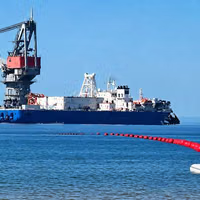
File photo by NEQSOL Holding shows the installation of the Trans-Caspian Fiber-Optic Cable across the seabed of the Caspian Sea as part of the Digital Silk Way initiative.
Investment in trade routes linking Asia and Europe through Central Asia and the Caucasus is putting pressure on Iran’s ambitions to become a major transit hub, with neighboring countries developing transport and digital networks that bypass Iranian territory.
Among them is the Middle Corridor, a network of rail, road and sea links connecting China to Europe through Central Asia and the Caucasus while bypassing Iran.
The corridor is intended not only to connect Chinese and European markets. Countries along the route are also expanding trade among themselves, and the broader connectivity push extends beyond cargo to energy, information technology and data.
On October 15, the presidents of Azerbaijan and Kazakhstan inaugurated a 380-kilometer fiber-optic link across the Caspian seabed with a capacity of more than 400 terabits per second. Part of the Digital Silk Way initiative, the cable complements the Middle Corridor.
Beyond carrying data along the East-West axis, its backers say it will help attract investment in AI data centers, cloud services and high-tech industries.
In its latest report, the World Bank projects that, if the planned investments materialize, freight volumes across the Caspian could rise from 8.8 million tons in 2023 to 32.1 million tons in 2040.
The report also finds that developing the corridor could, in the long term, increase the combined GDP of host countries by about 3.3 percent, equivalent to approximately $58 billion at current levels of economic activity, and raise employment by 2.9 percent.
These gains depend on policy and operational reforms alongside construction. The World Bank identifies at least $25 billion in infrastructure investment needs through 2040, plus an estimated $30 billion for connecting infrastructure, logistics facilities and equipment.
One of the most contentious proposed links is the route through southern Armenia that would connect mainland Azerbaijan to its Nakhchivan exclave, known in Azerbaijan as the Zangezur corridor.
Under agreements reached since August 2025, the US-backed project is being developed as the Trump Route for International Peace and Prosperity, or TRIPP, with Armenia retaining sovereignty and jurisdiction over its territory.
Azerbaijan projects that the route could carry 15 million tons of freight annually. The section through Armenia is roughly 42 to 43 kilometers long.
After several years of fierce opposition to the proposed Zangezur corridor, Iran appears to be taking a more pragmatic approach to Armenia’s inclusion in East-West transport networks, although concerns over American involvement remain.
Iran’s ambassador in Yerevan expressed concern in September about an American presence near the border and proposed a mechanism to address Tehran’s concerns. On October 16, Armenian Foreign Minister Ararat Mirzoyan said Iran had asked about the possible deployment of US military forces on Armenian territory and that Yerevan had assured Tehran this would not happen. He said he believed the Iranian side was satisfied with Armenia’s answers.
The World Bank estimates that developing the Middle Corridor could increase Armenia’s GDP by 3.4 percent, equivalent to $873 million, and raise employment by 3.9 percent in the long term. Armenia, however, is not yet a transit country on the route; the report assumes a direct rail link through the country becomes operational in the early 2030s.
Iran’s transit ambitions face growing competition
Azerbaijan and Iran have also pursued an alternative connection between mainland Azerbaijan and Nakhchivan through Iranian territory, known as the Aras corridor.
That route could preserve a role for Iran in regional transit, but participation in one connecting segment would fall short of Tehran’s broader ambition to become a central hub for trade between Asia and Europe. Western sanctions also complicate efforts to attract European businesses to routes through Iran.
A comparison with Turkey, a key link between the Middle Corridor and European markets, is telling. The World Bank estimates that corridor development could increase Turkey’s GDP by more than $47 billion and employment by about 4.4 percent in the long term.
Iran also faces competition from other regional transport plans. Iraq, with participation from Qatar, the UAE and Turkey, is advancing the Development Road, intended to link the Grand Faw port to the Turkish border at an estimated cost of about $17 billion. Iraqi officials have projected annual revenues of roughly $4 billion, although the project’s returns depend on financing, completion and demand.
The proposed India-Middle East-Europe Economic Corridor and Syria’s Four Seas initiative, linking the Mediterranean, Persian Gulf, Black Sea and Caspian region, likewise reflect efforts to develop alternative networks. These projects remain at different stages of development, and their commercial success is not assured.
More than two decades after Iran, India and Russia agreed to establish the International North-South Transport Corridor, Tehran’s ambition to become a transit hub linking India with Russia and European markets remains only partly realized. Shipments have moved through Iran, but the existence of traffic alone does not demonstrate that the route has fulfilled its wider commercial promise.
Iran’s weak logistics performance adds to the challenge. In the World Bank’s 2023 Logistics Performance Index, it ranked 123rd with a score of 2.3 out of five. Geography gives Iran potential advantages, but converting them into sustained transit business requires reliable infrastructure, efficient border procedures and commercially viable international connections.
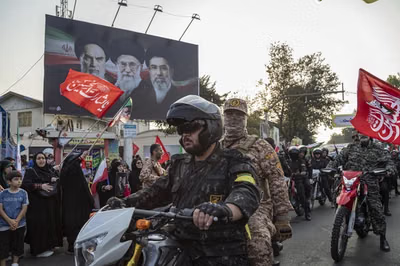
Participants take part in a state-organized Janfada mobilization event in Rasht, northern Iran, on October 15, 2026.
A growing number of former Iranian officials and political figures are calling for an agreement with the United States, while hardliners and military commanders continue to push for confrontation, exposing a deeper struggle over the direction of Tehran’s foreign policy.
Among the latest voices calling for a change of course are former President Hassan Rouhani, former Tehran mayor Gholamhossein Karbaschi and Hossein Marashi, secretary-general of the centrist Executives of Construction party.
Along with several other political figures, they have argued that Iran needs to reduce tensions with the United States and break its prolonged diplomatic impasse if it is to ease economic pressure and resume development.
Their interventions have come against a sharply different message from hardliners and military officials, who continue to frame resistance to Washington and Israel as essential to Iran’s security and warn against concessions under pressure.
The competing messages reflect a broader uncertainty at the heart of Iranian foreign policy: whether Tehran should use diplomacy to secure an exit from its confrontation with the United States or continue to raise the costs for its adversaries in the hope of extracting better terms.
The question has become more urgent after months of direct conflict with the United States, repeated warnings from Washington and Israel and several major waves of domestic unrest since 2018.
Those pressures have left the leadership increasingly sensitive to questions of public legitimacy while also making major diplomatic concessions politically dangerous. Any compromise with Washington risks being portrayed by rival factions as capitulation, giving decision-makers an incentive to postpone choices rather than assume responsibility for them.
Diplomacy without a clear destination
Hamid Aboutalebi, a former diplomat close to Rouhani, described that dilemma in an interview with Khabar Online this week, arguing that Iranian diplomacy has become caught between the urgency of immediate conflicts and the absence of a clearly defined long-term strategy.
The result, in his assessment, is a state of drift in which public expectations increasingly collide with geopolitical realities.
Aboutalebi’s criticism goes beyond whether Iran should or should not negotiate with Washington. He argues that Tehran has failed to clearly define the purpose, scope and desired outcome of diplomacy itself.
Without that clarity, he said, Iran cannot transform developments on the battlefield into political gains and is left “reacting to events rather than shaping them,” particularly in its confrontation with Israel and the United States.
That uncertainty is also visible in the government’s public messaging.
Many Iranians look to diplomacy primarily as a possible route toward economic relief and greater stability. Iranian officials, however, continue to alternate between warnings of further resistance and indications that negotiations remain possible.
The result is an expanding gap between what diplomacy is expected to deliver and what the government is prepared to commit to.
Aboutalebi argues that Iran must move beyond managing one crisis after another and instead define what it wants its foreign policy to achieve over the longer term.
That would require, in his view, deeper regional integration, a structured approach to the nuclear dispute and the development of economic partnerships capable of reducing Iran’s isolation.
The cost of suspended diplomacy
The argument is not new.
Tejarat-e Farda, one of Iran’s leading economic weeklies, has previously described the country’s approach as one of “suspended diplomacy” — a condition in which Tehran neither moves decisively toward confrontation nor commits itself to meaningful negotiations.
The magazine portrayed the consequences in unusually bleak terms, arguing that Iranians had come to recognize what it called the “tragic depth” of the country’s foreign-policy failures, producing not confidence or enthusiasm but “lethargy and despair.”
Writing in 2022, the publication argued that Iranian foreign policy had entered a prolonged state of strategic hesitation driven by domestic political caution, regional pressures and fear of diplomatic steps that might prove difficult to reverse.
The nuclear issue offered perhaps the clearest example.
Political analyst Fatemeh Mosayebi argued at the time that Tehran repeatedly signaled its willingness to engage in dialogue while avoiding concrete commitments, contributing to a cycle of hesitation in which neither Iran nor Western governments wanted to make the first major move.
Four years later, the circumstances are radically different, but the diagnosis retains much of its relevance.
Iran has moved from indirect regional confrontation to war with the United States, while the costs of economic pressure and military escalation have risen substantially. Yet the fundamental question identified in the earlier debate remains unresolved: what outcome is Iranian diplomacy actually intended to achieve?
Domestic rivalry further complicates the answer. Major foreign-policy decisions in Iran carry consequences not only for relations with Washington but also for the balance of power among competing political camps.
A failed compromise can be weaponized by hardliners, while escalation that imposes additional economic or military costs can become ammunition for their opponents.
That dynamic encourages delay. Tejarat-e Farda called it a “suspension of decision,” arguing that postponing difficult choices can ultimately “cost more than confrontation” by prolonging economic pressure without producing corresponding strategic gains.
The increasingly public calls for negotiations suggest that the price of that indecision is becoming harder to ignore.
Figures such as Aboutalebi and Marashi are not simply arguing for another round of talks. Their criticism raises a more fundamental question about whether Iran can continue simultaneously threatening escalation, signaling openness to diplomacy and postponing decisions about the compromises any agreement would ultimately require.
For now, Tehran continues to preserve both possibilities.
But the longer Iran remains caught between confrontation and compromise, the harder it becomes to present uncertainty itself as a strategy.
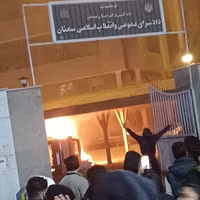
Protesters gather outside the Public and Revolutionary Prosecutor's Office in Semnan, east of Tehran, as a fire burns inside the compound during Iran's January 2026 uprising.
Iran's security forces deployed snipers on the rooftops of the provincial Friday prayer leader's office and a women's student dormitory to fire on protesters during January's deadly crackdown in Semnan, east of Tehran, an Iran International investigation found.
The investigation draws on eyewitness accounts and footage geolocated and verified by Iran International. The identities of the sources are being withheld for fear of reprisals by Iranian authorities.
It also found that hospital officials in Semnan province cooperated with security agencies to identify and arrest wounded protesters, in some cases before they could receive medical treatment.
The findings shed light on the methods used by authorities to suppress protests across the province during January's nationwide uprising.
Snipers stationed on government buildings
On January 8, as demonstrations intensified in Semnan, security forces deployed snipers and military-grade weapons on the rooftops of several prominent buildings.
The locations included the office of the provincial Friday prayer leader, the Maryam women's student dormitory and the provincial headquarters of Iran's state broadcaster, IRIB.
Witnesses described security personnel firing live ammunition at protesters from the elevated positions.
A machine gun was also deployed at the broadcasting building, where forces fired directly at protesters' heads and eyes in an attempt to suppress the crowds, according to the accounts.
On January 9, security forces raided the Kowsar student dormitory in Semnan, beating students with batons, using tear gas and arresting several people.
In the nearby city of Shahroud, witnesses described armed personnel patrolling residential streets on motorcycles and opening fire on residents.
Witnesses also said protesters detained at bases run by the Basij, a paramilitary force affiliated with the Islamic Revolutionary Guard Corps (IRGC), were shot with pellets in the backs of their legs from about one meter away, causing severe injuries, including torn tendons.
Security forces also used drones to identify demonstrators, armored vehicles to block roads and pepper spray against occupants of private vehicles, while widespread internet restrictions disrupted communications.
Hospitals used to identify wounded protesters
Kowsar Hospital in Semnan and other medical facilities were used to identify and arrest protesters during the January 8–12 crackdown, according to the investigation.
Hospital administrators and staff linked to security agencies systematically recorded the identities of patients arriving with pellet wounds or injuries from live ammunition and passed the information to security authorities.
Some wounded protesters were arrested immediately upon arrival, before receiving treatment.
In other cases, security personnel prevented emergency surgery on injured demonstrators, while medical resources were prioritized for government forces, according to accounts obtained by Iran International.
A Kowsar Hospital official who helped security forces identify protesters had previously served on a government election supervisory board.
The hospital also had close ties with IRGC officials and commanders and had hosted religious ceremonies and election-related gatherings.
Detainees subjected to torture, protestors killed
Witness accounts described protesters being transported to IRGC intelligence detention facilities and prisons with sacks covering their heads.
According to witness accounts, some detainees were held overnight alongside bloodied bodies, while others faced severe beatings, torture and verbal abuse targeting their ethnicity or gender.
Eyewitnesses previously told Iran International that at least 200 people were killed by security forces in Shahroud on January 8 and 9, although the figure could not be independently verified.
Iran International identified several of those killed, including Matin Montazerzohur, 31, who was shot in the chest on January 8, and Mahmoud Bijani, 24, who was shot dead outside the city's governor's office the following day.
Soleyman Norouzi, 31, was killed by live ammunition while returning from work on January 9. Hossein Gharib, 32, an electricity department employee and athlete, was also shot dead that day.
In another case documented by Iran International, security forces shot dead Saeed Golsorkhi, a 31-year-old powerlifter, outside his family home on January 11, two days after he was wounded during protests. Sources close to his family said he was killed in front of his mother and young niece.
Iranian authorities also executed Javad Zamani and Abolfazl Saedi, two protesters arrested during January's demonstrations in Shahroud, Semnan province, on June 16, according to the judiciary's Mizan news agency.
Protests spread across Semnan province
The January demonstrations extended across Semnan, Shahroud, Garmsar and Damghan, four counties accounting for more than 83 percent of the province's population and roughly half its territory.
The unrest spread across administrative centers, industrial districts, university communities and agricultural areas, showing that protests were not confined to a single city or social group.
Semnan province, home to approximately 700,000 people, has faced mounting economic and environmental pressures, including severe drought, declining groundwater supplies, land subsidence, industrial stagnation and rising living costs.
Despite numerous industrial estates along the Tehran-Mashhad corridor, the province has struggled with widening economic inequality and housing pressures.
Semnan also witnessed protests during nationwide uprisings in the Iranian calendar years beginning in March 2017 and March 2019, as well as the 2022 Woman, Life, Freedom uprising.
The province has also experienced labor and trade strikes, including those involving railway workers and merchants in Shahroud.
A sharp decline in voter turnout and growing political disillusionment reflect deep dissatisfaction with the continued rule of the Islamic Republic.
Official election figures show turnout in Semnan province fell from 87.82 percent in the 2009 presidential election to 49.11 percent in the first round of the 2024 vote.