• العربية
  • فارسی
BrandBrand
  • Iran Insight
  • Politics
  • Economy
  • Analysis
  • Special Report
  • Opinion
  • Podcast
  • Live TV
  • Iran Insight
  • Politics
  • Economy
  • Analysis
  • Special Report
  • Opinion
  • Podcast
  • Live TV
  • Theme
  • Language
    • العربية
    • فارسی
  • Iran Insight
  • Politics
  • Economy
  • Analysis
  • Special Report
  • Opinion
  • Podcast
  • Live TV
All rights reserved for Volant Media UK Limited
volant media logo

Saudi-led coalition orders evacuation of Sanaa oil facility

Oct 13, 2026, 13:41 GMT+1

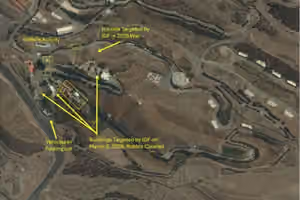
The Saudi-led coalition on Tuesday called on civilians to evacuate the Yemen Petroleum Company’s central al-Sabaha facility in Sanaa ahead of a planned military operation.

The coalition said the warning was issued for civilians’ safety and published a map identifying the site.

Most Viewed

Tehran seizes on Rubio’s Xerxes remarks to champion a past it once disparaged
1
INSIGHT

Tehran seizes on Rubio’s Xerxes remarks to champion a past it once disparaged

2

Iran hardliners back threats to strike Persian Gulf digital infrastructure

3

Iran-US diplomacy stalls as Houthi attacks on Saudi Arabia intensify

4
ANALYSIS

US military support against Houthis risks widening Iran war, expert says

5

Iran officials hinted at land incursions if US resumes strikes - WSJ

Spotlight

  • Houthi airport strikes carry echoes of Iran’s aviation threats, experts say

    Houthi airport strikes carry echoes of Iran’s aviation threats, experts say

  • Iran hardliners back threats to strike Persian Gulf digital infrastructure

    Iran hardliners back threats to strike Persian Gulf digital infrastructure

  • Can US sanctions derail Iran’s China trade route?
    ANALYSIS

    Can US sanctions derail Iran’s China trade route?

  • Machete-wielding men at IRGC-backed rally revive scrutiny of crackdowns
    ANALYSIS

    Machete-wielding men at IRGC-backed rally revive scrutiny of crackdowns

  • War puts Iran’s nuclear ambiguity under scrutiny
    INSIGHT

    War puts Iran’s nuclear ambiguity under scrutiny

Banner
Banner
Banner
Banner
•
•
•

More Stories

Gunfire heard as county-naming protest turns violent in central Iran

Oct 13, 2026, 11:00 GMT+1
100%

A protest over the name of a newly created county in central Iran turned violent after security forces moved to disperse demonstrators, with videos sent to Iran International capturing gunfire, tear gas and injured protesters.

The gathering took place on Sunday in Meymeh, a city in Isfahan province, where residents have objected to the new administrative district being named “Meymeh and Vazvan” rather than simply “Meymeh.”

Videos received by Iran International show demonstrators in the streets, tear gas in the area and people with bloodied clothing receiving medical treatment. Gunshots can also be heard, although it was not immediately clear what type of ammunition was used.

The number of people injured or detained remains unclear.

Local dispute over county name

Residents of Meymeh had campaigned for around two decades for their district to be upgraded to county status. The government eventually approved the change but in August 2024 named the new county Meymeh and Vazvan, combining the names of two cities.

Some Meymeh residents argue that their city’s historical identity should be reflected in the county name and have repeatedly called for the decision to be reversed. Officials have said the name should also recognize Vazvan.

The dispute culminated in Sunday’s street protest shortly before the new county administration was due to begin operating.

Footage showed some protesters carrying Islamic Republic flags and portraits of late Supreme Leader Ali Khamenei, underscoring the local nature of the dispute rather than an explicitly anti-government demonstration.

Security presence increases

The protest continued into the evening before security forces intervened and fired tear gas, according to videos and information received by Iran International.

Witnesses told Iran International that several protesters were wounded and detained, including some who were later taken into custody at hospitals. Iran International could not independently establish the number of arrests or verify the circumstances of each reported injury.

Reports from Meymeh on Tuesday indicated an increased security presence following the confrontation.

Iran says six killed as armed clashes intensify in southeast

Oct 13, 2026, 10:12 GMT+1
100%

The Revolutionary Guards said on Tuesday that five members of an alleged kidnapping cell and one of its personnel were killed near Zahedan, while separate reports said more than 20 members of an Iran-backed militia were killed or wounded in the area.

The IRGC Ground Force’s Quds regional headquarters said its forces located the group in the Kurin area after an engineer working on construction projects west of Zahedan was abducted a day earlier.

It said five members of the group were killed, the hostage was freed and one member of its forces was killed during the operation.

According to the statement, the kidnappers had links to armed groups and intended to take the engineer across Iran’s border into a neighboring country.

The statement supersedes an earlier report by the IRGC-affiliated Tasnim news agency, which had put the number of people killed in the operation at three.

More than 20 Fatemiyoun fighters reported killed or wounded in Taftan

Haalvsh, which covers developments in Sistan-Baluchestan, said more than 20 Fatemiyoun members were killed or wounded in fighting that continued for more than seven hours on Tuesday in the mountainous Chah Ahmad and Arzan Tak areas of Taftan County.

Citing local sources and eyewitnesses, Haalvsh said the first group sent into the area at around 6 a.m. included Fatemiyoun fighters traveling on about 18 motorcycles from a nearby base.

The outlet said armed men who had taken positions in the mountains opened heavy fire on the group. It said the dead and wounded were later removed in military vehicles.

  • Over 90 killed in six months as clashes escalate in Iran's southeast - report

    Over 90 killed in six months as clashes escalate in Iran's southeast - report

  • Iranian security forces face wave of deadly attacks in restive southeast

    Iranian security forces face wave of deadly attacks in restive southeast

  • Police officer killed in armed attack near Zahedan as violence continues in southeast Iran

    Police officer killed in armed attack near Zahedan as violence continues in southeast Iran

Fatemiyoun is an Iran-backed Shiite militia made up largely of Afghan fighters and organized with support from the Revolutionary Guards. Its members have fought alongside Iranian forces in regional conflicts.

Haalvsh said reinforcements arrived in more than 40 vehicles, accompanied by reconnaissance and combat drones.

The outlet reported continued mortar and heavy-weapons fire toward the surrounding heights after some of the armed men withdrew from the main area of fighting. It also said residents could hear drones overhead.

The identities and affiliation of the armed men involved in the Taftan clashes remained unclear.

Attacks on police and military personnel

Sistan-Baluchestan, which borders Pakistan and Afghanistan, has seen a series of armed attacks and security operations in recent weeks.

On October 9, Iranian state media reported that Nosrat Eftekhari, a senior police official responsible for cultural and social affairs in the province, was killed in a roadside bombing on the Cheshmeh Ziarat road near Zahedan.

A day earlier, a member of a police commando unit was killed in an armed attack near Nosratabad. A separate attack on a vehicle carrying Iranian Army personnel near Nikshahr killed another serviceman.

On September 23, an armed confrontation in Saravan killed Hossein Zarifi, a commander with the IRGC’s Sajjad base, according to the Guards’ Quds regional headquarters. Haalvsh separately reported that another intelligence official was killed and at least 13 other personnel were wounded.

At least five members of the Fatemiyoun, an Iran-backed Shiite militia made up largely of Afghan fighters and organized with support from the Revolutionary Guards, were also reported killed in an armed attack near Zahedan on October 2.

More than 90 killed since March - HRANA

The US-based Human Rights Activists News Agency said Monday that at least 94 people had been killed and 33 wounded in 63 armed incidents across southeastern Iran between March 31 and October 10.

HRANA said attacks on patrol vehicles and military convoys were the most common incidents it recorded, followed by targeted shootings. It also reported increased use of mines, rocket-propelled grenades and heavier weapons by armed groups, while government forces used drones, artillery and armored vehicles in some operations.

The group said the People’s Fighters Front, an alliance formed in December 2025 that includes Jaish al-Adl and several smaller Baluch armed groups, had taken responsibility for six incidents documented in its report. Most attacks remained unattributed or could not be reliably linked to a particular group, HRANA said.

Sistan-Baluchestan, one of Iran’s poorest provinces and home to much of the country’s Sunni Baluch minority, has long seen armed confrontations between government forces and Baluch groups. Recent incidents have increasingly involved attacks on police posts, military vehicles and senior security personnel.


‘Best advertisement for Starlink’ Iranians mock threat to subsea cables

Oct 13, 2026, 10:05 GMT+1
100%
File photo shows a Starlink satellite internet system set up on a miners boat on the Madeira River in Porto Velho, Rondonia state, Brazil, July 4, 2024.

The Islamic Republic’s threats to target undersea internet cables in the Persian Gulf drew mockery and criticism from readers who told Iran International that such attacks could deepen Iran’s isolation and damage its own connectivity.

The responses followed a warning by Mohsen Rezaei, secretary of Iran’s Supreme National Security Council, that communications cables, data centers and artificial intelligence facilities in the region could become targets if war resumes.

Hossein Shariatmadari, editor of the hardline Kayhan newspaper and the supreme leader’s representative at the publication, backed the warning and advocated cutting international fiber-optic cables to confront the United States and its allies.

“The threat to cut internet cables will end up like the Strait of Hormuz story: the whole region will have internet except Iran. Perhaps that is their aim,” one reader wrote.

Others mocked the proposal as an incentive to turn to satellite internet, with one calling it “the best advertisement for Starlink.”

‘Give him the wire cutters’

Much of the criticism focused on Shariatmadari, who wrote on Monday that nearly seven major international internet cable systems pass through the Persian Gulf and the Strait of Hormuz. He claimed even minor damage could disable more than 80 percent of commercial, banking, military and AI-related communications and disrupt the global internet.

Some readers questioned his technical understanding of the infrastructure he was proposing to attack.

“Give him the wire cutters. The strongman wants to cut the wires,” one wrote.

“Do you even know what fiber optics are?” another asked.

Other responses suggested the threats would encourage greater interest in Starlink, which provides internet access through low-Earth-orbit satellites and a dedicated terminal, without relying on local fixed or mobile networks.

“Starlink will surely support this too,” one reader quipped.

A reader from Firuzkuh wrote: “By the time you pick up the pliers to cut off the internet, Elon Musk will have activated Starlink. This remark alone gives him a good incentive to bring high-speed internet into Iran.”

‘Do you know anything about building?’

Other readers contrasted Shariatmadari’s proposal with what they described as his lack of interest in developing the country.

“Have you ever, even once in your life, thought about building and developing the country, now that you are threatening fiber-optic cables on the seabed?” one asked.

Another put it more briefly: “Do you know anything about building and development?”

One reader questioned the influence wielded by the newspaper editor: “The country has become so lawless that when Kayhan’s editor gives his opinion, you would think he was the supreme leader.”

Several messages drew comparisons with Shariatmadari’s earlier support for closing the Strait of Hormuz, warning that another attempt to disrupt regional infrastructure could backfire on Iran.

Shariatmadari has repeatedly advocated using communications infrastructure against Washington. On September 3, he urged Iran’s army and Revolutionary Guards to turn fiber-optic cables in the Persian Gulf into a means of confronting the United States.

Other hardline outlets have also promoted pressure on technology companies. In May, Tasnim News Agency called for charging foreign companies fees for cables passing through the Strait of Hormuz and requiring technology giants, including Meta, Amazon and Microsoft, to operate under Iranian laws.

Iran officials hinted at land incursions if US resumes strikes - WSJ

Oct 13, 2026, 08:03 GMT+1
100%
Members of the Iranian Army take part in a military exercise dubbed Fatehan of Kheibar, in the northwestern parts of Iran / File photo.

Some Iranian officials have privately suggested Tehran could send forces into neighbouring countries if the United States launches new strikes, the Wall Street Journal reported on Tuesday, citing people familiar with the warnings.

The newspaper did not identify the officials, specify which countries could be targeted by such incursions or provide details about when the warnings were delivered.

The report said Iranian officials have warned regional governments, both publicly and privately, that Tehran would widen its response across the Middle East if US attacks resume.

Iran has separately warned Arab officials that Saudi oil facilities could be targeted in a renewed conflict, according to people cited by the Journal. Mohsen Rezaei, Iran’s top national security official, said publicly on Sunday that Tehran could also target the United Arab Emirates, as well as regional data centers and internet cables.

US forces and warships threatened

The Iranian government has also told mediators that it could target US personnel more aggressively, including by trying to sink American warships in the Middle East and kill their crews, the Journal reported, citing people familiar with the warnings.

Iranian missiles came close to US warships during attacks in September, according to the report.

  • US pressure threatens Iran’s political survival but may not bring concessions

    US pressure threatens Iran’s political survival but may not bring concessions

  • Iran may be restoring activity at nuclear-linked site struck by Israel

    Iran may be restoring activity at nuclear-linked site struck by Israel

The Journal said Washington is also preparing for the possibility of renewed fighting, with a third aircraft carrier strike group and another Marine expeditionary unit heading toward the Middle East. The Pentagon is considering sending additional air-defense equipment and munitions to regional bases, it added.

President Donald Trump said last week that he would not order an attack on Iran before the November 3 midterm elections, although US officials have said the military is preparing options for further strikes.

Nuclear sites and military facilities reinforced

Iran has meanwhile reinforced defenses around nuclear sites and other sensitive facilities, the Journal reported.

Satellite imagery analyzed by the Institute for Science and International Security showed new passive defenses, including dirt barriers, around the Natanz and Pickaxe Mountain nuclear sites, according to the report.

The Journal also said Iran has used the pause in major direct fighting to rebuild missile and drone production facilities and replenish its arsenal.

Iranian officials have publicly said airports, ports and power plants are being prepared to operate under wartime conditions. State media have also shown pro-government rallies and military-related training, while billboards in Tehran have advertised civilian courses involving shoulder-fired anti-aircraft weapons and sniper rifles.

The report said the preparations reflect Tehran’s expectation that fighting with the United States could resume after the US midterm elections.

UKMTO warnings show 12 commercial ships attacked in one week

Oct 13, 2026, 04:37 GMT+1
100%
A view of the Strait of Hormuz from the coast of Bandar Abbas, southern Iran, October 6, 2026. (ISNA)

Twelve attacks on commercial vessels were reported in and around the Strait of Hormuz and Persian Gulf between October 5 and 11, according to UK Maritime Trade Operations (UKMTO) warnings.

The attacks culminated on October 11, when six commercial vessels — five tankers and a container ship — were reported struck in the Strait of Hormuz and near Oman’s Sohar anchorage.

Several incidents were reported only after they occurred, meaning initial assessments did not capture the full number of attacks. The Joint Maritime Information Center (JMIC) listed three confirmed attacks in the Strait of Hormuz during the preceding 72 hours and another in the Persian Gulf in its October 11 advisory.

A crude oil tanker was struck by an unidentified projectile while transiting the Strait of Hormuz on October 6. The incident was reported to UKMTO two days later. No casualties were reported.

A tanker was struck by multiple projectiles about 51 nautical miles north of Madinat ash Shamal, Qatar, on October 7. UKMTO reported casualties.

A tanker at anchor off the UAE coast was attacked on October 9, while an outbound tanker was struck in the Strait of Hormuz on October 10, causing a fire. The crew of the October 10 vessel was reported safe.

Another outbound tanker was hit in the strait on October 11, damaging its steering gear room and a water tank. Five additional attacks from that day were subsequently disclosed in UKMTO warnings, bringing the October 11 total to six.

Hormuz threat remains severe

JMIC maintained the threat level for the Strait of Hormuz at SEVERE, its second-highest classification, saying deliberate hostile action was highly likely.

It cited recent Iran attacks and continuing navigation interference, as well as Revolutionary Guards attacks, hailing and routing pressure.

JMIC also said attacks were spreading beyond the Hormuz transit lanes to vessels at anchor in the Persian Gulf. It warned that further projectile or drone attacks could affect tankers at UAE anchorages and outbound vessels in the southern Omani corridor.

Hormuz traffic remains far below normal

Commercial traffic through the Strait of Hormuz remains below historical levels.

US Naval Cooperation and Guidance for Shipping data showed about 29 US-facilitated vessel transits per day over the preceding 72 hours, compared with a historical average of roughly 138 daily transits, according to JMIC. Independent tracking indicated substantially fewer vessels passing through the strait.

JMIC maintained the Strait of Hormuz security threat at SEVERE, its second-highest classification.