US restricts Saudi airport use after Iran-backed Houthi attacks
US government employees in Saudi Arabia now require special authorization to use any airport in the kingdom following recent attacks by Iran-backed Houthis on Saudi airports, the US Embassy in Riyadh said Tuesday in a post on X.
The embassy said Saudi Arabia’s aviation authority had extended the suspension of operations at King Khalid International Airport in Riyadh through October 17, while airports in Jeddah and Dammam remained operational with some delays and cancellations.
It urged US citizens to exercise extreme caution when using Saudi airports, warning of potential attacks, flight cancellations, airspace closures and other travel disruptions.
Director Asghar Farhadi poses during a photocall for the film "Histoires paralleles" (Parallel Tales) in competition at the 79th Cannes Film Festival in Cannes, France, May 15, 2026.
Oscar-winning Iranian filmmaker Asghar Farhadi says his next film will be in Persian and set in Tehran but shot abroad to avoid Iran's mandatory hijab rules and government permit requirements.
In a caption accompanying Instagram video excerpts from a cinema masterclass in Brazil, Farhadi said the screenplay for his next film, a social drama, was nearing completion and filming was planned for 2027.
"My next film, whose screenplay is nearing completion, is a social drama in Persian and has nothing to do with Palestine," he wrote, apparently responding to social media rumors.
"Although the story is set in Tehran, as I have previously stated, I am not willing to make a film under an official permit and with mandatory hijab requirements. For this reason, the film is scheduled to be shot outside Iran next year."
Under Iran's film regulations, filmmakers must obtain production permits from the Ministry of Culture and Islamic Guidance, which oversees the film industry and enforces government censorship requirements.
Directors must submit scripts for approval before filming, while completed productions undergo a separate review before they can be screened publicly. Female performers are also required to wear the hijab on screen, including in scenes depicting private settings.
Farhadi, who won Academy Awards for A Separation and The Salesman, had already announced plans to return to Persian-language filmmaking.
In an August 18 interview with film industry publication Screen Daily, he said his next project would be shot outside Iran and France, citing political and social restrictions as his reason for not filming in his home country.
His latest comments explicitly reaffirmed his refusal to work under Iran's official permit system and mandatory hijab requirements.
Farhadi rejects Tehran’s interpretation of his Hollywood remarks
The filmmaker also addressed controversy surrounding remarks he made about Hollywood cinema and American democracy during a masterclass in Brazil.
Farhadi said some media outlets had incorrectly described his comments as an interview with entertainment publication Variety, when they were made in response to a moderator's question about the Hollywood film Argo during a session attended by students and cinema enthusiasts.
The 2012 film, directed by Ben Affleck, depicts a CIA operation to rescue six Americans from Iran during the 1979 hostage crisis.
"Criticizing parts of Hollywood cinema, the condescending perspective in some films, and discussing American democracy in no way means endorsing the existence of democracy or the way Iran is governed," Farhadi wrote.
He accused media outlets close to Iran's government of exploiting his remarks for political purposes, saying the same outlets had spent years insulting and attacking him.
"The appropriation of my remarks by certain media outlets close to the government is a blatant misuse for their political objectives, which I have never believed in," he wrote.
"Iran, my homeland, has been my red line throughout all these years," Farhadi added. "Everything I have said, and everything I will say from now on, has always been based on this conviction."
The Quds Force of Iran’s Islamic Revolutionary Guard Corps has appointed a new commander to its overseas assassination unit and renamed it to Unit 600 after its personnel and structure were exposed, two sources close to the IRGC-QF told Iran International.
Esmail Qaani, commander of the IRGC’s overseas arm, recently appointed Mojtaba Hagh-Lesan to lead the unit previously known as Unit 840, the sources said.
Hagh-Lesan, 64, previously headed the unit’s intelligence department. He replaces Yazdan Mir, also known as Haj Asghar Bagheri, who was killed in a targeted Israeli strike on April 6.
The unit had been without a commander since Mir’s killing, the sources said. Hagh-Lesan’s appointment puts an existing senior member in charge of a formation linked to plots against Iranian dissidents, journalists, former US officials and Israeli targets abroad.
The sources provided Iran International with the unit’s latest command chart, identifying its leadership and the officials responsible for operations across several regions.
Command structure revealed
According to the chart, Mohammad-Reza Ansari serves as Hagh-Lesan’s deputy and oversees the Israel portfolio.
Mohsen Boroujeni heads special operations for the United States and Europe, while Morteza Babaei leads the department responsible for the Middle East and Africa. Javad Sharfaei oversees special operations in Asia.
The chart identifies Meysam Sahraei as an operative involved in preparing attacks in Africa and India. It also names Gholamhossein Hosseini and Mohammad Hosseinpour as prominent operatives involved in the department’s activities.
The sources said the reliance on existing personnel reflected a crisis in the command structure following the killing of senior IRGC officers. They said it had also raised doubts among Quds Force members about the organization’s effectiveness.
Hagh-Lesan’s published work includes two articles in Strategic Studies, a journal published by the Expediency Council’s Center for Strategic Research.
“Regional Unrest and Domestic Security” appeared in the combined fifth and sixth issues, published on September 23, 1999. “US Intervention in the Bosnian Crisis” was published on November 22, 2004.
From US officials to Israeli businessmen
Unit 840 emerged from Unit 400 in the early 2010s on the orders of then-Quds Force commander Qassem Soleimani. Unit 400 is a covert special operations formation with close ties to Hezbollah.
A photograph of Mir alongside Hezbollah leader Hassan Nasrallah and senior IRGC commanders Mohammad Reza Zahedi and Mohammad Hejazi illustrates those connections.
Yazdan Mir, the former commander of Unit 840, pictured with Hassan Nasrallah, Mohammad Reza Zahedi and Mohammad Hejazi.
Informed sources told Iran International that a Western intelligence service identified and attacked the unit’s headquarters in Damascus in 2020.
The unit subsequently became the focus of investigations into assassination plots abroad.
In August 2022, the US Justice Department charged IRGC member Shahram Poursafi with plotting to assassinate John Bolton, who served as national security adviser during President Donald Trump’s first administration.
Prosecutors said Poursafi offered $300,000 for Bolton’s killing, likely in retaliation for the US strike that killed Soleimani in January 2020.
Iran International’s subsequent investigation, based on information provided by the Black Door hacking group, identified Ansari as the Syria-based Unit 840 commander who led the failed operation against Bolton and former Secretary of State Mike Pompeo.
According to that reporting, Poursafi worked under Ansari, and the network sought to hire non-Iranians to conceal Tehran’s involvement. The person recruited to arrange the killings was an FBI informant.
In June 2023, the US Treasury sanctioned Ansari and Poursafi, saying Ansari, with Poursafi’s support, had planned and attempted to assassinate two former US government officials.
Ansari was also linked to a foiled plot against two Israeli businessmen in Colombia. Iran International reported in December 2022, citing an investigation by Infobae, that he had directed the operation through locally recruited criminals.
The businessmen and their families left Bogota under tight security after Colombian intelligence authorities warned them of the threat, according to that reporting.
Criminal networks and journalist targets
Unit 840 has repeatedly sought to use criminal gangs and traffickers to carry out operations abroad.
In Germany, Iran International previously reported that Ramin Yektaparast, an Iranian-German member of the Hells Angels motorcycle gang, organized attacks against synagogues in Bochum and Essen on behalf of the Quds Force.
The investigation, citing a Western intelligence source and a source within the IRGC, also linked him to a failed plot to assassinate Iranian rapper Shahin Najafi at a concert in Hanover in September 2023.
Yektaparast was shot four times and killed in Tehran on April 28, 2024. Following reports of possible Mossad involvement, the IRGC-linked Tasnim news agency denied he had ties to the Guards and said he was killed in a dispute over “personal matters.”
His funeral notice nevertheless described his death as a “martyr-like ascension,” and he was buried in Section 19 of Tehran’s Behesht-e Zahra cemetery, reserved for fallen IRGC and Basij members.
In Britain, an ITV News investigation exposed a Unit 840 plot, codenamed “the wedding,” to kill Iran International journalists Fardad Farahzad and Sima Sabet.
ITV reported in December 2023 that Iranian operatives had offered a people-smuggler $200,000 to arrange the murders. It identified Ansari as the commander behind the plot.
The plan failed because the smuggler was working as a double agent for a Western intelligence service and passed details to his handler, according to the investigation. Iran’s embassy in London rejected ITV’s findings as baseless.
In Sweden and Denmark, the Quds Force used Rawa Majid, leader of the Foxtrot criminal network, to attack Israeli-linked targets, according to Iran International’s previous reporting.
Swedish investigative journalist Diamant Salihu told the BBC that Majid fled to Tehran in October 2023 and that his links with Iranian authorities developed afterward. Iran International reported in April 2025 that he was living in Iran under IRGC protection.
Britain sanctioned Majid and Foxtrot in 2025. Iran’s embassy in London denied Tehran’s links to the network.
Repeated intelligence setbacks
The unit has suffered a series of blows through the exposure of its personnel and operations.
In May 2022, footage emerged of an interrogation attributed to Mossad in which Mansour Rasouli, a trafficker linked to Unit 840, said he had been tasked with killing an Israeli citizen in Turkey, a senior US general in Germany and a journalist in France.
Later that month, Hassan Sayyad Khodaei, a senior figure in the unit, was shot dead in central Tehran. The New York Times, citing an intelligence official, reported that Israel had told the United States it was responsible.
Those setbacks were followed in June by the removal of Hossein Taeb as head of the IRGC Intelligence Organization.
The following month, Iran International reported that Mossad agents had interrogated Yadollah Khedmati, an IRGC logistics and support commander, near Tehran. Footage of that interrogation was also released.
More recently, Israel announced the disruption of another IRGC network accused of planning attacks on strategic infrastructure and Israeli and Jewish targets abroad.
In a joint statement on April 20, Mossad, the Israeli military and Shin Bet said an operation in Azerbaijan had foiled plans to attack the Baku–Tbilisi–Ceyhan oil pipeline, the Israeli embassy, a synagogue in Baku and Jewish community leaders.
Azerbaijani authorities arrested members of the cell and seized explosive drones and other explosives smuggled from Iran, according to the Israeli account. The suspects had conducted surveillance and photographed targets under orders from handlers in Tehran.
The US, Britain and European Union have imposed sanctions on figures linked to overseas assassination plots. Alongside the US measures against Ansari and Poursafi, Britain sanctioned Unit 840 and Ansari in January 2024. The EU sanctioned Ansari in July 2025, accusing him of ordering the assassination of journalists critical of the Islamic Republic.
Reorganization amid calls for revenge
According to Iran International’s sources, the Quds Force decided to reorganize Unit 840 after its structure and personnel were exposed. Six months after Mir’s killing, Hagh-Lesan’s appointment restores a commander to a unit responsible for covert operations against Iranian government opponents, critical journalists and Israeli targets worldwide.
The reorganization follows public calls for revenge over the killing of former Supreme Leader Ali Khamenei.
In July, Hossein Shariatmadari, the supreme leader’s representative at the hardline Kayhan newspaper, urged authorities to declare Trump and pilots involved in Khamenei’s killing people whose killing was a religious obligation.
Kayhan also said the security of Trump and Israeli Prime Minister Benjamin Netanyahu had been permanently destroyed. Tehran municipal murals threatened both leaders, including one bearing the English words “We will kill Trump.”
Iranian authorities have also expanded efforts to collect information about government opponents abroad.
In September, the IRGC-affiliated Fars news agency announced a system called “Alaj” to identify and track such individuals. It urged government supporters to submit information through the system’s website and the Telegram and Bale messaging platforms.
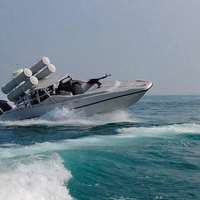
An IRGC Navy speedboat fitted with missile launch tubes and a mounted heavy machine gun during operations in the Persian Gulf.
Despite signs of movement in negotiations with Washington, Tehran is showing little inclination to ease military pressure, pursuing diplomacy while signaling that renewed US attacks could trigger a broader regional response.
Deputy Foreign Minister Kazem Gharibabadi said Tuesday that Iran was finalizing its response to US comments on a proposal Tehran submitted in New York, insisting that the Islamic Republic remained open to diplomacy but was prepared for war as well.
Some Iranian officials have privately suggested Tehran could send forces into neighboring countries if the United States launches new strikes, the Wall Street Journal reported Tuesday, citing people familiar with the warnings.
The newspaper said Tehran had warned regional governments, publicly and privately, that renewed US attacks would prompt a wider Iranian response across the Middle East.
The combination of diplomacy and military pressure reflects the central calculation facing Tehran: whether limited movement from Washington represents the beginning of a settlement or an attempt to weaken Iran's leverage without conceding its principal demands.
Mohsen Rezaei, secretary of Iran's Supreme National Security Council, has said Washington accepted “some” of Tehran's seven conditions for de-escalation through Qatari and Omani mediators. But Iranian officials have characterized the US response as insufficient.
At sea, there has been no corresponding easing of pressure.
The Revolutionary Guards have continued to warn ships against using routes Tehran considers unauthorized, including alternative passages intended to circumvent Iranian restrictions in the Strait of Hormuz.
Preserving Iran's leverage
Control over passage through the Strait of Hormuz remains one of Tehran's strongest sources of leverage. If US-protected shipping can routinely bypass Iranian restrictions, Tehran risks losing that leverage while continuing to suffer the effects of the US blockade on its own economy.
Tehran's demands include an end to the blockade and the release of billions of dollars in frozen Iranian assets. Allowing alternative routes to become normalized before securing substantial concessions would mean surrendering one of its most powerful bargaining tools.
But maintaining that pressure is also hurting Iran. Its oil exports have effectively stopped under the blockade, with Kpler data showing no crude oil or condensate loaded onto tankers throughout September.
Restrictions have also complicated imports and intensified pressure on an economy already struggling with a sharply weakened currency and high inflation.
Tehran is therefore trying to preserve its maritime leverage while suffering increasingly severe consequences from the confrontation that created it.
Widening the confrontation?
Enforcing Iranian restrictions farther from traditional shipping lanes risks turning a struggle over the Strait of Hormuz into a broader confrontation involving neighboring states.
Oman and Qatar have been central to mediation between Washington and Tehran. Any Iranian action threatening shipping close to Omani waters could complicate the diplomatic channel Tehran is simultaneously trying to preserve.
Iran has not publicly announced plans to send forces across its borders, but the warnings appear designed to convince regional governments that another US campaign against Iran would not remain confined to Iranian territory.
Houthi missile and drone attacks on Saudi Arabia have already demonstrated how quickly renewed fighting can spread beyond the direct US-Iran confrontation, threatening airports, energy infrastructure and regional shipping.
For Tehran, that instability can increase pressure on Washington and its allies. But it also raises the possibility of an escalation Iran may struggle to control.
War and diplomacy
Hardline and security-aligned voices portray Washington's willingness to engage with Tehran's proposals as evidence that military pressure has worked and argue against giving up that leverage prematurely.
Others favoring diplomacy see US movement as an opening that could disappear if attacks on shipping or neighboring states trigger another round of escalation.
Gharibabadi captured that dual approach Tuesday, saying Iran had not shied away from diplomacy but was prepared for either outcome.
For now, Tehran is pursuing both tracks simultaneously, negotiating while trying to demonstrate that failure to reach an agreement will remain costly — not only for Iran, but for the United States and its regional partners.
File photo: A construction worker looks on at a building site in Iran
The International Monetary Fund forecast Tuesday that Iran’s economy would shrink 7.6% in 2026, a worse outlook than for its main Middle Eastern rivals amid the war, with Saudi Arabia and the UAE facing smaller contractions and Israel and Turkey expected to grow.
The IMF's latest World Economic Outlook revised Iran's forecast downward from a 5.4% contraction projected in July. The economy is now expected to shrink for a second consecutive year, following an estimated 0.9% decline in 2025.
The IMF expects the economies of the Middle East and Central Asia to contract by 0.3% this year, a sharp reversal from the 1.9% growth it forecast in April.
Several countries in the region face deeper contractions than Iran, with the IMF forecasting declines of 16.7% in Kuwait, 16% in Iraq, 15.6% in Qatar and 11.3% in Bahrain.
Saudi Arabia and the United Arab Emirates are expected to see smaller contractions of 3.3% and 3.9%, respectively. Others are projected to grow, including Egypt by 5.1%, Israel by 4.5%, Oman by 4.1%, and Jordan and Turkey by 2.7% each.
The deterioration in most regional countries reflects renewed military exchanges and prolonged disruption to shipping through the Strait of Hormuz, while Iran faces the additional pressure of the US naval blockade.
Iran's projected contraction nevertheless stands out, reflecting restrictions on its oil exports and an economy already weakened by years of sanctions and structural problems.
‘Deep recession’
Iranian government data presents a similarly bleak picture.
The Statistical Center of Iran reported last month that GDP contracted 10% in spring 2026 compared with the same period a year earlier, the sharpest quarterly decline in 15 years.
Even excluding oil, the economy shrank 4.6%, showing that the downturn extended well beyond the energy sector.
Oil and gas production fell 26.4% from a year earlier, while industry and mining contracted 14.7% and services 4.8%. Agriculture was the only major sector to expand, growing 2.3%.
Exports of goods and services fell nearly 36% and imports declined almost 15%. Household consumption dropped 4%, indicating a further weakening of domestic demand and purchasing power.
The figures contrast sharply with the global outlook, with the IMF expecting growth of just over 3% worldwide in 2026.
Officials offer rosier picture
Senior Iranian officials have continued to offer far more optimistic assessments.
Central Bank Governor Abdolnaser Hemmati told state television last week that inflationary pressures had eased during the summer and that the government had prevented the economic collapse predicted by Washington.
Former Labor Minister Hojjat Abdolmaleki went further in recent remarks that drew mockery on Iranian social media, saying inflation was effectively Iran's only economic problem.
“If you put high prices aside, you have no other economic problems,” he said.
Pressure on oil exports
Iran loaded no crude oil or condensate onto tankers throughout September, according to data from commodities intelligence firm Kpler, the first full month without loadings since the 1979 Islamic Revolution.
Washington has described its economic campaign as an effort to deprive Tehran of its remaining sources of revenue.
On October 8, the US Treasury imposed sanctions on 17 vessels and associated companies it identified as part of Iran's remaining shadow fleet.
Treasury Secretary Scott Bessent said the administration would continue targeting those facilitating Iranian oil sales.
The combination of the IMF forecast and Iran's own economic data points to a recession extending well beyond the country's energy sector.
How much deeper it becomes will depend in large part on the duration of the war, the blockade and Tehran's ability to restore oil exports.
The name Caspian Sea seen on a map on Iran's state TV
Iranian state television has begun referring to the country’s northern sea as Caspian in Persian, a departure from the customary Khazar, after airing claims that the older familiar name serves alleged Israeli ambitions in the Caucasus.
Caspian takes its name from the Caspians, an ancient people who lived along the sea’s southwestern shores in modern Iran. Khazar refers to the Khazars, a medieval Turkic people whose state lay to the north and northwest of the sea and whose ruling elite adopted Judaism.
It remains unclear whether Iran’s state broadcaster has issued a formal directive to change its terminology across programs. However, the name change brings attention to competing arguments over history and national identity.
Supporters of Caspian describe it as a restoration of Iranian heritage, while opponents say Khazar is itself a deeply rooted geographical name whose use does not endorse the people it originally described.
State TV’s website features a segment from IRGC-affiliated Ofogh channel’s “War Headquarters” program with commentator and academic Ahmad Kazemi under the title “The Zionists’ plot to change the name of the Caspian Sea to Khazar.”
In remarks also shared by the IRGC-affiliated Fars News, Kazemi portrayed the use of Khazar as supporting an Israeli historical claim.
“By using the non-Iranian word Khazar today, we are effectively helping Israel’s thesis that seeks to prove the existence of a Jewish empire in the Caucasus,” he said.
The name Caspian Sea in Persian on another Iranian state TV program aired on Tuesday Oct. 13 , 2026.
Kazemi said people outside Iran mocked Iranians for using what he described as a foreign name while others used Caspian. He described the Caspians as an Iranian people who had lived across areas stretching from Kashan to Mazandaran and the Caspian coast.
His remarks did not provide evidence of an Israeli effort to influence the sea’s Persian name.
An appeal to Iranian heritage
For English-speaking audiences, the distinction can be easy to miss: the body of water is already called the Caspian Sea in English. The question is what Iranians should call it in Persian.
Campaigns to replace Khazar predate the television material. A petition addressed to the parliament speaker, the head of state broadcasting and the education minister calls for Caspian to be used in official sources, describing it as an authentic Iranian name.
Mohammad Ebrahim Zarei, then acting head of Iran’s Research Institute of Cultural Heritage and Tourism, also proposed using Caspi or Caspian at an annual gathering of Iranian archaeologists in 2025, arguing that it was the older name.
Caspian derives from the Caspians, an ancient people who lived along the sea’s southwestern shores. Encyclopedia Iranica identifies them in ancient sources while noting uncertainties about their precise location and linguistic background.
Khazar, meanwhile, derives from the medieval Khazars, whose state lay to the north and northwest of the sea. The name has been used in regional geographical writing for centuries.
The sea has also been known in Iran as the Mazandaran Sea, a name previously used in official contexts. During Mohammad Khatami’s presidency, a 2002 naming decision standardized Khazar for domestic use and Caspian for foreign texts and international agreements.
That policy favored an already established name over alternatives such as Mazandaran, rather than introducing Khazar for the first time.
Objections to replacing Khazar
Political geographer Pirouz Mojtahedzadeh offers a different argument, saying established geographical names should not be changed because of political, ethnic or religious objections to their origins.
He argued that abandoning Khazar over alleged Israeli claims to the region would accept the premise of those claims rather than challenge them. He also warned that changing the sea’s name would undermine Iran’s opposition to attempts to rename the Persian Gulf.
“Would you not, in practice, have justified and endorsed Arab efforts to change the geographical name of the Persian Gulf?” he asked supporters of replacing Khazar.
More recently, objections to the campaign have appeared on the website of the Islamic Revolution Documents Center.
In an August article, Arash Nasiri challenged the argument that the Khazars’ ethnic origins, military history or association with Judaism justified abandoning the name.
Some Khazar rulers adopted Judaism, but treating the entire population as uniformly Jewish oversimplified the historical record, he wrote.
Nasiri also argued that using a geographical name did not mean endorsing the conduct or beliefs of the people from whom it originated. Khazar had become an established part of Persian usage, extending beyond its association with a medieval people.
Caspian was historically valid, he wrote, but presenting the choice as “Iranian Caspian” versus “foreign Khazar” reduced a complex history to a political distinction.