• العربية
  • فارسی
BrandBrand
  • Iran Insight
  • Politics
  • Economy
  • Analysis
  • Special Report
  • Opinion
  • Podcast
  • Live TV
  • Iran Insight
  • Politics
  • Economy
  • Analysis
  • Special Report
  • Opinion
  • Podcast
  • Live TV
  • Theme
  • Language
    • العربية
    • فارسی
  • Iran Insight
  • Politics
  • Economy
  • Analysis
  • Special Report
  • Opinion
  • Podcast
  • Live TV
All rights reserved for Volant Media UK Limited
volant media logo

Iran-linked actors used US AI for fake journalism, military targeting

Oct 10, 2026, 00:30 GMT+1
Social media accounts for the “Ervin B. Hoskins” fake journalist persona, which OpenAI said was used in an Iran-origin influence operation to place articles in online media outlets. (OpenAI)

Iran-based and Iranian-linked actors have used two leading US artificial intelligence platforms to place articles under fake journalist identities and help develop targeting recommendations against US naval forces, according to separate investigations by OpenAI and Anthropic.

The latest disclosure came Thursday, when OpenAI said it disrupted an Iran-origin influence operation that used ChatGPT to help fake journalist personas place almost 100 articles in roughly a dozen online outlets around the world.

OpenAI dubbed the campaign “Bogus Bylines.”

The operators used seven fake journalist identities to pitch English-language articles, primarily about the US-Iran conflict. ChatGPT was used to refine drafts according to outlets’ submission requirements and prepare emails pitching them to editors.

The personas presented themselves as Western journalists, usually Americans. One, Ervin B. Hoskins, described himself as an “American freelance writer” and maintained accounts on X, Facebook, Instagram and Threads.

But OpenAI said platform transparency information showed the accounts were operated from Iran.

OpenAI identified articles under the operation’s bylines dating from July 2025 through October 2026 and said publication increased significantly after the US-Iran conflict began.

Some outlets subsequently promoted the articles through their own social media accounts, potentially exposing the material to audiences the operators could not otherwise reach.

The operators also used ChatGPT to produce batches of social media comments. Some were generated in response to posts promoting their own articles and praised or endorsed the stories, which OpenAI assessed was likely intended to make them appear more popular.

Other prompts requested comments portraying the United States as the aggressor in the conflict, Israel as an unreliable US ally and Iran as a defiant but resilient victim.

The operation generated more than two dozen batches of hostile Persian-language responses to posts by Iran International.

OpenAI said the replies it found generally received low engagement and rated that component Category 2 on its six-level IO Breakout Scale. The article-placement campaign was more successful, reaching Category 4 after repeatedly getting material published by media outlets.

OpenAI said the overall activity was consistent with a commercial actor running an influence campaign for hire but said it could not identify the actor behind it.

From influence to military targeting

The OpenAI findings follow a September report from Anthropic documenting Iranian-linked use of Claude for activities extending beyond influence operations.

Anthropic said it disrupted an “Iran-nexus threat actor” that used Claude to collect and analyze publicly available information to develop targeting recommendations against US naval forces in the region.

The actor used Claude to help construct a Python pipeline for tracking naval positions and compiling targeting handbooks.

The material included US personnel identified from captions on publicly available military photographs, ship and aircraft transponder identifiers, scripts for querying commercial satellite imagery and lists of public websites exposing US naval movements.

The actor also directed Claude to research vulnerabilities in shipboard systems, including maritime satellite communications terminals, Cisco communications equipment and industrial control products.

OpenAI and Anthropic have documented misuse by actors linked to several countries, including for cyber operations, influence campaigns and intelligence gathering, suggesting generative AI is increasingly being incorporated into activities that long predate the technology.

OpenAI concluded that the influence operations it uncovered resembled campaigns from the pre-AI era, with artificial intelligence making parts of the workflow easier.

The two investigations suggest AI is being used less to invent entirely new forms of influence and intelligence activity than to accelerate existing ones: drafting and pitching articles, manufacturing online responses, processing surveillance data, writing software and assembling open-source military intelligence.

Most Viewed

From talks to war: Tehran sees the gap narrowing
1
ANALYSIS

From talks to war: Tehran sees the gap narrowing

2
VOICES FROM IRAN

Iran's reported $200 million Hezbollah aid angers cash-strapped citizens

3

Iran turns on Pakistan as Saudi defense pact takes effect

4
ANALYSIS

Three years after October 7, Iran pays the price of miscalculation

5
EXCLUSIVE

Hezbollah recruitment network in Iran exposed, four safe houses identified

Banner
Banner

Spotlight

  • 'Three golden weeks': Trump’s no-strike pledge fuels calls in Iran to act first

    'Three golden weeks': Trump’s no-strike pledge fuels calls in Iran to act first

  • J’Accuse! Tehran defends French students, silences Iranian youth
    OPINION

    J’Accuse! Tehran defends French students, silences Iranian youth

  • US pressure hits Iranians harder than rulers, 68% in poll say
    VOICES FROM IRAN

    US pressure hits Iranians harder than rulers, 68% in poll say

  • Saudi Aramco hires US firm to upgrade shared oil field as Iran lags behind

    Saudi Aramco hires US firm to upgrade shared oil field as Iran lags behind

  • Iran looks for escape routes as US sanctions close in
    INSIGHT

    Iran looks for escape routes as US sanctions close in

  • China shifts to Iraqi oil: is Iran using old workaround to beat US blockade?
    ANALYSIS

    China shifts to Iraqi oil: is Iran using old workaround to beat US blockade?

Banner
Banner
•
•
•

More Stories

UK court hears how alleged Iran spy operation targeted Iran International

Oct 9, 2026, 13:07 GMT+1
100%
Court sketch from Woolwich Crown Court. Credit: SWNS/Julia Quenzler

Men accused of spying for Iran exchanged information about Iran International’s offices and presenter Kambiz Hosseini, while one defendant discussed money transfers and his legal troubles with contacts in Iran, a London court heard.

Jurors at Woolwich Crown Court were taken through photographs, messages and phone records documenting communications among the three defendants and between Mostafa Sepahvand and two men in Iran.

Sepahvand, 41, Farhad Javadi Manesh, 46, and Shapoor Qalehali Khani Noori, 57, have all pleaded not guilty to charges under Britain’s National Security Act 2023.

Prosecutors say they gathered information for Iranian intelligence to prepare for serious violence against at least one target, with Sepahvand expected to carry out an attack and the others helping to plan it.

Locations and social media

In an exchange on December 19, 2024, Sepahvand received a postcode from a UK mobile number and forwarded it to Javadi Manesh, the court heard.

The prosecutor told jurors the postcode identified the location of Volant Media, Iran International’s parent company. Sepahvand also forwarded the telephone number from which he had received it.

Messages from December 24 showed Sepahvand sending Javadi Manesh a photograph of Hosseini, a link to his Instagram account and information about Iran International’s website.

In one message, Sepahvand wrote: “go to insta and you will see both the dog and the car”.

The prosecution also reminded jurors of a video Noori had sent to Sepahvand showing a park where Hosseini walked his dog, Niko. Other messages referred to the dog’s name and a blue Volkswagen.

Jurors were shown photographs recovered from Noori’s phone depicting Malthouse Court in Brentford from several angles, taken from inside a car.

Prosecutors had previously told the court that Iran International journalist Mojtaba Pourmohsen lived there between 2019 and 2023, but the defendants appeared unaware he had moved.

  • Three Iranians spied on Iran International journalists in UK, prosecutors say

    Three Iranians spied on Iran International journalists in UK, prosecutors say

  • UK police charge man over Iran-linked foreign intelligence offence

    UK police charge man over Iran-linked foreign intelligence offence

  • Two Iranians charged over foiled plot targeting Manchester Jews

    Two Iranians charged over foiled plot targeting Manchester Jews

Money and contacts in Iran

The prosecution examined records of Sepahvand’s communications with Mostafa Ghorbani and another contact saved as “Amin Mostafa’s Friend”, both in Iran.

The exchanges included discussions about transferring money to Sepahvand and references to an account in his name at the Workers Welfare Bank.

Jurors also heard messages concerning Sepahvand’s court case in Iran. In one, Ghorbani wrote: “haji says your case will be fine”.

Sepahvand sent Ghorbani two Iranian court documents concerning vehicles linked to him. The documents included instructions to impound the vehicles and arrest Sepahvand if he was found driving them.

Shortly after sending the documents, Sepahvand called Ghorbani and the two spoke for nearly a minute and a half, according to the records presented to the jury.

In later exchanges, Sepahvand complained that nothing had happened with his case. The logs showed repeated attempts to reach Ghorbani, including unanswered calls in early January.

Prosecutors previously said Sepahvand wanted help resolving an Iranian criminal conviction, which they consider relevant to his motivation. Jurors were told not to treat the conviction itself as evidence against him.

A police witness was questioned about the dates, times and durations of calls and messages recorded in the logs, rather than asked to draw conclusions about their significance.

Defendants dispute prosecution’s account

According to the prosecution’s account of his defense, Sepahvand accepts conducting surveillance for Iran but says he feared the consequences of refusing and deliberately did a poor job. Prosecutors reject that account.

Javadi Manesh and Noori accept visiting locations and taking photographs and videos but say they did not know they were assisting Iranian intelligence, according to the prosecution.

US pressure hits Iranians harder than rulers, 68% in poll say

Oct 9, 2026, 01:10 GMT+1
•
Saba Heidarkhani
100%
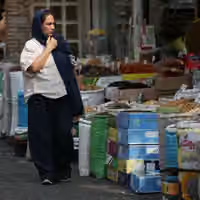
A woman walks past sacks of nuts, dried fruits and other goods at a market in Iran.

More than two-thirds of respondents to an Iran International Instagram poll said the Trump administration’s pressure on the Islamic Republic is hurting ordinary Iranians more than the authorities.

More than 56,000 people took part in the October 8 poll, with 68% saying ordinary people bear the greatest burden of US pressure. Another 23% said both the public and the government suffer, while 9% said the authorities are affected most.

Men accounted for approximately 76% of respondents and women for 24%.

The largest age group was 25 to 34, representing about 38% of participants, followed by those aged 35 to 44 at 29%. Respondents aged 18 to 24 and 45 to 54 each accounted for 12%.

Thousands of comments accompanying the poll reflected differing views on the economic consequences of US pressure, the Islamic Republic's responsibility for worsening living conditions and whether external pressure could bring political change.

Rising prices dominate concerns

The most common concern among respondents who believed ordinary Iranians were suffering most was the deterioration in daily living conditions.

Many cited rising prices, declining purchasing power, shrinking incomes and the growing financial burden on low-income households.

Others pointed to difficulties accessing medicine and medical treatment, arguing that people with fewer financial resources were particularly vulnerable to economic restrictions.

  • Officials trade blame as Iran’s economy sinks deeper

    Officials trade blame as Iran’s economy sinks deeper

"Only ordinary people are being crushed under the pressure," one respondent wrote.

Several participants argued that even when US measures target the Islamic Republic, their economic consequences ultimately reach households through higher prices and reduced access to essential goods.

Officials seen as insulated from hardship

Another recurring theme was the perceived gap between the living standards of ordinary Iranians and those of government officials.

Some respondents argued that access to wealth, foreign currency, privileged positions and state resources allowed officials and their associates to avoid some of the hardships experienced by the wider population.

"The main burden falls on the people. The government would even be happy to see people becoming poorer every day," one respondent wrote.

  • Iran drug shortages hit 800 medicines as costs could triple

    Iran drug shortages hit 800 medicines as costs could triple

Other participants said the Islamic Republic also suffers from economic restrictions through reduced revenues and limited access to financial resources, but can pass some of those costs on to the public.

For these respondents, the issue was not simply whether sanctions hurt the government or the public, but how the economic burden was distributed.

Economic hardship versus hopes for political change

The sharpest disagreement concerned whether the immediate economic costs of US pressure could be justified by the prospect of political change.

Some respondents acknowledged that ordinary Iranians were suffering but considered the hardship acceptable if it weakened the Islamic Republic or helped bring about a different political system.

"People will endure it because this suffering is worth it for a free Iran tomorrow," one wrote.

Others questioned whether worsening economic conditions would produce meaningful political change.

They argued that household finances could deteriorate far more quickly than external pressure could affect the country's political leadership.

100%
A woman shops at a market selling nuts, dried fruits and spices in Iran.

Several respondents held both US policies and the Islamic Republic's economic management responsible for the hardships facing Iranians.

Some likened sanctions to a painful medical treatment, reflecting a willingness among certain supporters of external pressure to accept short-term suffering in pursuit of longer-term political goals.

Others rejected that calculation, arguing that the prospect of political change remained uncertain while the immediate costs to families were already evident.

A divided view of US pressure

Although 68% of respondents believed ordinary Iranians were bearing the greatest burden, their answers did not necessarily show opposition to all forms of US pressure.

  • Iran says economy holding up as pressure mounts on oil, rial

    Iran says economy holding up as pressure mounts on oil, rial

Some viewed the economic consequences as unacceptable, while others regarded them as a painful but potentially necessary means of weakening the Islamic Republic.

Likewise, respondents who believed the government was suffering most did not necessarily dismiss the economic difficulties facing households.

Trump rules out Iran attack before midterms, Tehran says ready for prolonged war

Oct 8, 2026, 22:57 GMT+1
100%
US President Donald Trump in Sparrows Point, Maryland, October 6, 2026. White House

US President Donald Trump said Thursday the United States would not attack Iran before the November 3 midterm elections and that "productive" talks were underway, after reports of US preparations for possible large-scale strikes.

Trump said on Truth Social that Washington was having “productive discussions” with Iran and would not attack the country before the November 3 elections. He said, however, that the US blockade of Iranian ports would remain in place.

Trump had made similar remarks ahead of previous military action against Iran. In June 2025, he said he would decide within two weeks whether the United States would join Israel’s war against Iran, citing a “substantial chance” of negotiations. US forces struck Iranian nuclear sites days later.

Also days before the 2026 war, Trump said he preferred a diplomatic solution with Iran while also laying out the case for possible military action.

The remarks offered the clearest timeline yet for a pause in renewed US strikes, while leaving open the possibility of military action after the elections.

On the Iranian side, President Masoud Pezeshkian said during a meeting with Russian President Vladimir Putin that Tehran had not left the negotiating table and was working on its response to the latest US proposal.

Foreign Minister Abbas Araghchi provided further detail Thursday, saying Iran had received Washington’s response to Tehran’s “seven-day plan” and was reviewing it.

Araghchi said Tehran would deliver its response within the next few days and that messages continued to pass between Iran and the United States through mediators.

Reports of US military preparations

The talks are continuing as Washington prepares for the possibility of renewed military action.

Senior US officials told Israeli military chief Eyal Zamir earlier this week that the White House and Pentagon had instructed US forces to prepare for a possible large-scale attack on Iran within the next three weeks, Israel’s Channel 12 reported Thursday.

The network cited a senior US official and another source briefed on the conversation. Zamir warned that an attack within that timeframe could lead to the postponement of Israel’s October 27 election, based on an assessment that Iran would respond with heavy missile fire against Israel.

Trump’s pledge not to strike Iran before the US midterms appears to rule out that timeline, but does not remove the prospect of renewed military action after the November 3 vote.

No boots on the ground

Defense Secretary Pete Hegseth said Thursday Washington was not seeking to “nation build” in Iran or deploy large numbers of ground troops to control territory, framing the US objective as preventing Tehran from obtaining a nuclear weapon.

Hegseth said Iran could achieve that outcome “the easy way or the hard way,” but that Trump would ultimately decide how to proceed. If military action became necessary, he said, it would be “swift and decisive.”

Mediators are also seeking more room for diplomacy. They have asked Trump to give them additional time for negotiations before any potential attack on Iran, Al Hadath reported Thursday, citing a US source.

In his meeting with Putin, Iran’s Pezeshkian said there was no end to the war in sight as long as the United States continued what he described as unilateralism.

Iranian Defense Ministry spokesperson Reza Talaei-Nik also told the state TV that the country’s arms-production capacity was sufficient to sustain a prolonged war.

“We currently have the production capacity needed for a sustained and prolonged war within our production system,” Talaei-Nik added.

He said Defense Ministry personnel were working alongside missile launch crews, drone units and Revolutionary Guards and army naval and air forces to use battlefield experience to upgrade weapons and equipment based on emerging threats.

Hormuz remains a flashpoint

Iran’s warnings also focused on the Strait of Hormuz, a key issue in negotiations with Washington.

Revolutionary Guards commander-in-chief Ahmad Vahidi said Thursday that the United States and other “extra-regional” powers had no right to interfere in the strait or the Persian Gulf, warning that threats or unauthorized naval movements would face a forceful response.

Vahidi described the Strait of Hormuz as a strategic “red line” for the Islamic Republic and said the Guards’ naval forces were equipped with precision-guided missiles, attack drones, fast boats, electronic warfare capabilities and coastal defenses.

His warning came as tensions over shipping intensified. Reuters reported Thursday that vessel traffic through the strait had fallen to its lowest level in more than two months following a surge in attacks on tankers, while Tehran warned regional countries against attempts to establish oil-export routes it had not authorized.

Three years after October 7, Iran pays the price of miscalculation

Oct 8, 2026, 15:59 GMT+1
•
Ata Mohamed Tabriz
100%
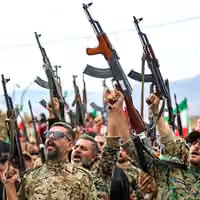
Three masked Iran-backed Hamas militants carrying assault rifles stand beneath a Palestinian flag.

Three years after Hamas's October 7 attack on Israel, the Islamic Republic faces a weakened network of regional allies, direct military confrontation and mounting economic pressure, upending its long-held strategy of deterring enemies while keeping war away from its territory.

"Don't ask when Iran will enter Gaza. Ask when it will leave," Hossein Shariatmadari, editor-in-chief of the hardline Kayhan newspaper, said a few weeks after the October 2023 attack.

The remark captured a contradiction in Tehran's approach. Iranian officials denied directing the Hamas operation while celebrating its consequences and presenting the so-called axis of resistance as evidence of the Islamic Republic's growing regional influence.

“Axis of Resistance” is the term Tehran uses for a network of Iran-backed groups in the region, including Palestinian militant groups, Lebanon’s Hezbollah, Iraqi militias and the Houthis in Yemen.

  • Hardline media admits losses after Assad’s fall in Syria

    Hardline media admits losses after Assad’s fall in Syria

The calculation rested on two assumptions: that time favored Iran and that its network of allied armed groups could simultaneously pressure Israel and shield Tehran from direct confrontation.

Three years later, both assumptions have been tested by wars that have weakened Iran's regional allies and brought military confrontation onto Iranian territory.

Celebrating an attack while denying responsibility

On October 10, 2023, then-Supreme Leader Ali Khamenei praised the Palestinian fighters behind the Hamas operation while denying Iranian involvement in planning it.

The distinction was deliberate. Tehran sought to benefit politically from the operation without assuming direct responsibility or risking a wider war with Israel and the United States.

Former Iranian vice president Mohammad Bagher Nobakht warned officials against remarks suggesting Iran had directly orchestrated the attack. Meanwhile, figures within the establishment argued that Hamas's weapons, tactics and organization would inevitably be associated with Iranian support.

The competing messages reflected a broader strategic dilemma: Tehran wanted its regional allies to appear powerful enough to deter its adversaries, but sufficiently independent to insulate Iran from retaliation.

Hossein Salami, then commander of the Revolutionary Guards, described the Hamas operation as Israel's greatest defeat since its establishment.

Iranian officials and military figures portrayed the attack as evidence of a shifting regional balance of power and declining US and Israeli influence.

  • Inside Iran’s Rhetoric On Hamas War On Israel

    Inside Iran’s Rhetoric On Hamas War On Israel

The underlying expectation was that Israel would struggle to sustain a prolonged conflict across multiple fronts, eventually strengthening Iran's position without requiring direct Iranian military intervention.

The regional shield breaks down

For decades, the Islamic Republic invested in a network of armed allies, including Hezbollah in Lebanon, Hamas in Gaza, Iraqi militias and the Houthis in Yemen.

These groups provided Tehran with influence beyond its borders and the ability to impose military costs on adversaries without committing Iranian forces directly.

But the wars following October 7 exposed the limitations of that arrangement.

The collapse of Bashar al-Assad's government in Syria deprived Iran of a central regional ally and a critical link in its network of influence.

Hezbollah suffered major military losses, including the killing of its leader Hassan Nasrallah, while Hamas and other Iran-aligned groups faced mounting military and political pressure.

The weakening of these allies preceded direct confrontation between Iran and Israel.

During the 12-day war, Israeli strikes damaged Iran's air defenses and killed senior military commanders, including figures who had spent years developing the Islamic Republic's regional network.

  • Iran replaces air defense commander in charge during June war

    Iran replaces air defense commander in charge during June war

The subsequent 40-day war exposed further weaknesses. The United States and Israel killed Iran's Supreme Leader Ali Khamenei at the outset of the conflict, while Hezbollah entered the fighting against Israel.

The Houthis later launched ballistic missiles toward Israel, and Iraqi militias targeted American positions in Iraq.

Although these operations imposed costs, they failed to prevent continued military action against Iran and its allies.

Fighting in southern Lebanon continued even after Tehran presented the cessation of hostilities as covering multiple fronts, underscoring its limited ability to protect regional partners.

  • Fall of Hezbollah heights ignites blame game in Tehran

    Fall of Hezbollah heights ignites blame game in Tehran

The network once intended to keep war away from Iranian territory had become increasingly unable to perform that function.

From regional proxies to strategic waterways

With its regional military network weakened, Tehran increasingly turned to geography as an instrument of pressure.

The Strait of Hormuz, a vital passage for global energy shipments, became central to Iran's efforts to raise the economic cost of military confrontation.

By restricting maritime traffic, the Islamic Republic sought to exert pressure not only on its immediate adversaries but also on Persian Gulf countries and the wider international economy.

  • Yemen takes Syria’s place in Iran’s security doctrine, says former commander

    Yemen takes Syria’s place in Iran’s security doctrine, says former commander

Tehran also looked toward the Houthis and their ability to threaten shipping through the Bab al-Mandab Strait, another critical maritime chokepoint connecting the Red Sea to international trade routes.

The strategy marked a shift from relying primarily on allied armed groups to using disruption of international commerce as leverage.

Yet it carried significant limitations.

Economic pressure on global markets did not necessarily translate into military deterrence against adversaries already prepared for confrontation.

At the same time, restrictions on shipping and the resulting increases in transportation costs placed additional pressure on Iran's own economy.

The Islamic Republic was therefore attempting to use economic disruption as a strategic weapon while facing increasingly severe economic constraints itself.

The cost of a strategy built on time

One assumption has remained remarkably consistent since October 2023: that prolonged confrontation will ultimately work in Iran's favor.

Tehran's strategy continues to depend on the belief that economic pressure on Persian Gulf states, disruption to global markets and the cost of sustained American military involvement will eventually strengthen its negotiating position.

But the conditions under which that calculation operates have changed substantially.

Iran now faces US pressure extending across maritime, air and land routes, alongside the consequences of war and the erosion of its regional military partnerships.

The pressure has exposed a contradiction in Tehran's strategy. Measures intended to raise the cost of confronting Iran have also increased the economic burden on the country itself.

  • Iran bears biggest economic cost of Hormuz closure

    Iran bears biggest economic cost of Hormuz closure

In 2023, the Islamic Republic sought to use the strength of its allies to force concessions from its adversaries while avoiding direct war.

Three years later, it is attempting to preserve its regional influence with fewer military buffers, a weakened economy and greater reliance on the strategic importance of Hormuz and Bab al-Mandab.

  • From Hormuz to Bab el-Mandeb, conflict converges on vital shipping lanes

    From Hormuz to Bab el-Mandeb, conflict converges on vital shipping lanes

The central question is no longer whether Iran's allies can exhaust Israel through prolonged confrontation, but whether Tehran can construct a credible form of deterrence after the weakening of the regional network on which its strategy depended.

The Islamic Republic entered the post-October 7 period expecting time and geography to strengthen its hand. Three years later, it must determine whether those same instruments can compensate for the military and economic costs of its original calculation.

Police officer killed in armed attack near Zahedan as violence continues in southeast Iran

Oct 8, 2026, 09:28 GMT+1
100%

An Iranian police officer was killed on Thursday when gunmen attacked a patrol near Zahedan in Sistan-Baluchestan, the latest in a series of deadly attacks and clashes involving security forces in southeastern Iran.

Zahedan governor Jamshid Rakhshani-Nasab said a vehicle belonging to a police commando unit came under fire in the Nosratabad area and that officers returned fire.

Sistan-Baluchestan police said the patrol was attacked on the main road in the Lakhshak area while carrying out a security mission. The officer killed was identified as Vahid Enayat.

Police said several attackers were wounded and fled the scene. Security forces were searching the area for those responsible, according to the statement.

Army minibus attacked on Makran coast

In a separate incident on Thursday, gunmen attacked a minibus carrying personnel from the Iranian Army’s 88th Armored Division stationed along the Makran coast, Mehr news agency reported.

The division said the personnel were traveling for a shift change when the vehicle came under fire. One person, identified as Mohammadreza Okati, was killed and three others were wounded.

Series of attacks in Sistan-Baluchestan

No group immediately took responsibility for Thursday’s attack.

The incident came three days after gunmen attacked two military vehicles in Bampur, also in Sistan-Baluchestan. Rights group Haalvsh reported at least three people killed in that attack, while Iranian state media reported lower casualty figures.

Last week, another roadside attack near Zahedan killed several people, according to differing accounts from Iranian authorities and Haalvsh. The IRGC confirmed that one of its fighters was killed in a bombing, while Haalvsh reported a higher toll and said those killed were members of the Iran-backed Fatemiyoun militia.

Repeated clashes in the southeast

The province has also seen recent fighting in Rask, Saravan and other areas, including attacks on police positions and security facilities.

Iranian authorities regularly describe armed groups operating in Sistan-Baluchestan as terrorist organizations. The province has seen repeated armed attacks, insurgent activity and clashes between security forces and gunmen in recent weeks.