• العربية
  • فارسی
BrandBrand
  • Iran Insight
  • Politics
  • Economy
  • Analysis
  • Special Report
  • Opinion
  • Podcast
  • Live TV
  • Iran Insight
  • Politics
  • Economy
  • Analysis
  • Special Report
  • Opinion
  • Podcast
  • Live TV
  • Theme
  • Language
    • العربية
    • فارسی
  • Iran Insight
  • Politics
  • Economy
  • Analysis
  • Special Report
  • Opinion
  • Podcast
  • Live TV
All rights reserved for Volant Media UK Limited
volant media logo

Iran lawmaker says conflicting US statements may aim to disrupt Tehran’s calculations

Oct 10, 2026, 07:08 GMT+1

An Iranian lawmaker referred to what he called “contradictory statements” by US officials about Iran, saying they could reflect internal disagreements or be part of an effort to disrupt Tehran’s calculations.

“These contradictions may be part of a strategy to disrupt Iranian officials’ calculations,” Abbas Goudarzi said.

The member of parliament’s presiding board also said Iran should strengthen its defensive deterrence to prevent its enemies from attacking the country.

He also said that the era of “hit and run” attacks is over, and any strike against Iran will be met with a response several times stronger.

Most Viewed

Iran turns on Pakistan as Saudi defense pact takes effect
1

Iran turns on Pakistan as Saudi defense pact takes effect

2

Iranian security forces face wave of deadly attacks in restive southeast

3
VOICES FROM IRAN

Iran's reported $200 million Hezbollah aid angers cash-strapped citizens

4
ANALYSIS

Three years after October 7, Iran pays the price of miscalculation

5

Trump rules out Iran attack before midterms, Tehran says ready for prolonged war

Banner
Banner

Spotlight

  • 'Three golden weeks': Trump’s no-strike pledge fuels calls in Iran to act first

    'Three golden weeks': Trump’s no-strike pledge fuels calls in Iran to act first

  • J’Accuse! Tehran defends French students, silences Iranian youth
    OPINION

    J’Accuse! Tehran defends French students, silences Iranian youth

  • US pressure hits Iranians harder than rulers, 68% in poll say
    VOICES FROM IRAN

    US pressure hits Iranians harder than rulers, 68% in poll say

  • Saudi Aramco hires US firm to upgrade shared oil field as Iran lags behind

    Saudi Aramco hires US firm to upgrade shared oil field as Iran lags behind

  • Iran looks for escape routes as US sanctions close in
    INSIGHT

    Iran looks for escape routes as US sanctions close in

  • China shifts to Iraqi oil: is Iran using old workaround to beat US blockade?
    ANALYSIS

    China shifts to Iraqi oil: is Iran using old workaround to beat US blockade?

Banner
Banner
•
•
•

More Stories

Bessent outlines US plan to cut off Iran’s remaining economic lifelines

Oct 10, 2026, 03:11 GMT+1
100%
US Treasury Secretary Scott Bessent speaks to the media after meeting China's Vice Premier He Lifeng, ahead of a summit between US President Donald Trump and Chinese President Xi Jinping, at JPMorgan Chase's global corporate headquarters in New York City, US, September 20, 2026. REUTERS/Vincent Alban

The United States is expanding its economic campaign against Iran beyond oil exports and financial sanctions, targeting Tehran’s overland trade routes, Iran-linked cryptocurrency and remaining shipping network, Treasury Secretary Scott Bessent said this week.

Bessent has pointed to Iran’s oil exports and the rial’s record lows as evidence the campaign is taking effect. On Monday, he said Iran had loaded no crude oil onto tankers in September.

A day later, he used the issue to question the appointment of Hamid Bovard as Iran’s acting oil minister, asking what he would oversee when, according to Bessent, Iran had not loaded crude onto a vessel since August 25.

The campaign has meanwhile expanded beyond seaborne oil exports. Speaking to Newsmax on Thursday, Bessent described the United Arab Emirates and Oman as partners in the effort and said Washington was working with Pakistan and Turkey to cut off Iran’s overland routes.

“We did have a maximum pressure campaign. Now we have an absolute isolation campaign and it’s working,” Bessent said.

That effort also extends to cryptocurrency. Bessent said the United States would “probably” seize about $1 billion in Iran-linked digital assets this week.

“We’re probably gonna seize a billion dollars of crypto this week,” he said. “We know where it is and we are isolating them.”
Closing Iran’s remaining economic routes

The widening campaign was reflected in a new round of Treasury sanctions Thursday targeting 17 vessels and their owners in what Washington describes as Iran’s remaining shadow fleet.

Treasury said the vessels had transported millions of barrels of Iranian crude oil, petroleum products and petrochemicals to markets in South and East Asia. It said the action effectively neutralized the vast majority of Iran’s remaining shadow fleet network.

The measures are the latest action under Operation Economic Outcast, launched on August 24 and dubbed Economic D-Day. The campaign initially increased sanctions exposure across Iran’s digital asset, technology, gold, aviation and shipping sectors before Washington widened it on October 1 to the automotive and rail industries.

Bessent has portrayed the effort as targeting not only Iran’s sources of revenue but also the ability of Iranian officials to access wealth and services abroad.

“They can’t go see their plastic surgeon in London, their girlfriend in Paris, and their money in Geneva,” he told Newsmax.

The campaign has coincided with a sharp decline in Iran’s currency, which traded near 2.7 million rials to the dollar this week despite efforts by the central bank to support it.

Bessent has said the ultimate objective is to force Tehran to choose between reintegration into the global economy and what he called “complete global isolation and a subsistence economy.”

Iran-linked actors used US AI for fake journalism, military targeting

Oct 10, 2026, 00:30 GMT+1
100%
Social media accounts for the “Ervin B. Hoskins” fake journalist persona, which OpenAI said was used in an Iran-origin influence operation to place articles in online media outlets. (OpenAI)

Iran-based and Iranian-linked actors have used two leading US artificial intelligence platforms to place articles under fake journalist identities and help develop targeting recommendations against US naval forces, according to separate investigations by OpenAI and Anthropic.

The latest disclosure came Thursday, when OpenAI said it disrupted an Iran-origin influence operation that used ChatGPT to help fake journalist personas place almost 100 articles in roughly a dozen online outlets around the world.

OpenAI dubbed the campaign “Bogus Bylines.”

The operators used seven fake journalist identities to pitch English-language articles, primarily about the US-Iran conflict. ChatGPT was used to refine drafts according to outlets’ submission requirements and prepare emails pitching them to editors.

The personas presented themselves as Western journalists, usually Americans. One, Ervin B. Hoskins, described himself as an “American freelance writer” and maintained accounts on X, Facebook, Instagram and Threads.

But OpenAI said platform transparency information showed the accounts were operated from Iran.

OpenAI identified articles under the operation’s bylines dating from July 2025 through October 2026 and said publication increased significantly after the US-Iran conflict began.

Some outlets subsequently promoted the articles through their own social media accounts, potentially exposing the material to audiences the operators could not otherwise reach.

The operators also used ChatGPT to produce batches of social media comments. Some were generated in response to posts promoting their own articles and praised or endorsed the stories, which OpenAI assessed was likely intended to make them appear more popular.

Other prompts requested comments portraying the United States as the aggressor in the conflict, Israel as an unreliable US ally and Iran as a defiant but resilient victim.

The operation generated more than two dozen batches of hostile Persian-language responses to posts by Iran International.

OpenAI said the replies it found generally received low engagement and rated that component Category 2 on its six-level IO Breakout Scale. The article-placement campaign was more successful, reaching Category 4 after repeatedly getting material published by media outlets.

OpenAI said the overall activity was consistent with a commercial actor running an influence campaign for hire but said it could not identify the actor behind it.

From influence to military targeting

The OpenAI findings follow a September report from Anthropic documenting Iranian-linked use of Claude for activities extending beyond influence operations.

Anthropic said it disrupted an “Iran-nexus threat actor” that used Claude to collect and analyze publicly available information to develop targeting recommendations against US naval forces in the region.

The actor used Claude to help construct a Python pipeline for tracking naval positions and compiling targeting handbooks.

The material included US personnel identified from captions on publicly available military photographs, ship and aircraft transponder identifiers, scripts for querying commercial satellite imagery and lists of public websites exposing US naval movements.

The actor also directed Claude to research vulnerabilities in shipboard systems, including maritime satellite communications terminals, Cisco communications equipment and industrial control products.

OpenAI and Anthropic have documented misuse by actors linked to several countries, including for cyber operations, influence campaigns and intelligence gathering, suggesting generative AI is increasingly being incorporated into activities that long predate the technology.

OpenAI concluded that the influence operations it uncovered resembled campaigns from the pre-AI era, with artificial intelligence making parts of the workflow easier.

The two investigations suggest AI is being used less to invent entirely new forms of influence and intelligence activity than to accelerate existing ones: drafting and pitching articles, manufacturing online responses, processing surveillance data, writing software and assembling open-source military intelligence.

'Three golden weeks': Trump’s no-strike pledge fuels calls in Iran to act first

Oct 9, 2026, 21:51 GMT+1
•
Maryam Sinaiee
100%
US President Donald Trump delivers remarks during a Columbus Day celebration in the East Room of the White House in Washington, D.C., US, October 9, 2026.

President Donald Trump’s pledge not to attack Iran before the November 3 US midterm elections has been greeted in Tehran as either a bluff or an opportunity, with some hardliners urging Iran to exploit the three-week window to strike first.

Trump wrote on Truth Social on Thursday that he had no intention of resuming strikes before the midterms, adding that the United States was engaged in “constructive negotiations” with Iran.

Global oil prices, which had fluctuated sharply during the week amid growing threats to shipping in the Persian Gulf and the Strait of Hormuz, fell following Trump’s remarks.

Heshmatollah Falahatpisheh, a former chairman of parliament’s National Security and Foreign Policy Committee, wrote on X that plans by the United States, Israel and their regional allies for another war with Iran had nothing to do with elections in either country.

He argued that Trump’s declaration that Washington would not attack Iran before November 3 was intended to prevent Iran from launching a “pre-emptive strike”.

Parisa Nasr, a journalist considered close to Iran’s Foreign Ministry, similarly dismissed Trump’s statement in a commentary titled “Forget Trump’s nonsense: A third war is imminent.”

“The evidence suggests that Trump’s claim that any military attack on Iran will be postponed until after the US midterm elections is, above all, more like a political game and a psychological operation,” she wrote.

Nasr argued that Washington’s calculations would depend largely on the scale of retaliation it expected from Iran.

Hardline commentator Alireza Taghaviniya also described Trump’s remarks as “deception,” pointing to US and Israeli military movements and coordination with Saudi Arabia and the United Arab Emirates as indications that a confrontation was approaching.

A window to strike first

Some Iranian hardliners argue that Tehran should use the period before the US midterm elections to launch pre-emptive attacks against American and Israeli interests.

Supporters of this approach say the objective would not necessarily be to trigger an all-out war. Instead, limited strikes could put pressure on oil markets and force Trump to accept an agreement on terms favorable to Iran.

Politician Abdolreza Davari argued on X that Trump had inadvertently exposed a weakness by ruling out a new military attack before the elections while simultaneously describing negotiations with Tehran as constructive. Davari said Trump feared the electoral cost of war.

“From today until November 3, a window of approximately three weeks has opened before Iran,” he wrote. “The Islamic Republic must use this opportunity to intensify military action as a means of bargaining and forcing Washington to accept Iran’s legitimate demands.”

In another post, he was blunter: “Grab the enemy by the throat right now and do not let go.”

The proposal drew warnings online that striking first would play into the hands of Trump and Israel.

A user identified as Mahmoud Irani argued that an Iranian attack would allow Trump to portray the United States as the victim and gain electoral advantage by retaliating: “Iran should maintain its military readiness so that, if Iran is attacked, it can counterattack Trump.”

Another user, identified as Rezvan, warned that Israeli Prime Minister Benjamin Netanyahu had been predicting an Iranian pre-emptive attack for weeks and “hopes this will happen,” either to postpone the US election or help Trump win.

Pressure at Hormuz

The debate comes as Iran is already increasing pressure in and around the Strait of Hormuz.

Iranian officials and military forces insist the waterway remains closed except to vessels Tehran authorizes, contrary to statements by Trump and other US officials, and say restrictions will remain until Washington accepts Iran’s seven conditions.

Hassan Ghashghavi, spokesman for parliament’s National Security and Foreign Policy Committee, also disputed Trump’s claim that oil shipments through the strait had increased.

“The initiative in the Strait of Hormuz is in our hands,” he told Rouydad 24, arguing that alternative routes and limited tanker movements had failed to eliminate the effects of Iran’s restrictions.

On Friday, the Islamic Revolutionary Guard Corps (IRGC) Navy said it targeted a liquefied natural gas carrier traveling south of the Strait of Hormuz along what Tehran described as an “illegal route”.

The Guards also widened their threat, saying for the first time that action against vessels using unauthorized routes would no longer be confined to the strait and that such ships could face punitive measures elsewhere in the region.

Pressure on shipping gives Tehran another means of raising the cost of the blockade without necessarily launching the direct pre-emptive strike advocated by some hardliners.

Iran executed over 2,000 people in past year, rights group says

Oct 9, 2026, 20:04 GMT+1
100%

Iran executed at least 2,003 people over the past year, a 29% increase from the previous period, rights group HRANA reported Friday, as UN experts warned that Tehran uses capital punishment to silence dissent and instill fear.

The report was released on October 9, on the eve of World Day Against the Death Penalty. Its figures cover October 10, 2025, through October 8, 2026.

The toll was the highest in 10 reporting periods, up from 1,553 the preceding year and 505 in 2016–2017. HRANA compiled its findings from 1,857 reports and said restrictions on independent monitoring may leave some executions undocumented.

According to HRANA, murder charges accounted for 57.56% of executions and drug offenses for 36.25%. About 95% of executions were not announced by official sources, while only 5% were officially reported.

Nine executions took place in public, while six other people received sentences calling for public executions. Among those executed were 47 women and four people who had been under 18 at the time of their alleged offenses.

Political executions and January protests

HRANA documented 69 political or security-related executions during the reporting period, including 35 cases linked to the January 2026 protests. Twenty-nine people were executed on charges of moharebeh, or enmity against God, alone or alongside other accusations.

Another 29 political or security-related executions occurred in April and May 2026 alone.

HRANA also documented 369 televised confessions connected to the January protests that it said had been extracted under torture. It cited the cases of Amirhossein Hatami, executed at 18, and Saleh Mohammadi, charged at 18 and executed at 19.

A separate Iran International review published on October 6 identified at least 70 executions in political and security cases between January 7 and October 5, averaging nearly two a week.

  • Iran executes nearly two people a week since January protests

    Iran executes nearly two people a week since January protests

Of those, 35 were linked to the January protests, nine to the 12-day and 40-day wars, and 26 to other political and security cases.

The review also identified at least 194 people facing death sentences in political and security cases, including 113 arrested in connection with the January protests. Among those facing execution were 13 women and at least seven people who were under 18 at the time of their alleged offenses.

The review found that 44 of the 70 executions had taken place in Karaj and Isfahan. It cautioned that the figures represented verified cases rather than the full scale of executions and death sentences.

In an accompanying statement, HRANA said judicial authorities and Revolutionary Courts accelerated proceedings against political prisoners and protesters following the January demonstrations.

The group said death sentences were issued and carried out after grossly unfair trials, extending repression from the streets into courtrooms and prisons and threatening protesters with death.

HRANA's monthly figures show 1,075 executions since the start of 2026, including 334 in January and 282 in February.

UN experts warn of repression

UN human rights experts on Friday described Iran as the world's most prolific executioner per capita and called for an immediate halt to executions.

“Iran’s death penalty is used to silence dissent, with broadly defined national security offences recasting peaceful activity as a threat,” the experts said.

They warned that prosecutions of people arrested during the January 2026 protests involved torture, enforced disappearances, sexual violence, coerced confessions and denial of access to lawyers.

A UN fact-finding mission previously concluded that the killing of thousands of protesters in January amounted to crimes against humanity.

The UN experts also said executions for drug offenses often targeted low-level couriers from impoverished and marginalized communities. They criticized Iran's qisas system, under which a defendant's ability to pay blood money can determine whether a death sentence is carried out.

HRANA said executions following unfair trials violated Article 6 of the International Covenant on Civil and Political Rights and called for an immediate halt. The UN experts also urged Tehran to commute death sentences and review cases against fair-trial standards.

J’Accuse! Tehran defends French students, silences Iranian youth

Oct 9, 2026, 18:07 GMT+1
•
Clément Therme
100%
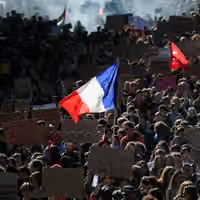
The French flag is hoisted during protests in Nantes, October 8, 2026.

Tehran has seized on protests by French high school students to accuse Paris of repression, seeking to obscure its own treatment of young Iranians by turning the language of human rights against one of its Western critics.

On October 6, Iran summoned French ambassador Pierre Cochard over the crackdown on high school demonstrations in France. The following day, Paris summoned Iran’s ambassador, accusing Iranian authorities of spreading disinformation through official Foreign Ministry accounts.

The diplomatic exchange reveals how the Islamic Republic appropriates the language of rights while denying those rights at home. It is also a struggle over the meaning of protest and who can claim to defend it.

Tehran seeks to reposition itself as an accuser, turning scrutiny away from its own security apparatus and toward a government that has condemned Iranian repression.

Internationally, Tehran seeks to weaken the authority of European criticism. Domestically, the diplomatic spat offers supporters reassurance that Western governments also face rejection. Neither objective requires solidarity with the students themselves; both require their images and grievances to be repurposed in defense of the regime.

This tactic has precedent. During the Yellow Vest movement, Ali Khamenei condemned French police violence, while a small group of regime supporters gathered outside the French embassy in Tehran.

Some wore yellow vests and placed candles and photographs of injured French protesters outside the embassy. Their placards denounced police violence but also carried an explicitly ideological message: “If only the French people had an Imam Khomeini!”

A statement read at the gathering invoked France’s reception of Khomeini at Neauphle-le-Château forty years earlier and portrayed Emmanuel Macron’s government as cruel and despotic.

At the same time, Iranian authorities were cracking down on protests by pensioners, workers, teachers and students. Then, as now, the tactic allowed Tehran to answer criticism of its own repression by accusing its critics of hypocrisy. Human rights become an arena for diplomatic one-upmanship rather than obligations owed to citizens.

France’s conduct must, of course, be scrutinized on its own merits. Injuries to demonstrators, particularly minors, demand independent investigation and accountability. But the evidence concerning Iran is substantial.

In March 2024, the UN Independent International Fact-Finding Mission concluded that violations committed during the repression of “Woman, Life, Freedom” included crimes against humanity.

Its findings encompassed murder, imprisonment, torture, rape and other sexual violence, persecution and enforced disappearance. The mission documented the involvement of state institutions and security forces, undermining attempts to portray the violence as a series of isolated excesses.

On September 17, 2026, the same mission reported that Iranian authorities had also committed crimes against humanity during the crackdown on protests that began in late December 2025 and continued into January.

Generation Z played a crucial role in “Woman, Life, Freedom” following Mahsa Amini’s death in September 2022. Schoolgirls removing their headscarves, teenagers challenging clerical authority and young women demanding control over their bodies exposed the limits of decades of ideological education.

The state had sought to reproduce loyalty. Instead, many young people asserted their right to determine how they would live.

Young Iranians mobilized again in the protests that began in late 2025, bringing another generation raised entirely under the Islamic Republic into confrontation with the state. Their rejection of its prescribed norms challenges the assumption that political control necessarily produces ideological consent.

The authorities’ response combines repression with continued recruitment into structures of loyalty. The Basij, under Revolutionary Guards command, provides a network for ideological discipline and security mobilization.

Human Rights Watch and Amnesty International have reported that an IRGC recruitment campaign accepts children as young as twelve, with Amnesty documenting children carrying weapons and serving at checkpoints and on patrols.

This goes beyond patriotic rhetoric: it places children directly in harm’s way. The state invokes the protection of young people abroad while drawing children into its military apparatus at home.

Yet Iranian youth cannot be divided neatly between those who serve the regime and those who confront it. Many seek simply to build lives apart from official Iran. Their resistance is not limited to protest: it also finds expression in everyday acts—choosing what to wear, loving, dancing, listening to music, nurturing friendships and keeping parts of their lives beyond the authorities’ control.

This has produced a form of what might be called “secular separatism”: an attempt to shield personal life from the regime’s ideological grip.

Within social, cultural and emotional circles, and spaces of celebration, another, fragile society is taking shape, though access to it inevitably varies with resources and social background.

Joy itself can become a way of asserting autonomy. Under a regime that glorifies martyrdom and encourages citizens to denounce one another, the simple acts of enjoying life and pursuing happiness acquire political meaning.

Tehran claims to speak for French high school students. It should begin by listening to young Iranians who aspire to build their own lives.