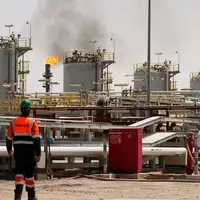
Iran holds talks on preparedness for nuclear emergencies, crisis chief says


Meetings have been held with the Atomic Energy Organization of Iran on preparedness for nuclear emergencies, the Crisis Management Organization chief said on Saturday.
Hossein Sajedinia said the agency was ready to help carry out necessary measures and organize preparedness exercises if needed, adding that Iran had capable personnel and technology.
He also said the Tehran municipality had installed kiosks around the city equipped with sirens for wartime alerts but added that he did not know whether they worked effectively.
Sajedinia said authorities had warned before missile strikes in recent wars that oil depots in Tehran’s Shahran district and on Artesh Boulevard should be relocated, and submitted recommendations in writing after the attacks.
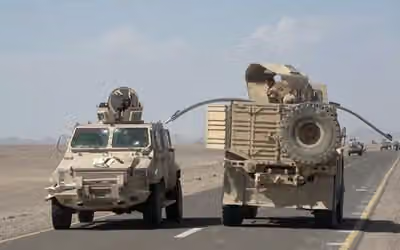


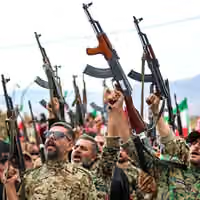

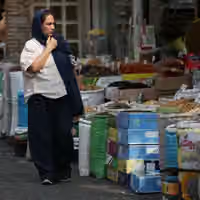

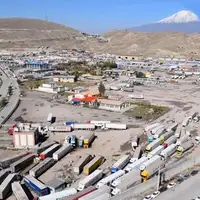
Iran is seeking more electricity from Turkey and Turkmenistan as war damage and other outages leave thousands of megawatts of industrial and petrochemical power capacity offline, even as Washington presses neighboring countries to help restrict Tehran’s remaining economic routes.
Mohammad Allahdad, head of Iran’s electricity company Tavanir, told ILNA that about 4,700 megawatts of generation capacity belonging to industries and petrochemical companies had gone offline for various reasons.
He said the infrastructure was now in place for petrochemical plants to receive imported electricity from Turkey through Iran’s national grid. The companies have not yet signed contracts for the supply.
“If this does not happen, supplying electricity to these industries will face challenges,” Allahdad said.
War damage drives import push
Allahdad said serious damage during the war to utilities serving petrochemical complexes had sharply increased their dependence on the national grid. Iran supplied the sector with six times as much electricity this summer as in previous years, he said.
He added that Iran currently had no plans to export electricity and was instead focused on increasing imports, particularly during the winter.
Iran is also negotiating with Turkmenistan to extend an existing electricity import agreement and increase the volume of power exchanged between the two countries, according to a government statement.
Officials have also discussed additional cross-border power lines and the possible transit of electricity through Turkmenistan to third countries, though those proposals remain subject to technical and economic studies.
US seeks to close remaining economic routes
The push for additional electricity imports comes as the United States broadens its economic campaign against Iran beyond oil exports and financial sanctions.
US Treasury Secretary Scott Bessent said this week Washington was working with Turkey and Pakistan to restrict Iran’s overland commercial routes, while describing the United Arab Emirates and Oman as partners in the broader pressure campaign.
“We did have a maximum pressure campaign. Now we have an absolute isolation campaign and it’s working,” Bessent told Newsmax.
Bessent has also said Washington is targeting Iran-linked cryptocurrency and its remaining shipping network. Treasury on Thursday sanctioned 17 vessels and their owners, saying they were part of what remained of Iran’s shadow fleet, while Bessent said the US could seize about $1 billion in Iran-linked digital assets.
The overlap puts Turkey in an unusual position, with Tehran seeking greater electricity supplies from its western neighbor while Washington says Ankara is also cooperating in efforts to constrict Iran’s remaining overland economic links.
The United States is expanding its economic campaign against Iran beyond oil exports and financial sanctions, targeting Tehran’s overland trade routes, Iran-linked cryptocurrency and remaining shipping network, Treasury Secretary Scott Bessent said this week.
Bessent has pointed to Iran’s oil exports and the rial’s record lows as evidence the campaign is taking effect. On Monday, he said Iran had loaded no crude oil onto tankers in September.
A day later, he used the issue to question the appointment of Hamid Bovard as Iran’s acting oil minister, asking what he would oversee when, according to Bessent, Iran had not loaded crude onto a vessel since August 25.
The campaign has meanwhile expanded beyond seaborne oil exports. Speaking to Newsmax on Thursday, Bessent described the United Arab Emirates and Oman as partners in the effort and said Washington was working with Pakistan and Turkey to cut off Iran’s overland routes.
“We did have a maximum pressure campaign. Now we have an absolute isolation campaign and it’s working,” Bessent said.
That effort also extends to cryptocurrency. Bessent said the United States would “probably” seize about $1 billion in Iran-linked digital assets this week.
“We’re probably gonna seize a billion dollars of crypto this week,” he said. “We know where it is and we are isolating them.”
Closing Iran’s remaining economic routes
The widening campaign was reflected in a new round of Treasury sanctions Thursday targeting 17 vessels and their owners in what Washington describes as Iran’s remaining shadow fleet.
Treasury said the vessels had transported millions of barrels of Iranian crude oil, petroleum products and petrochemicals to markets in South and East Asia. It said the action effectively neutralized the vast majority of Iran’s remaining shadow fleet network.
The measures are the latest action under Operation Economic Outcast, launched on August 24 and dubbed Economic D-Day. The campaign initially increased sanctions exposure across Iran’s digital asset, technology, gold, aviation and shipping sectors before Washington widened it on October 1 to the automotive and rail industries.
Bessent has portrayed the effort as targeting not only Iran’s sources of revenue but also the ability of Iranian officials to access wealth and services abroad.
“They can’t go see their plastic surgeon in London, their girlfriend in Paris, and their money in Geneva,” he told Newsmax.
The campaign has coincided with a sharp decline in Iran’s currency, which traded near 2.7 million rials to the dollar this week despite efforts by the central bank to support it.
Bessent has said the ultimate objective is to force Tehran to choose between reintegration into the global economy and what he called “complete global isolation and a subsistence economy.”
Iran-based and Iranian-linked actors have used two leading US artificial intelligence platforms to place articles under fake journalist identities and help develop targeting recommendations against US naval forces, according to separate investigations by OpenAI and Anthropic.
The latest disclosure came Thursday, when OpenAI said it disrupted an Iran-origin influence operation that used ChatGPT to help fake journalist personas place almost 100 articles in roughly a dozen online outlets around the world.
OpenAI dubbed the campaign “Bogus Bylines.”
The operators used seven fake journalist identities to pitch English-language articles, primarily about the US-Iran conflict. ChatGPT was used to refine drafts according to outlets’ submission requirements and prepare emails pitching them to editors.
The personas presented themselves as Western journalists, usually Americans. One, Ervin B. Hoskins, described himself as an “American freelance writer” and maintained accounts on X, Facebook, Instagram and Threads.
But OpenAI said platform transparency information showed the accounts were operated from Iran.
OpenAI identified articles under the operation’s bylines dating from July 2025 through October 2026 and said publication increased significantly after the US-Iran conflict began.
Some outlets subsequently promoted the articles through their own social media accounts, potentially exposing the material to audiences the operators could not otherwise reach.
The operators also used ChatGPT to produce batches of social media comments. Some were generated in response to posts promoting their own articles and praised or endorsed the stories, which OpenAI assessed was likely intended to make them appear more popular.
Other prompts requested comments portraying the United States as the aggressor in the conflict, Israel as an unreliable US ally and Iran as a defiant but resilient victim.
The operation generated more than two dozen batches of hostile Persian-language responses to posts by Iran International.
OpenAI said the replies it found generally received low engagement and rated that component Category 2 on its six-level IO Breakout Scale. The article-placement campaign was more successful, reaching Category 4 after repeatedly getting material published by media outlets.
OpenAI said the overall activity was consistent with a commercial actor running an influence campaign for hire but said it could not identify the actor behind it.
From influence to military targeting
The OpenAI findings follow a September report from Anthropic documenting Iranian-linked use of Claude for activities extending beyond influence operations.
Anthropic said it disrupted an “Iran-nexus threat actor” that used Claude to collect and analyze publicly available information to develop targeting recommendations against US naval forces in the region.
The actor used Claude to help construct a Python pipeline for tracking naval positions and compiling targeting handbooks.
The material included US personnel identified from captions on publicly available military photographs, ship and aircraft transponder identifiers, scripts for querying commercial satellite imagery and lists of public websites exposing US naval movements.
The actor also directed Claude to research vulnerabilities in shipboard systems, including maritime satellite communications terminals, Cisco communications equipment and industrial control products.
OpenAI and Anthropic have documented misuse by actors linked to several countries, including for cyber operations, influence campaigns and intelligence gathering, suggesting generative AI is increasingly being incorporated into activities that long predate the technology.
OpenAI concluded that the influence operations it uncovered resembled campaigns from the pre-AI era, with artificial intelligence making parts of the workflow easier.
The two investigations suggest AI is being used less to invent entirely new forms of influence and intelligence activity than to accelerate existing ones: drafting and pitching articles, manufacturing online responses, processing surveillance data, writing software and assembling open-source military intelligence.
President Donald Trump’s pledge not to attack Iran before the November 3 US midterm elections has been greeted in Tehran as either a bluff or an opportunity, with some hardliners urging Iran to exploit the three-week window to strike first.
Trump wrote on Truth Social on Thursday that he had no intention of resuming strikes before the midterms, adding that the United States was engaged in “constructive negotiations” with Iran.
Global oil prices, which had fluctuated sharply during the week amid growing threats to shipping in the Persian Gulf and the Strait of Hormuz, fell following Trump’s remarks.
Heshmatollah Falahatpisheh, a former chairman of parliament’s National Security and Foreign Policy Committee, wrote on X that plans by the United States, Israel and their regional allies for another war with Iran had nothing to do with elections in either country.
He argued that Trump’s declaration that Washington would not attack Iran before November 3 was intended to prevent Iran from launching a “pre-emptive strike”.
Parisa Nasr, a journalist considered close to Iran’s Foreign Ministry, similarly dismissed Trump’s statement in a commentary titled “Forget Trump’s nonsense: A third war is imminent.”
“The evidence suggests that Trump’s claim that any military attack on Iran will be postponed until after the US midterm elections is, above all, more like a political game and a psychological operation,” she wrote.
Nasr argued that Washington’s calculations would depend largely on the scale of retaliation it expected from Iran.
Hardline commentator Alireza Taghaviniya also described Trump’s remarks as “deception,” pointing to US and Israeli military movements and coordination with Saudi Arabia and the United Arab Emirates as indications that a confrontation was approaching.
A window to strike first
Some Iranian hardliners argue that Tehran should use the period before the US midterm elections to launch pre-emptive attacks against American and Israeli interests.
Supporters of this approach say the objective would not necessarily be to trigger an all-out war. Instead, limited strikes could put pressure on oil markets and force Trump to accept an agreement on terms favorable to Iran.
Politician Abdolreza Davari argued on X that Trump had inadvertently exposed a weakness by ruling out a new military attack before the elections while simultaneously describing negotiations with Tehran as constructive. Davari said Trump feared the electoral cost of war.
“From today until November 3, a window of approximately three weeks has opened before Iran,” he wrote. “The Islamic Republic must use this opportunity to intensify military action as a means of bargaining and forcing Washington to accept Iran’s legitimate demands.”
In another post, he was blunter: “Grab the enemy by the throat right now and do not let go.”
The proposal drew warnings online that striking first would play into the hands of Trump and Israel.
A user identified as Mahmoud Irani argued that an Iranian attack would allow Trump to portray the United States as the victim and gain electoral advantage by retaliating: “Iran should maintain its military readiness so that, if Iran is attacked, it can counterattack Trump.”
Another user, identified as Rezvan, warned that Israeli Prime Minister Benjamin Netanyahu had been predicting an Iranian pre-emptive attack for weeks and “hopes this will happen,” either to postpone the US election or help Trump win.
Pressure at Hormuz
The debate comes as Iran is already increasing pressure in and around the Strait of Hormuz.
Iranian officials and military forces insist the waterway remains closed except to vessels Tehran authorizes, contrary to statements by Trump and other US officials, and say restrictions will remain until Washington accepts Iran’s seven conditions.
Hassan Ghashghavi, spokesman for parliament’s National Security and Foreign Policy Committee, also disputed Trump’s claim that oil shipments through the strait had increased.
“The initiative in the Strait of Hormuz is in our hands,” he told Rouydad 24, arguing that alternative routes and limited tanker movements had failed to eliminate the effects of Iran’s restrictions.
On Friday, the Islamic Revolutionary Guard Corps (IRGC) Navy said it targeted a liquefied natural gas carrier traveling south of the Strait of Hormuz along what Tehran described as an “illegal route”.
The Guards also widened their threat, saying for the first time that action against vessels using unauthorized routes would no longer be confined to the strait and that such ships could face punitive measures elsewhere in the region.
Pressure on shipping gives Tehran another means of raising the cost of the blockade without necessarily launching the direct pre-emptive strike advocated by some hardliners.
Iran executed at least 2,003 people over the past year, a 29% increase from the previous period, rights group HRANA reported Friday, as UN experts warned that Tehran uses capital punishment to silence dissent and instill fear.
The report was released on October 9, on the eve of World Day Against the Death Penalty. Its figures cover October 10, 2025, through October 8, 2026.
The toll was the highest in 10 reporting periods, up from 1,553 the preceding year and 505 in 2016–2017. HRANA compiled its findings from 1,857 reports and said restrictions on independent monitoring may leave some executions undocumented.
According to HRANA, murder charges accounted for 57.56% of executions and drug offenses for 36.25%. About 95% of executions were not announced by official sources, while only 5% were officially reported.
Nine executions took place in public, while six other people received sentences calling for public executions. Among those executed were 47 women and four people who had been under 18 at the time of their alleged offenses.
Political executions and January protests
HRANA documented 69 political or security-related executions during the reporting period, including 35 cases linked to the January 2026 protests. Twenty-nine people were executed on charges of moharebeh, or enmity against God, alone or alongside other accusations.
Another 29 political or security-related executions occurred in April and May 2026 alone.
HRANA also documented 369 televised confessions connected to the January protests that it said had been extracted under torture. It cited the cases of Amirhossein Hatami, executed at 18, and Saleh Mohammadi, charged at 18 and executed at 19.
A separate Iran International review published on October 6 identified at least 70 executions in political and security cases between January 7 and October 5, averaging nearly two a week.
Of those, 35 were linked to the January protests, nine to the 12-day and 40-day wars, and 26 to other political and security cases.
The review also identified at least 194 people facing death sentences in political and security cases, including 113 arrested in connection with the January protests. Among those facing execution were 13 women and at least seven people who were under 18 at the time of their alleged offenses.
The review found that 44 of the 70 executions had taken place in Karaj and Isfahan. It cautioned that the figures represented verified cases rather than the full scale of executions and death sentences.
In an accompanying statement, HRANA said judicial authorities and Revolutionary Courts accelerated proceedings against political prisoners and protesters following the January demonstrations.
The group said death sentences were issued and carried out after grossly unfair trials, extending repression from the streets into courtrooms and prisons and threatening protesters with death.
HRANA's monthly figures show 1,075 executions since the start of 2026, including 334 in January and 282 in February.
UN experts warn of repression
UN human rights experts on Friday described Iran as the world's most prolific executioner per capita and called for an immediate halt to executions.
“Iran’s death penalty is used to silence dissent, with broadly defined national security offences recasting peaceful activity as a threat,” the experts said.
They warned that prosecutions of people arrested during the January 2026 protests involved torture, enforced disappearances, sexual violence, coerced confessions and denial of access to lawyers.
A UN fact-finding mission previously concluded that the killing of thousands of protesters in January amounted to crimes against humanity.
The UN experts also said executions for drug offenses often targeted low-level couriers from impoverished and marginalized communities. They criticized Iran's qisas system, under which a defendant's ability to pay blood money can determine whether a death sentence is carried out.
HRANA said executions following unfair trials violated Article 6 of the International Covenant on Civil and Political Rights and called for an immediate halt. The UN experts also urged Tehran to commute death sentences and review cases against fair-trial standards.