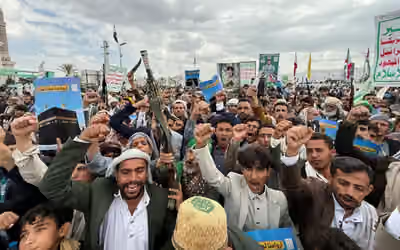
France summons Iran envoy over disinformation on student protests
Iran’s ambassador in Paris was rebuked over what France said was a disinformation campaign concerning student protests in the country, the French Foreign Ministry said Wednesday.
The ministry said Iran’s decision to summon the French ambassador in Tehran on October 6 was baseless and called for such “provocations” to end. It said the Iranian envoy was informed that false content disseminated by official Iranian Foreign Ministry accounts was unacceptable.
Tehran had summoned French Ambassador Pierre Cochard on Tuesday over what it described as excessive police violence against student protesters, citing more than 5,000 arrests, serious injuries and reports of police entering schools.
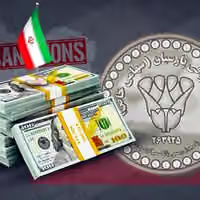
Iran’s central bank is offering as much as $2 billion in cash dollars to the public in an effort to slow the rial’s slide, triggering a fierce debate over whether the intervention can stabilize the currency or merely burn through increasingly scarce foreign reserves.
The dollar traded at nearly 2.7 million rials on Tuesday, after crossing the psychologically important threshold of 2.5 million last week, despite repeated efforts by authorities to contain the currency’s decline.
Central Bank Governor Abdolnaser Hemmati said Monday that the bank would take whatever measures it deemed necessary to manage the foreign exchange market.
The central bank announced on Sept. 30 that it would offer up to $2 billion in banknotes at a rate below the free-market price, beginning with $1 billion sold through selected banks and bank-affiliated exchange offices. Individuals can buy up to $10,000.
The rial’s decline has intensified public anxiety over the cost of living and the value of savings. Iranian news sites now routinely publish daily prices not only for currencies, gold and cars but even staples such as meat.
‘Structural problems’
Economists have questioned whether selling dollars can have more than a temporary effect while the forces driving the currency’s decline remain unchanged.
Kamran Nadari, an economist and university professor, told Rokna that the intervention could temporarily stabilize the exchange rate if its purpose was to meet speculative demand.
“The main problems in the foreign exchange market are declining foreign currency revenues, difficulties in transferring money and sanctions,” Nadari said. “Selling banknotes cannot solve these structural problems.”
He also warned that selling dollars below the free-market rate creates an opportunity for arbitrage, allowing buyers to obtain currency from the central bank and resell it for a profit.
“As a result, part of these $2 billion could go toward speculation and arbitrage rather than meeting genuine demand,” he said.
Hardliners attack the policy
The intervention has also triggered unusually strong criticism from hardliners in parliament.
Mehdi Kuchakzadeh, a prominent member of the hardline Paydari Party, argued that ordinary Iranians struggling with living costs could not afford the roughly 25 billion rials needed to purchase the maximum $10,000 allocation.
He called the central bank’s action a “crime” and urged parliament to intervene immediately.
“If I were not afraid of hell because of the shortcomings I have committed against you, the people, I would set myself on fire in front of the central bank,” Kuchakzadeh said.
Parliament Speaker Mohammad-Bagher Ghalibaf said he agreed with Kuchakzadeh’s concerns and would personally follow up on the issue, which he said could be raised at a parliamentary oversight session.
Rouhollah Abbaspour, a member of parliament’s Industries and Mines Committee, argued that the program would primarily benefit people with money to invest, who could also pay others to use their national ID cards to obtain additional dollars.
A fight over scarce dollars
The conservative newspaper Jomhouri Eslami described the policy as putting $2 billion of Iran’s foreign reserves “up for auction.”
It questioned the decision as Iran contends with reduced oil sales, difficulties repatriating export earnings and increased government costs from war-related destruction.
The criticism strikes at a broader vulnerability for Tehran. Oil exports have been heavily constrained by the US maritime blockade, depriving Iran of its principal source of foreign currency just as the rial has fallen to successive record lows.
Tabnak, a website considered close to former IRGC commander and National Security Council secretary Mohsen Rezaei, described the measure as “Hemmati’s controversial gift to the rich.”
A question of transparency
Supporters of the policy argue that selling dollars directly through banks makes the allocation of scarce foreign currency more transparent and reduces opportunities for connected intermediaries to profit.
Former communications minister Mohammad-Javad Azari-Jahromi sarcastically suggested that critics apparently preferred a system in which dollars passed through “insiders” and currency dealers without transparency over who obtained them or at what price.
Economist Sadegh al-Hosseini made a similar argument.
“Central banks everywhere manage markets by buying or selling foreign currency,” he wrote on Instagram. “The only question is: whom should the dollar be sold to—a particular exchange office, a few acquaintances and trusts, or everyone equally?”
The dispute has exposed a deeper dilemma for Iran as its foreign currency revenues shrink: whether scarce dollars should be used to defend the rial in the market, and whether doing so can have any lasting effect without addressing the sanctions, falling revenues and barriers to bringing export earnings back into the country.
US Secretary of State Marco Rubio speaks during a dedication ceremony at the chancery of the US Embassy, in Athens, Greece October 7, 2026.
US Secretary of State Marco Rubio said on Wednesday that Iran had failed to take advantage of repeated opportunities to reach an agreement with Washington over its nuclear program, while also saying Tehran had “lost complete control” of the Strait of Hormuz.
Speaking during a visit to Athens, Rubio said oil flows through the strait had returned to nearly their prewar level.
“The Strait of Hormuz is open. There’s almost as much oil flowing out now as there was before this conflict began,” Rubio said. “So they’ve lost complete control of the Strait.”
He also described Iran’s economy as being in “total and complete freefall” under US sanctions.
Rubio said Washington’s position on Iran’s nuclear program remained unchanged.
“Iran cannot have a nuclear weapon, simple, period, end of story,” he said. “Anything they agree to that would be acceptable to the United States has to be something that ensures that Iran will never have a nuclear weapon.”
Tehran responds to Vance on enrichment
Later on Wednesday, a senior Iranian official told Reuters that Tehran would never give up what it regards as its right to enrich uranium, responding to nuclear demands set out by US Vice President JD Vance.
“There have been no negotiations between Iran and the US about Tehran’s nuclear program,” the official said, describing Vance’s comments as American “ideas and requests.”
The official said US recognition of Iran’s right to enrichment was a “red line” and that Tehran would “never give up its right to enrich,” although the level and other details of enrichment could be discussed later.
The official also said Washington must first meet Tehran’s conditions before the nuclear issue could be discussed and said US proposals on enrichment were inconsistent with Iran’s demands.
IRGC adviser says Hormuz remains closed
Also on Wednesday, Mohammad Reza Naghdi, a senior adviser to the commander-in-chief of Iran’s Revolutionary Guards, disputed Washington’s account of the Strait of Hormuz.
“The Strait of Hormuz is closed, and the armed forces have full control over it,” Naghdi said. “This situation will continue until Iran’s legitimate demands are met.”
He said Iranian forces would block what he described as unauthorized routes through the waterway.
Naghdi also said limits on the range of Iranian weapons were based on policy rather than technical constraints.
“Whenever the supreme leader gives authorization, we will increase the range of our weapons according to the needs of the battlefield,” he said.
Trump says decision coming ‘pretty soon’
The exchanges followed remarks by President Donald Trump on Tuesday night that the United States still had to decide how to “finish up” with Iran.
“We have to finish up, and it's only a question of which way we want to do it: the nice way or the not-so-nice way,” Trump said at an Anduril Industries event in Maryland. “You will find out pretty soon.”
Trump said the United States was doing “extremely well” against Iran and said Tehran’s military had been severely weakened.
“They have no military in sight. The whole place is shut,” he said.
“They were the bully of the Middle East. They're not so much the bully anymore.”
Vance calls for enrichment cuts
Vance had told Reuters in an interview that Iran would need to meaningfully reduce its uranium enrichment capacity to meet US demands and end the war.
“If you don't want a nuclear weapon, then why do you need 60% enriched fuel?” Vance said. “If you want to show commitment to not building a nuclear weapon, don't build highly enriched fuel.”
“I think if they want to show a commitment to not building a nuclear weapon, they would do something meaningful on their enrichment capacity,” he added.
Vance said Washington remained open to an agreement but wanted concrete action from Tehran.
“We're not going to trade words for actions,” he said.
He also said the US had been communicating with President Masoud Pezeshkian and Foreign Minister Abbas Araghchi but remained uncertain about how decisions were being made within Iran’s political system.
Iran’s Bank Parsian, under US sanctions, used its foreign-exchange arm to move millions of dollars abroad through a network of intermediaries, according to an Iran International investigation based on leaked internal correspondence and transaction records.
The documents, covering the period from November 2022 to May 2023, show how Iran’s central bank and other financial institutions used Parsian Exchange, also known as Sarrafi Parsian, to facilitate payments outside Iran.
The transactions involved multiple layers of banks, companies and individuals, according to the records.
Bank Parsian is a private-sector Iranian bank that the US Treasury designated in October 2018, in an action against a network of companies financing the Basij paramilitary force.
The correspondence shows that four years after the designation, Bank Parsian was still arranging international payments through layered channels.
In most cases, no foreign currency actually left Iran. Foreign currency proceeds from oil, petrochemical and other exports were held in accounts overseas. At Bank Parsian’s instruction, Parsian Exchange transferred funds held in those accounts to overseas bank accounts designated by Iranian importers.
But the payments did not appear to come from the Iranian government, sanctioned banks or the Central Bank of Iran (CBI). Instead, they appeared to originate from private companies, with Parsian Exchange acting as an intermediary.
The process
In a typical transaction documented in the files, an Iranian importer—such as carmaker Iran Khodro—sought foreign currency from the CBI to pay a supplier overseas.
The CBI sold the foreign currency to Bank Parsian, according to the documents. The funds were then held at another Iranian bank in an account belonging to a separate individual or company, described in the records as a “trustee”.
The documents showed that Parsian Exchange facilitated the movement of this money between foreign accounts.
Many of the recipient accounts identified in the documents were held at banks in the United Arab Emirates, China and Hong Kong.
The documents show that, by structuring the transactions through these layers, Parsian Exchange obscured the money trail.
Iran International found no evidence that the banks in the UAE and China knowingly facilitated Iran’s efforts to circumvent US sanctions.
Bank Parsian and Parsian Exchange did not respond to Iran International’s requests for comment.
People behind the letters
Parsian Exchange is a subsidiary of Bank Parsian. The bank directly owns 90% of the company, with the remaining roughly 10% held through Parsian Financial Group, its investment arm.
Iran International identified 33 instruction letters in the leaked documents that directed the movement of UAE dirhams, Chinese yuan and US dollars, with a total value of roughly $36 million.
Almost all the letters were signed by Alireza Alaei, Bank Parsian’s head of international affairs. He joined Parsian Exchange’s board as vice chairman in early 2020 and has served as chairman since mid-2020.
Many of the letters were addressed to Rasoul Salehi Oskouei, Parsian Exchange’s chief executive. Official records show he joined the company’s board in early 2018 and has served as vice chairman and chief executive since early 2020.
Salehi Oskouei had also served at another bank-owned exchange company. More than 12 years before joining Parsian Exchange, he sat on the board of Sepehr Exchange, an affiliate of Bank Saderat, from early 2006 to mid-2008
A review of Parsian Exchange’s current and former executives shows a recurring pattern of ties to Bank Parsian and Setad, the economic conglomerate controlled by Iran’s supreme leader.
Alaei joined the company’s board in early 2020 as a representative of Tamin Andish Pars, a Bank Parsian affiliate, and remains on the board. He also served on the board of Parsis Kish starting in 2015, representing Parsian Insurance.
Hesam Shams Alam, who served on Parsian Exchange’s board from 2010 to 2014, had also sat on the board of Bank Parsian. In 2013, he joined the board of Tadbir Investment Group as a representative of Tadbir Industry and Mine Development, an affiliate of Setad.
Instructions for payments
The letters follow a consistent pattern. Alaei sent them to the international departments of other Iranian banks, including Saman, Shahr, Eghtesad Novin, Tourism Bank, Bank Melli and Bank Mellat, all sanctioned by the United States.
The letters were typically sent about 10 days after the banks purchased foreign currency from the Central Bank of Iran. In its letters to the other banks, Bank Parsian said the foreign currency had been “purchased from the central bank” and was being held “in a trustee account” at the recipient bank.
This is where Parsian Exchange came in. Bank Parsian asked the third-party bank to transfer the funds through Parsian Exchange to the ultimate beneficiary.
The subject line of each letter described the funds as being transferred via an intermediary, meaning the payment abroad was made in the name of a private individual or company rather than an Iranian bank or the state.
In a letter dated early 2023, Alaei sent a letter to the international division of the Tourism Bank. He asked the bank to transfer $990,000 held in a trustee account to an account belonging to SEALION General Trading Limited. A review of public records shows the company was active in Hong Kong.
In May 2023, Alaei asked Tourism Bank’s international affairs division to transfer $750,000 to an account held by SAHERI TRADING LIMITED, also registered in Hong Kong.
Bank-owned exchanges
More than 500 licensed exchange companies are currently registered in Iran, 28 of them owned by banks.
By revenue, Parsian Exchange ranks second among them.
Adjusted to September 2026 prices, Melli Exchange, affiliated with Bank Melli, reported annual operating revenue of 1,253 trillion rials. Parsian Exchange ranked second with 1,168 trillion rials, followed by Omid Sepah Exchange, affiliated with Bank Sepah, with 1,129 trillion rials.
Iranian banks began setting up exchange companies more than two decades ago.
Sepehr Exchange, owned by Bank Saderat, was the first exchange company established by an Iranian bank on 25 July 2004. Parsian Exchange followed two weeks later.
Sepah, the state-owned bank with long-standing ties to the armed forces, owns three separate exchange companies. Bank Melli also operates Melli Exchange.
Sanctions
Parsian Exchange has never been named on the US sanctions list. Under US rules, however, a company owned 50 percent or more by a sanctioned entity is automatically covered by the same sanctions, so US persons are already barred from dealing with it.
In April 2026 the U.S. Treasury sanctioned a company it identified as Bank Parsian’s “rahbar”—a private firm that manages the bank’s overseas payments—and in July 2026 an exchange house it said had contracts with the bank.
The United States has targeted bank-owned exchange companies since 2008, when it sanctioned the exchange arm of the Export Development Bank of Iran.
For about a decade, no new sanctions were imposed targeting exchange companies linked to the Islamic Republic until 2018.
By September 2026, the United States had sanctioned a total of 20 exchange companies based in Iran, including six bank-owned exchanges: Export Development Exchange, Dey Exchange, Sina Exchange, and Hekmat Iranian, Ansar and Omid exchanges, all three of which are subsidiaries of Bank Sepah.
More than three years after Joe Biden took office as president, Washington sanctioned five Iranian exchange companies on June 25, 2024: Hekmat Iranian Exchange, affiliated with the former Hekmat Iranian Bank; Omid Exchange, affiliated with Bank Sepah; Sadaf Exchange; Siavash Nourian Exchange; and Atropars Exchange.
It was the largest round of sanctions targeting Iranian exchange houses since Trump left office.
After Trump returned to the presidency, a new wave of sanctions on Iranian exchange houses began in 2025. By September 2026, the United States had sanctioned 11 more exchange houses.
“Write your will.”
Those were the words Iranian protester Erfan Nabian says he heard in solitary confinement before he was handed a sheet of paper and asked what he wanted for his final meal before his execution.
Nabian, whose legal name is Erfan Hajbonian Dehaghani, is a 26-year-old protester from Isfahan who was sentenced to death after being detained following Iran’s nationwide protests in January.
Speaking to Iran International from an undisclosed location, Nabian described torture, a coerced confession, a mock execution and imprisonment alongside protesters who were later executed.
Minutes after being told to write his will, blindfolded, he was led into another room and ordered to stand on a stool.
Then a noose was placed around his neck.
“All the memories of my life were coming before my eyes,” Nabian recalled. “I thought I would never see my family again.”
Even with the rope around his neck, Nabian said interrogators continued questioning him about the protests, his phone password and allegations linked to the Alikhani Square case, a mass prosecution stemming from deadly clashes during the January 8 protests in Isfahan, which he denied.
The noose remained around his neck for between five and 10 minutes, he said.
A confession under duress
Nabian said he was then placed in front of a camera and ordered to say he had not been beaten or physically harmed.
If he looked away or failed to give the answers his interrogators wanted, he said, they stopped the recording, beat him and started again.
After the filming, Nabian said a man told him: “You’re going to be executed. The sentence has been issued.”
Nabian asked to call his family. Permission was refused.
Minutes later, shackled to a bench, he asked again.
“Please, can you tell them to let me speak to my family? I want to hear my family’s voices for the last time.”
Only then, he said, was he told he would not be executed at that moment and would instead be transferred to prison.
From Alikhani Square to detention
Nabian said he had also joined Iran’s 2019 and 2022 protests.
On January 8, 2026, he joined demonstrations in Isfahan. At Alikhani Square, he said security forces were firing live ammunition at protesters. Four or five pellets struck his right leg.
Fearing arrest if he sought treatment at a hospital, Nabian made his way home. With no knowledge of how to remove the pellets, he cleaned and bandaged the wound himself as his leg began bleeding heavily.
Erfan Nabian removes pellets from his body after being shot during protests in Isfahan on January 8, 2026.
He said he later went back outside to look for a young girl who had become separated from her mother and found the child dead.
Despite what he had seen, Nabian returned to the streets the following day.
“We couldn’t turn a blind eye,” he said, referring to the violence he had seen on January 8 as protesters were shot at.
The events at Alikhani Square later became the basis for one of the most consequential capital cases to emerge from the January protests. Fifty-nine people were initially arrested and 12 were sentenced to death, according to a lawyer who spoke to Iran International.
UN experts led by Mai Sato, the UN Special Rapporteur on human rights in Iran, said the defendants were tried in a single closed hearing that violated fair-trial standards and raised concerns over the use of televised confessions.
Amnesty International separately described the proceedings as a “grossly unfair mass trial” and documented torture, forced confessions and denial of access to lawyers among defendants.
‘The Alef-Ta slaughterhouse’
Nabian said he was arrested on March 6 and taken to Ghaemieh police station.
There, he said, officers demanded the password to his phone and gave him an unidentified substance intravenously.
He was then transferred to a detention facility he identified as Alef-Ta in Isfahan.
Nabian described it as a roughly 10-story building used for solitary confinement and torture.
“I call it the Alef-Ta slaughterhouse,” he said.
He described being stripped, soaked with water and beaten with hoses and batons. At one point, he said, his arms were secured above him while he was beaten for around an hour.
Star of David tattoos and accusations of spying for Israel
Nabian said his tattoos became a particular focus for his interrogators.
They included Hebrew writing, a Star of David on the right side of his neck and ancient Iranian symbols, including the Derafsh Kaviani, on his arm.
He said interrogators repeatedly struck areas bearing the tattoos, including the Hebrew writing on his back.
Erfan Nabian is pictured with a Star of David tattoo on his neck in a photo posted on social media in November 2022.
“One of them kept saying, ‘I’ll beat you so much you’ll start speaking Hebrew,’” Nabian recalled.
He said interrogators accused him of being an Israeli spy, receiving money from Israel and undergoing training.
Nabian denied the allegations.
Dastgerd and the sentence
On March 20, Nabian was transferred to Dastgerd prison in Isfahan.
He said intake staff initially refused to admit him because of his injuries, including a broken finger and damaged knees.
His death sentence was later commuted to 11 years in prison, according to a court verdict reviewed by Iran International.
Nabian said the sentence included one year for propaganda and 10 years over alleged psilocybin possession. He denied the drug allegation and said authorities gave differing accounts of the amount.
Iranian authorities have previously faced allegations of bringing fabricated drug charges against political detainees.
Norway-based rights group Iran Human Rights has described the case of Iranian-Dutch protester Zahra Bahrami, arrested after the 2009 demonstrations and executed in 2011, as a fabricated drug case in which she was tortured into confessing.
The US-based Center for Human Rights in Iran, then known as the International Campaign for Human Rights in Iran, said at the time that Iranian security agencies had in several cases planted drugs and added drug-related charges to the cases of political prisoners.
The cellmates later executed in connection with the Alikhani case
Inside Dastgerd, Nabian lived alongside other defendants tied to the Alikhani case.
Among them were Sasan Azadvar and Erfan Esfandiari, both later executed.
Nabian also spent around two days with Abolfazl Sepahi, another Alikhani defendant.
He said Sepahi told him he had been shot from behind with live ammunition in the pelvis during the January 8 protests and described torture he endured in detention, including having a butane torch held near his eye.
Sepahi was later publicly executed alongside Amirhossein Safari in Ali-Khani Square.
He also remembered Shervin Bagherian, another Ali-Khani defendant whom he befriended in Dastgerd, as intelligent and good-natured. Bagherian often came to his room, where he played chess and spent time with fellow prisoners.
It was only after his release that Nabian saw Bagherian’s forced confession, broadcast on state television. “My heart broke,” he said. “I kept thinking about what this kid must have gone through.”
Amnesty International said Bagherian had been forcibly disappeared for 21 days, subjected to torture and denied access to a lawyer before his forced confession was broadcast on state television on January 25.
For Nabian, the names appearing in reports of executions were not strangers. They were men he had lived beside, spoken with and come to know in prison — before watching, from outside, as one after another was taken to the gallows.
Air strike and crackdown inside Dastgerd
Nabian was still inside Dastgerd when an air strike on March 31 hit military facilities immediately behind the prison.
Iran International later reported that a military base and ammunition depot behind Dastgerd were hit by three missiles and parts of the prison were damaged. A judicial document said some prisoners were killed and others died in the ensuing fire.
Nabian said the blasts cut electricity, water and telephone access and were strong enough to throw prisoners from upper bunks.
“Everyone was shouting, ‘Come save us. Open the doors so we can get out.’”
He said some staff left while inmates remained behind locked ward doors. Some doors were later damaged or opened as prisoners tried to reach safety.
Nabian said security forces and IRGC personnel subsequently entered the prison and opened fire.
His ward remained locked. He said other prisoners later told him they had seen bodies and black body bags in corridors.
The following day, Nabian said, he could hear prisoners being beaten and tortured. He also described a “tunnel of terror,” in which prisoners accused of involvement in the unrest were forced between lines of guards who struck them with gun stocks, batons and hoses.
A judicial document later obtained by Iran International listed 75 prisoners as defendants over the unrest and fire. At least 26 were ordered to stand trial, while 18 faced charges that could carry the death penalty.
Nabian was released on bail on April 7. He said he left Iran because he feared rearrest, further torture, a lengthy prison term or another death sentence.
“I really love my country,” he said. “I always believed Iran would be free.”
A senior hardline Iranian lawmaker has been named in an allegation involving unauthorized excavation for antiquities and treasure, while parliament is also examining a reported excavation case involving an unnamed member of the legislature.
Investigative journalist Yashar Soltani said he had obtained documents indicating that Mojtaba Zolnouri, a lawmaker from Qom and a figure associated with the hardline Paydari Front, was involved in unauthorized digging for historical artifacts and treasure.
“After oil, the Paydari camp is now after treasure,” Soltani wrote on X on Tuesday.
“I have obtained documents indicating that Mojtaba Zolnouri, the lawmaker representing Qom, was involved in unauthorized excavation in search of historical artifacts and treasure,” he added.
Soltani did not publish the documents or say where or when the excavation allegedly took place. The allegation has not been independently verified, and Zolnouri has not publicly responded.
Parliament examining excavation case
Journalist Zahra Abdollahi separately said the issue of a lawmaker involved in excavation for buried treasure had been raised at a recent meeting of parliament’s Internal Affairs and Councils Committee and referred to the body that oversees lawmakers’ conduct.
“At a recent meeting of parliament’s Internal Affairs and Councils Committee, the issue of a lawmaker’s misconduct in connection with digging for treasure and buried antiquities was raised, and it was decided that the matter should be reviewed by the board overseeing lawmakers’ conduct,” she wrote on X.
Abdollahi did not identify the lawmaker, meaning there is no public evidence establishing that the parliamentary case concerns Zolnouri.
She said she had obtained an official document addressed to a prosecutor concerning excavation at a residential property in a historically sensitive area. According to her account, the letter called for the work to be halted.
Abdollahi said she planned to release further details of the document.
Paydari link comes amid oil-sales scrutiny
Soltani tied his latest allegation to a separate controversy surrounding Iran’s sanctions-era oil sales.
“I previously said that one of the four recipients of 85 million barrels of oil was the son-in-law of the Paydari Front spokesperson,” he wrote.
The reference was to Ruhollah Razavi, whose name has appeared in reporting on the network of trusted intermediaries, known in Iran as “trustees,” used to sell sanctioned oil and move the proceeds back to the country.
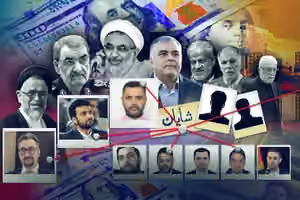
The wider system has come under growing scrutiny over billions of dollars in oil revenues that were not returned to Iran. An Iran International investigation found that members of one network collectively failed to repatriate $11 billion, while confidential documents showed 86 million barrels of oil had been assigned to four intermediaries who already owed money from previous sales.
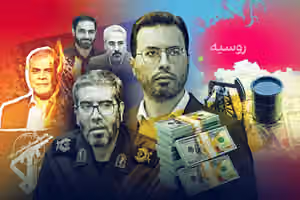
Iran International also reported this week that senior IRGC commander Hossein-Reza Sadeghi and his son Saeed played central roles in efforts to preserve an IRGC Intelligence oil-sales network and shift its financial operations from the United Arab Emirates to Russia.