Iran lawmaker named in alleged illegal treasure excavation
A senior hardline Iranian lawmaker has been named in an allegation involving unauthorized excavation for antiquities and treasure, while parliament is also examining a reported excavation case involving an unnamed member of the legislature.
Investigative journalist Yashar Soltani said he had obtained documents indicating that Mojtaba Zolnouri, a lawmaker from Qom and a figure associated with the hardline Paydari Front, was involved in unauthorized digging for historical artifacts and treasure.
“After oil, the Paydari camp is now after treasure,” Soltani wrote on X on Tuesday.
“I have obtained documents indicating that Mojtaba Zolnouri, the lawmaker representing Qom, was involved in unauthorized excavation in search of historical artifacts and treasure,” he added.
Soltani did not publish the documents or say where or when the excavation allegedly took place. The allegation has not been independently verified, and Zolnouri has not publicly responded.
Parliament examining excavation case
Journalist Zahra Abdollahi separately said the issue of a lawmaker involved in excavation for buried treasure had been raised at a recent meeting of parliament’s Internal Affairs and Councils Committee and referred to the body that oversees lawmakers’ conduct.
“At a recent meeting of parliament’s Internal Affairs and Councils Committee, the issue of a lawmaker’s misconduct in connection with digging for treasure and buried antiquities was raised, and it was decided that the matter should be reviewed by the board overseeing lawmakers’ conduct,” she wrote on X.
Abdollahi did not identify the lawmaker, meaning there is no public evidence establishing that the parliamentary case concerns Zolnouri.
She said she had obtained an official document addressed to a prosecutor concerning excavation at a residential property in a historically sensitive area. According to her account, the letter called for the work to be halted.
Abdollahi said she planned to release further details of the document.
Paydari link comes amid oil-sales scrutiny
Soltani tied his latest allegation to a separate controversy surrounding Iran’s sanctions-era oil sales.
“I previously said that one of the four recipients of 85 million barrels of oil was the son-in-law of the Paydari Front spokesperson,” he wrote.
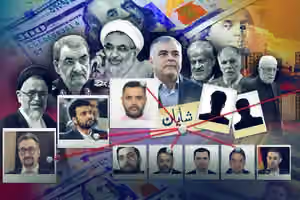
The reference was to Ruhollah Razavi, whose name has appeared in reporting on the network of trusted intermediaries, known in Iran as “trustees,” used to sell sanctioned oil and move the proceeds back to the country.
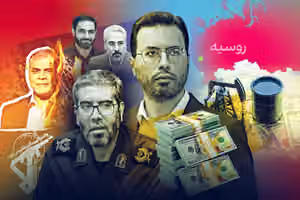
The wider system has come under growing scrutiny over billions of dollars in oil revenues that were not returned to Iran. An Iran International investigation found that members of one network collectively failed to repatriate $11 billion, while confidential documents showed 86 million barrels of oil had been assigned to four intermediaries who already owed money from previous sales.
Iran International also reported this week that senior IRGC commander Hossein-Reza Sadeghi and his son Saeed played central roles in efforts to preserve an IRGC Intelligence oil-sales network and shift its financial operations from the United Arab Emirates to Russia.
Two surveys emerging from within or around Iran's political establishment paint a bleak picture of public confidence: deep skepticism toward state institutions, single-digit trust in political officials and overwhelming demand for change.
What they reveal much less clearly is what kind of change Iranians actually want, partly because answering such questions openly can carry serious consequences.
One, presented by Ebrahim Hajiani, a former director of the state-affiliated Iranian Students Polling Agency (ISPA), says the proportion of Iranians seeking "fundamental political change" has risen from 8 to 67 percent in two decades.
The other, supervised by Ali Rabiei, social adviser to President Masoud Pezeshkian, found that about 53 percent supported fundamental reforms, 19 percent wanted regime change and 13 percent favored minor structural adjustments. Only 9 percent supported preserving the status quo.
Despite their different methodologies and categories, the findings converge on one broad conclusion: dissatisfaction with Iran's political and social institutions is deep, and relatively few respondents appear content with the status quo. Hajiani's "fundamental political change," however, cannot automatically be equated with regime change.
The trust figures are similarly stark.
According to Hajiani, only 7 to 8 percent of respondents trust political officials, while trust in the three branches of government ranges between 25 and 30 percent.
Rabiei's survey found trust in the judiciary at just over 30 percent, against more than 54 percent who expressed distrust. The executive branch was trusted by just over 25 percent, while more than 59 percent expressed distrust. Parliament was trusted by 23 percent, with more than 59 percent saying they distrusted it.
The security institutions fare better. Hajiani found that 53 percent trust the regular Army, while both the Islamic Revolutionary Guard Corps and the police are trusted by 46 percent.
Both researchers describe the findings in terms of an institutional crisis. Hajiani speaks of a "crisis of authority" or "crisis of reference," while Rabiei identifies a "crisis of efficiency, trust and political representation."
Hajiani also identifies 2022, the year the Woman, Life, Freedom uprising erupted, as a social watershed, dividing Iranian society into a "before" and "after" in attitudes towards dress codes, family dynamics, religion and the role of women.
Rabiei, meanwhile, argues that a "broad social middle" still exists: a large segment of society that is dissatisfied but seeks reform, stability and gradual improvement rather than upheaval. He says this constituency is poorly represented in the media, political parties and state institutions.
His figures provide some support for that interpretation, but the conclusion should be treated cautiously. The surveys themselves illustrate why.
Hajiani says around 70 percent of those approached by pollsters do not respond. That raises an obvious question over whether those willing to participate are representative of those who refuse, particularly when questions concern the legitimacy of the political system.
Sharq newspaper has previously noted that refusals and evasive answers are particularly common on questions touching on the legitimacy of the government and political system.
In an environment where opposition activity can bring serious consequences, respondents may have reason to be cautious about openly expressing support for replacing the Islamic Republic.
That does not necessarily mean the polling itself is dishonest. Even a methodologically rigorous survey can produce guarded responses when the questions are politically sensitive.
There are other limitations. Neither of the reports as publicly presented provides sufficient detail about sample size, methodology or response rates to allow a full assessment of representativeness.
Their institutional connections also warrant caution: Rabiei is a presidential adviser, while Hajiani is a former head of a state-affiliated polling organization.
A potentially more consequential problem is harder to measure: who agrees to answer sensitive questions, how those questions are framed, and which findings ultimately become public.
That makes precise conclusions about how many Iranians want reform, fundamental change or the replacement of the Islamic Republic difficult to draw from these surveys alone.
Still, even research emerging from institutions connected to Iran's establishment describes a society in which confidence in political leaders is extremely low, demand for substantial change is widespread and only a small minority appears satisfied with the status quo.
Iran’s central bank chief has rejected what he portrays as a US prediction of economic collapse, even as the rial trades near record lows and Iranian oil exports have fallen to zero.
Central Bank Governor Abdolnaser Hemmati said Tuesday that a US prediction of economic collapse was failing to materialize, pointing to what he described as the continued functioning of Iran’s economy despite months of war, sanctions and restrictions on its oil trade.
“There are only five days left of that two-week promise they made that the country’s economy was supposedly going to collapse,” Hemmati told state television. “We are sitting here now talking about the country’s economic achievements, and I tell them that this will not happen.”
Hemmati appeared to be referring to recent remarks by US Treasury Secretary Scott Bessent, who said on Sept. 27 that Iran had about 15 million barrels of oil left in transit and would make its final deliveries to China within roughly two weeks, after which it would have “nothing left to trade for anything.”
The remarks come as Washington intensifies economic pressure on Iran, targeting its oil revenues and access to the international financial system.
Hemmati played down the impact of reduced access to foreign currency, saying Iran had supplied about $24.9 billion since the beginning of the Iranian calendar year in March, compared with $28 billion during the same period a year earlier.
The central bank has also moved to provide up to $2 billion to the foreign exchange market in an effort to support the rial.
“The reason we provided $2 billion in foreign currency for the market was to make Trump and his Treasury secretary understand that we have no problem providing foreign currency,” Hemmati said.
The rial nevertheless continued to lose value, falling to about 2.688 million against the US dollar on the unofficial market on Saturday, a record low. The currency has lost more than half its value over the past year, while inflation has risen above 70%.
Pressure on Iran’s principal source of foreign revenue has also intensified. Iranian oil exports fell to zero in September amid the US naval blockade, even as Persian Gulf oil flows excluding Iran recovered to more than 81% of their pre-war levels.
Bessent said Tuesday that Iran had not loaded a single barrel of crude onto a vessel since Aug. 25.
Despite playing down the impact of the pressure on Iran’s economy, Hemmati acknowledged the difficulties facing ordinary Iranians.
“We truly understand the difficulties and pressures people are facing,” he said. “We are doing our best, and we are concerned as well. We are trying to minimize these problems.”
A portrait of Iran's slain Supreme Leader Ali Khamenei is displayed during a Janfada rally in Mashhad, October 6, 2026
Rhetoric is hardening on both sides of the Iran-US standoff, with even Iranian analysts traditionally optimistic about diplomacy warning that relations are slipping back to “square one” as military and economic pressure intensifies.
President Masoud Pezeshkian added to that sense of a narrowing diplomatic opening this week, declaring that “talks are meaningless” while Washington maintains what he described as a naval siege and fails to honor its existing commitments.
Pezeshkian said Tehran would not negotiate under military pressure or abandon its seven conditions for de-escalation, a position that leaves little obvious room for compromise as the US builds up forces in the region and tensions around the Strait of Hormuz continue.
Veteran foreign policy analyst Ali Bigdeli, who has traditionally taken a relatively optimistic view of diplomacy with Washington, told Fararu on Tuesday that Iran-US relations had effectively returned to “square one,” with deep mistrust and uncertainty prevailing in both capitals.
He also warned that the increased US military presence in the region, combined with mounting economic pressure on Iran, raised the risk of miscalculation.
Hardline newspaper Kayhan seized on Pezeshkian’s remarks, calling for an immediate and complete withdrawal from Qatar-mediated diplomatic channels.
The English-language Tehran Times portrayed his refusal to negotiate under naval pressure as “a principled rejection” of unilateral Western coercion.
On Monday night, international maritime security agencies issued four attack warnings within four hours following new projectile strikes on commercial oil tankers transiting the Strait of Hormuz.
Seven attacks on commercial vessels have been reported in the strait in the past week, according to maritime intelligence reports, which also describe direct radio warnings from the Revolutionary Guards Navy ordering some tankers to turn around.
IRGC-linked daily Javan highlighted the rapid succession of attack advisories and radio interdictions as evidence that CENTCOM’s naval presence has failed to guarantee freedom of navigation through the waterway.
But the same confrontation that hardliners portray as evidence of Iranian leverage is also generating warnings about its economic cost.
Economic daily Donya-ye Eghtesad argued that shadow fleets and off-radar transfers may allow crude oil to continue moving, but cannot reliably provide the raw materials needed by Iranian industry.
Once existing stocks of industrial inputs are exhausted, the newspaper warned, the combination of disrupted shipping and severed formal banking channels could push domestic industry into deeper decline.
Some Iranian outlets have increasingly focused on the possibility that a single security incident could upset the fragile balance altogether.
Moderate outlet Rouydad24 pointed to reports that American bombers were moved from RAF Fairford in Britain amid concerns about a possible Iranian or IRGC drone threat, as well as a US national security meeting last week with Iran and Yemen on the agenda.
The outlet warned that a single security incident could become a political trigger for escalation, sharply narrowing the distance between negotiation and confrontation.
Diplomatic channels have not disappeared, but harder positions in Tehran and Washington, an expanding US military presence, repeated incidents around Hormuz and growing economic pressure leave increasingly little room for error.
The emerging message from Iranian commentary is that a prolonged stalemate carries risks in either direction: deeper economic deterioration if it continues, and potentially rapid military escalation if it breaks.
Economic crisis is driving some Iranians across the border to Armenia for construction, taxi and delivery work, turning a longtime holiday destination into a source of income for families struggling to make ends meet at home.
For years, Armenia meant something very different for many Iranian visitors.
Travel agencies sold packages for the country’s water festival, wine festivals and concerts. The images returning from Yerevan were largely of Iranians who had crossed the border for a few days of music, celebrations and leisure.
Those trips continue, and Iranians remain one of the largest groups of foreign visitors to Armenia.
But as economic pressures have deepened in Iran, another Iranian presence has become increasingly visible in Yerevan.
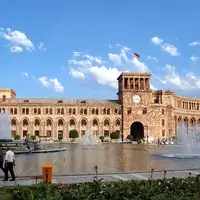
Around Republic Square, tourists stroll past fountains and the square’s distinctive stone buildings. Among them, Iranian men of different ages sit on benches speaking Persian.
Listen to some of their conversations and the subject is not where to eat or what to see.
It is work: wages, employers, rent and who is still hiring.
For some Iranians, Armenia is no longer somewhere to spend money on a few days away. It is a nearby country where they hope to earn enough to cover their own expenses and send what remains to their families in Iran.
‘Job placement’ signs in Persian
A few streets away, around Tigran Mets Avenue and the Firdusi neighborhood, the change is even more visible.
A job placement advertisement near Tigran Mets Avenue in Yerevan.
Sheets of paper attached to some walls carry a single word in Persian: job placement.
The reasons Iranians travel to Armenia vary widely. Many still come as tourists. Others choose Yerevan as a place to meet relatives who have emigrated to Western countries.
War and concerns about security have also prompted some to leave Iran temporarily.
But another group has been pushed out by the struggle to make a living.
High inflation, falling purchasing power, the declining value of the rial and the growing difficulty of covering everyday expenses have changed the calculation for some Iranian workers.
Even casual work in a neighboring country can make financial sense when the income is earned in Armenian drams and can be converted before some of it is sent back to Iran.
For these workers, a wage that is modest by Armenian standards can carry considerably more weight at home.
Working in Armenia, supporting a family in Iran
Ahmad, a 47-year-old from Sanandaj who asked to be identified by a pseudonym, left his wife and children in Iran and traveled alone to Armenia about four months ago.
He spent his first three months doing construction work in towns around Yerevan, earning about 7,000 drams a day, roughly $19.
Iran’s economic crisis has driven some citizens to Armenia in search of work.
A substantial share of that money went to the contractor.
The size of the wage was not Ahmad’s only concern. He had no written contract and worried that he might finish the job without receiving the money he was owed.
About a month ago, he switched jobs and began driving for Yandex in Yerevan.
Ahmad does not speak Armenian. He has learned only a few basic words useful for navigating the city: left, right and straight.
“From morning until the afternoon, I make enough to cover the car and my expenses. Whatever I earn after that, I can save,” Ahmad said.
That money is sent to his family in Sanandaj.
Reza, another Iranian in his 30s, arrived in Armenia from Karaj two months ago.
Friends who had traveled there before him suggested he come to Yerevan for work.
Concerns about war played a role in his decision to leave Iran, but economic pressure became the main reason for staying.
“The economic situation was so bad that I couldn’t cover my own expenses, let alone help my retired father. Now I work construction here. At least I can convert my wages into foreign currency and send money to them,” Reza said.
Reza also works without a formal written contract.
He has heard about workers whose employers failed to pay them, although he has not had problems with his own employer so far.
Construction, taxis and deliveries
The jobs newly arrived Iranians find are often in sectors where fluency in Armenian or advanced professional qualifications are not required.
Iranians were among the nationalities that filed the most employment-based residence applications in Armenia in the first half of 2026.
Construction is one of the main options, with Iranians working in jobs ranging from steel reinforcement and block laying to electrical work.
Others drive taxis through ride-hailing platforms. Some work as couriers, delivering food and other goods by bicycle, electric scooter or even on foot.
Others have found jobs in online casinos or entertainment and nightlife businesses.
Armenia’s expanding construction sector has helped create demand for workers. Official figures show construction activity increased 24.5% in the first six months of 2026 compared with the same period a year earlier.
But the attraction of these jobs for Iranian workers is not simply that Armenia pays higher wages.
The difference between the value of money earned in the two countries matters just as much.
As the rial has lost value and purchasing power has declined in Iran, earnings that may not stretch far in Yerevan can take on a different value once converted and sent home.
For some, working in Armenia is therefore not the beginning of an attempt to settle there permanently.
It is a way of keeping a household in Iran afloat.
Tourist on paper, worker in Yerevan
Official statistics provide only a partial picture of the Iranian presence in Armenia because not everyone who crosses the border and finds work appears in employment-based residency figures.
The number of Iranian tourists visiting Armenia increased from 176,453 in 2024 to 182,364 in 2025, a rise of about 3.3%.
Iranians accounted for around 8.1% of all foreign tourists in Armenia in 2025, making them the third-largest group after Russians and Georgians.
But being recorded as a tourist does not necessarily mean a visitor spends the entire trip sightseeing or on holiday.
Iranian citizens do not need visas for short-term travel to Armenia. Some who enter under those arrangements find jobs after arriving and enter the informal labor market without obtaining a work permit or employment-based residency.
That leaves open the possibility that some Iranians appearing in tourism and arrival statistics are, in practice, looking for work or returning to jobs they have already found.
High housing costs, unfamiliarity with the Armenian language and banking restrictions are among the main challenges facing newly arrived Iranians in Yerevan.
Available figures do not show how many Iranian visitors begin working after arrival, meaning the share of such workers in the overall increase in Iranian visitors cannot be calculated.
Temporary residency figures offer a clearer view of the formal side of labor migration.
A total of 8,181 foreign nationals received temporary residency in Armenia during the first half of 2026, with citizens of Russia, India and Iran making up the three leading nationalities, according to Armenia’s Interior Ministry Migration and Citizenship Service.
Of those temporary residency permits, 6,085 were issued on the basis of employment.
Citizens of Vietnam, Iran, China and India were among the nationalities filing the largest numbers of applications for employment-based residency.
The figures put Iranians among the main groups receiving temporary residency and among the leading applicants for employment-based status.
The exact number of Iranians granted employment-based residency in the first half of 2026 has not been published.
Those figures also cover only people who went through the formal process. Iranians working without permits in construction, taxis, delivery services and other sectors do not appear in that part of the data.
Tourism and residency figures therefore offer signs of a growing Iranian presence but cannot establish the actual size of the Iranian workforce in Armenia.
Earning abroad, sending money home
Employment brings its own difficulties.
Housing is among the first challenges facing new arrivals. Many Iranians stay in hostels or share rooms and apartments with several other people to keep costs down.
Access to banking services can also be difficult.
Sanctions and banks’ risk-management policies mean opening an Armenian bank account does not necessarily give Iranian nationals full access to cards and international financial services.
But workers such as Ahmad and Reza are not comparing Yerevan with wealthy European cities.
Their calculation is more immediate: what they could earn in Iran versus what they can save in Armenia and send to the people waiting for them at home.
That calculation is giving Armenia a different meaning for some Iranians.
A country associated for years with tours, concerts, festivals and short holidays is now also a place where Iranians lay blocks on construction sites, drive taxis and deliver food to earn money for households across the border.
For those families, Iran’s economic crisis is measured not only in inflation, the exchange rate or lost purchasing power. It is measured in the distance between home and the nearest place where one member of the family can still earn enough to send something back.
File photo shows President Masoud Pezeshkian addressing the parliament in August 2024.
Iranian President Masoud Pezeshkian has nominated Mehrdad Akhlaghi Ketabchi as defense minister, moving to fill a post left vacant since Defense Minister Aziz Nasirzadeh was killed in US-Israeli strikes in February.
Sasan Valizadeh, an adviser to the president’s deputy for parliamentary affairs, said Pezeshkian sent the nomination to Parliament Speaker Mohammad Bagher Ghalibaf under Article 133 of the constitution, which requires ministers to win a parliamentary vote of confidence. Lawmakers are expected to review Akhlaghi Ketabchi’s program and policies before scheduling the vote.
The Defense Ministry has been run by Majid Ebn-e-Reza since March 2, when Pezeshkian appointed him acting minister after Nasirzadeh’s death on February 28. Ebn-e-Reza, previously the deputy defense minister, has represented the ministry in domestic and foreign meetings but was never nominated for the permanent post.
Akhlaghi Ketabchi is a longtime Defense Ministry official with deep roots in Iran’s missile and aerospace industries. He was listed by the UN Security Council in 2007 as head of the Shahid Bagheri Industrial Group, a Defense Ministry entity linked to Iran’s ballistic missile program. His name returned to the UN sanctions list when earlier sanctions on Iran were re-applied in September 2025.
Then-defense minister Hossein Dehghan appointed him head of the Aerospace Industries Organization in November 2014. The United States also sanctioned him in 2020, identifying him as director of the Defense Industries Organization and citing conventional arms-related activities.
The nomination also raises the question of how the appointment was cleared at the top of Iran’s political system. Defense ministers are formally nominated by the president and confirmed by parliament, but the post is among the sensitive ministries whose nominees have traditionally been coordinated with and approved by the supreme leader beforehand.
That process is less transparent under Supreme Leader Mojtaba Khamenei, who has not made a public appearance since taking office. Decisions, appointments and written messages have continued to be issued in his name, but officials have not said whether or how his approval was obtained for Akhlaghi Ketabchi’s nomination.