Euro tops 3 million rials as Iran's currency hits fresh record lows

Iran's rial fell to new record lows on Saturday, with the euro crossing 3 million rials for the first time and the US dollar hovering around 2.7 million rials on the open market.

Iran's rial fell to new record lows on Saturday, with the euro crossing 3 million rials for the first time and the US dollar hovering around 2.7 million rials on the open market.
The British pound reached about 3.52 million rials, while the UAE dirham traded above 730,000 rials, according to open-market rates at the start of Saturday's trading.
The dollar had been trading at about 2.45 million rials earlier this week, meaning its price in rials has risen more than 8% in less than a week.
The latest slide extends the sharp deterioration in the currency amid sanctions, restrictions on Iran's oil exports and the economic costs of the conflict with the United States.
About a year ago, the dollar was trading at roughly 1.1 million rials, more than doubling in rial terms over the past year.
The weakening rial is adding to pressure on households and businesses already facing steep inflation. Official data for September showed consumer prices were 89.8% higher than a year earlier, while average inflation over the preceding 12 months reached 73.6%.
For businesses dependent on imported medicines, machinery, raw materials and other goods, the currency's fall feeds directly into higher local prices, further eroding purchasing power.




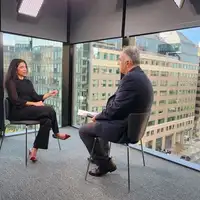

The Islamic Republic is in a "slow meltdown" that may not bring it down soon but is narrowing its options as the economy sinks, repression deepens and divisions open up among its own hardliners, analysts told Iran International's Eye for Iran podcast.
"I just don't see a pathway to rehabilitation," said Kamran Bokhari, a strategic forecaster and senior resident fellow at the Middle East Policy Council.
“This regime cannot go back to what it was.”
The pressure is coming from every direction. The rial fell past 2.5 million to the dollar this week, a record low; at that rate the minimum monthly wage of 166 million rials is worth about $66.
On Wednesday, Washington extended sanctions to Iran's auto and rail industries, on top of a naval blockade of Iranian ports and a campaign against sanctions evasion that have already cut deep into oil revenue and access to foreign currency.
At home, two people detained after January's nationwide protests were executed this week, and four others arrested during the unrest have recently been sentenced to death.
An appeals court upheld sentences of 74 lashes against the singer Parastoo Ahmadi and seven musicians and organizers over a concert she performed without a headscarf, filmed and posted online.
Human Rights Watch and the Abdorrahman Boroumand Center documented 29 executions between March and the end of August of people arrested in connection with the protests. Five were carried out in public.
'They want to show they're in charge'
Alberto Fernandez, a former US diplomat and vice president of the Middle East Media Research Institute, said the repression should be read alongside the economic pressure.
"They want to show they're in charge," he said. Extreme violence, he said, is one way of demonstrating to Iranians and to the world that the state can still impose its will. The more it relies on that, the more it shows both the power it has left and the pressure it is trying to hold down.
"The challenge of the regime is not the war," Bokhari said. "The challenge is governance and economic statecraft."
Three senior Iranian sources told Reuters last month that the US campaign against oil exports and sanctions evasion was becoming increasingly hard to withstand. The average monthly wage now covers less than a third of a household's basic costs, Reuters reported.
Even if Tehran wins some sanctions relief, Bokhari said, he sees little prospect of it recovering what it had.
"Regimes take a long time to undergo a meltdown," he said. "That meltdown was happening even before this war."
The price of eggs
David Patrikarakos, a special correspondent for the Daily Mail and an author, said he watches one basic indicator.
"I have become a keen watcher of the price of Iranian eggs," he said.
When he spoke with people inside Iran during the war, he said, the conversation kept returning to the cost of necessities.
"When the basics become too expensive, no government can deal with that," he said. "You can only terrorize people back into their homes for so many things. If they're starving, they can't afford food, there's nothing you can do."
The authorities appear to know it. More than 6,000 people have been arrested since the war began, Reuters reported this week, as officials worry about renewed protests.
But repression has limits. Bokhari called it a "precision instrument" that can backfire when used too broadly.
"You can oppress people, but if you start to do it at scale, then it can backfire," he said. "At some point, your own security forces will say, 'Where is this going?'"
'The butter part is going out'
If the Islamic Republic survives, Fernandez said, one model is what he called the "North Koreanization" or "Houthization" of Iran: a poorer, more predatory state that can still repress at home and project force abroad while its economy and institutions are hollowed out.
That was never the plan. The Islamic Republic wanted revolutionary and military power abroad and a functioning society and middle class at home, Fernandez said, the old combination of guns and butter.
"Well, the butter part is going out," he said.
Without a reversal, he said, Iran could become "a more ramshackle predatory state." "It still can bite, but it becomes much more fragile, much more fractious."
That trajectory would run against Iran's own sense of itself and the aspirations of its educated population, Patrikarakos said. "The Iranian self-image is wanting to take part in the world."
Even the Islamic Republic, for all its decades of confrontation with the West, never sought North Korea's isolation, he said.
"They don't want to go down the North Korea path," Bokhari said. "The question is, can they avoid it?"
As the options narrow, he said, survival is overriding everything else. "Regime survival is now more than ever before the primary imperative."
What to watch
Bokhari said he is watching for infighting that can no longer be contained. "I'm also watching for signs of infighting, where different elements of the regime start to disagree to a point where the disagreement isn't behind closed doors," he said.
Fernandez said the visible divisions are no longer mainly between moderates and conservatives, the old frame for Iranian politics, but among hardline factions themselves.
He is also watching the currency, and how long Tehran can hold out without real relief. Iran's leaders may be looking to the US midterm elections and the next Congress in the hope that politics in Washington will ease the pressure, he said. If that hope fails, they face a long period of no war and no peace while the squeeze continues.
The Islamic Republic has survived periods when it looked weaker, more isolated and less popular than before. Survival and recovery are not the same thing. The price of food, the value of the rial, unrest in the streets, fractures at the top and the loyalty of the security forces will show how far the meltdown has gone.
"This situation is untenable," Bokhari said.
You can watch Eye for Iran on YouTube or listen on any podcast platform.
Iran’s worsening economic crisis has opened an increasingly bitter argument over who is responsible, as the government points to outside pressure and market psychology while hardliners accuse Tehran’s own economic officials of making the situation worse.
On Thursday, the end of Iran’s market week, the rial fell to another record low. Year-on-year inflation has reached almost 90 percent, with food prices rising even faster.
The deterioration comes as US sanctions and a naval blockade squeeze Iran’s sources of revenue. The blockade has severely constrained oil exports, while Washington on Thursday expanded sanctions into the automotive and rail sectors, targeting some of the country’s largest industrial companies.
US Treasury Secretary Scott Bessent has seized on the rial’s collapse as evidence that Washington’s pressure campaign is working, saying this week that it had driven the currency to its lowest level in history.
Iranian Economy Minister Ali Madanizadeh rejected Bessent’s assessment, telling the official IRNA news agency Thursday that predictions of an imminent economic collapse had repeatedly proved wrong.
“They want to create unrest and stress among the people so they rush to the currency market and the exchange rate increases; otherwise, these statements serve no purpose, and we will not allow this to happen,” he said.
The Central Bank has offered a similar diagnosis. It said Friday that the exchange rate was not “fully consistent with the economy’s fundamental variables,” attributing much of the gap to heightened uncertainty, psychological pressure and market expectations.
The bank announced Wednesday that it planned to inject $2 billion in banknotes into the market. So far, however, the intervention has failed to halt the rial’s slide.
‘The Central Bank shoots it into its own goal’
Hardliners have challenged the government’s explanation, arguing that sanctions and the war cannot by themselves account for the surge in the exchange rate and prices.
Nadergholi Ebrahimi, a hardline lawmaker, claimed in an online interview Thursday that the war had contributed no more than 25% to the recent rise in prices and accused government economic officials of deliberately fueling inflation.
Threatening to seek the impeachment of economic ministers, he accused them of waging an “economic sedition” that was reducing the public’s ability to withstand economic pressure and increasing dissatisfaction.
Hossein Samsami, an economist and hardline lawmaker, has also attacked the Central Bank’s handling of the exchange rate.
“Today, the currency is the enemy’s tool in an all-out economic war, and the measure of its success is the devaluation of our national currency,” Samsami wrote on X.
But he accused the Central Bank itself of helping drive that process by following an exchange rate he said was artificially determined by Iran’s enemies.
“The enemy passes the ball, and the Central Bank shoots it into its own goal!” he wrote.
Inflation approaches 90 percent
Whatever the relative weight of sanctions, war, expectations and domestic policy, their combined effect is increasingly visible in household finances.
According to the Statistical Center of Iran, annual inflation has reached 73.6%, while year-on-year inflation rose to a record 89.8%.
Food and beverage prices have risen substantially faster than overall inflation, hitting lower-income households particularly hard because they devote a larger share of their income to food and other essentials.
Accelerating prices have also eroded the value of government food vouchers introduced after subsidized foreign-exchange rates for a range of goods were removed amid a sharp depreciation of the rial and economic protests in December and January.
Although the government pledged to increase the value of the vouchers in line with rising prices, it has yet to do so.
Wages fall behind as prices surge
The pressure is also increasingly visible among salaried workers.
Videos circulating on social media in recent weeks have shown teachers and nurses saying low wages have left them with no choice but to resign after years in their professions.
Ali Farhadi, spokesman for Iran’s Education Ministry, dismissed reports of widespread teacher resignations as a “rumor” on Friday.
The dispute has become another front in the broader argument over the economic crisis, with government supporters alleging that expressions of discontent are being amplified to encourage unrest and critics accusing authorities of dismissing genuine economic grievances.
Samsami, however, has placed greater responsibility for the hardship on domestic economic policy than on Washington.
“The pressure imposed on people’s livelihoods by misguided economic policies is far greater than that caused by sanctions and the naval blockade,” he wrote, adding: “We are not at an impasse. By reforming our policies, we can control inflation even under these sanctions.”
Iran’s Education Ministry dismissed reports of teacher resignations over working conditions and security pressure as a “rumor,” despite numerous videos of teachers announcing departures and a teachers’ council warning of a growing exodus.
Education Ministry spokesman Ali Farhadi said Friday that reports of teacher resignations were “not true” and accused unspecified actors of trying to undermine in-person education.
“The resignation of teachers is a rumor,” Farhadi told the Tasnim news agency, saying teachers and students had welcomed the return to classrooms across the country, including in southern provinces such as Hormozgan.
But the Coordinating Council of Iranian Teachers’ Trade Associations has offered a sharply different account, saying numerous videos and reports of resignations have emerged from different parts of the country in recent weeks.
The council said teachers were leaving because of a combination of wages below the poverty line, worsening living conditions, administrative pressures and what it described as the securitization of the profession, including dismissals, suspensions, arrests and legal cases against teachers and union activists.
It warned that experienced teachers were being driven out of classrooms by policies that had pushed the education system toward decline.
Videos circulating on social media in recent days have shown teachers announcing their resignations and citing financial hardship, workload and a lack of recognition for their work.
The dispute comes as Iran’s education system is already grappling with teacher shortages and longstanding discontent over pay and working conditions.
Teachers have repeatedly protested over salaries and benefits, including at a demonstration outside the Planning and Budget Organization in Tehran in September.
Labor activists have also warned that financial pressures are forcing some teachers to work multiple jobs, while shortages of teaching staff are affecting the quality of education.
The resignations have emerged against a wider backdrop of pressure on teachers and union activists, who in recent years have faced arrests, prison sentences, dismissal and suspension from work.
The Coordinating Council rejected the government’s portrayal of the unrest in schools as the product of outside agitation, arguing that the discontent stems instead from conditions within the education system itself.
Whether the resignations amount to the “wave” described by the teachers’ council is difficult to establish. The pressures it says are driving teachers out are considerably easier to document.
Iran’s stock market is breaking records even as the dollar and gold hit new highs, an apparent contradiction that may point to the same dynamic: households and investors scrambling to protect their wealth as the rial weakens and the economic toll of the Iran-US war grows.
Before trading closed on Wednesday, the final working day of the week in Iran, the Tehran Stock Exchange reached a record 7,766,000 points.
The market has risen 109 percent since the start of the Iranian year, while small investors poured roughly 4.7 trillion tomans, or about $19 million, into shares in a single day.
Iran’s prominent economic daily Donya-ye Eghtesad argues that the surge is not necessarily a sign of confidence. People are buying shares as political and economic risks rise, it says, while savers are also moving into gold, coins and dollars, all of which hit record highs on the same day.
The open-market dollar has passed 250,000 tomans, while measured in dollars, the stock market remains well below previous peaks.
At least part of the rally therefore appears to reflect a search for protection against the falling rial rather than confidence in the underlying economy.
Similar pressures are visible in consumer markets, where prices for cheaper mobile phones rose 33 to 42 percent in a month, outpacing the currency’s decline as import quotas, registration rules and fees hit lower-priced devices particularly hard.
Earlier this week, the government announced that the central bank would sell up to $2 billion in cash. The first $1 billion tranche is being sold through banks, with adults holding a national ID card allowed to buy up to $10,000.
The government’s own newspaper, Iran, warned that selling cash may slow the dollar’s rise but cannot reverse the underlying trend while inflation, budget pressures and political uncertainty remain unresolved.
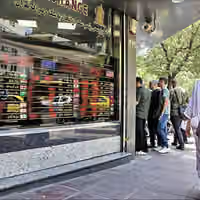
Tehran’s prosecutor also ordered action against “market disruptors,” including online channels publishing exchange rates. Eyewitnesses on Ferdowsi Avenue, the capital’s main currency-trading hub, reported shorter queues and more sellers than buyers on September 30.
The respite was brief. On October 1, the open-market dollar rose 1.49 percent to 2,593,000 rials, its highest level in a year.
The central bank has been steadily raising the official exchange rate, from about 137,000 to more than 174,000 tomans this year, to encourage exporters to repatriate their foreign-currency earnings. Even so, the open-market rate remains much higher.
Because official imports are priced at the exchange-center rate, increases can feed through into the cost of imported goods. They also reduce the real value of the government’s electronic food-voucher scheme unless the state spends more rials to maintain it.
Hardline outlets including Kayhan and the IRGC-linked Javan portray the rial’s fall as part of Washington’s economic war. But their criticism is also directed at Iranian policymakers.
Kayhan calls currency sales a repeatedly failed policy and a waste of resources in wartime. It wants the government to reverse its economic liberalization and use judicial and security pressure to force exporters to repatriate their foreign-currency earnings.
The criticism exposes an argument within the establishment over how Tehran should respond: spend scarce foreign currency trying to contain demand, or preserve it while tightening controls over exporters and the domestic market.
That argument is becoming more urgent as the US blockade curtails Iranian oil exports, depriving Tehran of a major source of foreign currency.
Diplomacy could provide some relief, with Iran seeking access to frozen assets and an easing of sanctions and the blockade as part of negotiations with Washington.
For now, however, the clearest signal comes from the markets themselves. Stocks, gold and the dollar are all setting records. The simultaneous rush into them suggests that for many Iranians, almost anything that might preserve its value increasingly looks preferable to holding rials.
At least five people were reported killed on Friday in an attack near Zahedan in southeastern Iran, as the Revolutionary Guards confirmed a roadside bombing in the area that killed one of its fighters.
Haalvsh, which covers developments in Sistan-Baluchestan, said five members of the IRGC-Quds’s Fatemiyoun militia were killed in the Rudmahi area near Zahedan after an explosive device detonated beside their vehicle and gunmen opened fire.
Iran's Revolutionary Guards gave a different account, confirming a roadside bombing in the province but saying one fighter was killed. The IRGC Ground Force said what it described as "terrorists" had planted a bomb along a road in Sistan-Baluchestan and carried out an indiscriminate attack.
The Guards did not identify the person killed, mention Fatemiyoun or give a precise location for the incident.
Conflicting accounts of Zahedan attack
Haalvsh said the attack took place at about 6:30 a.m. as the men were patrolling the Kaleh-Pedeh route in the Rudmahi area in a Land Cruiser equipped with a DShK heavy machine gun.
Citing eyewitnesses, the outlet said an explosive device was detonated as the vehicle passed and that gunmen opened fire after the blast destroyed the vehicle.
The identities of those reported killed have not been released.
Haalvsh said local sources continued to put the death toll at five and identified all of those killed as Fatemiyoun members, but said it had not been able to independently verify the precise number of deaths.
Fatemiyoun is a militia linked to the IRGC's Quds Force and made up largely of Afghan Shiites. It was formed with Iranian support and fought alongside forces loyal to Bashar al-Assad during Syria's civil war. The United States sanctioned the group in 2019.
Haalvsh said Friday's incident was the second deadly attack on forces it identified as Fatemiyoun in Rudmahi in less than a month. It reported in September that four members deployed in the area by the IRGC were killed when gunmen attacked them during a patrol.
The outlet has also reported the deployment of hundreds of Fatemiyoun members to several parts of Sistan-Baluchestan, including areas around Zahedan, Mirjaveh, Rask, Saravan, Zabol, Chabahar, Konarak and Iranshahr.
Hours of fighting in Rask
The violence on Friday was not limited to Zahedan.
Haalvsh said Iranian military and security forces moved in Rask county at about 5:30 a.m., triggering fighting with armed men that lasted more than six hours.
Heavy gunfire and explosions were heard during the confrontation, according to the outlet, which said reinforcements and additional military equipment were sent to the area.
Armored vehicles, pickup trucks and civilian cars with private license plates were seen at the scene, while a vehicle carrying a heavy weapon was also deployed, Haalvsh reported.
Local sources cited by the outlet said reconnaissance quadcopters and explosive drones were used during the operation.
Haalvsh said the identity and affiliation of the gunmen remained unknown and that no reliable information had emerged about casualties or damage.
IRGC-linked Fars news agency, citing an unnamed source, said security forces had begun an operation against armed groups in Rask on Friday morning and that "a number" of gunmen had been killed. Fars said the operation was continuing.
Intelligence facility targeted
An intelligence ministry facility in Nokabad, the administrative center of Taftan county, was also attacked by gunmen early Friday, according to the Baloch Human Rights Documentation Network.
The group said the attackers fired at the building. Local sources also reported an explosion and said a grenade may have been used.
No casualties or damage were immediately reported, and no individual or group had taken responsibility for the attack.
Fighting follows deadly clash a day earlier
Friday's incidents came a day after another hours-long confrontation near Zahedan.
On Thursday, the IRGC said six gunmen were killed during fighting with security forces in the Manzelab area. The Guards' Quds regional headquarters said its forces had identified and "destroyed" what it described as an armed "terrorist-Takfiri" cell that had been preparing an attack.
Haalvsh said that clash began at about 6 a.m. and continued for several hours, with heavy gunfire and rocket-propelled grenade fire heard in the area.
The IRGC said explosive devices were recovered but did not identify the armed group or name those killed.
A police officer, Alireza Sanchouli, was also killed in a separate armed attack on a checkpoint at the entrance to Rask, according to Iranian reports.
At least one person was killed earlier in the week during another confrontation with security forces in Iranshahr.
Last month, a roughly nine-hour battle in the Bakhshan area of Saravan killed three IRGC members and four gunmen. Reports at the time linked the armed side to the People's Fighters Front, an alliance formed in late 2025 that includes several Baluch armed groups, among them Jaish al-Adl.
Iranian authorities regularly describe armed groups operating in Sistan-Baluchestan as terrorist organizations. The southeastern province has seen repeated armed attacks, insurgent activity and clashes between security forces and gunmen in recent weeks.