• العربية
  • فارسی
Brand
  • Iran Insight
  • Politics
  • Economy
  • Analysis
  • Special Report
  • Opinion
  • Podcast
  • Live TV
  • Iran Insight
  • Politics
  • Economy
  • Analysis
  • Special Report
  • Opinion
  • Podcast
  • Live TV
  • Theme
  • Language
    • العربية
    • فارسی
  • Iran Insight
  • Politics
  • Economy
  • Analysis
  • Special Report
  • Opinion
  • Podcast
  • Live TV
All rights reserved for Volant Media UK Limited
volant media logo

Iran lawmaker says armed forces have full control over Strait of Hormuz

Oct 2, 2026, 11:15 GMT+1

Iran’s armed forces have “full intelligence and operational oversight” of the Strait of Hormuz, the head of parliament’s civil affairs committee said on Friday.

“Any vessel seeking to pass through the Strait of Hormuz, and any developments there, will be subject solely to the will of Iran’s armed forces,” Mohammadreza Rezaei Kouchi said.

Most Viewed

Iran oil exports vanish as regional flows surpass prewar levels
1

Iran oil exports vanish as regional flows surpass prewar levels

2
INSIGHT

US ‘feedback’ leaves Iran debating the price of diplomacy

3

Iranian weapons, Chinese supplies fuel Houthi advance in Yemen - WSJ

4

Trump says renewed bombing of Iran after midterms 'possible'

5
INSIGHT

Tehran weighs what comes next if US diplomacy fails

Banner
Banner

Spotlight

  • Can the Caspian give Iran a way around Hormuz?
    ANALYSIS

    Can the Caspian give Iran a way around Hormuz?

  • An account of espionage: From banks and phone lines to Malard missile base blast
    SPECIAL REPORT

    An account of espionage: From banks and phone lines to Malard missile base blast

  • Iranian press sees diplomacy alive but narrowing after US response
    INSIGHT

    Iranian press sees diplomacy alive but narrowing after US response

  • Leaked Kremlin plan undercuts Moscow's claims on ruble-rial trade with Iran
    INSIGHT

    Leaked Kremlin plan undercuts Moscow's claims on ruble-rial trade with Iran

  • Iran oil exports vanish as regional flows surpass prewar levels

    Iran oil exports vanish as regional flows surpass prewar levels

  • 670 bridges, 380 tunnels: The network that moves Iran's army and its missiles
    SPECIAL REPORT

    670 bridges, 380 tunnels: The network that moves Iran's army and its missiles

  • Iran turns to younger children in postwar ideological push
    ANALYSIS

    Iran turns to younger children in postwar ideological push

Banner
Banner
Banner
•
•
•

More Stories

Al-Qaeda is Iran's quiet backup if the war turns, expert says

Oct 2, 2026, 10:15 GMT+1
•
Kambiz Tavana
100%
Sara Harmouch, chief executive of H9 Defense and an adjunct professor at George Washington University, during an interview with Iran International in Washington, DC

Iran has spent two decades keeping al-Qaeda close as a partner it can deny, and could turn to it if the war with the United States escalates, a counterterrorism expert told Iran International. With Hezbollah and Hamas weakened, she said, it is the card Tehran has left.

Sara Harmouch, chief executive of H9 Defense and an adjunct professor at George Washington University, said the relationship is no longer a historical footnote.

"Who is better to rise as a secret proxy for Iran than al-Qaeda?" she said. "Al-Qaeda keeps a low profile and continues to maintain plausible deniability."

Intelligence circulating in the Middle East and among the Arab states of the Persian Gulf, which US and Western officials have not confirmed, suggests that Saif al-Adel, al-Qaeda's de facto leader, who has long been based in Iran, is preparing attacks if the war widens, Harmouch said. That would suit both sides, she said: Iran could deny involvement, and al-Qaeda could return to the world stage against Western interests.

"It's all possible, and it's not far-fetched," she said. Iran, she added, had helped with the operations, funding and logistics of the September 11 attacks. "So why wouldn't they now, especially if they're in such a difficult situation with the war?"

The 9/11 Commission found that Iran allowed several of the hijackers to transit its territory but found no evidence that Tehran knew of the plot. A US federal court later found Iran liable in a civil case brought by victims' families, a judgment Iran did not contest.

'Pragmatism always trumps ideology'

Washington, Harmouch argued, still treats the rivalry between Sunni and Shia Islam as a wall. In 2024 she wrote that al-Qaeda was becoming "Iran's ace in the hole," with Adel at the center. Western outlets turned the piece down, she said, because editors would not accept cooperation across the sectarian line.

"Someone who has not been to the region at all felt compelled to tell me, oh, but there's a Sunni-Shia divide," she said.

She made the argument instead on the podcast of Michael Morell, a former acting director of the CIA. Two years later, she said, the same pattern is being reported as news: al-Qaeda in Yemen has stopped fighting the Houthis, and the cooperation has spread to al-Shabaab in Somalia.

"Pragmatism always trumps ideology," she said.

As evidence of that shift, Harmouch pointed to a drone unit the Houthis helped al-Qaeda set up, a joint meeting of al-Qaeda in Yemen, al-Shabaab and the Houthis, and a claim that the Houthis paid al-Qaeda $65,000 in recent months for an attack carried out on their behalf.

Al-Qaeda has publicly rejected UN findings that it cooperates with the Houthis and has stepped up anti-Houthi propaganda, which she read as cover rather than a break.

The leader who avoids the camera

Adel, she said, is why the silence in Yemen was predictable. Al-Qaeda has never publicly named him leader because he is in Iran, and unlike Osama bin Laden he avoids the camera. A 52-minute al-Qaeda video released around this year's September 11 anniversary used old footage of Hamza bin Laden and quoted Adel's book without showing him. In that book, she said, the word "deception" appears 99 times.

In her account, the relationship took shape after 2001, when al-Qaeda figures fled Afghanistan for Iran. Tehran detained some and sent others home. It kept Adel, under what former CIA director George Tenet later called a loose house arrest. Adel stayed close to Qassem Soleimani, the Revolutionary Guards' Quds Force commander, and, Harmouch said, told him: "We are partners. We're not enemies. We are partners in changing the world."

She traced episodes that, she said, show the house arrest was never a cage: the 2003 Riyadh bombings, which US officials said were directed in part from Iran; a 2013 plot to derail a train between Toronto and New York, which Canadian police said had direction from al-Qaeda elements in Iran; and, after Abu Musab al-Zarqawi began killing Shia in Iraq, a turn from hospitality to coercion, including the holding of members of bin Laden's family.

In a 2007 letter, bin Laden called Iran "our main artery for funds, personnel, and communications" and warned against attacking it. In 2008, she said, Ayman al-Zawahiri praised the Revolutionary Guards for strengthening al-Qaeda in Yemen.

In Syria, she said, the relationship worked like a proxy arrangement. Iran released Muhsin al-Fadhli, who went on to move money and fighters into the Syrian war. In 2015 it freed Abu Khayr al-Masri and other senior figures in a prisoner exchange; Harmouch said the Quds Force used them to split the forces of Abu Muhammad al-Jolani, now Syria's president, Ahmad al-Sharaa.

Abu Muhammad al-Masri, al-Qaeda's second in command, remained in Iran until Israeli agents killed him in Tehran in 2020. The US Treasury has since sanctioned Iranian-based networks for supporting al-Qaeda.

After Zawahiri was killed in 2022, Adel's rise closed the circle, she said. Since the Hamas attack of October 7, 2023, he has told affiliates to stop hitting Iran's proxies. What unites them, in his words as she rendered them, is greater than what unites their enemies: one God, one qibla, the direction of prayer, and one political goal. His statements and Tehran's have lined up on the Red Sea, on protests at American universities, and on Afghanistan.

'There is no winning'

A deal, or a harder US campaign, would not end the problem, Harmouch said. Iran fights by attrition and will absorb losses the United States will not, and when it cannot control what happens outside its borders, it turns on its own population.

The cells inside the United States that are often cited as a threat have not produced a directed attack, she said. They may not exist, or Tehran may be holding them as leverage that disappears once used.

The likelier diversion, in her view, is an al-Qaeda attack Iran can disown, buying time to rebuild. A nuclear announcement is possible, she said, but less necessary since Iran's closure of the Strait of Hormuz showed what it could do to American gasoline prices.

"I don't think there is winning a war against Iran," she said. "As long as it's still in the fight, it is winning."
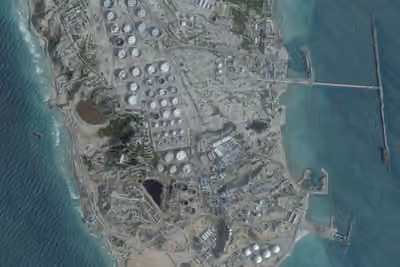

Can the Caspian give Iran a way around Hormuz?

Oct 2, 2026, 09:21 GMT+1
•
Umud Shokri
100%
File photo: Ships dock at Anzali Port on Iran’s Caspian Sea coast

With war disrupting Iran’s southern trade routes, Tehran is looking north to the Caspian for alternatives. But the available evidence suggests they cannot replace its crucial oil exports.

More cargo moving across the Caspian could help Iran keep supplies coming in. But rising freight totals do not show whether Tehran has found a practical alternative for exporting oil.

To establish that, we need to know what is being shipped, where it is going and what trade it replaces.

Grain and industrial goods can ease shortages; crude needs its own export infrastructure and buyers. Iran’s oil swaps at Neka show both what the northern route can offer and what it cannot.

What the freight numbers measure

Russia’s Ministry of Transport reported 1.8 million tonnes of freight on the trans-Caspian route in 2025 and 1.3 million tonnes in the first half of 2026. It separately reported maritime freight of 2.8 million tonnes in 2025 and about 4.5 million tonnes in the first seven months of 2026.

The figures point to increased activity, but the ministry does not break the cargo down by Iranian origin, Iranian destination or commodity.

The North–South Transport Corridor spans several countries, routes and modes. Cargo can transit Iran without being Iranian trade or move between other participating countries.

A corridor-wide increase could reflect transit shipments, trade between third countries or Iranian goods rerouted from elsewhere. The aggregate numbers do not distinguish among them.

Nor should the route and maritime figures be added together as if they measure the same flow. The ministry presents them separately and does not provide enough detail to establish how their coverage overlaps.

Evidence of genuine substitution requires knowing what cargo moved, where and which route it replaced. Grain rerouted from a southern port to northern Iran would demonstrate substitution for that cargo.

A shipment merely transiting Iran would demonstrate corridor use, not replacement of lost Iranian trade.

Imports and exports are different problems

Northern routes can still be valuable for Iran. Food, feed and industrial inputs can support domestic supply during a disruption. But that resilience should not be confused with replacing oil revenue.

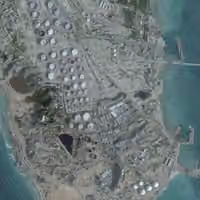
Around 90% of Iran’s crude exports normally pass through Kharg Island in the Persian Gulf, according to Reuters. Bringing goods into northern Iran does not automatically provide the terminals, pipelines and shipping arrangements needed to move Iranian crude to international buyers.

Iran’s ports have nominal annual capacity of about 300 million tonnes, but only around 30 million tonnes is in the north, according to figures cited by Al Jazeera. One large vessel in the south can potentially carry as much cargo as 20 Caspian ships.

The question is not simply whether trade can move north, but whether those routes can serve the same economic purpose at comparable scale.

Neka was not an oil-export system

Iran’s Neka terminal was connected by pipeline to refineries in Tehran and Tabriz. Under previous oil-swap arrangements, crude from Caspian producers was delivered to Neka and processed in northern Iran. Iran then made an equivalent volume of its own crude available for export through Kharg.

The arrangement helped supply northern refineries while freeing Iranian crude elsewhere for export. It did not eliminate reliance on southern export infrastructure.

Swap volumes peaked at about 110,000 barrels per day in June 2006, fell to almost zero by 2011 and did not subsequently resume at scale, according to Lee and Kalyuzhnova. Changes in relative pricing were among the factors that made the route less attractive.

Infrastructure alone therefore does not create a durable oil route. The economics of each barrel, the terms of any swap and the availability of buyers matter too.

Any claim that Neka now provides a meaningful export alternative requires current evidence: how much crude is arriving, whether it is being refined, swapped or exported, and where any exported Iranian barrels actually leave the country.

Who controls the alternative?

Moscow’s transport ministry links freight growth to Russian-Iranian cooperation and identifies the unfinished Rasht–Astara railway as a key project.

The more important question is whether Iranian access depends on a limited number of suppliers, carriers, financiers or cross-border arrangements. Iran could gain another route while still having little control over the terms on which it operates.

That is not inevitable. A corridor involving several suppliers and transport partners could give Tehran more options.

The test is whether cargo can move regularly at competitive cost, with workable payment and customs arrangements, without a single partner becoming a bottleneck.

What would an alternative look like?

The available figures establish that activity on parts of the northern corridor has increased. They do not establish how much Iranian trade has been rerouted, whether those routes are commercially sustainable or whether they can substitute for oil-export capacity.

The Caspian may give Iran useful alternatives for specific shipments. Whether that amounts to strategic diversification depends on what Iran can move, at what scale, where it can send it and who sets the terms.

For now, rising freight totals are a starting point for that analysis, not proof that Iran has built a northern substitute for its oil-export system.

Iran's rhetoric against UAE hardens after Netanyahu visit

Oct 2, 2026, 08:00 GMT+1
•
Maryam Sinaiee
100%
Masoud Pezeshkian and Khaled bin Mohamed bin Zayed Al Nahyan, Crown Prince of the United Arab Emirates

Iranian officials and media have sharply condemned Israeli Prime Minister Benjamin Netanyahu’s visit to the UAE, warning Abu Dhabi over its deepening ties with Israel amid renewed tensions over three disputed Persian Gulf islands.

Iran’s Foreign Ministry on Thursday condemned Netanyahu’s visit, warning of what it called the “very dangerous consequences” of an Israeli presence in the region.

The ministry said any move that provides “a platform for destabilizing actors to enter the region” would ultimately harm regional countries by fueling division and instability. It called on governments to prevent their territories from becoming “a platform for destabilizing actions” against neighboring states.

Mohsen Rezaei, secretary of Iran’s Supreme National Security Council, issued a more direct warning to the UAE on Wednesday.

“Just as hosting US military bases has not brought you security, hosting the butcher of Gaza will not have positive consequences either,” he wrote on X. “Learn from the recent war, stop starting wars and refrain from making baseless claims about the Iranian islands.”

The hardline Javan newspaper, affiliated with the Revolutionary Guards (IRGC), described Rezaei’s remarks as “a clear warning to Abu Dhabi,” saying Iran’s neighbors could pay a price for policies they believed would bring them greater security.

The rhetoric comes as the UAE’s security relationship with Israel faces fresh scrutiny following an attempted attack aboard a Flydubai flight from Dubai to Tel Aviv.

Israeli and Emirati authorities are investigating the incident, while US President Donald Trump said Thursday that investigators were examining a possible Iranian connection, although no evidence of Tehran’s involvement has been made public.

Iranian media intensify criticism

The criticism in Iranian media has increasingly gone beyond Netanyahu’s visit, with conservative outlets portraying the UAE as an active participant in efforts to contain Iran and questioning whether its cooperation with Israel extends beyond diplomacy.

Nour News, which is close to the Supreme National Security Council, accused the UAE of pursuing a two-track policy — publicly advocating de-escalation and dialogue with Iran while maintaining close security ties with the United States and Israel and pressing its claims to the disputed islands.

The website also portrayed Netanyahu’s visit as part of broader Israeli-Emirati efforts to reshape the regional security order and increase pressure on Saudi Arabia, though it offered no evidence of a coordinated plan.

Sobh-e No, considered close to parliament speaker Mohammad-Bagher Ghalibaf, warned that cooperation with a country involved in a war against Iran, whether military or intelligence-related, could affect Tehran’s security calculations.

The newspaper questioned whether the UAE’s role had been limited to hosting political meetings or whether its security cooperation with Israel had extended to the military confrontation with Iran.

Economic ties under strain

The increasingly hostile rhetoric comes against a history of extensive economic ties between Iran and the UAE, although Abu Dhabi suspended trade with Iran in August amid the war.

In 2024, around $21 billion of Iranian imports came from the UAE, accounting for roughly 30% of the total, according to World Trade Organization data. The UAE was also one of Iran’s largest destinations for non-oil exports.

The country has also long served as a hub for Iranian companies and intermediaries involved in moving goods and money around US sanctions.

Some Iranian conservatives are now arguing that those economic ties gave the UAE excessive influence over Tehran’s policy.

Conservative political activist Ali Gholhaki accused the UAE of profiting from sanctions on Iran while increasingly using its influence in Israel’s favor. He also alleged the existence of a “UAE lobby” inside Iran that had prevented Tehran from taking punitive measures against Abu Dhabi.

Calls for retaliation

The rhetoric has gone further among some figures close to Iran’s political establishment, with calls for direct retaliation against the UAE.

Mehdi Mohammadi, a strategic adviser to parliament speaker Ghalibaf, accused the UAE of cooperating with Netanyahu in launching a war against the Islamic Republic in a commentary published by the conservative Alef website.

“There is not much difference between them and the Israelis,” Mohammadi wrote.

“This time, the Emiratis should taste in Dubai, Sharjah and Ras al-Khaimah what they have brought about in Africa, Yemen, Somalia and the Arabian Peninsula. It is time for flames of light to be seen in the middle of Dubai.”

The rhetoric marks a sharp deterioration in Iranian discourse toward a neighbor with which Tehran had until recently sought de-escalation and maintained extensive commercial ties, with Netanyahu’s visit intensifying an already widening rupture over Israel, regional security and the disputed islands.

Iranian press sees diplomacy alive but narrowing after US response

Oct 2, 2026, 03:34 GMT+1
•
Behrouz Turani
100%
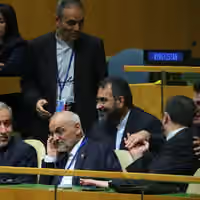
Iranian Foreign Minister Abbas Araghchi and other delegates attend the 81st United Nations General Assembly (UNGA) at UN headquarters in New York City, US, September 23, 2026.

Tehran media see diplomacy with Washington as increasingly precarious but not yet dead, with the two sides far apart over the sequencing of any deal and the window for compromise appearing to narrow.

Iran has disputed US accounts that Secretary of State Marco Rubio ordered Foreign Minister Abbas Araghchi and his delegation to leave the country after indirect negotiations in New York reached a stalemate.

Iran’s UN mission said the delegation left according to a schedule communicated to the State Department on September 17 and dismissed reports of a US-mandated departure as “baseless and worthless.”

Two US officials told the Associated Press that Rubio ordered the delegation to leave after little progress in indirect talks mediated by Qatar.

The dispute follows Washington’s response to Iran’s seven-point proposal for de-escalation and reopening the Strait of Hormuz. Araghchi has said Tehran has made no changes to the proposal, which calls for lifting the blockade and unfreezing Iranian assets as steps toward reopening maritime transit and resuming nuclear negotiations.

Iranian media have nevertheless stopped short of declaring the diplomatic process dead.

Across outlets ranging from the government’s Iran Newspaper and state broadcaster-affiliated Jam-e Jam to the moderate business daily Donya-ye Eghtesad, the negotiations are portrayed as a stalled bargaining process rather than a complete collapse.

Washington’s response, delivered through Qatar, is seen as keeping the diplomatic channel open even as the two sides remain far apart.

Across the three outlets, four broad conclusions emerge.

First, no comprehensive settlement appears close. Even the more optimistic assessments envisage, at best, a phased arrangement focused initially on crisis management rather than a broader breakthrough.

Second, trust remains a central constraint. Iran Newspaper and Jam-e Jam cite the US withdrawal from the JCPOA in 2018 and subsequent American policy, while Donya-ye Eghtesad frames the problem more neutrally as the enduring question of which side should move first.

Third, the central dispute is increasingly about sequencing. Tehran wants an end to hostilities, sanctions and blockade relief before reopening Hormuz within seven days and moving to nuclear talks. Washington wants nuclear concessions and movement on Hormuz before easing pressure.

Fourth, from Tehran’s perspective, the Islamabad Memorandum of Understanding remains the principal reference point. The Iranian press portrays the seven-day plan as an accelerated version of the June framework rather than a departure from it.

As the government’s voice, Iran Newspaper presents the seven-point proposal as a reasonable sequence that Washington is obstructing.

It also turns its attention to actors it sees as working against diplomacy, linking Benjamin Netanyahu’s visit to the UAE and his reported intelligence briefing there to efforts to build regional opposition to Iran.

Jam-e Jam similarly rejects accusations that Tehran is seeking to avoid the nuclear issue, arguing that the proposal would bring forward the start of nuclear negotiations from roughly 60 days to seven.

Donya-ye Eghtesad, however, focuses more heavily on the costs of prolonged deadlock. It treats the US response as a test of Iran’s willingness to show nuclear flexibility and argues that verifiable limits on its program would improve the prospects for an agreement.

Despite their different political orientations, the three outlets broadly treat the seven-point plan as the basis for further negotiations rather than something Tehran should abandon.

The remaining debate is largely about timing.

Iran Newspaper and Jam-e Jam argue that leverage over Hormuz, combined with US pre-election concerns about energy prices, favors Tehran holding firm. Donya-ye Eghtesad warns instead that the diplomatic window could close within weeks and that the risks of waiting until after the election may outweigh the benefits.

Trump’s rejection of key Iranian demands, Israeli intelligence activity and the UAE’s acknowledgement of Netanyahu’s visit also provide ammunition to voices in Tehran arguing against early concessions.

Jam-e Jam compared the diplomatic process to a game of Snakes and Ladders, in which every advance is followed by a setback. For now, it sees the US midterm elections as the next major variable that could alter the calculations of either side.

Leaked Kremlin plan undercuts Moscow's claims on ruble-rial trade with Iran

Oct 2, 2026, 01:38 GMT+1
•
Kerri Bitsoff
100%
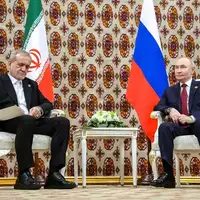
Russian President Vladimir Putin and Iranian President Masoud Pezeshkian attend a meeting in Ashgabat, Turkmenistan December 12, 2025.

A leaked Russian government roadmap obtained by Fox News put the share of Russia-Iran trade settled in national currencies at 68%, far below Moscow’s public claims that nearly all bilateral trade had shifted to rubles and rials.

The push to settle bilateral trade outside the dollar has drawn renewed US scrutiny. Last month, the US Treasury imposed new sanctions on Russia’s VTB Bank, in part for its role in creating a ruble-rial settlement system.

On Thursday, Treasury also targeted the Russia-linked A7 Network, describing it as a “shadow banking network” used by Iran to evade sanctions. It said A7’s sub-agents formed a money-laundering and sanctions-evasion mechanism connected to Russian illicit finance that Iran used to move funds, including for oil sales and weapons procurement.

Both governments have spent years insisting they don’t need the dollar, but the amount of trade settled in each other’s currencies isn’t a number you need to announce unless you’re trying to convince people that sanctions aren’t working.

Sanctions leverage only works if people believe it is there. To convince people otherwise, Russia has since 2019 announced a rising share of its Iran trade settled in rubles and rials: from 40 percent to 50, 60, 80, until Putin himself claimed 95 percent in January 2025.

The Islamic Republic communicates in broad proclamations rather than Soviet-style quarterly statistical reports: its central bank governor said in November 2024 that Iran had “completely excluded the dollar” and traded only in rubles and rials.

But the internal plan, approved in September 2024, put it at 68 percent, with a goal of 71 by 2026.

The reality doesn’t fit the claim

The Kremlin’s claim of a working ruble-rial payment system is harder to sustain when the two sides have an imbalance in trade, because that can leave one side without enough of the other’s currency to meet demand. Russian figures put 2023 bilateral trade at about $4 billion, comprising $2.7 billion in Russian exports and $1.3 billion in Iranian exports.

The two countries also simply do not like holding each other’s currencies. Russia’s central bank described its problem with currencies like the rial in 2023: they are “often non-convertible or only partially convertible,” carry “higher volatility,” and trade in markets too thin to hedge.

Iranian exporters, according to Iran’s Resistance Economy Think Tank, refuse rubles when they can, and if they accept them sell them for dirhams as quickly as possible.

The usual fix for a shortage like this is a central bank swap line, which Iran and Russia signed in July 2024. Two years on, however, the only money either side has publicly put behind it was a 1 billion-ruble deposit, worth about $10 million at the time, at VTB to cover “possible ruble shortages,” and any further draw would leave Russia holding rials as collateral — a currency it cannot sell at home and that has lost 29 percent against the ruble since January.

An Iranian MP says Russia has offered a $20 billion ruble loan that Iran has not taken.

The trade goes around it

If the ruble-rial system worked as advertised, Iranian merchants wouldn’t be paying exchange houses in Dubai and Turkey to reach Russian suppliers.

Iranian MP Meysam Zohourian told Fars News in June that before the war even essential goods bought from Russia were routed through the UAE and settled in dirhams.

Fars asked in August why merchants still settle Russia trade through exchange houses and trustees in Turkey.

Iran’s central bank governor, Abdolnaser Hemmati, called his June trip to Moscow “an operational mission to untie the knots” in foreign trade, starting with letters of credit for Iranian merchants.

What the number counts

Whatever number is claimed, it doesn’t measure money moving between Russia and Iran — it’s a bookkeeping instrument, recording which currency left a Russian company’s account, not what currency reached the other side.

If a Russian importer’s bank takes rubles out of its account, converts them to dollars, and pays the seller in dollars, Russia’s Central Bank counts that as a ruble settlement, despite a contract priced in dollars and a seller that receives dollars.

The number also leaves out trade arranged without conventional cross-border payments. When countries are cut off from the international financial system, it’s easier to move goods than money, and Russia and Iran have increasingly turned to barter and swap arrangements.

Moscow has made barter official policy. The economy ministry issued a government manual for barter contracts in 2023, and a Russian economist says Iran is the one trading partner where barter accounts for a real share of the trade.

Russia and Iran have also pursued energy swaps. Swap deliveries of petroleum products had begun by late 2022, while the two sides were discussing a broader arrangement covering up to 5 million tons of oil and 10 billion cubic meters of gas a year. Trade conducted through such arrangements would not necessarily appear in the national-currency settlement percentage.

What the mismatch tells you

Russia and Iran’s coordination is real, but both countries overstate the impact. The public number, announced for propaganda value, doesn’t even match the government’s internal goal.

And the mechanism is in reality a cobbled-together assortment of poorly working, mismatched payment arrangements that don’t serve either side well except in their fight against the international financial system.