US approves waiver for 40 daily Iran flights to/from Najaf, Iraq says
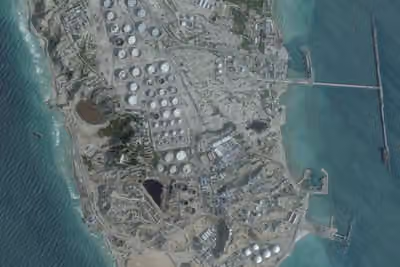
The United States has agreed to grant a waiver allowing Iranian airlines to operate 40 daily flights to and from Iraq’s Najaf International Airport, excluding Mahan Air, the Iraqi prime minister’s office said Friday.
The office said the agreement followed Iraqi government efforts to resume the flights, including contacts with relevant parties. It welcomed Washington’s decision, saying it would ease travel between Iran and Iraq for medical treatment, religious visits and tourism.
Baghdad would continue consultations to remove obstacles to air transport, the statement added.
At least five people were reported killed on Friday in an attack near Zahedan in southeastern Iran, as the Revolutionary Guards confirmed a roadside bombing in the area that killed one of its fighters.
Haalvsh, which covers developments in Sistan-Baluchestan, said five members of the IRGC-Quds’s Fatemiyoun militia were killed in the Rudmahi area near Zahedan after an explosive device detonated beside their vehicle and gunmen opened fire.
Iran's Revolutionary Guards gave a different account, confirming a roadside bombing in the province but saying one fighter was killed. The IRGC Ground Force said what it described as "terrorists" had planted a bomb along a road in Sistan-Baluchestan and carried out an indiscriminate attack.
The Guards did not identify the person killed, mention Fatemiyoun or give a precise location for the incident.
Conflicting accounts of Zahedan attack
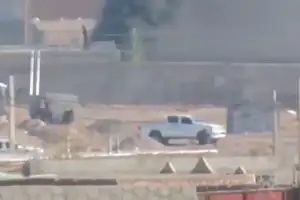
Haalvsh said the attack took place at about 6:30 a.m. as the men were patrolling the Kaleh-Pedeh route in the Rudmahi area in a Land Cruiser equipped with a DShK heavy machine gun.
Citing eyewitnesses, the outlet said an explosive device was detonated as the vehicle passed and that gunmen opened fire after the blast destroyed the vehicle.
The identities of those reported killed have not been released.
Haalvsh said local sources continued to put the death toll at five and identified all of those killed as Fatemiyoun members, but said it had not been able to independently verify the precise number of deaths.
Fatemiyoun is a militia linked to the IRGC's Quds Force and made up largely of Afghan Shiites. It was formed with Iranian support and fought alongside forces loyal to Bashar al-Assad during Syria's civil war. The United States sanctioned the group in 2019.
Haalvsh said Friday's incident was the second deadly attack on forces it identified as Fatemiyoun in Rudmahi in less than a month. It reported in September that four members deployed in the area by the IRGC were killed when gunmen attacked them during a patrol.
The outlet has also reported the deployment of hundreds of Fatemiyoun members to several parts of Sistan-Baluchestan, including areas around Zahedan, Mirjaveh, Rask, Saravan, Zabol, Chabahar, Konarak and Iranshahr.
Hours of fighting in Rask
The violence on Friday was not limited to Zahedan.
Haalvsh said Iranian military and security forces moved in Rask county at about 5:30 a.m., triggering fighting with armed men that lasted more than six hours.
Heavy gunfire and explosions were heard during the confrontation, according to the outlet, which said reinforcements and additional military equipment were sent to the area.
Armored vehicles, pickup trucks and civilian cars with private license plates were seen at the scene, while a vehicle carrying a heavy weapon was also deployed, Haalvsh reported.
Local sources cited by the outlet said reconnaissance quadcopters and explosive drones were used during the operation.
Haalvsh said the identity and affiliation of the gunmen remained unknown and that no reliable information had emerged about casualties or damage.
IRGC-linked Fars news agency, citing an unnamed source, said security forces had begun an operation against armed groups in Rask on Friday morning and that "a number" of gunmen had been killed. Fars said the operation was continuing.
Intelligence facility targeted
An intelligence ministry facility in Nokabad, the administrative center of Taftan county, was also attacked by gunmen early Friday, according to the Baloch Human Rights Documentation Network.
The group said the attackers fired at the building. Local sources also reported an explosion and said a grenade may have been used.
On Thursday, the IRGC said six gunmen were killed during fighting with security forces in the Manzelab area. The Guards' Quds regional headquarters said its forces had identified and "destroyed" what it described as an armed "terrorist-Takfiri" cell that had been preparing an attack.
Haalvsh said that clash began at about 6 a.m. and continued for several hours, with heavy gunfire and rocket-propelled grenade fire heard in the area.
The IRGC said explosive devices were recovered but did not identify the armed group or name those killed.
A police officer, Alireza Sanchouli, was also killed in a separate armed attack on a checkpoint at the entrance to Rask, according to Iranian reports.
At least one person was killed earlier in the week during another confrontation with security forces in Iranshahr.
Last month, a roughly nine-hour battle in the Bakhshan area of Saravan killed three IRGC members and four gunmen. Reports at the time linked the armed side to the People's Fighters Front, an alliance formed in late 2025 that includes several Baluch armed groups, among them Jaish al-Adl.
Iranian authorities regularly describe armed groups operating in Sistan-Baluchestan as terrorist organizations. The southeastern province has seen repeated armed attacks, insurgent activity and clashes between security forces and gunmen in recent weeks.
Hamid Kouhsari was carrying a wounded woman on his back through the streets of Gorgan on January 8 when security forces shot him from behind. He spent the next eight months in hiding with his leg untreated, before leaving Iran.
Kouhsari, 31, told Iran International that during the January 2026 uprising he saw security forces use violence unlike anything he had witnessed before in Gorgan, the capital of Golestan province in northern Iran, including the shooting of a toddler in the face. He spoke from a location that is being withheld because he fears reprisals from the Iranian authorities.
Security forces opened fire directly on crowds on January 8 as demonstrations swelled across the city, he said.
"You couldn't believe what you were seeing," he said. "They pointed their weapons directly at the crowd and opened fire. People were falling like sparrows."
Kouhsari had taken part in the November 2019 protests and in the 2022 protests that followed the death in morality police custody of Mahsa Amini, who had been detained for allegedly violating Iran's hijab rules. Nothing he saw then, he said, compared with January.
"It was unimaginable," he said. "They were firing bursts into the middle of the crowd."
‘The hardest part’
The scene that affected him most, Kouhsari said, involved a couple carrying a child he thought was about two years old.
"The hardest part for me was when there was a husband and wife with a child, about two years old, in their arms," he said.
All three were caught in the gunfire, he said. The father was hit below the waist, and the mother in her face, neck and abdomen. Kouhsari and others moved the parents toward people helping the wounded.
In the chaos, his attention turned to their child.
"I was thinking about the child in all that fear and panic," he said.
He realized he could no longer hear the toddler crying, he said, and then saw the child lying near the curb.
"I was just praying the child wasn't dead, that they were unconscious," he said.
When he picked the child up, he saw a severe gunshot wound to the face.
"Half of the child's face was gone from the bullet," he said.
Kouhsari said he screamed and began crying, then carried the child to a woman helping the wounded.
"I told her, 'This is their child too. Wherever you sent the mother and father, send the child there as well.'"
He never learned what happened to the family.
Shot while carrying a wounded woman
Later that night, another wounded woman begged him for help.
"Help me. Don't let them kill me," he recalled her saying.
Kouhsari lifted her onto his back and began carrying her toward the crowd.
"I told her, even if I die myself, I won't let you die here," he said.
As he neared the other protesters, security forces shot him from behind in the right leg.
He managed a few more steps before collapsing. Protesters pulled him into the crowd and used scarves and shoelaces to stem the bleeding.
Video reviewed by Iran International shows Kouhsari lying in a house where he was hiding, his wounded leg bleeding into a container, visibly in pain.
A screengrab of footage showing Hamid Kouhsari receiving makeshift treatment for a gunshot wound to his right leg while in hiding after the January 8 protests in Gorgan.
He could not risk going to a hospital, he said, and was afraid even to try to get medicine from a pharmacy, because wounded protesters were being identified and detained.
"I wasn't afraid of being shot," he said. "I was terrified they would come and take me away."
That fear came from what happened after the November 2019 protests. Kouhsari said he was detained and later summoned to a Revolutionary Guards facility in Gorgan, where over several hours he was pressured into recording a confession.
His father, he said, was a veteran of the 1980-88 Iran-Iraq war and was wounded in it. Decades later, the son was shot by his own country's security forces in the street.
A doctor who later examined his leg privately told him it needed surgery because of damage to the bone and nerves, Kouhsari said.
The operation never happened.
Kalashnikovs, pellet guns and lasers
Kouhsari said he saw security forces use Kalashnikov-type rifles and pellet guns on January 8, as well as a weapon he could not identify.
He also described gunmen positioned above the streets, and protesters being marked with lasers before they were shot from those elevated positions.
"They would keep the laser on them even when they went into the crowd," he said. "The sniper from above would shoot the people they had marked with the laser."
Separate CCTV footage from Gorgan on January 9, obtained and verified by Iran International, shows security forces using lasers during the crackdown.
Kouhsari said Reza Asadi, a protester killed by live fire in Gorgan on January 8, was among those he saw marked with a laser before being shot.
CCTV footage obtained and verified by Iran International shows security forces using lasers in Gorgan on January 9, a day after Hamid Kouhsari said protesters were targeted with similar tactics.
A body taken, a family kept searching
Among those killed that night was Kouhsari's relative Mostafa Kouhsari, a father of two from Azadshahr, about 75 kilometers east of Gorgan.
Mostafa was shot at around 9 p.m., Kouhsari said, and died on the way to the hospital as protesters tried to save him.
Revolutionary Guards forces took his body, Kouhsari said, and for four days the family had no word of where he was. After days of searching, they found him at a morgue in Gonbad-e Kavus, a city in the north of the province.
Mostafa Kouhsari was shot by security forces during the January 8 protests and died on the way to hospital, according to his relative Hamid Kouhsari.
Intelligence agents then escorted the body back to Viro, a village east of Gorgan, and pressed the family not to hold a public funeral, Kouhsari said. Mostafa was buried there at around 6 a.m.
The pressure continued after the burial. The family held no memorial at the village mosque and instead marked the third, seventh and 40th days after his death, the customary points of mourning in Iran, privately at Mostafa's home.
Others close to him were also killed, Kouhsari said, but some of their families had asked him not to name them for fear of reprisals.
Eight months in hiding
With his leg still badly injured, Kouhsari went into hiding.
For about eight months, he said, he moved between car washes, cattle sheds, abandoned houses and remote villas belonging to friends.
"When I heard the sound of police, the hair on my body would stand up," he said.
Friends brought him food and medicine. The surgery the doctor had said he needed never took place.
His fear of being found grew after a friend was detained. The man revealed information under torture, Kouhsari said, and he became increasingly afraid the authorities could identify him.
In the end, facing the threat of arrest and fearing for his life, he was forced to leave Iran.
A final goodbye
Before leaving, Kouhsari photographed his home after emptying it of his belongings.
He could not properly say goodbye to much of his family, he said, and does not know when he will see them again.
"Saying goodbye to my mother was very hard," he said.
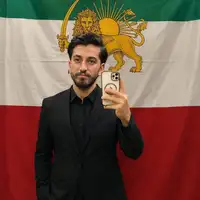
Hamid Kouhsari
One of his last memories is of saying goodbye to his dog, whom he left with a friend.
"When I was saying goodbye to my dog, I saw my whole family in that animal," he said.
"The night I left Iran, for the first time in eight months I was able to sleep peacefully."
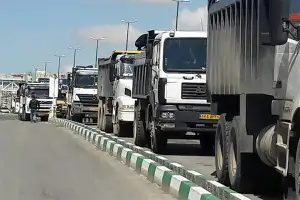
Staff at a repair workshop in Isfahan’s Amir Kabir industrial district, where businesses serving trucks and heavy machinery have reported a sharp drop in activity. (ILNA)
Business at one of central Iran’s main heavy-vehicle service hubs has fallen by about 30% from a year earlier, offering a ground-level view of an economy where soaring food prices, a battered currency and weaker freight activity are squeezing workers and small businesses.
The Amir Kabir industrial area in Isfahan is home to mechanics, machinists, body shops, battery specialists and parts dealers serving trucks, construction equipment and mining machinery. Labor news agency ILNA said activity across the district had fallen sharply as transport demand weakened and the cost of keeping vehicles on the road climbed.
“When freight activity slows and less cargo is being moved, drivers face serious problems,” a person working in the district told ILNA. “Most drivers bought their vehicles on installment, so besides making loan payments, they also have to cover the high cost of supporting their families.”
The slowdown comes as Iranian households face some of the steepest price increases in years. Official data for September showed consumer prices were 89.8% higher than a year earlier, while average inflation over the preceding 12 months reached 73.6%. Food and drink prices had already risen 127.5% year on year in August.
Reuters reported in September that food prices had more than doubled while the wider economy was being squeezed by sanctions, restrictions on oil exports and the costs of the seven-month conflict with the United States.
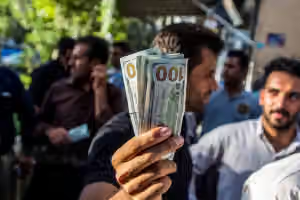
Iran’s currency has added another layer of pressure. The rial fell beyond 2.5 million to the US dollar on the free market earlier this week, a record low, compared with roughly 1.1 million a year earlier.
For businesses dependent on imported equipment, that fall feeds quickly into prices.
“Parts dealers buy according to the day’s dollar rate,” an Amir Kabir business operator said, adding that prices often fail to come back down even when the rial temporarily strengthens.
“The consumer and the worker end up carrying the greatest burden,” he said.
The industrial district illustrates how weakness in one part of Iran’s economy spreads quickly into others.
A single truck can generate work for engine mechanics, gearbox specialists, machinists, painters, welders, upholsterers and parts sellers before it gets back on the road. When freight volumes fall, drivers delay repairs and workshops lose business.
“There’s a deep slowdown across the industrial area,” the tradesperson said. “It’s not that the vehicles don’t need work. Purchasing power and liquidity have fallen sharply.”
Some vehicles are repaired but then sit idle because there is no cargo to move, he said. Even when transport work is available, delayed payments from cargo owners leave drivers and workshops short of cash.
That weakness is also reflected in accounts shared with Iran International, with Iranians describing cuts to spending on food, housing and medicine as savings run down and private-sector job losses spread.
Cheap parts bring expensive problems
Workshop owners are also grappling with replacement parts that they say are either prohibitively expensive or of poorer quality.
A local tradesperson told ILNA that original components for older European and American heavy vehicles had become difficult to obtain, leaving operators increasingly dependent on Chinese-made replacements.
“In the past, if you rebuilt a Volvo or Mack with original parts, it could run for years without another major repair,” he said. “Now poor-quality parts mean repeated breakdowns.”
Original parts can still sometimes be found, he added, but at prices that often make them uneconomical for truck owners already dealing with loans, insurance and weaker freight income.
The result is a cycle in which operators choose cheaper parts, suffer more frequent failures and return to workshops while having less money available to pay for the repairs.
The downturn is beginning to affect hiring and job security.
A machining workshop may employ 10 to 12 people repairing engine blocks, crankshafts and other heavy components. With business down and insurance, municipal charges and other expenses still rising, workshop owners may stop taking on workers or begin cutting staff, according to ILNA.
“A workshop with 10 or 12 workers may no longer want to expand its workforce and may even reduce the number of employees because its income cannot cover its costs,” a local business owner said.
The impact could outlast the immediate downturn. Training an experienced technician can take about a decade, he said, but workshops have less incentive to bring in apprentices when they are unsure whether they can retain existing staff.
Pressure reaches beyond Isfahan
The problems in Amir Kabir mirror a broader contraction in everyday economic activity as the government struggles with reduced oil revenues, sanctions and restrictions on trade.
US pressure has sharply reduced Iran’s access to foreign currency from oil exports, while sanctions evasion has become more costly. That has made imported equipment and raw materials harder to finance just as the rial’s fall raises their local-currency price.
For the workers and drivers in Isfahan, however, the crisis comes down to a simpler calculation: there is less work, while virtually everything needed to do that work costs more.
“If prices are going to remain high, then at the very least the volume of work has to increase,” a local tradesperson told ILNA. “Businesses need enough cash flow to keep operating.”
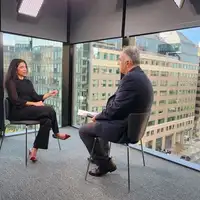
Sara Harmouch, chief executive of H9 Defense and an adjunct professor at George Washington University, during an interview with Iran International in Washington, DC
Iran has spent two decades keeping al-Qaeda close as a partner it can deny, and could turn to it if the war with the United States escalates, a counterterrorism expert told Iran International. With Hezbollah and Hamas weakened, she said, it is the card Tehran has left.
Sara Harmouch, chief executive of H9 Defense and an adjunct professor at George Washington University, said the relationship is no longer a historical footnote.
"Who is better to rise as a secret proxy for Iran than al-Qaeda?" she said. "Al-Qaeda keeps a low profile and continues to maintain plausible deniability."
Intelligence circulating in the Middle East and among the Arab states of the Persian Gulf, which US and Western officials have not confirmed, suggests that Saif al-Adel, al-Qaeda's de facto leader, who has long been based in Iran, is preparing attacks if the war widens, Harmouch said. That would suit both sides, she said: Iran could deny involvement, and al-Qaeda could return to the world stage against Western interests.
"It's all possible, and it's not far-fetched," she said. Iran, she added, had helped with the operations, funding and logistics of the September 11 attacks. "So why wouldn't they now, especially if they're in such a difficult situation with the war?"
The 9/11 Commission found that Iran allowed several of the hijackers to transit its territory but found no evidence that Tehran knew of the plot. A US federal court later found Iran liable in a civil case brought by victims' families, a judgment Iran did not contest.
'Pragmatism always trumps ideology'
Washington, Harmouch argued, still treats the rivalry between Sunni and Shia Islam as a wall. In 2024 she wrote that al-Qaeda was becoming "Iran's ace in the hole," with Adel at the center. Western outlets turned the piece down, she said, because editors would not accept cooperation across the sectarian line.
"Someone who has not been to the region at all felt compelled to tell me, oh, but there's a Sunni-Shia divide," she said.
She made the argument instead on the podcast of Michael Morell, a former acting director of the CIA. Two years later, she said, the same pattern is being reported as news: al-Qaeda in Yemen has stopped fighting the Houthis, and the cooperation has spread to al-Shabaab in Somalia.
"Pragmatism always trumps ideology," she said.
As evidence of that shift, Harmouch pointed to a drone unit the Houthis helped al-Qaeda set up, a joint meeting of al-Qaeda in Yemen, al-Shabaab and the Houthis, and a claim that the Houthis paid al-Qaeda $65,000 in recent months for an attack carried out on their behalf.
Al-Qaeda has publicly rejected UN findings that it cooperates with the Houthis and has stepped up anti-Houthi propaganda, which she read as cover rather than a break.
The leader who avoids the camera
Adel, she said, is why the silence in Yemen was predictable. Al-Qaeda has never publicly named him leader because he is in Iran, and unlike Osama bin Laden he avoids the camera. A 52-minute al-Qaeda video released around this year's September 11 anniversary used old footage of Hamza bin Laden and quoted Adel's book without showing him. In that book, she said, the word "deception" appears 99 times.
In her account, the relationship took shape after 2001, when al-Qaeda figures fled Afghanistan for Iran. Tehran detained some and sent others home. It kept Adel, under what former CIA director George Tenet later called a loose house arrest. Adel stayed close to Qassem Soleimani, the Revolutionary Guards' Quds Force commander, and, Harmouch said, told him: "We are partners. We're not enemies. We are partners in changing the world."
She traced episodes that, she said, show the house arrest was never a cage: the 2003 Riyadh bombings, which US officials said were directed in part from Iran; a 2013 plot to derail a train between Toronto and New York, which Canadian police said had direction from al-Qaeda elements in Iran; and, after Abu Musab al-Zarqawi began killing Shia in Iraq, a turn from hospitality to coercion, including the holding of members of bin Laden's family.
In a 2007 letter, bin Laden called Iran "our main artery for funds, personnel, and communications" and warned against attacking it. In 2008, she said, Ayman al-Zawahiri praised the Revolutionary Guards for strengthening al-Qaeda in Yemen.
In Syria, she said, the relationship worked like a proxy arrangement. Iran released Muhsin al-Fadhli, who went on to move money and fighters into the Syrian war. In 2015 it freed Abu Khayr al-Masri and other senior figures in a prisoner exchange; Harmouch said the Quds Force used them to split the forces of Abu Muhammad al-Jolani, now Syria's president, Ahmad al-Sharaa.
Abu Muhammad al-Masri, al-Qaeda's second in command, remained in Iran until Israeli agents killed him in Tehran in 2020. The US Treasury has since sanctioned Iranian-based networks for supporting al-Qaeda.
After Zawahiri was killed in 2022, Adel's rise closed the circle, she said. Since the Hamas attack of October 7, 2023, he has told affiliates to stop hitting Iran's proxies. What unites them, in his words as she rendered them, is greater than what unites their enemies: one God, one qibla, the direction of prayer, and one political goal. His statements and Tehran's have lined up on the Red Sea, on protests at American universities, and on Afghanistan.
'There is no winning'
A deal, or a harder US campaign, would not end the problem, Harmouch said. Iran fights by attrition and will absorb losses the United States will not, and when it cannot control what happens outside its borders, it turns on its own population.
The cells inside the United States that are often cited as a threat have not produced a directed attack, she said. They may not exist, or Tehran may be holding them as leverage that disappears once used.
The likelier diversion, in her view, is an al-Qaeda attack Iran can disown, buying time to rebuild. A nuclear announcement is possible, she said, but less necessary since Iran's closure of the Strait of Hormuz showed what it could do to American gasoline prices.
"I don't think there is winning a war against Iran," she said. "As long as it's still in the fight, it is winning."
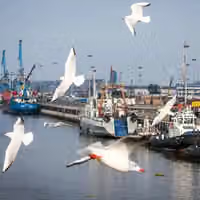
File photo: Ships dock at Anzali Port on Iran’s Caspian Sea coast
With war disrupting Iran’s southern trade routes, Tehran is looking north to the Caspian for alternatives. But the available evidence suggests they cannot replace its crucial oil exports.
More cargo moving across the Caspian could help Iran keep supplies coming in. But rising freight totals do not show whether Tehran has found a practical alternative for exporting oil.
To establish that, we need to know what is being shipped, where it is going and what trade it replaces.
Grain and industrial goods can ease shortages; crude needs its own export infrastructure and buyers. Iran’s oil swaps at Neka show both what the northern route can offer and what it cannot.
What the freight numbers measure
Russia’s Ministry of Transport reported 1.8 million tonnes of freight on the trans-Caspian route in 2025 and 1.3 million tonnes in the first half of 2026. It separately reported maritime freight of 2.8 million tonnes in 2025 and about 4.5 million tonnes in the first seven months of 2026.
The figures point to increased activity, but the ministry does not break the cargo down by Iranian origin, Iranian destination or commodity.
The North–South Transport Corridor spans several countries, routes and modes. Cargo can transit Iran without being Iranian trade or move between other participating countries.
A corridor-wide increase could reflect transit shipments, trade between third countries or Iranian goods rerouted from elsewhere. The aggregate numbers do not distinguish among them.
Nor should the route and maritime figures be added together as if they measure the same flow. The ministry presents them separately and does not provide enough detail to establish how their coverage overlaps.
Evidence of genuine substitution requires knowing what cargo moved, where and which route it replaced. Grain rerouted from a southern port to northern Iran would demonstrate substitution for that cargo.
A shipment merely transiting Iran would demonstrate corridor use, not replacement of lost Iranian trade.
Imports and exports are different problems
Northern routes can still be valuable for Iran. Food, feed and industrial inputs can support domestic supply during a disruption. But that resilience should not be confused with replacing oil revenue.
Around 90% of Iran’s crude exports normally pass through Kharg Island in the Persian Gulf, according to Reuters. Bringing goods into northern Iran does not automatically provide the terminals, pipelines and shipping arrangements needed to move Iranian crude to international buyers.
Iran’s ports have nominal annual capacity of about 300 million tonnes, but only around 30 million tonnes is in the north, according to figures cited by Al Jazeera. One large vessel in the south can potentially carry as much cargo as 20 Caspian ships.
The question is not simply whether trade can move north, but whether those routes can serve the same economic purpose at comparable scale.
Neka was not an oil-export system
Iran’s Neka terminal was connected by pipeline to refineries in Tehran and Tabriz. Under previous oil-swap arrangements, crude from Caspian producers was delivered to Neka and processed in northern Iran. Iran then made an equivalent volume of its own crude available for export through Kharg.
The arrangement helped supply northern refineries while freeing Iranian crude elsewhere for export. It did not eliminate reliance on southern export infrastructure.
Swap volumes peaked at about 110,000 barrels per day in June 2006, fell to almost zero by 2011 and did not subsequently resume at scale, according to Lee and Kalyuzhnova. Changes in relative pricing were among the factors that made the route less attractive.
Infrastructure alone therefore does not create a durable oil route. The economics of each barrel, the terms of any swap and the availability of buyers matter too.
Any claim that Neka now provides a meaningful export alternative requires current evidence: how much crude is arriving, whether it is being refined, swapped or exported, and where any exported Iranian barrels actually leave the country.
Who controls the alternative?
Moscow’s transport ministry links freight growth to Russian-Iranian cooperation and identifies the unfinished Rasht–Astara railway as a key project.
The more important question is whether Iranian access depends on a limited number of suppliers, carriers, financiers or cross-border arrangements. Iran could gain another route while still having little control over the terms on which it operates.
That is not inevitable. A corridor involving several suppliers and transport partners could give Tehran more options.
The test is whether cargo can move regularly at competitive cost, with workable payment and customs arrangements, without a single partner becoming a bottleneck.
What would an alternative look like?
The available figures establish that activity on parts of the northern corridor has increased. They do not establish how much Iranian trade has been rerouted, whether those routes are commercially sustainable or whether they can substitute for oil-export capacity.
The Caspian may give Iran useful alternatives for specific shipments. Whether that amounts to strategic diversification depends on what Iran can move, at what scale, where it can send it and who sets the terms.
For now, rising freight totals are a starting point for that analysis, not proof that Iran has built a northern substitute for its oil-export system.