• العربية
  • فارسی
Brand
  • Iran Insight
  • Politics
  • Economy
  • Analysis
  • Special Report
  • Opinion
  • Podcast
  • Live TV
  • Iran Insight
  • Politics
  • Economy
  • Analysis
  • Special Report
  • Opinion
  • Podcast
  • Live TV
  • Theme
  • Language
    • العربية
    • فارسی
  • Iran Insight
  • Politics
  • Economy
  • Analysis
  • Special Report
  • Opinion
  • Podcast
  • Live TV
All rights reserved for Volant Media UK Limited
volant media logo

Saudi airport says flydubai pilots injured after emergency landing

Sep 30, 2026, 11:57 GMT+1

Saudi Arabia's Prince Sultan bin Abdulaziz International Airport said on Wednesday that both the captain and first officer of flydubai flight FZ1073 were injured after the aircraft made an emergency landing in Tabuk.

The airport said it received a distress call from air traffic control at 8:44 a.m. local time and the flight landed safely at 9:45 a.m.

The two pilots were taken to hospital for medical care, while passengers were assisted at the terminal, the airport said. It added that flydubai was arranging a replacement aircraft.

Saudi authorities are investigating the incident, the statement said.

Most Viewed

Iran’s shrinking air links raise costs, strain regional ties
1

Iran’s shrinking air links raise costs, strain regional ties

2
EXCLUSIVE

Key IRGC intelligence figure in Iran’s oil sales identified: Who is Mostafa Ahadi?

3

IRGC outlet accuses reformists of feeding Trump's pressure campaign

4
INSIGHT

Iranian hardliners turn on Ghalibaf and judiciary after lawmaker’s sentencing

5

US-Iran contacts continue as terms of possible deal remain disputed

Banner
Banner

Spotlight

  • Iranian hardliners turn on Ghalibaf and judiciary after lawmaker’s sentencing
    INSIGHT

    Iranian hardliners turn on Ghalibaf and judiciary after lawmaker’s sentencing

  • German-based aid worker gets 10-year prison sentence in Iran

    German-based aid worker gets 10-year prison sentence in Iran

  • The body as a battleground: Iran's resistance etched in ink and blood
    SPECIAL REPORT

    The body as a battleground: Iran's resistance etched in ink and blood

  • Khamenei’s vision of Iranian power faces a test of reality
    ANALYSIS

    Khamenei’s vision of Iranian power faces a test of reality

  • Why Trump said no to Iran’s Hormuz proposal
    ANALYSIS

    Why Trump said no to Iran’s Hormuz proposal

  • Iran’s oil industry has too many masters
    OPINION

    Iran’s oil industry has too many masters

  • Iran wrong to expect midterms to restrain Trump, former US official says

    Iran wrong to expect midterms to restrain Trump, former US official says

Banner
Banner
•
•
•

More Stories

Iran debtors face prison, hiding and suicide attempts

Sep 30, 2026, 04:22 GMT+1
100%
Prisoners are seen behind bars in Iran, where thousands have been imprisoned over unpaid financial obligations.

Years in prison or hiding, suicide attempts and severe financial hardship are among the consequences of Iran’s imprisonment of people over unpaid financial obligations, according to an IHRDC report published Tuesday.

According to a report published Tuesday by the Iran Human Rights Documentation Center (IHRDC), the findings draw on 10 confidential interviews conducted between March 2024 and July 2026 with debtors and close relatives of people subjected to financial enforcement.

All requested anonymity because of the stigma and other risks associated with imprisonment for debt.

One case concerns a man identified by the pseudonym Borna, whose sister told IHRDC that he spent two years in hiding after falling behind on payments linked to a marital financial obligation of 300 gold coins. He attempted suicide by jumping from a fourth-floor building and later spent about three years in prison.

His sister said a trial court found that Borna lacked the means to pay and ordered his release, but an appellate court required him to first pay 14 gold coins in arrears. IHRDC cited the case as evidence that people recognized as unable to pay can nevertheless remain exposed to detention.

The report also recounts the case of a young woman who was arrested at about 16 for theft and remained imprisoned for nearly three years after completing her sentence because she could not repay 400,000 tomans, which the report put at about $400 at the time. According to testimony cited by IHRDC, she attempted suicide in prison by swallowing depilatory powder and suffered lasting internal injuries.

The individual accounts are set against official figures showing that an average of 10,087 people were held in “imprisonment until payment” for civil financial judgments on any given day in 2022-23, representing 4.3% of Iran’s average prison population. The figure excludes people held over blood money and those on day release.

IHRDC’s open-source database separately recorded at least 88,078 releases of imprisoned debtors across all 31 provinces between 2016 and 2026. The organization said available figures represent minimums and do not capture everyone affected by financial detention.

Under Article 3 of Iran’s Law on the Enforcement of Financial Judgments, a debtor can be imprisoned at a creditor’s request until the judgment is satisfied, a court accepts an insolvency claim or the creditor consents to release. IHRDC said people genuinely unable to pay can still face detention because of procedural and evidentiary barriers, including missed deadlines and difficulties securing witnesses, collateral or legal assistance.

Iran told the United Nations during its 2025 Universal Periodic Review that no one is imprisoned merely for failing to fulfill a contractual obligation and that detention is reserved for people who have the means to pay but refuse. IHRDC said its examination of the law, statistics and witness accounts found that assurance “does not hold.”

IHRDC called for abolishing imprisonment for genuine inability to pay and replacing it with measures including asset tracing, wage attachment and installment plans based on a debtor’s ability to pay, while retaining sanctions for proven fraud, concealment or deliberate refusal to pay despite having the means.

Iranian hardliners turn on Ghalibaf and judiciary after lawmaker’s sentencing

Sep 30, 2026, 01:48 GMT+1
•
Maryam Sinaiee
100%
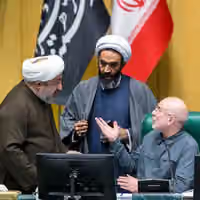
Hardline lawmaker Hamid Rasaei (left) speaking with Speaker Mohammad-Bagher Ghalibaf (right) in this file photo from July 2026.

Attacks by hardliners on Parliament Speaker Mohammad-Bagher Ghalibaf and Chief Justice Gholam-Hossein Mohseni-Ejei following hardline lawmaker Hamid Rasaei’s imprisonment have intensified the rift among Iran’s conservatives.

Rasaei said during an online parliamentary session on Sunday that Ghalibaf, former president Hassan Rouhani, President Masoud Pezeshkian and the Secretariat of the Supreme National Security Council had filed complaints against several lawmakers.

He said one of those complaints had resulted in a 10-month prison sentence against him. Rasaei described the ruling as “non-legal” and “political,” but said he would report to prison to serve the sentence.

Rasaei was elected third in Tehran in the parliamentary election three years ago, when around 80 percent of eligible voters in the capital boycotted the election.

He is the first sitting lawmaker to be sent to prison during his term in office.

The complaint dates to before Rasaei was elected to parliament and concerns a case brought by Ghalibaf against the weekly 9 Dey, where Rasaei was managing director. The complaint followed an article published in January 2024 under the headline “Ghalibaf’s Manipulation of Parliamentary Documents.”

The judiciary announced on Monday that Rasaei had appeared at Tehran’s Special Clerical Court and was sent to the clerics’ section of Evin Prison the same day to begin serving his sentence. According to the judiciary’s statement, Rasaei had more than 18 months to resolve the case by apologizing to Ghalibaf.

Rasaei’s positions are closely aligned with those of the Paydari Party and former nuclear negotiator Saeed Jalili.

Hardliners react to the sentence

Rasaei’s supporters have accused Ghalibaf of “silencing the voices of critics” and criticized him for pursuing the complaint against Rasaei rather than focusing on the country’s economic and security problems.

Figures associated with these groups and their media outlets also attacked Mohseni-Ejei. The criticism has spilled over into some recent nightly pro-government gatherings.

Mohammad-Manan Raeisi, a Qom lawmaker who headed Saeed Jalili’s presidential campaign in the city two years ago, sharply criticized Ghalibaf and other officials and warned of a possible popular backlash against them.

“I doubt that, under these circumstances, people will allow you to appear in any mosque, gathering, public square or religious ceremony, and you may face a popular backlash,” he wrote.

Meysam Nili, managing director of the Raja News website and a figure associated with the Paydari Party, accused the judiciary of injustice and political bias, claiming that a “coup” was being organized against media and political figures belonging to the faction.

Hardline social media user Mohsen Maghsoudi, referring to arguments in favour of negotiations with the United States, wrote: “When it is possible to negotiate with the killer of the martyred Imam (Ali Khamenei) in the national interests and still talk about negotiations despite receiving insult, humiliation and aggression, why can’t we, in order to preserve unity, drop a three-year-old complaint over the headline of a weekly newspaper so that a revolutionary representative does not go to prison and hundreds of thousands of people’s votes do not become ineffective for 10 months?”

Other conservatives push back

Other conservative figures have sharply criticized the controversy generated by Rasaei’s supporters and the hardline groups.

The IRGC-affiliated Tasnim news agency published an article headlined “On Mr Rasaei’s Strange Fallacies!” and described his objections to the ruling as “slander against a judicial ruling.”

Tasnim said Rasaei had effectively challenged the validity of the ruling by describing it as “strange” and “contrary to procedure,” while accusing the judiciary of political conduct by calling the ruling “political and non-legal.” The agency characterized his statements as criminal.

The Tabnak website published a video showing hardliners chanting in support of Rasaei and against Ghalibaf at one of the nightly gatherings. It called them “infiltrators” and said a small number of people were using the gatherings to “advance factional objectives.”

The conservative Khorasan newspaper said Rasaei’s refusal to apologize had led the court to conclude that he was not only unrepentant about the allegations he had made against Ghalibaf, but was also refusing to resolve the case and defying a judicial order.

Mojtaba Zarei, a member of parliament’s National Security and Foreign Policy Committee, wrote that turning a judicial case into a political and media confrontation during wartime would only deepen divisions among political forces.

Deepening confrontation

Hardliners have stepped up attacks in recent days against political rivals who support resolving the dispute with the United States through negotiations and returning to the Islamabad understanding.

They have gathered outside the home of former President Hassan Rouhani, whom they accuse of being subservient to the West, and called for him and his former foreign minister, Mohammad-Javad Zarif, to be prosecuted.

They also chanted against President Masoud Pezeshkian and called him an “infiltrator” as he returned from New York, where he attended the UN General Assembly. Hardliners have also registered an impeachment motion against Foreign Minister Abbas Araghchi over his meeting with Steve Witkoff, US President Donald Trump’s special envoy for Iran, and launched an online campaign calling for Pezeshkian’s removal.

German-based aid worker gets 10-year prison sentence in Iran

Sep 29, 2026, 23:26 GMT+1
•
Negar Mojtahedi
100%
Serkan Eren, founder of the Stuttgart-based humanitarian organization STELP.

Years in prison or hiding, suicide attempts and severe financial hardship are among the consequences of Iran’s imprisonment of people over unpaid financial obligations, according to an IHRDC report published Tuesday.

A German-based humanitarian worker has been sentenced to 10 years in prison in Iran after entering the country to help vulnerable Iranians, Stuttgart-based aid organization STELP said.

Serkan Eren, the 42-year-old founder of STELP, was convicted over alleged contacts with a country Iran considers hostile, according to the organization. STELP has not identified the country or disclosed further details, citing concerns for Eren and others involved.

Eren, a Turkish citizen and longtime resident of Germany, has been in Iranian custody for more than a year.

He entered Iran in late June 2025 as the 12-day war was drawing to a close. Five days later, after a ceasefire had taken effect, he headed toward the Iraqi border to leave the country. He never made it out.

STELP called the verdict unjustified and said the sentence did not reflect the circumstances of his case.

“The ten-year prison sentence given to Serkan Eren is not about what he has done. It is about what the Islamic Republic wants,” Shahin Milani, executive director of the Iran Human Rights Documentation Center, told Iran International.

Milani said Eren's charitable work offered little protection from what he described as Tehran's established practice of using foreign detainees as political leverage.

“Even working for a charitable organization does not protect foreign nationals,” he said.

Contemporaneous German reporting provides a detailed account of why Eren went to Iran and the precautions he took before entering.

German-Iranians had approached STELP seeking help for relatives inside the country, according to the Stuttgarter Zeitung. Eren said he was in contact with seven elderly Iranians, some of them ill, whom he hoped to help reach Turkey. He also intended to bring food into Tehran.

The risks were apparent before he crossed the border.

Eren deliberately left behind a satellite phone, bulletproof vest and helmet, fearing such equipment could cause Iranian authorities to mistake him for an agent or saboteur. Instead, he crossed from Turkey into Iran on foot with little more than a backpack.

Once inside, those concerns intensified. Eren later described armed checkpoints on his route to Tehran where he was forced to strip naked during searches.

More than a year later, an Islamic Republic court convicted him over alleged contacts with a hostile country.

Human rights lawyer Gissou Nia said humanitarian status has not historically insulated either foreign aid workers or Iranian charities from pressure by the authorities.

“Unfortunately, being a humanitarian aid worker is not a shield when it comes to the Islamic Republic detaining and arbitrarily imprisoning individuals,” Nia told Iran International.

She cited the case of Belgian humanitarian worker Olivier Vandecasteele, who was detained in Iran in 2022 and later sentenced to a lengthy prison term before being released in 2023 in a prisoner exchange involving Assadollah Assadi, an Iranian diplomat imprisoned in Belgium over a foiled bomb plot.

“This is a pattern that we've seen before,” Nia said.

Nia also pointed to the treatment of humanitarian organizations operating inside Iran. The Imam Ali Popular Students Relief Society, a prominent independent charity that worked with impoverished families and vulnerable children, was dissolved following years of pressure from Iranian authorities.

The Center for Human Rights in Iran reported in 2022 that an appeals court upheld an order dissolving the organization after authorities arrested several of its members and accused its founder of offenses including insulting Iran's leadership and acting against national security.

The case, Nia said, illustrates how work designed to remain outside politics can itself become politically charged in Iran.

“Even the sort of non-politicized work of humanitarian aid organizations has been politicized in some ways,” she said.

Eren's Turkish citizenship adds another layer to efforts to secure his release.

Despite living in Germany and running a Stuttgart-based organization, Eren does not hold German citizenship. Germany's Foreign Office has said it is aware of his case but that responsibility rests with Turkish authorities because he is a Turkish national. STELP says it has been working closely with Ankara since his detention.

Nia said his ties to Germany nevertheless give Berlin reason to remain engaged.

“I anticipate that Germany will raise the case, especially because he was working for a German-based organization,” she said. “And the Turkish government will probably be involved as well, because he is a Turkish citizen.”

The sentence has already drawn calls for Eren's release in Germany. Baden-Württemberg Minister-President Cem Özdemir said he would continue pushing for Eren to be freed immediately.

Eren has spent years working in humanitarian crises. He began aid work during Europe's 2015 refugee crisis and received Germany's Federal Order of Merit in 2023 for his humanitarian service.

Before entering Iran, he openly questioned whether authorities would allow him into the country at all.

“It’s arbitrary,” Eren told the Stuttgarter Zeitung at the time.

He nevertheless hoped his status as a humanitarian worker would help protect him.

It did not.
US blockade divides Iranians online over pressure on rulers, cost to public

Sep 29, 2026, 22:15 GMT+1
•
Hooman Abedi
100%
A woman walks past a person using an ATM outside a Bank Saderat branch in Iran.

Iran’s deepening isolation is drawing divided reactions from Persian-language social media users, with some welcoming US pressure to weaken the country’s rulers and others warning that ordinary people will bear the cost without producing political change.

The posts reviewed by Iran International reflect individual online reactions and are not representative of public opinion in Iran. But they show how the growing economic pressure is being interpreted by people arguing both for and against the blockade.

That pressure has intensified as the US naval blockade sharply curtailed Iran’s oil exports, a major source of foreign currency. Iranian crude loadings fell from about 2 million barrels per day in March to roughly 220,000-255,000 in August, according to shipping data cited by Reuters.

“Great. An air and sea blockade, then a land blockade, will lead to the government’s fall,” one Persian-language social media user wrote.

“The economic blockade is choking it,” another wrote.

  • Tehran ‘ashamed’ as Iranians struggle to make ends meet

    Tehran ‘ashamed’ as Iranians struggle to make ends meet

Support for continued pressure has also appeared on Reddit. “I said months ago that the blockade is a good strategy,” one commenter wrote, expressing hope that US President Donald Trump would maintain it.

Another user in the discussion described maintaining the pressure as “Great for Iran.”

Taken together, the posts illustrate a view among supporters of the blockade that restricting trade and government revenue could weaken the Islamic Republic’s ability to withstand domestic pressure.

One user argued that the blockade could erode the authorities’ ability to administer and control the country by reducing oil revenue, weakening internal cohesion and increasing economic pressure.

“The blockade is not the objective, but the instrument,” he wrote, arguing that the aim was to increase pressure until the authorities struggled to maintain stability and manage the economy.

Others say ordinary Iranians will pay

Other users rejected the idea that economic isolation would bring political change and warned that the greatest burden would instead fall on the public.

“I don’t know of an example in history where sanctions and an economic blockade caused a revolution. Ordinary people just suffer,” one user wrote on X.

Another said prolonged isolation could strengthen corruption and preferential access, leaving politically connected people better placed to profit from shortages while the wider population becomes poorer.

“This situation could continue for years,” the user wrote, adding that the authorities could blame worsening economic conditions on the blockade.

For others, the consequences are already visible far beyond politics and trade.

“You can’t leave the country by air or sea. All the language exams have sanctioned us. Eighty percent of online games are restricted for Iranians. You can’t even create a Gmail account,” another person wrote on Instagram.

  • Iranian test-takers head abroad as exam access shrinks

    Iranian test-takers head abroad as exam access shrinks

“It’s as though the project to erase Iranians from the face of the earth has officially begun,” the user added.

Dark humor over growing isolation

The restrictions have also prompted sarcasm directed at official assertions of resilience.

After Turkish Airlines suspended its Iran flights until at least March 2027, one commenter ironically invoked a familiar phrase in Iranian political rhetoric: “America can’t do a damn thing.”

  • Turkish Airlines says all Iran flights suspended until March 2027

    Turkish Airlines says all Iran flights suspended until March 2027

“They just keep announcing victories one after another,” another wrote with laughing emojis.

A longer sarcastic comment mocked rhetoric about missiles, drones and military strength before concluding: “If the blockade continues, soon we’ll have to eat grass.”

Economic hardship also featured in discussions on Reddit. One commenter said half their monthly salary went on groceries and food and the other half on rent, leaving them dependent on savings. Another described paying 15 million rials for a kilogram of cold cuts and pickles.

The rial has fallen sharply during the economic squeeze, trading at more than 2.3 million to the dollar in September.

Iran’s official minimum monthly wage is about 166 million rials, worth roughly $71 at that exchange rate, meaning the purchase described by the commenter would amount to about 9% of a minimum-wage worker’s basic monthly pay.

Iran says awaiting US response on Hormuz proposal

Sep 29, 2026, 13:28 GMT+1
100%
Vessels transit the Strait of Hormuz, a key route for global oil shipments.

Iran said on Tuesday it is awaiting a US response to its proposal for reopening the Strait of Hormuz, as regional oil flows continued to recover and the rial sank past 2.5 million to the dollar.

The developments put Iran’s efforts to secure relief for maritime trade alongside mounting economic pressure at home and warnings from Iranian and US officials over further confrontation.

“We are awaiting an official response from the United States through the mediators,” Foreign Minister Abbas Araghchi said.

Qatar was expected to relay Iran’s proposals to Washington and return with a response, possibly by Wednesday, Araghchi said. Iran had made no concessions and reopening Hormuz remained conditional on its demands being met, he added.

“At present, the only issue is the Strait of Hormuz,” Araghchi said. “Iran’s conditions are entirely fair and reasonable. If the Americans say they want an agreement or a peaceful solution, we have presented that solution.”

Oil flows recover despite risks in Hormuz

Persian Gulf oil exports have recovered despite disruption around Hormuz, potentially reducing the impact of restrictions on one of the world’s most important energy routes.

Oil shipments through the strait and alternative routes have returned to nearly 80% of pre-war regional levels, the Wall Street Journal reported Monday.

Crude exports from major Middle Eastern producers including Saudi Arabia, Iraq and the United Arab Emirates have climbed to almost 13 million barrels per day this month, their highest level since February, according to ship-tracking data cited by the Journal.

Risks to shipping persist. A vessel transiting Hormuz was struck by a suspected unknown projectile Monday evening, causing a fire that was later extinguished, the UK Maritime Trade Operations said. The crew was safe.

Against that backdrop, Iran tied the security of regional energy infrastructure to its own ability to export oil. “If we do not sell oil in a region, no one will sell oil there, and if our security is not guaranteed, no infrastructure will be safe,” parliament speaker Mohammad Bagher Ghalibaf said Tuesday.

Rial crosses 2.5 million per dollar

Iran’s free-market exchange rate crossed 2.5 million rials to the dollar Tuesday, extending a currency decline that has increased import costs and eroded household purchasing power.

The dollar had reached 2.418 million rials Monday before gaining more than 80,000 rials, or over 3%, in less than 24 hours.

The decline comes alongside inflation, falling production, trade restrictions, foreign-currency shortages and difficulties transferring money.

Iran is seeking alternatives to maritime trade. Rail freight from China has increased tenfold since the US naval blockade began, lawmaker Meisam Zohourian said.

Three rail routes and expanded capacity at northern ports could provide overland capacity equivalent to about 400,000 barrels of oil a day, though they could not fully replace maritime trade, Zohourian said.

Revolutionary Guards prepare message to Americans

The Islamic Revolutionary Guards have addressed the American public in a letter portraying Iran as the victor in the war with the United States and crediting Mojtaba Khamenei’s leadership for the outcome.

“This is a letter, not a propaganda effort to shape the media narrative,” IRGC spokesman Hossein Mohebbi said Tuesday.

The letter said Khamenei’s “unparalleled command” had left “the world’s two leading military powers” unable to prevail and argued that his leadership gave Iran an advantage the United States lacked.

“A God-fearing and just leader, a wise scholar and a pure and courageous ascetic — this is what your armed forces and your country lack and do not have,” the Revolutionary Guards wrote in the letter to Americans.

Mohebbi also called US President Donald Trump “a big liar” and said Washington had no choice but to acknowledge failure and leave the region.

Washington, for its part, warned Iran against targeting US interests beyond the confrontation over Hormuz. US Secretary of State Marco Rubio said Iran had openly threatened American interests around the world and would face repercussions for any attack or attempted attack.

Iran’s government, however, coupled its readiness for further conflict with an openness to diplomacy. “We are not afraid of war and we do not run away from negotiations,” government spokesperson Fatemeh Mohajerani said.