Iran lawmaker calls for diplomat’s dismissal over staying for Trump UN speech


Hossein Ali Haji-Deligani, deputy head of parliament’s Article 90 Commission, said lawmakers had called for Nasser Asadi, a member of Iran’s UN mission, to be removed from his post and dismissed from the Foreign Ministry after he remained in the General Assembly hall during US President Donald Trump’s speech.
Asadi was the only Iranian diplomat who stayed in the chamber during Trump’s address.
Haji-Deligani also called for Iran to pursue a nuclear deterrent, saying that because countries Tehran considers enemies possess nuclear weapons, “we must also act on this issue to create deterrence against American crimes.”






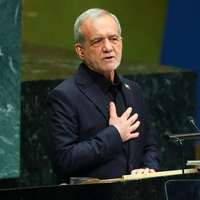
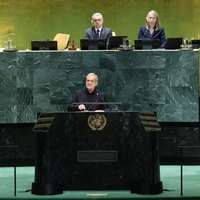
President Donald Trump may be putting off a difficult choice over Iran until after the US midterm elections, a former senior US diplomat told Iran International.
Trump used his address to the United Nations General Assembly this week to call for Iran's “complete economic isolation,” while saying he believed a deal could come after the November midterm elections.
Iranian President Masoud Pezeshkian, meanwhile, said Tehran would not surrender to US pressure but remained open to diplomacy.
The two sides held their first indirect talks in months on the sidelines of the UN gathering but remained far apart on how to end the war, including over Iran’s conditions for reopening the Strait of Hormuz.
Ludovic Hood, a senior fellow at the Hudson Institute who spent two decades as a US diplomat and previously served as special adviser for the Middle East to Vice President Mike Pence, told Iran International's Eye for Iran that the approaching elections may help explain the current pause.
“We have elections coming up in America that I think have partly bounded President Trump’s willingness to be more confrontational at this point in time,” Hood said.
He described the conflict as a “standoff” with “more chapters to be written,” saying Trump could face a decision over whether to escalate again after the midterms or as the United States enters the new year.
“He may seek to escalate again militarily,” Hood said.
Potential targets could include commercial and economic assets inside Iran owned by or directly linked to the Islamic Revolutionary Guard Corps, he said, if Trump chooses to intensify the campaign.
Pressure without political change
Iran has suffered major military losses while contending with a US naval blockade and an expanding sanctions campaign. Yet nearly seven months into the war, those pressures have not produced fundamental political change in Tehran.
Hood cautioned against assuming that battlefield losses automatically translate into political change. Instead, he pointed to the cumulative impact of declining revenues, sanctions, domestic discontent and potential strains within the institutions responsible for protecting the state.
He described the Islamic Republic as “about as vulnerable as it’s been in 47 years,” pointing in particular to questions about the government's ability to continue paying salaries, including those of security forces.
“To me, a fifth uprising is a question of when, not if,” he said.
Hood said some people advising Trump have made the case that the collapse of the Islamic Republic is possible, while emphasizing that he was not predicting whether or when that would happen.
Washington has continued tightening economic pressure even as negotiations resumed in New York. New US restrictions on Iran's aviation sector have contributed to the loss of international routes, with additional Iraqi destinations restricting Iranian connections this week.
Saudi Arabia and the United Arab Emirates are also urging Washington to maintain sanctions and the naval blockade rather than make concessions prematurely, according to a Wall Street Journal report.
Both governments nevertheless oppose further US military escalation, according to the report.
Hood said the significance of Washington's economic campaign lies not simply in announcing additional sanctions, but in enforcing existing measures and steadily reducing the resources available to Tehran.
Despite the resumption of diplomacy in New York, no breakthrough has emerged. A senior Iranian official told Reuters this week that the two sides remained far apart.
That leaves Washington confronting a larger question: whether the pressure already imposed can fundamentally alter Tehran’s behavior, or whether the current pause will ultimately give way to another round of military escalation.
The answer may become clearer after November—when both Washington and Tehran appear to believe the political calculus could change.
Iranian hardliners have intensified attacks on President Masoud Pezeshkian after he signalled nuclear flexibility and backed negotiations with Washington in a Fox News interview.
Conservative officials and media outlets had largely welcomed Pezeshkian’s speech to the UN General Assembly on Wednesday, but his comments to Fox News a day later provoked a sharp backlash from hardliners.
Pezeshkian said Iran was prepared to reduce its level of uranium enrichment, dilute its existing stockpile of uranium enriched to 60% and allow international verification as part of efforts to ease tensions over its nuclear program.
He also said Tehran wanted a possible agreement before the US midterm elections in November and denied that Iran had a plan to assassinate US President Donald Trump.
The contrasting reactions underscored a problem confronting Pezeshkian and Foreign Minister Abbas Araghchi: declarations of defiance can command broad support within Iran’s political establishment, but the concessions involved in actually reaching an agreement with Washington are proving considerably more contentious.
“Mr. Pezeshkian, don't spout nonsense about nuclear matters and uranium!” wrote hardline activist Mohammad-Hossein Chavoshi.
“We supported you when you spoke the truth, and we'll do it again; but if you step out of line, we'll deal with you accordingly. We will not give up the nuclear issue.”
But some defended Pezeshkian’s position.
“Did he say we should abandon the nuclear program?” one user wrote. “He is talking about 60% enrichment. Should we have constant war, remain under siege and have no money?
“Go to a large pharmacy and see what the shortage of medicine is like, not to mention the state of businesses and the market. Nobody is saying we should surrender. We can move forward thoughtfully.”
Araghchi’s plan
The backlash has not been confined to Pezeshkian. Foreign Minister Abbas Araghchi has faced sustained attacks from hardliners since presenting an Iranian proposal to the US through intermediaries on Tuesday.
The proposal sets out a phased, one-week process for implementing commitments, after which direct or indirect talks on a broader agreement could resume, according to Araghchi.
He said at a press conference on the sidelines of the UN General Assembly that Iran was ready to begin implementing the plan as soon as Washington agreed to it and that negotiations on the nuclear issue would resume after the Strait of Hormuz was reopened at the end of the seventh day.
According to Araghchi, one of the conditions is US agreement on a maritime passage arrangement through the Strait of Hormuz that has been agreed between Iran and Oman.
Although Mohsen Rezaei, secretary of Iran’s Supreme National Security Council, confirmed in a television interview on Saturday that Araghchi had been authorized to convey Iran’s conditions to the US through intermediaries in New York, criticism of the foreign minister has continued.
On Wednesday, hardline parliamentarian Amir-Hossein Sabeti said he had registered an impeachment motion against Araghchi through parliament’s system.
Warnings of wider conflict
At the same time, political and military figures have stepped up warnings of escalation if US pressure continues.
Ahmad Alamolhoda, the Friday prayer leader in Mashhad, said Friday that Iran had new weapons that would be used in the event of another US attack. He said Iran could expand the geographical range of attacks against US forces as far as the Indian Ocean.
IRGC spokesman Hossein Mohebbi similarly said Iran was prepared to enter new stages of confrontation with the US and could respond to another attack by “changing the geography of the conflict, using new equipment and weapons, and selecting different targets.”
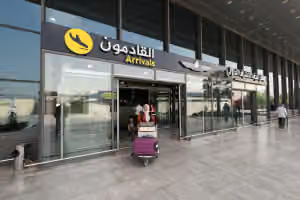
The warnings have increasingly extended to neighboring countries as restrictions on Iranian aviation have tightened. Iranian flights to Najaf, Iraq, were cancelled Friday, further narrowing the country’s remaining international connections.
Rezaei warned regional countries earlier this week that if they barred Iranian flights in cooperation with Washington, flights from their own airports could also be stopped.
Mohammad Mokhber, an adviser and aide to Supreme Leader Mojtaba Khamenei, sharpened that warning Friday.
“Flights in the region are either free for everyone or for no one,” he wrote on X. “If Iran is unable to fly and receive airport services, no country in the region will have this possibility either.”
The competing messages highlight the difficulty facing Tehran as contacts with Washington resume: Pezeshkian and Araghchi are outlining the concessions and sequencing that a negotiated settlement could require, while hardline political and security figures emphasize Iran’s ability to widen the confrontation.
The IRGC-affiliated Fars News criticized Iran’s executive vice-president on Friday for joining Saudi officials in a cake-cutting ceremony marking the kingdom’s National Day in Tehran, which it said created an overly “friendly” image at a time of heightened regional tensions.
“Jafar has done it again,” Fars wrote, referring sarcastically to Mohammad Jafar Ghaempanah.
The issue, it said, was not Ghaempanah’s attendance at the event but what it described as the creation of an overly “friendly” image at a time of heightened tensions involving Iran, Saudi Arabia and the United States.
Ghaempanah later told state television that he had not been personally eager to attend the ceremony and had done so on instructions from officials responsible for Iran’s foreign policy.
“I had no motivation to attend the Saudi National Day ceremony, but I was instructed by the relevant foreign policy authorities to take part,” he said.
Ghaempanah added that during the event he condemned what he described as US attacks on Iran carried out from Saudi territory.
Fars said Iran and Saudi Arabia have diplomatic relations and that officials attending each other’s formal ceremonies was consistent with Tehran’s neighborhood policy.
But the outlet objected to images showing Ghaempanah standing alongside Saudi officials and holding hands with a Saudi representative during the cake-cutting ceremony, saying there was a distinction between “diplomatic presence” and producing “a friendly frame” under current conditions.
It pointed to the US naval blockade of Iran and reports of military cooperation between Washington and Riyadh against Iran-aligned groups in the region, arguing that symbolic gestures by senior Iranian officials would therefore face greater scrutiny.
Fars also linked the episode to earlier controversies surrounding Ghaempanah, saying a pattern had emerged in which remarks or actions by the vice president triggered criticism before he later explained that they had been misunderstood.
Ghaempanah previously drew criticism from hardliners after questioning the costs associated with Iran’s uranium enrichment program and arguing that policy should be assessed partly on a cost-benefit basis.
He later said those remarks were intended to argue for minimizing the costs of pursuing national objectives, rather than opposing uranium enrichment itself.
Iran will not make concessions over its nuclear program even if the United States accepts Tehran’s proposal for reopening the Strait of Hormuz, Reuters reported Friday citing a senior Iranian official.
The official, who spoke on condition of anonymity, said Hormuz would remain closed until Washington met all of Iran’s conditions, including lifting its naval blockade of Iranian ports.
The position adds a significant caveat to a proposal outlined by Foreign Minister Abbas Araghchi in New York this week, under which Iran has offered to reopen the strait within seven days if the United States meets a series of demands.
Those include ending the blockade of Iranian ports, waiving sanctions on Iranian oil sales, releasing frozen Iranian funds and ending hostilities on other fronts, including Lebanon. Nuclear negotiations could then resume as part of efforts toward a broader settlement.
President Masoud Pezeshkian said Thursday that Iran was prepared to relinquish its stockpile of uranium enriched to 60% within the framework of international law and its obligations under the Nuclear Non-Proliferation Treaty.
The distinction could reflect the different questions being addressed: Pezeshkian spoke about Iran’s existing highly enriched uranium stockpile, while the senior official ruled out broader flexibility over the nuclear program.
Iran has long maintained that its nuclear program is entirely peaceful and that it does not seek an atomic weapon.
But senior officials have recently signalled that the attacks on Iran could prompt a reassessment, with Supreme National Security Council Secretary Mohsen Rezaei asking publicly why Iran should not pursue nuclear weapons itself.
The United States and Israel struck the Natanz and Fordow enrichment facilities and the Isfahan nuclear complex during the 2025 conflict, while the fate of Iran’s stockpile of uranium enriched to 60% has remained uncertain.
Natanz was targeted again after the current war began on Feb. 28.
The confrontation follows the collapse of the 2015 nuclear agreement, known as the JCPOA, under which Iran accepted restrictions on its nuclear activities in return for sanctions relief.
Trump withdrew the United States from the agreement in 2018 and reimposed sanctions.
President Donald Trump has made preventing Iran from obtaining a nuclear weapon a central US objective in the current conflict.
In his UN General Assembly address this week, he threatened further military action if an agreement was not reached while predicting that a deal could come after November’s US midterm elections.
Talks between Iranian and US diplomats have continued in New York despite increasingly harsh rhetoric from both capitals, but the emerging dispute is less over whether to negotiate than over who must move first.
The discussions have increasingly focused on sequencing: Iran wants the United States to lift its economic blockade before Tehran reopens the Strait of Hormuz, while Washington is seeking movement on the strait before surrendering its principal source of leverage.
Neither side appears willing to go first despite the mounting economic and political costs of the deadlock.
On the sidelines of the UN General Assembly, Iranian President Masoud Pezeshkian said in an interview with Fox News that Tehran was willing to relinquish its stockpile of uranium enriched to 60% within the framework of international law and its obligations under the Nuclear Non-Proliferation Treaty.
The choice of Fox News may also have reflected an effort to reach President Donald Trump and his political audience more directly, given the network’s close relationship with the president.
Pezeshkian also said Tehran hoped to revive its June ceasefire understanding with Washington before the US midterm elections in November.
“We don't want it to get to the midterm elections,” he told reporters.
Trump has suggested the opposite timetable, saying in his UN General Assembly address that an agreement with Iran would likely be reached after the elections.
Who moves first?
Although both sides insist they seek peace, they remain divided over how an agreement would be implemented and in what order each should make concessions.
Tehran insists that no agreement can be reached before the United States lifts its economic blockade, while Washington and its European allies favour the opposite approach.
The disagreement is compounded by the collapse of the Islamabad Memorandum of Understanding.
From Tehran’s perspective, returning to an agreement that Washington previously failed to honour requires guarantees upfront. From Washington’s perspective, reviving the June arrangement risks appearing to reward Iran for using the Strait of Hormuz as leverage.
Supporters of diplomacy on both sides, along with mediators including Pakistan and Qatar, continue to urge the replacement of military rhetoric with political dialogue.
The problem is that each side is making a different calculation about timing and sequencing, while political considerations discourage either from moving first.
Iran’s demand that “all fronts” be addressed further complicates the equation, linking any agreement to Israel’s actions in Lebanon and elsewhere, while the widening confrontation in the Red Sea and around Bab el-Mandeb has added another layer of uncertainty to negotiations.
The midterms
The competing timetables reveal another dimension of the deadlock: both capitals have now openly linked a potential agreement to the November elections, but appear to be drawing opposite conclusions about who benefits from waiting.
It remains unclear whether Pezeshkian’s remarks will materially alter the course of negotiations. For now, each side appears to calculate that time is placing greater pressure on the other.
Trump’s threat to “annihilate Iran” raises the domestic political cost for Tehran of making concessions and increases the risk that any flexibility will be portrayed by Pezeshkian’s hardline opponents as capitulation.
Washington has political constraints of its own, with congressional hawks and influential regional lobbying groups likely to raise the political cost of concessions to Tehran ahead of the midterm elections.
The view from Tehran
The reformist daily Sharq argued on Thursday that the resumption of contacts offered an opportunity to prevent further escalation, but that significant differences between the two governments and political opposition at home made an immediate breakthrough unlikely.
“The mere continuation of mediation, or even a direct meeting between the presidents of Iran and the United States, lacks the capacity to overcome the current deadlock,” it said. “Changing this situation requires practical and reciprocal decisions from both Tehran and Washington that go beyond diplomatic messaging.”
That assessment points to the constraints facing Pezeshkian, including opposition from hardline parliamentary factions and Iran’s powerful security establishment.
For Iran’s leadership, the principal risk of an agreement is surrendering strategic leverage without guaranteed sanctions relief. For the Trump administration, moving first could expose it to accusations of appeasement ahead of the midterm elections.
The contacts in New York therefore suggest that diplomacy itself is not the missing ingredient. The harder question is whether either side is prepared to move first — and accept the political cost of doing so.