• العربية
  • فارسی
BrandBrand
  • Iran Insight
  • Politics
  • Economy
  • Analysis
  • Special Report
  • Opinion
  • Podcast
  • Live TV
  • Iran Insight
  • Politics
  • Economy
  • Analysis
  • Special Report
  • Opinion
  • Podcast
  • Live TV
  • Theme
  • Language
    • العربية
    • فارسی
  • Iran Insight
  • Politics
  • Economy
  • Analysis
  • Special Report
  • Opinion
  • Podcast
  • Live TV
All rights reserved for Volant Media UK Limited
volant media logo
INSIGHT

Pezeshkian straddles Iran’s divide at UN as US talks test balance

Sep 25, 2026, 02:55 GMT+1

President Masoud Pezeshkian’s UN speech won unusual praise across Iran’s political establishment Thursday, but emerging details of negotiations with the United States could soon test the president’s careful balancing act.

Continue reading

Most Viewed

Houthi gains reversed at Bab al-Mandab, but Iran’s leverage runs deeper
1
ANALYSIS

Houthi gains reversed at Bab al-Mandab, but Iran’s leverage runs deeper

2
INSIGHT

Iran, US back to ‘square one’ as diplomacy stalls

3

Iran’s own surveys reveal demand for 'fundamental change'

4
EXCLUSIVE

IRGC commander, son helped build new oil-sales network

5

Iran says economy holding up as pressure mounts on oil, rial

Banner
Banner

Spotlight

  • Iran looks for escape routes as US sanctions close in
    INSIGHT

    Iran looks for escape routes as US sanctions close in

  • China's turn to Iraqi crude shows growing impact of Iran oil blockade
    ANALYSIS

    China's turn to Iraqi crude shows growing impact of Iran oil blockade

  • Tehran divided over $2 billion plan to prop up rial

    Tehran divided over $2 billion plan to prop up rial

  • Parsian Exchange transferred millions of dollars for Iran despite sanctions
    EXCLUSIVE

    Parsian Exchange transferred millions of dollars for Iran despite sanctions

  • Iran protester recounts torture, mock execution after January arrest

    Iran protester recounts torture, mock execution after January arrest

  • Iran’s own surveys reveal demand for 'fundamental change'

    Iran’s own surveys reveal demand for 'fundamental change'

  • Iran executes nearly two people a week since January protests

    Iran executes nearly two people a week since January protests

  • Iran, US back to ‘square one’ as diplomacy stalls
    INSIGHT

    Iran, US back to ‘square one’ as diplomacy stalls

Banner
Banner
•
•
•

More Stories

Pezeshkian straddles Iran’s divide at UN as US talks test balance

Sep 25, 2026, 00:00 GMT+1
•
Maryam Sinaiee
100%
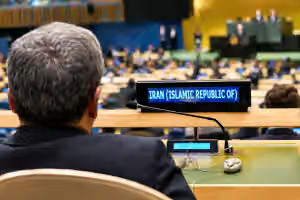
Iran's President Masoud Pezeshkian addresses the 81st United Nations General Assembly (UNGA) at UN headquarters in New York City, US, September 23, 2026.

President Masoud Pezeshkian’s UN speech won unusual praise across Iran’s political establishment Thursday, but emerging details of negotiations with the United States could soon test the president’s careful balancing act.

Conservatives embraced Pezeshkian’s defiant rhetoric at the General Assembly, while reformists highlighted his willingness to negotiate, allowing both sides to find something to welcome in an address that rejected surrender while keeping the door open to diplomacy.

The harder test may now come at the negotiating table.

US and Iranian negotiators in New York are exploring a phased agreement that could reopen the Strait of Hormuz in exchange for Washington lifting its economic blockade of Iran, Reuters reported Thursday.

Neither side wants to surrender its main source of leverage before the other acts, and the talks remain far from an agreement.

Any substantive movement toward such an arrangement could sharpen the domestic divisions that Pezeshkian’s speech temporarily managed to straddle, particularly among hardliners who have opposed negotiations with Washington.

‘We will not surrender’

Pezeshkian’s speech Wednesday night drew praise from senior officials including Parliament Speaker Mohammad Baqer Qalibaf, judiciary chief Gholam-Hossein Mohseni Ejei, Expediency Council Chairman Sadegh Amoli-Larijani and Army Commander Major General Amir Hatami.

Revolutionary Guards commander Ahmad Vahidi said Pezeshkian’s remarks reflected the position of the Iranian people.

“We are not afraid of war. This is the voice of the Iranian people that was heard by the world through him,” Vahidi wrote.

Acting Defense Minister Majid Ibn al-Reza also praised the speech, saying Iran’s message represented a “change in Iran’s defense doctrine” and that the country would accelerate the development of its military capabilities accordingly.

Kayhan, one of the strongest opponents of negotiations with the United States, said Pezeshkian had turned New York into a “court for prosecuting the crimes of Washington and Tel Aviv” and delivered a decisive response to US President Donald Trump.

Javan, a newspaper affiliated with the IRGC, put Pezeshkian’s “We will not surrender” phrase on its front page.

‘Strategic mistake’

Reformist newspapers, however, emphasized another part of the same address: Pezeshkian’s stated readiness for negotiations and engagement with the world.

Their headlines included “We are not afraid of war, we do not shy away from negotiations for peace” and “Neither warmongering nor fear of negotiations,” illustrating the markedly different ways the speech was being presented to domestic audiences.

The balancing act did not satisfy everyone.

Hardline journalist Davoud Modarresian described parts of the speech as worthy of praise but criticized Pezeshkian for travelling to New York and continuing to advocate negotiations.

In the face of Trump’s threats against Iran, he argued, declaring readiness for talks amounted to a “strategic mistake.”

Other hardline commentators complained that Pezeshkian had failed to demand retribution for US and Israeli attacks.

A speech for home?

Reformist journalist Ahmad Zeidabadi, meanwhile, questioned the enthusiastic reception from some of Pezeshkian’s most determined opponents of negotiations with the United States.

He asked whether those praising the president also supported his references to negotiations, or were selectively highlighting his more confrontational remarks in an effort to push the president in a more radical direction.

Some reformists saw the combination differently. Journalist Mohammad Sohofi argued that Pezeshkian sometimes employed populist slogans precisely to reduce tensions and marginalize hardline opponents of his policies.

Former Tehran Chamber of Commerce chairman Hossein Selahvarzi said the speech appeared designed more for a domestic audience than for the international community.

“Pezeshkian’s speech seemed to have been written more to be heard inside the country than to convince the world,” he wrote, arguing that the president should have presented more concrete proposals and initiatives.

Pezeshkian gets the generals' applause, and no word from the man above them

Sep 24, 2026, 11:18 GMT+1
•
Niloufar Goudarzi
100%
Iran's President Masoud Pezeshkian addresses the 81st United Nations General Assembly (UNGA) at UN headquarters in New York City, US, September 23, 2026.

Iran's generals and hardliners spent the week warning Masoud Pezeshkian not to smile in New York. After his UN speech they lined up to praise him. He had not changed their minds about talking to Washington. He had given a speech that did not require them to.

The one voice that could settle what Tehran wants from the diplomacy under way in New York has not been heard at all. Supreme Leader Mojtaba Khamenei has said nothing publicly about the contacts with Washington, the attacks on his foreign minister, or the speech itself.

He did not receive the president before the trip. And this is the first UN General Assembly in 37 years at which his father was not Iran's supreme leader.

What changed, and what did not

Before the speech, the hardline press was hostile to the trip itself. Kayhan warned that "New York is not a place for smiles and negotiations" and that the General Assembly should be turned into "a court for US crimes." Fars, affiliated with the Revolutionary Guards, wrote that Pezeshkian should not have gone at all.

Moderates pushed the other way: the daily Etemad recalled the meetings Iranian presidents failed to hold with Bill Clinton in 2000 and Barack Obama in 2013, and the reformist Mehdi Karroubi urged Pezeshkian to meet Donald Trump.

  • 'Killers in suits': Iranians ask New York's mayor why Pezeshkian walks free

    'Killers in suits': Iranians ask New York's mayor why Pezeshkian walks free

Pezeshkian did neither. After Trump used the UN podium to threaten to "annihilate" Iran, the president said he had rewritten his speech. He held up photographs of children killed in the strike on a school in Minab in the war's first hours alongside a portrait of the late Ali Khamenei, said Iran had defended itself "powerfully," said it remained open to negotiation, and said it would not accept "the language of coercion."

There was no offer in it, no gesture toward a meeting, nothing a hardliner could call weakness.

The praise followed within hours, and it praised the defiance.

Revolutionary Guards spokesman Hossein Mohebbi said the president had "at the heart of the system of arrogance, reproduced the message of power, pride, dignity and hope of a nation," in a statement carried by IRNA.

Iran would rely on unity "from the country's highest executive official to the brave fighters in the field and the people in the streets," he said.

  • Pezeshkian squeezed at home over meeting Trump in New York

    Pezeshkian squeezed at home over meeting Trump in New York

  • New US-Iran talks run into old question of who speaks for Tehran

    New US-Iran talks run into old question of who speaks for Tehran

  • Threats and counter-threats complicate new US-Iran diplomacy

    Threats and counter-threats complicate new US-Iran diplomacy

Mohammad Mokhber, an adviser to the supreme leader, called Pezeshkian "a worthy representative and the voice of all Iranians" who had been "decisive, reasoned and logical."

The message, he wrote on X, was clear: "we will not bow our heads before a bully, we will not forget our martyrs and we will make the aggressors regret their actions."

Ali Abdollahi, chief of staff of the armed forces and commander of the Khatam al-Anbiya Central Headquarters, Iran's wartime command, said the people "through Dr. Pezeshkian, slapped the criminal president of the United States before the eyes of the world," and that the armed forces stood "in harmony and in one voice with the people and the respected president."

Army commander Amir Hatami followed on Thursday. "Mr. President, well done. We sincerely thank you," he said, calling the address "a manifestation of the unity and coordination of all Iran against the bullying enemy."

  • Khamenei adviser says Tehran can negotiate, hardliners say it must not

    Khamenei adviser says Tehran can negotiate, hardliners say it must not

Parliament speaker Mohammad Bagher Ghalibaf wrote that Pezeshkian "spoke not just for a government, but for a 3,000-year-old civilization."

Every one of those statements praised the speech for what it refused. None mentioned the talks.

The missing voice

In previous years, state media made a point of showing the president meeting the supreme leader before a major trip, including before the General Assembly. The meeting was the signal: the president traveled with the leader's mandate, and everyone in Tehran knew it. No such meeting was announced this year. Mojtaba Khamenei has not been seen or heard in public since he was named to succeed his father in March, and he has issued nothing on New York.

The closest anyone has come to speaking for him was Major General Yahya Rahim Safavi, one of his military advisers, on Wednesday. "If the Supreme Leader has deemed it expedient and left the government's hands open in the negotiations, that is an important act of prudence," Safavi said on state television. Even the adviser spoke in the conditional.

That leaves the generals' applause doing a job the leader's meeting used to do. Their statements told Tehran that the speech was approved. What they did not tell anyone is whether the contacts around it are.

The fight that did not stop

The argument over those contacts continued through the praise, and it is an argument about authorization, not about whether to talk.

Ebrahim Rezaei, of parliament's National Security and Foreign Policy Committee, challenged Foreign Minister Abbas Araghchi on Wednesday over his meeting in New York with US envoy Steve Witkoff. "

On the basis of which authorization and policy did the foreign minister meet the representative of the aggressor enemy?" he wrote on X. Iran's seven conditions had already been conveyed to Washington, he said, and "nothing comes from such an illegal meeting except a sign of weakness."

Tasnim, also affiliated with the Guards, called Araghchi's explanation "childish and vile" and, citing Mohsen Rezaei, the secretary of the Supreme National Security Council, said the approved plan had been to pass the conditions through mediators, not to meet Witkoff. It called the meeting "a major error." Fars argued the contact had eased pressure on Washington without securing anything.

On Thursday Ali Khezrian, another member of the Committee, said Araghchi had not been authorized to hold direct talks and that MPs had registered a motion to impeach him. "Araghchi must, after returning from his trip, answer in parliament on what basis this conversation with the American side took place," he said.

The foreign minister had defenders. MP Mojtaba Zarei said his own inquiries showed Araghchi had been authorized to meet Witkoff. "There was and is no negotiation," he wrote; the seven conditions had been delivered directly to Trump's envoy. Mohebbi, for the Guards, had already set the terms: "We don't reject diplomacy, but we impose our own conditions. Our defensive power will be proven in the field."

The man who stayed in his seat

A second row concerned Nasser Asadi, a member of Iran's UN mission who remained in the hall during Trump's address. Hossein Ali Haji-Deligani, deputy head of parliament's Article 90 Committee, which handles public complaints against state bodies, called it "a source of shame and regret" and said MPs would use "all supervisory tools, including the impeachment of Araghchi." Hardline accounts contrasted Asadi with delegations that walked out.

Foreign Ministry spokesman Esmail Baghaei defended him. "Iran's seat in a place such as the United Nations General Assembly is our trench," he said. "If we are supposed to leave this trench because of the harsh words, hostility and insults of others, then we certainly have not done our duty."
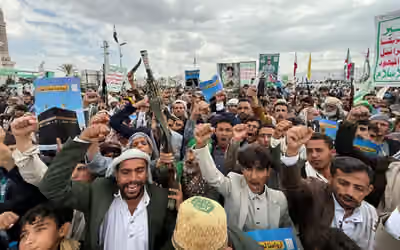

Threats and counter-threats complicate new US-Iran diplomacy

Sep 23, 2026, 23:30 GMT+1
•
Maryam Sinaiee
100%
File photo: Crowds gather during a state-sponsored event in central Tehran, Iran

Iran warned Wednesday that any renewed US attack would draw a stronger military response, even as officials from the two countries pursued a new diplomatic opening in New York that has triggered a backlash among hardliners in Tehran.

The warnings followed President Donald Trump's threat at the United Nations to “annihilate” Iran, while Tehran has said further negotiations depend on Washington accepting seven conditions it has put forward for ending the conflict.

Mohsen Rezaei, secretary of Iran's Supreme National Security Council, sharply criticized Trump in remarks broadcast on state television, saying Iran would not return to what he described as the previous model of diplomacy.

He said the United States would first have to meet Iran's seven conditions before Tehran would agree to reopen the Strait of Hormuz and begin negotiations.

Rezaei said it had been agreed at a meeting with President Masoud Pezeshkian that Foreign Minister Abbas Araghchi would communicate the conditions to intermediaries during his visit to New York.

That account has become significant amid a growing dispute in Tehran over Araghchi's contact with US special envoy Steve Witkoff on Tuesday and whether the foreign minister had authorization to meet him directly.

US officials have described the latest contact between the two sides as face-to-face, while Iranian accounts have emphasized the role of mediators and said the purpose was to convey Tehran's conditions to Washington.

‘Childish and vile’

Iran's state broadcaster reported Tuesday evening that Araghchi had met Witkoff at the insistence of the American side and that the purpose of the meeting was to communicate Iran's conditions for reopening the Strait of Hormuz.

Foreign Ministry spokesman Esmail Baghaei said contact with the US side took place through Qatari mediators and was intended to communicate conditions including an end to the war on all fronts, a halt to US military operations, an end to the naval blockade and economic war, and the release of Iranian assets.

The contact prompted strong criticism of Araghchi from hardline and IRGC-affiliated media.

Tasnim News Agency, which is affiliated with the IRGC, described Araghchi's explanation as “childish and vile” and demanded an apology, questioning why he needed to meet Witkoff if Iran's conditions had already been communicated through intermediaries.

Ebrahim Rezaei, spokesman for parliament's National Security and Foreign Policy Committee, also questioned the meeting and asked Araghchi to explain what authorization he had received.

But parliament member Mojtaba Zarei defended Araghchi, saying his own review indicated that the foreign minister had been authorized to meet Witkoff.

“There was and is no negotiation,” Zarei wrote, saying Iran's seven conditions, including the lifting of the blockade of Yemen, had been communicated directly to Trump's representative.

Pezeshkian’s revised speech

The dispute unfolded as Pezeshkian and Trump publicly exchanged warnings while leaving open the possibility of diplomacy.

Pezeshkian said during his address to the General Assembly on Wednesday that he had changed his prepared remarks after hearing Trump's speech.

Holding up photographs of children killed in the attack on a primary school in Minab alongside an image of late Supreme Leader Ali Khamenei, Pezeshkian accused the United States and Israel of imposing the war on Iran and said the Islamic Republic had “powerfully” defended itself.

But he also said Iran remained open to negotiations in pursuit of peace and would not accept what he called “the language of coercion.”

Trump, meanwhile, issued a fresh warning against Iran while also expressing optimism that the dispute between Washington and Tehran could be resolved.

Speaking Wednesday at a meeting with Gulf Cooperation Council leaders in New York, Trump said the United States would “immediately” attack Iran if it carried out activities at the Kolang underground facilities.

Later Wednesday, after meeting British Prime Minister Andy Burnham, Trump said negotiations were continuing and that he believed the two sides would ultimately reach an agreement.

Iran's General Staff of the Armed Forces and the Khatam al-Anbiya Central Headquarters accused Trump of using the UN podium to justify military action and said Iran was prepared to deliver “stronger, crushing and unpredictable blows” in response to any renewed attack.

The simultaneous threats and diplomatic contacts have left the two sides pursuing negotiations while publicly warning that renewed military action remains possible.

Iran’s nightly pro-state rallies become factional battleground

Sep 18, 2026, 09:45 GMT+1
•
Maryam Sinaiee
100%
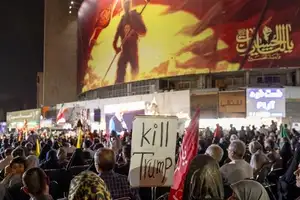
Supporters of the Islamic Republic wave Iranian flags during the 200th consecutive night of pro-state rallies in Tehran, September 17, 2026.

Iran’s nightly pro-government rallies have become an increasingly visible show of political force, occupying streets and squares for 200 consecutive nights and, more recently, turning their fire on rivals within the Islamic Republic itself.

For critics of the government, the gatherings have long carried a message beyond support for Iran during the war: that the street belongs to supporters of the Islamic Republic.

Coming after the mass protests of January, critics have viewed their nightly presence as a form of intimidation and a way of denying public space to potential dissent. For many, the effect is more mundane but relentless: late-night loudspeakers, road closures and disruption to daily life.

But the rallies have increasingly taken on another function. Participants have chanted against Parliament Speaker Mohammad-Bagher Ghalibaf, Foreign Minister Abbas Araghchi, President Masoud Pezeshkian and former presidents Hassan Rouhani and Mohammad Khatami.

Some gatherings have also featured demands for strict enforcement of Iran’s controversial hijab law, whose implementation has been held back following a decision by the Supreme National Security Council amid concerns over public backlash.

The shift has prompted warnings that gatherings promoted as demonstrations of national unity are becoming arenas for political score-settling.

The Supreme National Security Council-linked Nour News website described videos showing increasingly harsh slogans at recent gatherings as a “worrying shift in Iran’s political scene.”

“When street gatherings become a place for ‘death to’ and ‘down with’ slogans against domestic political figures, the first sign of a shift in the direction of popular reactions—from the foreign enemy to the domestic rival—becomes apparent,” Nour News wrote.

That shift is particularly significant because hardline media have portrayed the nightly gatherings as a measure of national opinion.

The hardline Hamshahri newspaper marked the 200th night with an article titled “200 Nights of Referendum,” presenting continued participation as an answer to politicians who have called for the public to be consulted over the country’s direction.

“Two hundred nights of participation in nighttime gatherings are a completely clear response to the doubts of some politicians who believe that the people should be consulted and a referendum held in order to continue the resistance,” it wrote.

The article was referring to Rouhani’s recent suggestion that continuing the war and confrontation with the United States and Western countries should be subject to consultation with the public.

The reformist Shargh newspaper warned that a social gathering that began in the name of “patriotism” could acquire a different meaning if it became a place for deciding “who has the right to speak about the country’s policies and who does not.”

Even the conservative daily Khorasan, considered close to Ghalibaf, called for a review of how the gatherings are organised in an article titled “200 Nights of Taking the Field.”

It questioned the use of the gatherings to promote hijab-related demands that it said exacerbate social divisions. It also highlighted complaints about the disruption the gatherings cause to residents and traffic.

“What image of these gatherings forms in citizens’ minds when the sound of loudspeakers keeps a sick person in a nearby home awake late into the night, or when hastily organized vehicle convoys create severe traffic jams and leave a driver exhausted after a day’s work stuck in traffic?” the newspaper asked.

Similar complaints have appeared on social media.

One X user urged supporters of the rallies to ask shopkeepers, residents and taxi drivers what they thought of the disruption, asking: “What has that taxi driver done to deserve sitting in traffic because of 30 government supporters?”

Another user, Morteza Rezazadeh, pointed to the changing targets of the slogans: from Israel and the United States to Iran’s president and parliament speaker. Mossad can “rest easy,” he quipped, because those chanting were doing its work for it.

After 200 consecutive nights, the dispute over the gatherings is therefore no longer simply about noise, traffic or even demonstrations of support for the state. It has become a dispute over who controls the street, who can claim to speak for the public and who inside the Islamic Republic is considered a legitimate political voice.

Why Iran’s hardliners keep talking of ousting Pezeshkian

Sep 17, 2026, 17:29 GMT+1
•
Behrouz Turani
100%
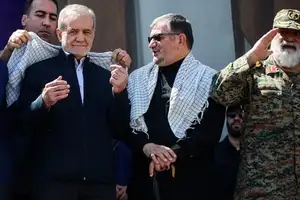
Iran's president Masoud Pezeshkian attends an event celebrating pensioners in Tehran, Iran, September 14, 2026

Renewed talk among Iranian hardliners of removing President Masoud Pezeshkian has revived comparisons with Iran’s only presidential impeachment, but there is little evidence so far of a coordinated effort capable of unseating him.

Instead, the latest speculation fits a pattern that has followed Pezeshkian since taking office in 2024: recurring calls for resignation or impeachment that intensify during periods of political, economic or geopolitical pressure.

The latest round was partly triggered by cryptic comments from Qom MP Mojtaba Zarei referring to a possible “coup” or coordinated political move against Pezeshkian.

Rouydad24 examined whether hardline networks, particularly Sharyan—the Persian acronym for the Strategic Network of Islamic Revolution Supporters—and allies of Saeed Jalili, Pezeshkian’s rival in the 2024 presidential election, were seeking early presidential elections.

The outlet presented no formal evidence of such a plan but pointed to repeated calls by radical lawmakers to invoke Article 89 of the Constitution, under which parliament can declare a president politically incompetent.

Mohsen Gharavian, a seminary and university lecturer, described the campaign to portray Pezeshkian as politically incompetent as a “targeted political conspiracy” and a soft “coup.”

Writing for Khabar Online, he argued that ultra-conservatives angered by their 2024 electoral defeat were using political networks and sustained media pressure to weaken the government.

In a separate Khabar Online report, moderate politician Hassan Rasouli criticised proposals to impeach Pezeshkian or transfer executive authority to First Vice President Mohammad Reza Aref.

Rasouli said such moves, particularly amid heightened national security pressures, amounted to “a direct attack on high-level governance cohesion.” He dismissed comparisons with the 1981 removal of Iran’s first president, Abolhassan Banisadr, as political theatre rather than a serious legal pathway.

Threats to use parliament against sitting presidents have a long history in the Islamic Republic.

During Akbar Hashemi Rafsanjani’s second term from 1993 to 1997, conservative opponents mounted sustained pressure on his government, including the impeachment of cabinet ministers.

Hassan Rouhani also faced repeated impeachment threats during his presidency, particularly from opponents of his diplomatic engagement with Washington.

The only successful precedent remains Banisadr in 1981. Parliament declared him politically incompetent during the Iran-Iraq war, after which Ayatollah Ruhollah Khomeini formally dismissed him.

Banisadr’s removal has since become a recurring reference point in disputes over presidential authority. Hardline lawmakers have invoked his case in attacks on Pezeshkian, particularly over diplomacy, economic policy and the conduct of the war.

But invoking Article 89 and successfully removing a president are different things. There is currently no indication that Pezeshkian’s opponents have assembled the parliamentary support required to declare him politically incompetent.

Opposition to Pezeshkian has nevertheless persisted since he took office following Ebrahim Raisi’s death in 2024. Calls for his resignation, comparisons with Banisadr and threats to invoke Article 89 have resurfaced during periods of economic turmoil, currency volatility and war.

The repeated threat of impeachment can serve a political purpose even without enough votes to remove the president: keeping his competence under question and constraining his room for manoeuvre on economic and diplomatic policy.

This week’s talk of a “coup” and renewed debate over presidential competence therefore appears less a new escalation than the latest iteration of a political struggle that has accompanied Pezeshkian for much of his presidency.