• العربية
  • فارسی
Brand
  • Iran Insight
  • Politics
  • Economy
  • Analysis
  • Special Report
  • Opinion
  • Podcast
  • Live TV
  • Iran Insight
  • Politics
  • Economy
  • Analysis
  • Special Report
  • Opinion
  • Podcast
  • Live TV
  • Theme
  • Language
    • العربية
    • فارسی
  • Iran Insight
  • Politics
  • Economy
  • Analysis
  • Special Report
  • Opinion
  • Podcast
  • Live TV
All rights reserved for Volant Media UK Limited
volant media logo

Iran rapidly rebuilding site tied to past nuclear weapons research - report

Sep 17, 2026, 18:14 GMT+1
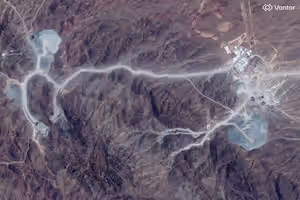
Satellite image shows Parchin military complex in Iran after an Israeli attack, October 2024 (Photo: Planet Labs Inc./Handout via REUTERS)

Iran is rapidly reconstructing a heavily fortified facility at the Parchin military complex that was previously linked to nuclear weapons research and has been struck twice since 2024, new satellite imagery analyzed by a Washington-based nuclear watchdog shows.

Vantor Technologies imagery from September 13 shows extensive construction at Taleghan 2 in southeastern Tehran, with Iran erecting a large tarp over the destroyed underground structure that obscures work beneath it from satellites and aerial reconnaissance, the Institute for Science and International Security said in a report published Thursday.

The imagery shows dump trucks, bulldozers, concrete pump trucks, mixers and cranes operating across the site, according to the institute. Iran has also added concrete reinforcement on one side of the facility, while a similar structure identified in July appears to have been completed on the other side, measures the institute said would provide additional blast protection against aerial attack.

Repair work began in June, initially focused on sealing three penetration holes left by bunker-buster weapons used in an attack three months earlier. High-resolution imagery reviewed by the institute in June and July showed the holes being excavated, covered with reinforcing steel and prepared for permanent concrete caps.

The reconstruction marks Iran's second effort to rebuild Taleghan 2 in less than two years.

The original facility was destroyed in an Israeli strike in October 2024. Iran began rebuilding it in May 2025, eventually constructing a reinforced structure encased in concrete and covered with earth. By early 2026, the site had effectively become a hardened bunker, with additional defensive features including concrete barriers and protection against drones.

In November, satellite images of the reconstruction showed a large cylindrical object inside the facility resembling a high-explosive containment chamber. The institute estimated it at about 36 meters long and at least 12 meters wide and said such a chamber could be used for explosive experiments relevant to nuclear weapons development, though imagery alone could not establish its purpose.

The rebuilt facility was struck again in early March 2026. Satellite images afterward showed three large penetration holes over the portion of the buried structure where the suspected cylindrical chamber had been installed. The Institute for Science and International Security assessed that the internal structure and probable chamber were likely destroyed.

The institute said the pace of the latest reconstruction raises questions about why Tehran has repeatedly restored a facility with a history tied to work relevant to nuclear weapons.

Ties to past nuclear weapons research

Taleghan 2's significance predates the recent attacks. The institute says the facility was used during Iran's AMAD Plan, a program that Western governments and nuclear experts have linked to work on a nuclear explosive device in the early 2000s.

According to the institute's reconstruction of material from Iran's nuclear archive, Taleghan 2 once housed a specially designed high-explosive chamber and flash X-ray equipment used to study explosive compression.

It says a scaled-down test of a multipoint initiation system — technology relevant to triggering an implosion-type nuclear weapon — was conducted there in 2003. The institute says the International Atomic Energy Agency (IAEA) never inspected the Taleghan 2 building itself.

The IAEA's own 2015 assessment found that before the end of 2003 Iran had an organizational structure capable of coordinating a range of activities relevant to developing a nuclear explosive device.

Information available to the agency indicated that those activities became concentrated in the early 2000s under projects known as the AMAD Plan and were halted in late 2003.

The IAEA found that some related activities continued afterward but were not part of a coordinated effort. Iran denied both that it had a coordinated nuclear weapons program and that the AMAD Plan existed as such.

The agency revisited Iran's past nuclear work in a comprehensive safeguards assessment last year. It concluded that Lavizan-Shian, Varamin and Marivan, along with potentially related locations, had been part of an undeclared structured nuclear program until the early 2000s and that some activities involved undeclared nuclear material.

At the same time, the IAEA said it had no credible indications of an ongoing undeclared structured program of that kind. Tehran rejected the findings and maintained that it had declared all nuclear material required under its Safeguards obligations.

IAEA not able to monitor Iran’s nuclear program

The renewed work at Taleghan 2 comes as the IAEA says its ability to monitor Iran's current nuclear program has deteriorated sharply.

IAEA Director General Rafael Grossi said this week that the agency had conducted almost no in-field verification in Iran for more than six months, apart from an inspection of the Bushehr nuclear power plant in June.

The agency has also been unable for more than a year to maintain continuity of knowledge over previously declared stocks of enriched uranium at facilities affected by military strikes.

Before losing access, the IAEA estimated that Iran possessed 440.9 kilograms of uranium enriched to as much as 60% purity. The agency has been unable to verify how much remains or its current location and has also said it still cannot establish the status of Iran's fourth declared enrichment facility at Isfahan.

Grossi called the lack of information and access a “serious proliferation concern” requiring urgent action.

Last week, the IAEA Board of Governors also reported Iran to the UN Security Council over safeguards non-compliance, after the agency said Tehran had failed to provide inspectors with information and access necessary to account for nuclear material. Iran called the move politically motivated and has argued that US and Israeli attacks on its facilities have made normal inspections impossible.

The Institute for Science and International Security said the purpose of the new Taleghan 2 facility still cannot be established from satellite imagery alone. But after two attacks and two reconstruction campaigns, it said Iran's continued investment in the site demonstrates its determination to restore the facility despite its sensitive history.

Banner

Most Viewed

Security forces deploy as shops in western Iran strike on Mahsa Amini anniversary
1

Security forces deploy as shops in western Iran strike on Mahsa Amini anniversary

2
ANALYSIS

A generation shaped by Woman, Life, Freedom refuses to go back

3
VOICES FROM IRAN

Iranian women recall the first time they went out uncovered

4

US House passes Iran sanctions as Trump signals war may be nearing end

5

US officials met Iran-aligned Houthis in Oman - Reuters

Banner

Spotlight

  • Why Iran’s hardliners keep talking of ousting Pezeshkian
    INSIGHT

    Why Iran’s hardliners keep talking of ousting Pezeshkian

  • Woman, Life, Freedom and the Iran that cannot go back
    OPINION

    Woman, Life, Freedom and the Iran that cannot go back

  • Calls to quit NPT grow in Iran as critics warn of strategic trap

    Calls to quit NPT grow in Iran as critics warn of strategic trap

  • From Halkbank to Golden Global: Turkey’s Iran banking ties under US scrutiny

    From Halkbank to Golden Global: Turkey’s Iran banking ties under US scrutiny

  • Iranian women recall the first time they went out uncovered
    VOICES FROM IRAN

    Iranian women recall the first time they went out uncovered

  • ‘This is the cost you must pay’: Iran accused of denying food to death-row twin

    ‘This is the cost you must pay’: Iran accused of denying food to death-row twin

Banner
Banner
•
•
•

More Stories

Calls to quit NPT grow in Iran as critics warn of strategic trap

Sep 17, 2026, 00:30 GMT+1
•
Maryam Sinaiee
100%
Demonstrators hold Iranian flags and a banner reading “Zero enrichment we do not have a deal” during a rally outside the Atomic Energy Organization of Iran in Tehran, May 2025

Calls for Iran to withdraw from the Nuclear Non-Proliferation Treaty are gaining ground among hardliners after the IAEA referred the country to the UN Security Council and its nuclear chief was barred from attending the agency’s annual conference in Vienna.

The growing debate has exposed a divide within Iran’s political establishment between those who see NPT membership as offering little protection and others who warn that withdrawal would surrender one of Tehran’s remaining diplomatic and legal advantages.

Mohsen Rezaei, secretary of Iran’s Supreme National Security Council, appeared to threaten withdrawal from the treaty on Sunday, saying that “political and destructive actions” by the International Atomic Energy Agency would “push countries toward leaving the Nuclear Non-Proliferation Treaty.”

But President Masoud Pezeshkian reiterated the same day, during a visit to India, that Iran was not seeking nuclear weapons. “If we were seeking nuclear weapons, we would not have become a member of the NPT,” he said.

The debate intensified after Mohammad Eslami, head of Iran’s Atomic Energy Organization, was prevented from attending the IAEA General Conference in Vienna.

Austria had sought an exemption from a UN travel ban to allow Eslami to attend, but the sanctions committee did not approve it after a US objection.

Calls for immediate withdrawal

Supporters of immediate withdrawal say NPT membership has failed to protect Iran from international pressure or attacks on its nuclear facilities.

Continued membership, they argue, only makes sense if members’ nuclear rights are given equal weight alongside their obligations.

Sepehr Khalaji, who headed the Government Information Council under former President Ebrahim Raisi, questioned why Iran remained in the treaty.

“They bombed the nuclear facilities, martyred the scientists, sanctioned nuclear technology and say they will strike the remaining nuclear facilities. They referred Iran’s case to the Security Council, and they do not allow the head of the Atomic Energy Organization to enter the IAEA. So why are we still in the IAEA? Why don’t we withdraw from the NPT?” he wrote on X.

Parliamentary push

The debate has also reached parliament, where lawmakers are preparing a proposal for Iran to withdraw from the NPT.

Hassan-Ali Akhlaghi, a member of parliament, told the Fars news agency on Wednesday that lawmakers had prepared a triple-urgency bill that would be put to a vote if approved by the parliamentary leadership.

Given what he called the IAEA’s “entirely hostile and illogical” resolution, Akhlaghi said Iran should leave the treaty as soon as possible.

The proposal, however, has not yet formally reached parliament’s National Security and Foreign Policy Committee and is not currently on the parliamentary agenda.

Warnings of a trap

The conservative Khorasan newspaper on Wednesday warned that leaving the treaty could increase political and diplomatic pressure on Iran without producing significant security gains.

“On the surface, these positions may appear to be a revolutionary and deterrent response to the enemy; but when the pieces of the situation are put together, another worrying picture emerges,” it wrote.

Khorasan argued that the United States and Israel were deliberately trying to push Iran’s political debate toward more radical positions, including testing a nuclear weapon, changing its nuclear doctrine and immediately withdrawing from the NPT.

The newspaper said leaving the treaty before Iran had achieved deterrence could reveal Tehran’s intentions rather than demonstrate strength, potentially giving its opponents an opportunity to act.

“Iran has obtained an important part of the practical outcome without making an official and costly withdrawal: the IAEA no longer has its previous access, while Tehran continues to benefit from the legal protection of NPT membership and the political support of Russia and China,” Khorasan wrote.

“Official withdrawal would destroy this useful grey zone without creating a new strategic advantage.”

Reformist politician Rasoul Montajab-Nia made a similar argument.

“If the agency has not acted impartially toward Iran, we should not resort to disrupting the framework, because this would mean fuelling disputes and war with other countries.”

Montajab-Nia said withdrawal would not benefit Iran and would be “in line with Israel’s objectives.”

The nuclear threshold

At the outer edge of the debate, some advocates of developing nuclear weapons have argued that Iran should remain in the NPT unless it decides to change its nuclear doctrine — and then coordinate withdrawal with a nuclear test.

Foad Izadi, a hardline political commentator, told the Moj news agency that Iran had no need to leave the NPT while its current nuclear doctrine remained in place.

But if Tehran decided to change that doctrine, he said, Iran could withdraw from the treaty after a nuclear test or simultaneously with one.

IAEA raises alarm over Iran access amid mounting Hormuz tensions

Sep 14, 2026, 13:23 GMT+1
100%
Pedestrians walk past a billboard promoting Iran’s nuclear program in Tehran.

Concern over Iran’s nuclear program intensified on Monday as the UN nuclear watchdog said it had conducted almost no inspections in the country for more than six months, while tensions surrounding Hormuz deepened and Yemen’s Iran-backed Houthis claimed another attack on Saudi.

The developments centered on the loss of international oversight of Iran’s nuclear material, mounting restrictions and threats involving shipping through Hormuz, and a new round of regional military activity that prompted Saudi emergency alerts and high-level talks with the head of US Central Command.

IAEA warns of serious proliferation concern

The International Atomic Energy Agency has carried out no in-field verification activities in Iran for more than six months, except for an inspection of the Bushehr nuclear power plant in June, Director General Rafael Grossi said at the agency’s General Conference in Vienna.

Grossi said the IAEA withdrew its inspectors after renewed attacks on Iran in late February, worsening a decline in oversight of Tehran’s nuclear program during 2026.

The agency has also lacked continuity of knowledge for more than a year regarding Iran’s previously declared inventories of low- and highly enriched uranium, including material enriched to 60% purity, at nuclear facilities affected by attacks in June 2025.

“The Agency’s lack of information about this nuclear material and access to facilities to verify it is a matter of serious proliferation concern and needs to be addressed with the utmost urgency,” Grossi said.

He called a return to diplomacy and negotiations over Iran’s nuclear program “imperative,” warning that the situation had consequences for the wider global non-proliferation system.

The remarks came as Iran summoned Austria’s chargé d’affaires over Vienna’s failure to issue a visa to Mohammad Eslami, the head of the Atomic Energy Organization of Iran. Foreign Ministry spokesperson Esmail Baghaei called the decision “completely unjustified” and said Tehran had formally protested.

Bloomberg reported earlier that Austria denied Eslami entry after pressure from the Trump administration, preventing him from addressing the IAEA conference. A US official cited by Bloomberg said Washington had urged Austria not to grant a UN-requested sanctions waiver that would have permitted the visit.

Iran threatens restrictions against 77 vessels

Maritime tensions also escalated as Iran’s Persian Gulf Strait Authority published an updated list of 77 vessels it accused of violating Iranian protocols governing passage through the Strait of Hormuz.

The authority warned that the vessels could face restrictions on future passage, including fines, detention or confiscation. Ships cooperating with vessels on the list would also be added, it said, while companies and other entities were warned not to provide services to them.

  • Hormuz diplomacy stalls as attacks deepen pressure on Persian Gulf oil routes

    Hormuz diplomacy stalls as attacks deepen pressure on Persian Gulf oil routes

Iran’s Foreign Ministry said Tehran would continue taking what it considered necessary measures for as long as the United States maintained its maritime blockade.

Baghaei said security in the Strait of Hormuz was a matter for Iran and Oman as the two coastal states and blamed US actions for instability in the waterway. He said an understanding between Tehran and Muscat establishing safe shipping routes had been reached after weeks of negotiations while preserving the sovereign rights of both countries.

But a wider regional meeting planned in Oman had been postponed. Baghaei said it could have provided even a small step toward dialogue between Tehran and Persian Gulf countries, describing its postponement as a missed opportunity.

“Israel is the only beneficiary of tensions between Iran and Persian Gulf countries,” he said, calling on neighboring states to set aside past disputes and pursue regional dialogue.

Saudi Arabia had sought amendments to the Omani-Iranian proposal over concerns that its language could establish an unacceptable new status quo in the strait, Axios reported, citing a senior regional official.

The United States, meanwhile, said its forces had redirected 101 commercial vessels while enforcing the blockade against Iran as of September 13.

Shipping traffic through Hormuz remained sharply reduced over the weekend. Only four commodity vessels exited the Persian Gulf and 10 entered, Reuters reported, citing preliminary tracking data. Daily traffic fell to single digits, compared with a 10-day average of 14 vessels, although the figures excluded ships operating with their tracking transponders switched off.

The IRGC also said that it had detected and destroyed an advanced MQ-1 drone over the Strait of Hormuz using a new Aerospace Force air-defense system. It did not identify the drone’s operator, and the statement was not independently verified.

Houthis claim Saudi air-base attack

Yemen’s Iran-backed Houthis said they attacked an air base in Khamis Mushait in southwestern Saudi Arabia on Monday. Saudi authorities did not immediately confirm that a strike had occurred.

Saudi Arabia’s Civil Defense initially issued emergency alerts warning of potential danger in Khamis Mushait and nearby Abha, but announced shortly afterward that the danger had passed in both locations.

Saudi Crown Prince Mohammed bin Salman met US Central Command chief Admiral Brad Cooper to discuss the latest regional developments.

Elsewhere, missiles struck three camps belonging to Iranian Kurdish opposition groups east of Sulaimaniya in Iraq’s Kurdistan region early Monday, two security sources told Reuters. No casualties were reported, and the sources did not identify who carried out the attacks.

The latest round of tensions has added to pressure on energy markets and regional shipping. Brent crude rose more than $3 to above $108 a barrel at the opening on Monday following fresh strikes on Saudi Arabia and vessels in the Persian Gulf over the weekend.

Pressure was also evident in Iran’s currency market with the US dollar trading at 2.34 million rials, the euro at about 2.7 million rials and the British pound at 3.16 million rials by around midday Monday.


IAEA reports Iran to UN Security Council for first time in 20 years

Sep 9, 2026, 17:37 GMT+1
100%
FILE PHOTO: General view of the IAEA headquarters in Vienna, Austria, June 23, 2025.

The UN nuclear watchdog’s 35-nation Board of Governors voted Wednesday to report Iran to the Security Council over breaches of its nuclear non-proliferation obligations, escalating a two-decade nuclear dispute amid an ongoing war and renewed Western pressure on Tehran.

The resolution was spearheaded by the United States and the E3 (Britain, France and Germany) after the International Atomic Energy Agency said Iran had failed to provide inspectors with access to nuclear facilities and information needed to account for its enriched uranium stocks.

It is the first time Iran has been reported to the Security Council by the IAEA since 2006, when an escalating confrontation over Tehran’s nuclear activities moved from the Vienna-based watchdog to the UN body and eventually led to a series of Security Council sanctions.

The latest referral comes in radically different circumstances. Iranian nuclear facilities have been heavily damaged in US and Israeli strikes, and inspectors have not returned to the affected sites since the attacks began in June 2025.

The IAEA says it has consequently lost track of Iran’s stockpile of uranium enriched to 60% purity, which before the strikes stood at 440.9 kilograms.

Iran maintains that its nuclear program is peaceful and has argued that the US and Israeli attacks themselves made continued inspections impossible.

Tehran’s mission to international organizations in Vienna said on X that the resolution would facilitate the “further erosion and ultimate collapse of the proliferation regime as a whole,” intensifying Tehran’s criticism of the IAEA as politically driven.

China and Russia joined Iran ahead of Wednesday’s vote in opposing the Western-backed resolution, saying the referral “lacks a legal basis” and would aggravate the crisis rather than aid diplomacy.

The three countries described the finding of Iranian non-compliance as “politically motivated and far-fetched” and argued that US and Israeli attacks on Iran’s nuclear facilities were the primary reason Tehran had subsequently denied the IAEA access.

The vote adds another layer of diplomatic pressure as Iran faces an intensifying war with the United States and widening economic sanctions.

Britain this week unveiled tougher restrictions targeting Iran’s access to its financial system, trade and shipping, following the reimposition of UN sanctions under the snapback mechanism initiated last year by Britain, France and Germany.

What happens at the Security Council is less certain. Russia and China both hold vetoes, making substantive action against Iran difficult even as the referral returns the nuclear dispute to the UN body for the first time in two decades.

Construction surges at suspected Iran nuclear site – CSIS

Sep 9, 2026, 13:08 GMT+1
100%
A satellite view shows tunnel entrances at Pickaxe Mountain, of the Natanz nuclear facility, near Natanz, Iran, June 30, 2026. (Reuters file photo)

Construction activity has surged at a deeply buried complex near Iran’s Natanz nuclear facility, but satellite evidence suggests the site may not yet be capable of uranium enrichment, according to a new analysis by the Center for Strategic and International Studies.

CSIS examined six years of satellite imagery of Kuh-e Kolang Gaz La, commonly known as Pickaxe Mountain, an underground complex about two kilometers south of Natanz and roughly 225 kilometers south of Tehran.

The analysis found more road activity at the site in 2026 than at any previous point in its history and what researchers described as a “clear surge in construction activity.”

Recent work included raising and hardening tunnel entrances, paving internal roads, reinforcing access areas and removing excavated soil, according to images taken in July and August.

  • What is Pickaxe Mountain, and why does Trump keep saying he will bomb it?

    What is Pickaxe Mountain, and why does Trump keep saying he will bomb it?

The researchers said the activity indicated that work had shifted from excavation toward probable construction inside the complex, while reinforcement of its exterior continued.

CSIS outlined three possible purposes for Pickaxe Mountain: a centrifuge assembly facility, a uranium enrichment plant or a protected location for other nuclear-related work, including uranium metal conversion.

The report said publicly available evidence was insufficient to determine what Iran intended to place inside the complex. It could neither confirm nor disprove reports that Tehran had moved centrifuges or centrifuge components there.

Continuous construction, the absence of increased internal security and the lack of vehicles or equipment unrelated to building work suggested the site was “not yet capable of enrichment work,” if enrichment was its intended purpose, the analysts said.

CSIS also said the complex would be extremely difficult to destroy using conventional weapons because it is buried deep inside a granite mountain.

Open-source estimates place parts of the facility between 80 and 100 meters underground, but the report cautioned that satellite imagery could not reliably establish its depth or internal design.

The GBU-57 Massive Ordnance Penetrator, the heaviest conventional bunker-busting bomb in the US arsenal, may not be able to reach and destroy the complex, according to the analysis.

A military operation could instead seek to collapse the tunnel entrances, potentially degrading or temporarily disabling the facility without destroying it.

CSIS concluded that military strikes might delay work at the facility but would not offer a sustainable solution to concerns about Iran’s nuclear program, arguing that any lasting resolution would require a verifiable diplomatic agreement.

The IAEA has requested information about Pickaxe Mountain and access to the site, but Iran has not responded, the report said.

Iran began building the facility in 2020 after an aboveground centrifuge assembly workshop at Natanz was damaged in suspected Israeli sabotage. Iranian nuclear chief Ali Akbar Salehi said at the time that a replacement centrifuge assembly facility would be built underground near Natanz.

US President Donald Trump said on September 4 that Washington may strike Pickaxe Mountain “very soon,” reiterating that Iran would not be allowed to have a nuclear weapon.

The Pentagon has made preparations this year to test classified capabilities against deeply buried targets, CNN reported on Wednesday, citing federal contracting records and people familiar with the effort.

Days before the war began on February 28, the Defense Threat Reduction Agency approved an emergency $1.2 million contract to repair a specialized underground testing facility at White Sands Missile Range in New Mexico. The work was intended to prepare the site for a live-fire test against rapidly emerging threats, according to the records.

Three sources told CNN that the planned test was connected to the Iran war and efforts to develop a way to strike Iran’s deepest underground facilities, potentially by simulating attacks on specific nuclear sites.

Satellite imagery reviewed by CNN showed excavation and vehicle activity at the White Sands site beginning in mid-February and continuing into March. CNN said it could not independently verify whether the test occurred or determine its purpose. The Pentagon and the contractor did not provide comment.

The US military also maintains operational plans for striking Pickaxe Mountain, and the facility was included in a target package considered earlier this summer, a source familiar with the matter told CNN. The plan involved some of the largest bombs in the US arsenal, though it remained unclear whether they could penetrate deeply enough to destroy the facility.

Another source told CNN that Defense Department officials recently held a “planning sprint” on options for attacking deeply buried sites. The US Air Force is separately developing a next-generation penetrator to replace its existing bunker-busting bomb, with initial prototype work commissioned in September 2025.

UK expands Iran sanctions over nuclear program and hostile activity

Sep 8, 2026, 11:56 GMT+1
100%
A general view of the Houses of Parliament at sunrise, in London, Britain.

Britain said on Tuesday it was expanding sanctions on Iran, targeting key sectors including energy, metals, banking, insurance and shipping as part of efforts to restrict Tehran's nuclear program and other hostile activity.

Minister of State Stephen Doughty said the government was introducing legislation to tighten financial and trade restrictions, widen powers to sanction ships linked to Iran and bar Iranian aircraft from landing in the UK unless exemptions apply.

“Today we are laying legislation which will tackle Iranian nuclear activity and other hostile Iranian activity,” Doughty said in a written statement to parliament.

Focus on nuclear program

Doughty said Iran had expanded its nuclear program in ways that had no credible civilian justification and pointed to its stockpile of more than 400 kg of uranium enriched to 60%.

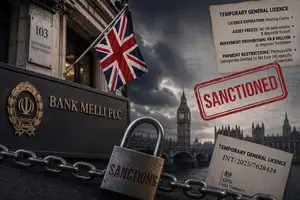
  • If Britain backs US plan, Iran's London bank shuts down on October 22

    If Britain backs US plan, Iran's London bank shuts down on October 22

“Iran is the only country without nuclear weapons to enrich uranium to this level,” he said.

Britain restored UN sanctions on Iran in October 2025 after the snapback mechanism was triggered and also designated 71 people and entities linked to Iran's nuclear program, including financial institutions and energy companies.

Wider trade and financial restrictions

The new rules expand restrictions on goods, technology and services tied to sectors including energy, software, metals and gold, as well as shipping, insurance and banking.

They also ban exports of additional goods and technology that Britain says could support Iran's conventional weapons and nuclear capabilities.

Doughty said the financial measures would “further reduce the Government of Iran’s ability to access the UK financial system and raise funds in support of its nuclear programme.”

  • UK minister says new state-threat bill could pave way for IRGC designation

    UK minister says new state-threat bill could pave way for IRGC designation

Shipping and aviation targeted

Britain will also gain broader powers to sanction ships that it says enable or facilitate Iran's nuclear program or other destabilizing activity.

Iranian aircraft will be barred from landing in the UK unless exemptions apply, following Britain's termination of bilateral air service arrangements with Iran in 2024.

The legislation includes exemptions to allow continued operations at the Shah Deniz gas field in Azerbaijan, which supplies energy to European countries.

Doughty said Britain remained committed to diplomacy, saying a negotiated outcome was “the only long-term solution” to the dispute over Iran's nuclear program.