• العربية
  • فارسی
Brand
  • Iran Insight
  • Politics
  • Economy
  • Analysis
  • Special Report
  • Opinion
  • Podcast
  • Live TV
  • Iran Insight
  • Politics
  • Economy
  • Analysis
  • Special Report
  • Opinion
  • Podcast
  • Live TV
  • Theme
  • Language
    • العربية
    • فارسی
  • Iran Insight
  • Politics
  • Economy
  • Analysis
  • Special Report
  • Opinion
  • Podcast
  • Live TV
All rights reserved for Volant Media UK Limited
volant media logo

Sweden expels Iranian embassy employee over threats to Jewish, Israeli interests

Sep 16, 2026, 14:00 GMT+1

Sweden expelled an Iranian embassy employee and summoned Iran's ambassador over what it said were threats targeting Jewish and Israeli interests in the country, AFP reported on Wednesday.

“We know that Iran, over a long period of time, has conducted activities that threaten security in and against Sweden, targeting both individuals who oppose the Iranian regime and various Jewish and Israeli interests in our country,” Justice Minister Gunnar Strommer said in a statement to AFP.

“This has, among other things, been done by making use of criminal networks,” he added.

Banner

Most Viewed

US, Iran hint at talks even as sanctions tighten and Hormuz tensions stay high
1

US, Iran hint at talks even as sanctions tighten and Hormuz tensions stay high

2
ANALYSIS

Iran's Saudi leverage could become its liability

3
ANALYSIS

After Muscat collapse, Tehran argues over what comes next

4

Islamic Republic asks public to identify opponents abroad

5

Hormuz traffic plunges ahead of Iran-China talks

Banner

Spotlight

  • From Halkbank to Golden Global: Iran sanctions and Turkey’s banking ties

    From Halkbank to Golden Global: Iran sanctions and Turkey’s banking ties

  • A generation shaped by Woman, Life, Freedom refuses to go back
    ANALYSIS

    A generation shaped by Woman, Life, Freedom refuses to go back

  • Mahsa Amini and the century-long struggle of Iranian women
    INSIGHT

    Mahsa Amini and the century-long struggle of Iranian women

  • ‘This is the cost you must pay’: Iran accused of denying food to death-row twin

    ‘This is the cost you must pay’: Iran accused of denying food to death-row twin

  • January's unfinished love stories: Lives severed by Iran protest killings

    January's unfinished love stories: Lives severed by Iran protest killings

  • After Muscat collapse, Tehran argues over what comes next
    ANALYSIS

    After Muscat collapse, Tehran argues over what comes next

Banner
Banner
•
•
•

More Stories

US officials met Iran-aligned Houthis in Oman - Reuters

Sep 16, 2026, 13:25 GMT+1
100%
Iran-aligned Houthi fighters pose next to a captured vehicle following what the source described as an attack on Saudi-backed forces in the location given by the source as al Jawf governorate, Yemen, in this screengrab taken from a video released by Houthi Military Media on September 15, 2026

US officials met representatives of Yemen's Iran-aligned Houthis in Oman over the weekend, Reuters reported on Wednesday, citing five sources familiar with the matter, days after the group seized a strategic stretch of Yemen's Red Sea coast.

The previously undisclosed meeting was held at the US Embassy in Muscat, three of the sources told Reuters. Two said Oman, a longtime regional mediator, helped organize the talks.

One source said the meeting took place on Sunday. US embassy personnel represented Washington, while the Houthi delegation included senior official Mohammad Abdulsalam, who is under US sanctions, and Abdelmalik al-Ajiri, according to Reuters.

  • Iran's Saudi leverage could become its liability

    Iran's Saudi leverage could become its liability

Houthis say US ships not a target

The Houthis told US officials they did not intend to attack American vessels and remained committed to a ceasefire reached with Washington in 2025, two sources told Reuters.

A Yemeni source said the group also said it would not attack Israeli ships or other commercial vessels, except those belonging to Saudi Arabia.

The State Department did not confirm the meeting but said protecting freedom of navigation in the Red Sea and preventing terrorism from spreading from the Middle East were core US interests.

President Donald Trump said on Saturday that the Houthis had contacted his administration and asked Washington to stay out of the Yemen war. Vice President JD Vance said on Monday that the United States was in direct contact with the group.

  • Saudi Arabia squeezed from Iraq and Yemen ahead of GCC talks with Iran

    Saudi Arabia squeezed from Iraq and Yemen ahead of GCC talks with Iran

Talks come despite terrorist designation

The Trump administration designated the Houthis a "foreign terrorist organization" in March 2025.

Washington nevertheless negotiated with the group later that year and reached a ceasefire in May after two months of US strikes aimed at stopping attacks on Red Sea shipping.

The latest talks came after the Houthis seized effective control of Yemen's Red Sea coastline, including the port of Mocha and Perim Island in the Bab el-Mandeb Strait, a key route for international shipping.

Saudi-Houthi fighting intensifies

Later on Wednesday, Houthi military spokesman Yahya Saree said that the group had attacked an airbase in Khamis Mushait as well as Aramco facilities in Yanbu. Saudi Arabia did not confirm either of the attacks.

The Houthis have fought a Saudi-led coalition for more than a decade after seizing Yemen's capital, Sanaa, in 2014.

  • Iran-backed Houthis attack Saudi cities and energy facilities, wounding at least 73

    Iran-backed Houthis attack Saudi cities and energy facilities, wounding at least 73

Fighting had largely eased under a ceasefire but resumed in July after the Houthis declared a blockade of Saudi shipping in the Red Sea in response to a Saudi blockade of Yemeni ports.

Saudi warplanes have since struck Houthi positions as the group has advanced along the Red Sea coast and launched attacks toward Saudi Arabia.

Riyadh sought US help

Saudi Crown Prince Mohammed bin Salman called Trump last week seeking US military support as the Houthi offensive accelerated, Reuters reported.

Washington told Riyadh it would not become directly involved in the fighting, according to Reuters.

The escalation has also increased pressure on global energy supplies already disrupted by the Iran war and reduced shipping through the Strait of Hormuz.

Shot and left for dead, Iran protester faces 26th surgery

Sep 16, 2026, 12:56 GMT+1
•
Farnoosh Faraji
100%
Protesters gather around a fire during demonstrations in Ardebil, northwestern Iran, on January 8, 2026.

Twenty-five surgeries have failed to end the ordeal of a protester shot during January demonstrations in Iran, with a severe infection still spreading through the wounded leg and a 26th operation now planned, Iran International learned.

The person was shot with a Kalashnikov rifle from about 20 meters away in the central city of Isfahan on the evening of January 9, according to an informed source.

“The infection at the wound site is still continuing, and a problem with the tissue flap means another surgery is necessary,” the source said.

The bullet shattered bone and severed a nerve and tendon in the leg, leaving some of the damage permanent.

What followed the shooting began a medical ordeal that has stretched across months, repeated hospital admissions and operating rooms.

100%
The wounded protester receives hospital treatment after being shot during January demonstrations in Isfahan. The patient has undergone 25 surgeries and continues to suffer from a severe infection.

Iran International is withholding the individual’s identity and the names of the hospitals involved because of security concerns.

Shot, taken away and left in a gutter

Security forces put the badly wounded protester into a vehicle after the shooting. But the patient never reached hospital in that vehicle.

Believing the wounded person had died, the forces left them in a roadside gutter.

“Some time later, someone found the protester and took them to a hospital,” the source said.

The patient was still alive, but in critical condition.

Doctors administered 18 units of blood in an effort to save the protester’s life.

After the condition partially stabilized, the person was transferred to another hospital. There, the medical emergency collided with another problem: the presence of intelligence forces.

  • Iranian protester still unable to walk despite 23 operations for gunshot wound

    Iranian protester still unable to walk despite 23 operations for gunshot wound

Agents at one point prevented orthopedic doctors from entering to perform surgery.

Medical staff nevertheless secretly arranged to transfer the patient to the operating room.

A wound that would not heal

Surviving the shooting was only the beginning. The bullet had extensively shattered the bone in the leg, while exposure of the open wound to contamination contributed to a severe infection.

The patient remained in hospital for about four months.

Doctors used vacuum-assisted therapy to treat the wound and an external fixator to stabilize the severe bone injury. Surgery followed surgery.

Discharge from hospital did not bring the treatment to an end. The protester repeatedly had to return as doctors continued trying to treat the damage and control the infection.

A tissue flap – skin and underlying tissue transferred to reconstruct the damaged area – has since developed complications, making yet another operation necessary.

It will be the 26th.

Months after the shooting, the infection remains uncontrolled and protester’s life continues to move between home, hospital and the operating room.

  • Iranian protester undergoes months of secret treatment to save wounded leg

    Iranian protester undergoes months of secret treatment to save wounded leg

Treatment under security pressure

The physical injuries are only part of the difficulty surrounding the treatment.

The wounded person works in an administrative position at a government institution, and concern that the circumstances of the injury could become known has added to the difficulties surrounding treatment.

100%
Images show the protester’s injured leg during months of treatment following the shooting. The gunshot shattered bone and severed a nerve and tendon, requiring repeated surgeries and extensive wound care.

The account is one of several received by Iran International describing protesters facing prolonged treatment after being wounded during the January demonstrations.

The family of a 34-year-old demonstrator wounded in Qazvin previously told Iran International that the patient underwent more than five operations after being shot in the lower leg with live ammunition and had to pursue parts of the treatment secretly and at considerable expense.

Iran used state machinery to crush 2022 uprising, Amnesty says

Sep 16, 2026, 10:34 GMT+1
100%
A woman standing on a roof in Tehran (2012)

Iranian state authorities organized a systematic, high-level campaign of murder, torture, and sexual violence to crush the 2022 Woman, Life, Freedom uprising, according to a 1,000-page investigation published by Amnesty International on Wednesday.

The report states that senior officials directed, executed, and subsequently covered up acts that constitute crimes against humanity.

The findings are based on interviews with 270 witnesses, analysis of over 2,000 videos, and leaked official Iranian government documents.

"Amnesty International unequivocally opposes violations of international law by all parties and rejects any attempt to instrumentalize the suffering of victims of human rights violations in Iran to justify unlawful attacks that inflict further civilian harm," said Secretary General Agnès Callamard at the report's press launch, addressing both state repression and broader regional conflict.

  • Amnesty says Iran drove global surge in executions in 2025

    Amnesty says Iran drove global surge in executions in 2025

Calls for international criminal prosecutions

Amnesty International identified 87 Iranian officials, including top IRGC and police commanders, who it said should be investigated for crimes against humanity under superior responsibility principles. Amnesty said that it shared its findings and the list of identified officials with Iran's leadership prior to publication but received no response.

"This investigation exposes the layers of command and coordination behind the Iranian authorities' deadly protest crackdowns," Callamard said. "The agents on the streets operated within a hierarchical and coordinated chain of command linking them to officials who directed, enabled, facilitated and supported crimes committed on a massive scale. It is beyond time to establish an international criminal justice mechanism for Iran before another protest massacre."

The report warned that impunity for the 2022 crackdown directly enabled subsequent mass atrocities, warning that state suppression of demonstrations earlier this year bore the same hallmarks on an even wider and deadlier scale. Amnesty urged the UN General Assembly to establish an independent international criminal justice mechanism to prosecute responsible officials.

  • A generation shaped by Woman, Life, Freedom refuses to go back

    A generation shaped by Woman, Life, Freedom refuses to go back

High-ranking officials named for criminal investigation

Among the top-tier officials listed for criminal investigation under command responsibility principles are Supreme Leader Ali Khamenei, who was killed on February 28, 2026, during military strikes, and former Armed Forces Chief of Staff Mohammad Bagheri, who died on June 13, 2025.

Other key figures identified in the report include Ahmad Vahidi, who served as Minister of Interior during the 2022 crackdown and was subsequently appointed General Commander of the IRGC, Deputy Interior Minister for Security Majid Mir-Ahmadi, Tehran IRGC Commander Hassan Hassanzadeh, and Tehran Deputy Prosecutor Mohammad Shahriari.

  • Security forces deploy as shops in western Iran strike on Mahsa Amini anniversary

    Security forces deploy as shops in western Iran strike on Mahsa Amini anniversary

Leaked documents show early surveillance directives

Minutes from confidential security meetings show that within 48 hours of Mahsa Amini’s death in custody on September 16, 2022, state officials focused on controlling the public narrative and suppressing online protests. Security chiefs discussed strategies to secure public statements from Amini's father to support the official explanation of her death.

A government resolution dated September 18, 2022, assigned the Islamic Revolutionary Guard Corps (IRGC) intelligence unit to monitor athletes and political figures. The same document tasked the Ministry of Intelligence with tracking actors, artists, and opposition movements.

Written orders drove escalation of lethal force

Written instructions issued by the General Staff of the Armed Forces on September 21, 2022, ordered security forces nationwide to deliver a "firm and severe response" to demonstrations. Of the 326 fatalities documented during protest dispersals or in militarized zones, 178 occurred within the first two weeks of the crackdown.

  • Women face forced undressing, breast touching at Iran's Evin Prison

    Women face forced undressing, breast touching at Iran's Evin Prison

Amnesty documented a total of 377 protest-related deaths, including 56 children. State authorities have officially acknowledged only 202 deaths and falsely attributed most fatalities to "rioters" or "armed terrorists" despite overwhelming evidence to the contrary.

Security forces used assault rifles, machine guns, and shotguns loaded with metal pellets at close range, while kinetic impact munitions caused severe long-term physical injuries and loss of vision among survivors.

Disproportionate impact on ethnic minorities

Baluchi and Kurdish protesters and bystanders accounted for 62% of all recorded deaths during protest dispersals, despite representing a much smaller share of Iran's overall population.

Operational guidelines detailed the deployment of Basij militia units and motorcycle patrols of up to 40 vehicles per battalion to maintain street control and prevent anti-government slogans from being written in urban centers.

  • Amnesty says Iran using war to intensify repression

    Amnesty says Iran using war to intensify repression

Systemic detention abuses and judicial cover-ups

The investigation documented widespread torture, beatings, rape, and sexual assault against detained protesters, including minors. Internal judicial communications show that prosecutors classified formal rape complaints against IRGC agents as "completely secret" and instructed staff to close files over time without citing security agencies.

When lower courts delivered murder convictions against security personnel, higher authorities intervened to overturn the verdicts, reclassify the killings as unintentional, or reduce prison sentences. State courts also penalized bereaved families by withholding statutory financial compensation and attempting to coerce false television confessions attributing deaths to opposition groups.

Security forces deploy as shops in western Iran strike on Mahsa Amini anniversary

Sep 16, 2026, 08:17 GMT+1
100%

Iranian security forces fanned out across several western cities on Wednesday as shopkeepers shut down businesses to mark the fourth anniversary of the death of Mahsa Amini, according to videos and messages sent to Iran International.

The general shutdown followed a joint call by an alliance of Iranian Kurdish political groups for businesses to close and workers to stay home on the anniversary of the 22-year-old’s death in morality police custody, an event that ignited the nationwide Woman, Life, Freedom movement.

Tensions were highest in Saqqez, Amini's hometown. Authorities deployed heavy security around the city and the nearby Aichi cemetery, where she is buried.

Local rights group Kurdpa reported that authorities released water from the nearby Cheragh-Veis dam for a third consecutive year to submerge secondary routes to her grave, while installing elevated structures to mount additional surveillance cameras along the main road.

  • Resistance born from Mahsa Amini’s death endures, UN rapporteur says

    Resistance born from Mahsa Amini’s death endures, UN rapporteur says

Strikes and heavy military presence

Videos and messages sent to Iran International showed shuttered markets across Saqqez, Sanandaj, Oshnavieh, Bukan, Paveh, Divandareh, Kermanshah, and Marivan.

Residents and human rights monitors reported riot police, military convoys, and heavily armed units, some equipped with mounted machine guns, patrolling key commercial corridors. Rights group Hana said security forces actively pressured shopkeepers to reopen their businesses and reported a distinct slowdown in internet services in the region.

The shutdown was preceded by a pre-anniversary crackdown. Rights monitor Hengaw reported that at least 20 young people were arrested in Oshnavieh ahead of Wednesday. Additional military units and anti-riot convoys were seen moving from Divandareh into Saqqez on Tuesday evening.

  • A generation shaped by Woman, Life, Freedom refuses to go back

    A generation shaped by Woman, Life, Freedom refuses to go back

Beyond the western provinces, residents in Isfahan, Rasht, Fouman, Mashhad, and Neyshabur sent reports to Iran International detailing an increased presence of morality patrols, hijab monitors, and plainclothes security personnel enforcing strict dress codes.

100%
Zeinab Jalalian, Varishe Moradi, Sakineh Parvaneh and Matlab Ahmadian

Solidarity behind bars

Prominent political prisoners also backed the strike. Four female prisoners, Zeinab Jalalian, Varishe Moradi, Sakineh Parvaneh, and Matlab Ahmadian, announced a one-day hunger strike on Wednesday in support of the economic shutdown, calling it "the most civil form of expressing protest" in a message distributed by the Kurdistan Human Rights Network.

Dayeh Sharifeh, the mother of executed political prisoner Ramin Hosseinpanahi, also endorsed the action, saying: "We keep the pursuit of justice alive; we neither forgive nor forget."

Amini died in September 2022 after being detained in Tehran over alleged violations of Iran's mandatory hijab rules. Her funeral in Saqqez sparked months of widespread anti-government demonstrations that grew into one of the most serious challenges to the Islamic Republic in decades.
A generation shaped by Woman, Life, Freedom refuses to go back

Sep 16, 2026, 02:59 GMT+1
•
Reza Akvanian
100%
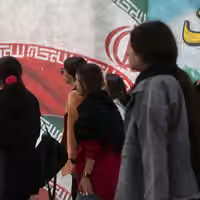
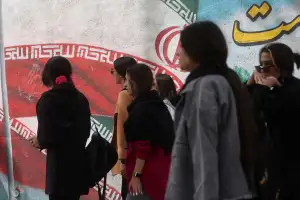
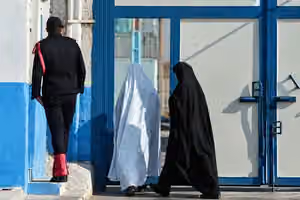
A group of Iranian women walking in public without the mandatory hijab

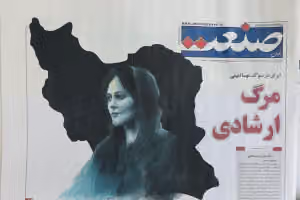
Four years after Mahsa “Jina” Amini’s death in Iran’s morality police custody sparked the Woman, Life, Freedom uprising, teenagers who watched her name become a rallying cry have grown up amid repression but beyond many of the social and political boundaries of pre-2022 Iran.

A girl who was just entering adolescence when the Woman, Life, Freedom protests began is now approaching adulthood. The past four years have been part of the period in which her understanding of society, government and freedom has taken shape.

Women burning their headscarves, nighttime chants from apartment windows, protests in schools and universities, young people knocking turbans off clerics’ heads and protesters standing up to security forces all became part of the memories that accompanied that generation into adulthood.

One of the most enduring changes is visible on the streets.

Many women now appear without mandatory hijab in streets, universities, cafes, shopping centers and on public transport. Some ride bicycles and motorcycles without covering their hair.

The Islamic Republic has responded to this defiance with arrests and summonses, warning text messages, vehicle seizures, restrictions on bank accounts and SIM cards, surveillance cameras and the closure of businesses.

Human rights organizations say tens of thousands of women have faced security or judicial action over their clothing during the past four years.

Abandoning mandatory hijab has become one of the clearest forms of collective disobedience to emerge from 2022, continuing in parts of society despite the security and legal costs.

As the fourth anniversary of Amini’s death approached, a coalition of Iranian Kurdish political groups called for a general strike on September 16, urging people to close shops and markets and stay away from work.

From Mahsa Amini’s death to prison and executions

Mahsa “Jina” Amini, a 22-year-old woman from Saqqez in Iran’s Kordestan province was detained by the morality police in Tehran on September 13, 2022. She was taken to hospital and died three days later.

Her gravestone bears the words: “Dear Jina, you will not die. Your name will become a symbol.”

Her father, Amjad Amini, wrote on September 14, ahead of the fourth anniversary of her death, that her name had “gone beyond our small home.”

The family, he said, was still waiting for the truth to emerge.

“The sealed secret that you and all the loved ones resting in this earth carry with you will not remain hidden forever,” he wrote.

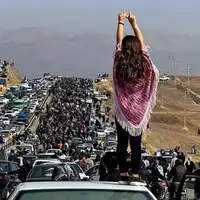
Amini’s name quickly became a rallying cry for protests that began in Saqqez and Kordestan, spread to Tehran and then swept across Iran. The Kurdish slogan “Jin, Jiyan, Azadi” and its Persian equivalent, “Woman, Life, Freedom,” became the uprising’s defining chant.

“Death to the dictator,” “This is the final message, the target is the entire system,” “Poverty, corruption, high prices — we will go on until overthrow,” and “Don’t call it a protest, it’s called a revolution” were also heard on the streets, reflecting the political direction the protests had taken.

Supreme Leader Ali Khamenei and the Islamic Republic itself became the direct targets of many of the slogans.

The uprising also quickly became a global cause. Artists, athletes, academics, human rights activists and political figures around the world voiced support, carrying Amini’s name and the slogan Woman, Life, Freedom far beyond Iran’s borders.

The authorities answered the protests with lethal force, widespread injuries and mass arrests.

Human rights organizations have put the number of people killed in the uprising at more than 550. Many more were wounded, while shotgun pellets blinded dozens of protesters in one or both eyes.

Judiciary chief Gholam-Hossein Mohseni-Ejei said in May 2025 that more than 90,000 cases had been opened in connection with the 2022 protests, including cases involving schoolchildren, university students and teachers.

The crackdown continued in the courts after large street gatherings subsided.

Execution, imprisonment, flogging, internal exile, fines, travel bans and restrictions on social rights were among the punishments handed down to protesters and activists linked to the uprising.

Mohsen Shekari, Majidreza Rahnavard, Mohammad Mehdi Karami, Mohammad Hosseini, Saleh Mirhashemi, Saeed Yaghoubi, Majid Kazemi, Milad Zohrevand, Mohammad Ghobadlou, Reza Rasaei, Mojahed Korkor, Mehran Bahramian, Mehrab Abdollazadeh, Abdoljalil Shahbakhsh and Aref Khoshkar were among those executed in cases connected to the 2022 protests.

Others remain at risk of execution.

Among them is Ali Zarei Dozdarehsi, who suffered an eye injury from shotgun pellets during the uprising. After spending time in Germany, he returned to Iran, was arrested and was later sentenced to death by a Revolutionary Court.

Dozens of other protesters have also received death sentences or still have cases under review.

Golrokh Iraee, Nasim Simiyari, Hamid Ghareh-Hassanlou, Farzaneh Ghareh-Hassanlou and Hossein Mohammadi are among hundreds of political prisoners connected to the Woman, Life, Freedom uprising who have faced restrictions in prison, including being denied phone calls, family visits or furlough.

For some, much of the past four years has been spent behind bars, even as Iranian society outside prison has moved through new protests and new changes.

A generation that says ‘We are not going back’

The children and teenagers of 2022 have grown older. Some are now at university, some have entered the workforce and others have left Iran.

What many share is the experience of growing up in a society that lived through one of the most widespread uprisings in the history of the Islamic Republic.

Schools themselves became protest sites in 2022. Students chanted slogans, pulled down images of Islamic Republic officials from classroom walls and girls removed their headscarves.

Universities saw weeks of demonstrations, sit-ins and confrontations with security forces.

For a generation that witnessed those scenes during formative years, politics became tied to the street, the school, the university and everyday life.

German-American political thinker Hannah Arendt linked freedom to the human capacity to begin something new. In her thought, political action emerges among others in the public sphere, and revolutions are among the moments when the possibility of a “new beginning” becomes visible.

For the teenagers of 2022, an experience of that kind unfolded on a mass scale before their eyes: people who often did not know one another chanted the same slogans, supported each other and joined collective action in schools, universities, neighborhoods and streets.

Four years later, this generation lives in a society where repression continues. But the experience of 2022 has not been erased from its political memory.

What Woman, Life, Freedom gave the protests that followed

The 2022 uprising did not topple the Islamic Republic, but it changed the language and horizons of protest.

Woman, Life, Freedom entered Iran’s political vocabulary alongside slogans calling for the overthrow and end of the Islamic Republic.

Women stood at the center of a nationwide uprising. School students emerged as a visible force in protest, and acts of disobedience moved from demonstrations into everyday life.

Some of the behaviors that took shape during those months continued in the years that followed.

Rosa Luxemburg, the Marxist revolutionary and theorist, viewed the defeats of revolutionary movements as links in a historical chain that could help prepare the ground for future victories.

After the failed January 1919 uprising in Berlin, she treated the experience and political understanding gained through defeat as part of a revolutionary movement’s accumulated strength.

The protests that followed 2022 began from a point that Woman, Life, Freedom had already reached. Opposition to the Islamic Republic as a whole, and demands for its overthrow, remained present in later protest slogans.

January 2026 offered one of the clearest examples.

Protests that began over economic grievances rapidly spread across the country, with political slogans against the Islamic Republic becoming a major feature.

Estimates of those killed ranged from the government’s official figure of 3,117 to more than 36,500 in Iran International’s reporting. Tens of thousands were wounded, while around 100,000 people were arrested, summoned or interrogated.

For the generation that had experienced 2022, January 2026 became a second encounter with a nationwide uprising and a bloody crackdown within only a few years.

A generation carrying the memory of several generations

Iran’s teenagers and young adults now stand at the end of a much longer history of protest and repression: women’s protests against compulsory hijab in March 1979, the executions of the 1980s, the July 1999 university dormitory crackdown, the 2009 Green Movement, the protests of January 2018 and the bloody November 2019 crackdown.

Many learned about those events through their families, photographs, books and news reports.

Woman, Life, Freedom and the January 2026 protests, however, belong to their own lived experience.

That distinction has helped shape this generation’s political memory.

Images of protesting women, schoolgirls, young people in the streets, families demanding justice and political prisoners now sit alongside images of those killed, wounded and executed.

A girl who was just entering adolescence in September 2022 is now approaching adulthood carrying memories of Amini, protest, repression and disobedience — memories now layered alongside the stories earlier generations carried from March 1979, the 1980s, July 1999, the Green Movement and November 2019.

Four years after Amini’s death, Woman, Life, Freedom remains part of this generation’s memory: in the school and the street, in experiences of repression and defiance, and in the picture of freedom and Iran’s future that it carries into adulthood.

Above all, this generation has seen that the path to political change in Iran runs through the street, collective action and effective organization.