Iranian protester still unable to walk despite 23 operations for gunshot wound
An Iranian protester shot in the leg during January’s demonstrations remains unable to walk after 23 operations, with further treatment ahead, medical bills mounting and concerns for his safety persisting months after the shooting.
“Despite all these surgeries, I am still confined to my home,” the protester, whose identity and place of residence are being withheld for security reasons, told Iran International. “I am married, and during this time we have faced many problems paying for my treatment.”
His family eventually sold their car to help cover his medical bills, the protester said. Doctors have told him that regaining the ability to walk could take at least another year.
The account reflects the prolonged physical and financial consequences facing some people wounded during the protests, with Iran International receiving multiple accounts of injured demonstrators struggling to obtain treatment and pay medical expenses months later.
A building burns during protests in Iran in January 2026, as people gather nearby.
An Iranian protester shot in the leg during January’s demonstrations remains unable to walk after 23 operations, with further treatment ahead, medical bills mounting and concerns for his safety persisting months after the shooting.
“Despite all these surgeries, I am still confined to my home,” the protester, whose identity and place of residence are being withheld for security reasons, told Iran International. “I am married, and during this time we have faced many problems paying for my treatment.”
His family eventually sold their car to help cover his medical bills, the protester said. Doctors have told him that regaining the ability to walk could take at least another year.
The account reflects the prolonged physical and financial consequences facing some people wounded during the protests, with Iran International receiving multiple accounts of injured demonstrators struggling to obtain treatment and pay medical expenses months later.
23 operations and more treatment ahead
The gunshot caused extensive damage to the protester’s leg, requiring doctors to perform muscle and skin grafts during a series of operations.
An injured Iranian protester’s leg during treatment following a gunshot wound. The protester told Iran International he has undergone 23 surgeries and remains unable to walk.
“About a month has passed since the skin graft, and the Ilizarov device that was fitted to my leg at the beginning of treatment is due to be put back on for about three months,” the protester said.
An Ilizarov apparatus is an external bone-fixation system using metal rings, rods and wires to gradually reposition sections of bone. It can be used to treat severe damage or the loss of part of a bone.
Doctors also attached a vacuum-assisted device to the wound for several months to promote new tissue growth, the protester said.
Infection, nerve damage and numbness later forced doctors to remove some of the repaired tissue and perform a muscle graft about six months after the shooting, according to the protester.
“I asked people who were able to help, but in the end, with great difficulty and even by selling our car, we tried to cover the costs,” he said.
Security fears complicate hospital treatment
Fear of arrest or identification at hospitals has complicated treatment for some protesters wounded during demonstrations, prompting some to seek medical care covertly or at home.
“After one of the surgeries, because there were many security officers in the emergency department, the doctor helped me leave the hospital,” the protester said.
Hospital staff recorded the cause of his injuries as a traffic accident, and his doctor later helped take him to Tehran to continue undergoing surgery, the protester said.
“I really do not know how to thank the medical staff,” he added. “They cooperated extensively and tried to make sure nothing else happened to me.”
Protester recounts January 8 shooting
Security forces initially fired pellets toward demonstrators before a live round struck his leg at close range on the evening of January 8, the protester said.
“My whole body is covered with pellet marks. The bullet hit my leg from close range,” he said. “When I was shot, they dragged me along the ground while I was in a very bad condition. I will never forget that night.”
Security personnel insulted him and tried to remove his clothing after he was wounded, according to his account.
“I held tightly onto my trousers, and they struck my hands with their boots,” he said. “My entire body was bruised, and I even thought my ribs were broken.”
The officers then put him on a motorcycle, the protester said.
“One of them said, ‘Don’t hit him here, take him farther up,’” he said. “I thought they meant they were going to finish me off. I passed out from fear.”
The injured Iranian protester undergoes treatment with an external fixation device after suffering a gunshot wound to the leg during demonstrations on January 8.
The protester said he regained consciousness alone in a dark alley, where an elderly couple found him and helped him reach a hospital.
“At first, I thought I was dead,” he said. “Then an elderly woman and man found me. They were like angels to me and helped me get to the hospital.”
The protester said he had joined the demonstrations knowing that doing so could put his life at risk.
Eighteen prisoners held at Dastgerd prison in the central Iranian city of Isfahan could face death sentences over unrest and a fire at the facility, according to a judicial document obtained by Iran International.
The case has been sent to a Revolutionary Court, with some of the defendants accused of “leading the unrest” or “inciting war and killing,” charges that can carry severe penalties under Iranian law.
The document lists 75 prisoners as defendants in the case, while prosecutors in Isfahan have ordered at least 26 of them to stand trial.
The case was opened after unrest and a fire at Isfahan Central Prison, also known as Dastgerd, following an air strike near the prison in March. A military base and ammunition depot behind the prison were hit, while parts of the prison grounds and accommodation areas were also damaged.
Information accompanying the document said some prisoners were killed during the incident, and others died in the fire.
Human rights groups, citing witnesses and relatives of prisoners, have said the unrest began after missiles struck a military site behind the prison and projectiles also hit parts of the prison complex. Guards and prison officials left some posts after the explosions, and inmates came out of their wards fearing the facility could collapse, according to those accounts.
The groups said some prisoners then set fire to blankets, sheets and other materials in an effort to force authorities to open doors and allow them into safer areas. Smoke spread through enclosed corridors as the fires grew.
Human rights groups have also said security forces later entered the prison and used live ammunition, pellet rounds and tear gas against inmates. According to witness accounts cited by the groups, some prisoners were shot, while others died from burns or smoke inhalation during the unrest.
Prosecutors have brought charges including "inciting people to war and killing each other with the aim of disrupting national security," deliberate arson, destruction of public facilities and taking part in an illegal prison gathering that led to a riot during wartime, according to the document.
Other accusations include destroying surveillance cameras, windows and security doors, taking part in or assisting with property damage and setting fire to the prison infirmary.
Iran International identified 17 prisoners facing such accusations. The documents indicate that 18 prisoners could face death sentences.
The referral to the Revolutionary Court comes after five protesters held at Dastgerd were executed over the past two months in a separate case known as the "Alikhani Square" case.
Five other people sentenced in that case are at risk of imminent execution.
The latest case comes amid a rise in executions and heavy prison sentences in Iran in recent weeks as tensions with the United States have intensified.
Concerns over prison conditions
Concerns over Dastgerd have also grown over treatment of inmates and health conditions.
Political prisoner Abdolrasoul Mortazavi said in an audio message from the prison in June that some people detained during the January protests had been tortured. He also reported beatings, harsh interrogations, restrictions on contact with families and limits on outdoor exercise.
Iran International has also received reports of worsening health conditions and a meningitis outbreak at the prison in recent weeks.
A source familiar with the situation told Iran International in August that several prisoners had died from infectious diseases. Information obtained by Iran International also indicated that meningitis had spread to most prison wards and that some inmates had been taken to Al-Zahra hospital in Isfahan.
An aerial view shows a crude oil tanker at an oil terminal off Waidiao island in Zhoushan, Zhejiang province, China January 4, 2023.
A new Iranian oil trading network has been entrusted with selling millions of barrels of sanctioned crude even though its members still owe billions of dollars from earlier sales, according to documents obtained by Iran International and Oil Ministry sources.
One document, a confidential letter from the Supreme National Security Council’s protection unit to the Oil Ministry, raises concerns over the ministry’s decision to hand large volumes of crude to four trusted intermediaries, known as trustees, on credit and at steep discounts.
The crude was allocated after a new oil sales team took control in July, according to the letter.
The former chief executive of Naftiran Intertrade Company (NICO) had identified the intermediaries as carrying large debts and failing to return billions of dollars from previous oil sales, the document says.
The ministry nevertheless offered the intermediaries a discount of $8.50 per barrel, a level the confidential letter described as unusual.
The documents and two Oil Ministry sources point to Mohammad Javad Bavand, a former Revolutionary Guards intelligence official appointed to oversee oil trading, as a central figure in the new arrangement.
Disputed cargo tied to sanctioned tankers
A second confidential document records a closed Oil Ministry meeting on June 28 concerning Iranian crude exported to China aboard three sanctioned tankers linked to Hossein Shamkhani, also known as Hector, an oil trader and son of Ali Shamkhani, a former adviser to slain Supreme Leader Ali Khamenei.
Two million barrels of crude were shipped through a front company aboard the tanker Lily to China’s Dongjiakou port on March 24, according to the document.
The owner of Lily subsequently took control of the cargo, citing a financial dispute with Panel Good Wholesalers, the company involved in the shipment, the document says.
Lily belongs to a shipping network and shadow fleet controlled by Hossein Shamkhani that has been sanctioned by the US Treasury. Dubai-registered Panel Good Wholesalers is also one of Shamkhani’s companies used for oil trading.
Oil trader Mohammad Hadi Momenin recovered the two-million-barrel cargo at NICO’s request and stored it in tanks at Dongjiakou, participants at the June meeting were told, according to the document.
Momenin then sought $33 million in compensation from the Iranian oil company, including $27 million for the loss in value of the tanker Covenio following US sanctions and $6 million for charter costs involving another tanker, Jaya.
Bavand instructed Momenin to return ownership of the cargo to the Oil Ministry and, through one of Momenin’s companies, charter Covenio for one year at $90,000 per day, according to the meeting record.
Both Covenio and Jaya belong to Shamkhani’s sanctioned shadow fleet.
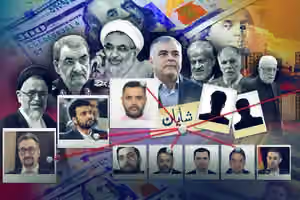
Iran International reported three weeks ago that Momenin was a member of an Intelligence Ministry network known as the Shayan network. Momenin, born in 1989, has failed to return about $2 billion in Iranian oil proceeds, according to Iran International’s previous investigation.
Five traders form Bavand’s network
Momenin is one of five trustees in an oil trading network assembled by Bavand following his return to the Oil Ministry, two ministry sources told Iran International.
Another member is Mostafa Niazazari, the fifth defendant in the corruption case involving former senior judiciary official Akbar Tabari.
Niazazari was accused in the case of giving Tabari 15,000 square meters of land as a bribe. After fleeing to Canada, he returned to Iran four years ago and has since resumed oil trading while residing in a European country.
Niazazari is the son of Kioumars Niazazari, a former Intelligence Ministry director-general in Mazandaran province.
Two businessmen known for importing essential commodities have also joined Bavand’s network after entering the oil trade during the tenure of former NICO chief executive Saeed Sadeghi, according to the Oil Ministry sources.
Hassan Afrashtehpour, also known as Dariush and the owner of Afra Holding, has for years controlled imports of some essential commodities. An Iranian court sentenced him to 25 years in prison for economic corruption in 1997, but he was released four years later.
Masoud Modallal, a major importer of cooking oil and animal feed who has faced large banking debts, is another member of the network, the sources said.
Modallal previously received $985 million in preferential-rate foreign currency for essential-goods imports and owed 5.75 trillion rials to Sarmayeh Bank and 7.82 trillion rials to Pasargad Bank.
Modallal shifted his focus toward oil trading after Iran ended preferential currency allocations, according to the sources.
The fifth member is Ali Bayandorian, a trader sanctioned by the United States six years ago over what Washington described as financing for the Revolutionary Guards’ Quds Force.
Bayandorian uses a network of companies registered in Iran and Southeast Asia to sell oil and petrochemical products outside conventional markets, according to the sources.
Together, the five traders make up what the Oil Ministry sources described as Bavand’s new trustee network.
The two confidential documents obtained by Iran International show members of this network continuing to receive Iranian oil despite outstanding proceeds from previous sales.
From Guards intelligence to oil sales
Bavand studied at Imam Sadiq University, known for combining Islamic studies with modern social sciences, and until 2021, served as deputy to Mostafa Ahadi, the economic deputy of the Revolutionary Guards Intelligence Organization.
Ahadi is a nephew of Ali Akbar Hosseini Mehrab, a security official whose name has appeared in major Iranian corruption cases, including the Crescent gas dispute.
Bavand entered a Supreme National Security Council committee in 2018 following the US withdrawal from the nuclear agreement and Washington’s restoration of sanctions on Iranian oil.
The council created a working group to manage oil sales designed to bypass the restrictions, alongside a security committee composed of representatives from Iranian military and intelligence organizations.
The Revolutionary Guards Intelligence Organization sent Bavand, then deputy head of its economic division, to the security committee.
Bavand built a network of trusted oil intermediaries during his time on the committee, including Majid Azami, chief executive of Sepehr Energy Jahan Nama Pars, Majid Taj, brother of Iranian Football Federation president Mehdi Taj, and trader Hamed Kachoui.
Iran’s oil sales structure changed further after Ebrahim Raisi became president in 2021 and his government authorized the armed forces to participate formally in oil trading.
The Revolutionary Guards subsequently sent Bavand to the Oil Ministry, where he took responsibility for trading oil under sanctions.
A significant part of the problems involving trustees and unreturned oil proceeds emerged during that period.
Following Raisi’s death, Oil Minister Mohsen Paknejad initially entrusted management of sanctioned oil sales to officials with previous links to Shayan, an Intelligence Ministry official involved in fuel operations.
Bavand returned to the Oil Ministry following Shayan’s removal.
Paknejad appointed Bavand special assistant to the oil minister for supervision of oil trading after the previous NICO chief executive was removed following disclosures concerning trustees and unreturned oil proceeds.
Bavand is also related to Hossein Taeb, the former head of the Revolutionary Guards Intelligence Organization, who is currently the commander of the Basij paramilitary unit, and a figure close to Supreme Leader Mojtaba Khamenei.
Bavand now plays a central role in decisions over sanctioned oil sales and has assembled a new group of trusted intermediaries.
The documents show that traders carrying large outstanding debts from earlier oil sales have again been entrusted with millions of barrels of Iranian crude, placing Bavand and his network at the center of the system used to sell Iran’s oil under sanctions.
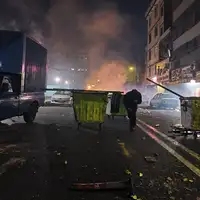
Trash bins block a street during protests in Tehran’s Naziabad neighborhood in January 2026.
A 34-year-old protester shot in the Iranian city of Qazvin on January 8 has undergone five major operations and months of largely secret medical care as doctors work to save and reconstruct his badly damaged leg.
“The bullet severely destroyed the bone in his right lower leg, and the lower part of his leg was almost attached to his body only by tissue and skin,” the protester’s brother told Iran International.
The protester was shot on Khayyam Street in Qazvin on the evening of January 8, according to information obtained by Iran International. The shot was fired from a Kalashnikov rifle at a distance of about 100 meters.
The shooting took place during nationwide protests that began in December 2025 amid worsening economic conditions and a sharp fall in Iran’s currency, then grew into broader opposition to the Islamic Republic.
Security forces killed tens of thousands of Iranians during the January 8-9 crackdown, making it the deadliest two-day protest massacre in history, according to documents reviewed by Iran International’s Editorial Board.
After initial attempts to stop the bleeding failed, the family sought help from an acquaintance to move him secretly to a hospital in Qazvin, his brother said.
The family has had to keep much of his treatment secret for fear he could be identified and detained, his brother said.
Iran International has documented similar cases since the January protests, in which wounded demonstrators avoided medical facilities or sought treatment in secret for fear of identification and arrest.
A photo provided to Iran International shows the wounded protester’s surgically treated leg alongside an X-ray showing an external fixation device used during months of treatment after he was shot in Qazvin on January 8.
Sources in Mamasani, in Fars province, previously confirmed that some wounded protesters there avoided medical centers because they feared their identities could be exposed and they could face prosecution.
Secret hospital exit after seven-hour surgery
The hospital in Qazvin was among those willing to admit wounded protesters despite the risks, his brother said.
Staff placed the 34-year-old in a darkened room with several other wounded people and cut power to parts of the hospital to stop surveillance cameras from recording patients’ movements, his brother said.
He lost consciousness after severe blood loss and underwent surgery at about 3 p.m. on January 9. The operation lasted roughly seven hours.
After surgery, hospital staff warned the family that he needed to leave quickly through a rear exit, fearing security forces could arrive and detain him, according to the family.
About an hour later, relatives and hospital staff moved him out of the building, before he had fully regained consciousness, and took him to a home to recover.
Iran International has previously documented the scale and severity of injuries inflicted during the January crackdown.
A specialist in a northern Iranian city said he and his son operated on dozens of wounded people on January 9 and 10. His son removed more than 270 pellets from the eyes of about 130 protesters, the doctor said.
Severe infection complicates recovery
Deep wounds and extensive damage to the protester’s lower leg complicated his recovery after the first operation, with large amounts of fluid draining from the wound each day, his brother said.
The family changed his dressings at home with help from a doctor they knew. As the infection worsened, they contacted the surgeon who had performed the first operation. He continued treating the protester at his private practice.
The family was told that the bullet had shattered a large section of his shinbone, leaving a gap that prevented the remaining ends from joining on their own.
The surgeon referred him to a colleague in Tehran for specialist treatment.
For months, the family has taken him from Qazvin to Tehran roughly every two weeks. He has undergone more than five major operations on his leg, his brother said.
Iran International has received other accounts of doctors secretly helping protesters wounded in January. In one case, a Tehran doctor treated dozens of wounded protesters free of charge and arranged for their radiology fees to be waived, sources said.
Surgeons remove 12 centimeters of bone
Surgeons eventually had to remove about 12 centimeters of damaged bone from his lower leg and make a surgical cut in the bone near his ankle.
They then fitted an Ilizarov apparatus, an external frame of metal rings, rods and wires used to gradually move sections of bone. The technique can help repair extensive bone damage and replace missing bone.
Doctors hope to use the device to gradually close the gap between the healthy sections before performing a bone graft, according to the family.
He faces a prolonged recovery, with no immediate prospect of regaining normal mobility or returning to work.
An X-ray provided shows extensive damage to the lower leg of a 34-year-old protester who was shot in Qazvin on January 8.
Treatment costs strain family
Months of surgery, medication, wound care and travel between Qazvin and Tehran have put the family under growing financial pressure, his brother said.
File photo shows container cranes and cargo facilities at Shahid Rajaee Port near Bandar Abbas, southern Iran, in 2025. Photo by ISNA
Satellite imagery reviewed by Iran International shows a sharp fall in visible shipping activity at Shahid Rajaee and Imam Khomeini ports since the US naval blockade was reimposed in mid-July, underscoring the growing squeeze on Iran’s imports and exports.
Sequences of Copernicus satellite images comparing the months before the war with the period under the blockade show a striking change at both ports.
At Shahid Rajaee near Bandar Abbas, pre-war images show vessels occupying multiple berths and denser use of the container terminal, while later images show far fewer ships and large sections of the port appearing largely inactive.
After
Before
Drag the handle left or right to compare
Copernicus satellite images from January 2, 2026 and September 4, 2026 show Shahid Rajaee Port near Bandar Abbas before the war and during the US blockade, with far fewer vessels visible at its berths in the later image.
Shahid Rajaee is Iran’s most important export port and, after Imam Khomeini Port, its second-largest gateway for imports. It is also the country’s largest container port, handling nearly 80% of Iran’s container loading and unloading, according to official figures.
A similar pattern is visible at Imam Khomeini Port in southwestern Iran, the country’s largest import gateway, where satellite imagery shows markedly reduced vessel presence and terminal activity compared with the period before the conflict.
After
Before
Drag the handle left or right to compare
Copernicus satellite images from February 25, 2026 and September 5, 2026 show Imam Khomeini Port in southwestern Iran before the war and during the US blockade, with a marked decline in visible vessel and terminal activity.
The images provide a visual measure of the disruption at ports that are critical to Iran’s economy. Shahid Rajaee handles more than 55% of Iran’s imports and exports and an estimated 85% to 90% of its container trade, according to Iranian port data.
Imam Khomeini Port plays a particularly important role in imports of food and other basic commodities. Iran’s Ports and Maritime Organization said the port handled more than 48 million tons of cargo in the year ending March 2025, including 19.2 million tons of imported goods.
The satellite evidence reinforces other indications that the blockade is increasingly biting. Video published from Shahid Rajaee in late August showed no ships docked and little apparent loading or unloading activity.
Iran International reported in July that activity at the port had been reduced to a minimum, with thousands of containers stranded and about half of its workforce laid off.
Iranian officials have also increasingly acknowledged the economic impact. President Masoud Pezeshkian said in late August that blocked routes were preventing goods, including gasoline, from entering the country.
Reuters reported this week that Iranian trade had fallen by as much as 35% amid the blockade and intensified sanctions, while gasoline supplies had tightened sharply.
The effect has been even more pronounced on Iran’s oil trade. Iranian crude loadings fell from around 2 million barrels per day before the war to roughly 220,000–255,000 bpd in August, according to shipping data cited by Reuters.
Washington says the blockade can be sustained indefinitely. As of Aug. 23, US Central Command said its forces had redirected 70 commercial vessels attempting to breach it, while three had been disabled and two boarded.
Iran’s foreign trade has contracted sharply since the conflict with the United States began, with non-oil exports and imports falling by around a quarter or more, according to customs data released after months of delay.
Iran exported about $15 billion worth of non-oil goods, including natural gas and LPG, through August 16, nearly five months into the Iranian calendar year that began on March 21. That was nearly 30% below the figure reported for the first five months of the previous year.
Imports fell to about $17 billion over the same near-five-month period, about a quarter below the full five-month figure reported a year earlier.
The figures show a sharp deterioration in Iran’s trade during a conflict that has disrupted key industries and shipping routes, adding to an economy already struggling under years of sanctions, declining oil revenues and chronic shortages of foreign currency.