London penthouses linked to Iran’s Supreme Leader put up for sale – Sunday Times

Two luxury London penthouses linked to Iran’s Supreme Leader Mojtaba Khamenei, bought for a combined £36 million, have been put up for sale, The Sunday Times reported.
Two luxury London penthouses linked to Iran’s Supreme Leader Mojtaba Khamenei, bought for a combined £36 million, have been put up for sale, The Sunday Times reported.
The apartments are at 3a Palace Green, an exclusive development overlooking Kensington Palace and close to the official London residence of the Prince and Princess of Wales. Both properties include staff accommodation and private roof terraces, according to the report.
One is a five-bedroom duplex covering 3,944 square feet across the sixth and seventh floors. It was purchased for £19 million in 2016 but is now being offered for just under £12 million.
Knight Frank and Sotheby’s International Realty are jointly marketing the apartment. The listing describes it as “an exceptional duplex penthouse with staff accommodation and commanding unrivalled views across Kensington Gardens from one of London’s most prestigious addresses.”
The brochure does not identify its politically sensitive connections but notes: “Due to the property being in receivership, we do not have all of the material information for the property; therefore you should ensure you make all relevant inquiries,” the report said.
The second penthouse occupies the seventh and eighth floors of the same building. It was bought for £16.75 million in 2014 and has also entered receivership.
Land Registry documents show that financial advisory firm Teneo was appointed as its receiver, the report said, adding that the apartment does not appear to have been publicly listed, leaving its asking price unknown.
Several prospective buyers are believed to have viewed the properties amid significant interest, according to The Sunday Times.
The registered owner of both apartments is Iranian banker Ali Ansari, whom the US Treasury sanctioned in July as a “key financier” for Khamenei. Washington said Ansari “oversees a sprawling global network of assets benefiting Iran’s leader, Mojtaba Khamenei, and other regime elites.”
Ansari was previously sanctioned by Britain over allegations that he financed the Islamic Revolutionary Guard Corps. His British assets were frozen, and he was barred from entering the country. He is understood to deny wrongdoing.
The British government is believed to have authorized the sale of the two apartments after Ansari defaulted on their mortgages, according to The Sunday Times. The private lenders that financed the purchases appointed receivers to recover their money, although the amount originally borrowed is not known.
Any proceeds remaining after the lenders are repaid are expected to be frozen while Ansari remains under sanctions.
Neither Khamenei nor Ansari has been seen by employees at the Palace Green development since the apartments were purchased, the newspaper reported.
Since his father was killed in US-Israeli airstrikes in February, Mojtaba Khamenei has not been seen or heard publicly, leaving his condition and circumstances unclear.









Satellite imagery reviewed by Iran International shows a sharp fall in visible shipping activity at Shahid Rajaee and Imam Khomeini ports since the US naval blockade was reimposed in mid-July, underscoring the growing squeeze on Iran’s imports and exports.
Sequences of Copernicus satellite images comparing the months before the war with the period under the blockade show a striking change at both ports.
At Shahid Rajaee near Bandar Abbas, pre-war images show vessels occupying multiple berths and denser use of the container terminal, while later images show far fewer ships and large sections of the port appearing largely inactive.


Copernicus satellite images from January 2, 2026 and September 4, 2026 show Shahid Rajaee Port near Bandar Abbas before the war and during the US blockade, with far fewer vessels visible at its berths in the later image.
Shahid Rajaee is Iran’s most important export port and, after Imam Khomeini Port, its second-largest gateway for imports. It is also the country’s largest container port, handling nearly 80% of Iran’s container loading and unloading, according to official figures.
A similar pattern is visible at Imam Khomeini Port in southwestern Iran, the country’s largest import gateway, where satellite imagery shows markedly reduced vessel presence and terminal activity compared with the period before the conflict.


Copernicus satellite images from February 25, 2026 and September 5, 2026 show Imam Khomeini Port in southwestern Iran before the war and during the US blockade, with a marked decline in visible vessel and terminal activity.
The images provide a visual measure of the disruption at ports that are critical to Iran’s economy. Shahid Rajaee handles more than 55% of Iran’s imports and exports and an estimated 85% to 90% of its container trade, according to Iranian port data.
Imam Khomeini Port plays a particularly important role in imports of food and other basic commodities. Iran’s Ports and Maritime Organization said the port handled more than 48 million tons of cargo in the year ending March 2025, including 19.2 million tons of imported goods.
The satellite evidence reinforces other indications that the blockade is increasingly biting. Video published from Shahid Rajaee in late August showed no ships docked and little apparent loading or unloading activity.
Iran International reported in July that activity at the port had been reduced to a minimum, with thousands of containers stranded and about half of its workforce laid off.
Iranian officials have also increasingly acknowledged the economic impact. President Masoud Pezeshkian said in late August that blocked routes were preventing goods, including gasoline, from entering the country.
Reuters reported this week that Iranian trade had fallen by as much as 35% amid the blockade and intensified sanctions, while gasoline supplies had tightened sharply.
The effect has been even more pronounced on Iran’s oil trade. Iranian crude loadings fell from around 2 million barrels per day before the war to roughly 220,000–255,000 bpd in August, according to shipping data cited by Reuters.
Washington says the blockade can be sustained indefinitely. As of Aug. 23, US Central Command said its forces had redirected 70 commercial vessels attempting to breach it, while three had been disabled and two boarded.
Iran’s foreign trade has contracted sharply since the conflict with the United States began, with non-oil exports and imports falling by around a quarter or more, according to customs data released after months of delay.
Iran exported about $15 billion worth of non-oil goods, including natural gas and LPG, through August 16, nearly five months into the Iranian calendar year that began on March 21. That was nearly 30% below the figure reported for the first five months of the previous year.
Imports fell to about $17 billion over the same near-five-month period, about a quarter below the full five-month figure reported a year earlier.
The figures show a sharp deterioration in Iran’s trade during a conflict that has disrupted key industries and shipping routes, adding to an economy already struggling under years of sanctions, declining oil revenues and chronic shortages of foreign currency.
When a refrigerator breaks in Iran now, the family often cannot replace it, and increasingly cannot afford to repair it either. Behind that is an industry losing its raw materials, its customers and, since March, two of the industrial hubs that supplied it.
Iranian manufacturers are being squeezed from both ends at once. The steel and plastics they build appliances from have multiplied in price since Israeli and US strikes hit the country's main industrial hubs in March, while the households they sell to have been priced out of the market entirely. Production of refrigerators, televisions and washing machines was already falling by a quarter to more than 40 percent a year before the war began.
What the industry cannot do is pass the costs on, because the arithmetic on the shop floor no longer works for anybody.
The price of a working kitchen
Iran's minimum monthly wage is about 166 million rials, roughly $75. Set against that, the price list on the country's largest online retailer reads as a catalogue of things a working household can no longer buy.
The cheapest mini refrigerator sells for 258 million rials, about $117, a month and a half of that wage. A basic 13-cubic-foot fridge-freezer costs 544 million rials, some $247, more than three months. A mid-sized model runs to 890 million rials, about $405. A washing machine, in the band where most models cluster, costs around 920 million rials, roughly $418, or five and a half months of a minimum wage, and a gas cooker starts at about 360 million rials, $164, rising to 638 million.
Televisions trace the same curve. The cheapest set on the site, a 24-inch model, costs 230 million rials, about $104. A 32-inch television runs to 270 million, and a 43-inch, among the best-selling sizes, to 490 million rials, roughly $223, or nearly three months of wages. A 65-inch set, also a strong seller, costs 1.06 billion rials, about $482, more than six months. At the top of the range, an 85-inch model is listed at 2.9 billion rials, some $1,318, or nearly a year and a half of a minimum wage.
The cheapest dishwasher listed costs 1.34 billion rials, some $609, eight months of wages, which is why dishwashers have moved out of the category of household appliance altogether and into the category of luxury.
At the very top of the market, an imported side-by-side refrigerator is advertised at 4.54 billion rials, about $2,065, or more than two years of a minimum wage.
Iranian media have been documenting what these numbers mean. In May, when conditions were still less severe than they are now, the newspaper Donya-e Eqtesad reported that field observations and consumer complaints showed the breakdown of a refrigerator or washing machine had become an economic and psychological crisis for many families.
Until a few years ago, the paper noted, many households could replace an appliance after saving for several months. Today, buying even a refrigerator, a washing machine or a basic vacuum cleaner has become a distant prospect for a growing number of them.
Repair was the fallback. Repair costs have risen too, and for many families that door is closing as well.
A sector that was already shrinking
The industry serving this market was contracting before the war began.
The Statistical Center of Iran's most recent figures, covering the winter that ran through to March, show refrigerator production down 25 percent year-on-year to 531,000 units. Television production fell 36 percent to 332,000, and washing machine production dropped 42 percent, to 270,000 units.
No comparable production data have been published for other major categories, and the government has released no comprehensive industrial production figures for the past six months.
What the Statistical Center has published is the price index: home appliances in August cost 117 percent more than a year earlier.
Bombed inputs
Then came the strikes. Israeli and US attacks in March hit Iran's two main steel hubs, Mobarakeh and Khuzestan, and its two main petrochemical hubs, Asalouyeh and Mahshahr. Together these complexes account for roughly 50 percent of Iran's steel capacity and 70 percent of its petrochemical capacity.
The effect on manufacturers' input costs has been severe. According to the Iranian Home Appliance Industries Association, the price of the steel used by the industry has risen roughly two and a half times since last summer. Petrochemical feedstocks, including ABS and polypropylene, have gone up three to fourfold.
Authorities have released no detailed figures on the damage or on the operational status of the affected complexes. What is visible is the response: the government has restricted or banned the export of a large share of steel and petrochemical products, while domestic prices for those products have risen sharply.

Protected, and still dependent
The industry these costs are crushing was built behind a wall.
Iran banned home appliance imports in 2016, and in 2021 imposed a particularly strict ban on appliances made by South Korean companies, which had previously held a significant share of the market. The policy shifted the market decisively toward domestic manufacturers, and it has drawn persistent criticism over the quality of what those manufacturers produce.
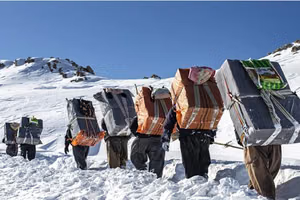
With foreign competitors largely excluded, domestic firms have faced far less pressure on price. The restrictions have also sustained a thriving trade in smuggled foreign appliances.
What protection has not produced is self-sufficiency. Iran has failed to fully localize production of even its four main categories: refrigerators, washing machines, televisions and dishwashers. According to Hakem Memkan, a member of parliament's economic commission, the country imports around $1.2 billion of components a year for those four categories alone.
So the strategy of substituting domestic production for imports has left manufacturers dependent on imported parts while their domestic input costs multiply.
Nowhere to go
Each of these pressures would be serious alone. Arriving at once, collapsing household purchasing power, multiplied raw material costs, import restrictions, input shortages and continued dependence on foreign components leave the industry with nothing to adjust.
It cannot raise prices without losing more of a market that has already stopped buying. It cannot cut costs without inputs it cannot obtain. And it cannot look abroad, because the wall built to protect it also encloses it.
Most families will simply keep the fridge they have, for as long as it runs.
Iranians are being warned against handing their gold to jewelers in return for regular payments, with the head of a provincial Gold and Jewelry Union saying the practice carries a high risk of losses.
Head of the Gold and Jewelry Union in Kermanshah, Mohammad Saeed Jafari, told ISNA that under the arrangement, jewelry businesses use or trade the gold and pay the owner what is described as rent or a return.
Jafari did not specify exactly how the gold is used after it is handed over. Such arrangements can effectively allow a jeweler to use the metal as part of its business inventory, meaning the owner's gold may not necessarily be kept aside in its original form.
"We have received numerous complaints," he said, adding that in some cases operators initially paid attractive returns to gain customers' trust but later failed to return their gold.
Jafari urged people to avoid such arrangements where possible. Those who still choose to lease out their gold should obtain strong documentation and deal only with licensed, established jewelers, he said.
He also cautioned investors buying melted gold or bullion to avoid online sellers where possible and instead use licensed gold and jewelry businesses.
Economic pressure fuels search for returns
The warning comes as Iran's economy faces mounting pressure after years of sanctions, high inflation and chronic currency weakness. The rial fell to a record low of about 2.2 million to the US dollar this week, while inflation was running at about 66% in July.
Washington has also stepped up its economic campaign in recent weeks. In late August, Treasury Secretary Scott Bessent launched a campaign aimed at cutting Iran's financial links abroad, building on measures targeting shadow banking networks, foreign exchange houses, cryptocurrency platforms and shipping channels used to move money and trade revenues.
These steps are designed to make it harder for Iran to access foreign currency and move funds through the international financial system, adding pressure to an economy that was already struggling with sanctions, high inflation and a weakening rial.
Even the possibility that Iran could put mines into one of the world’s most important shipping routes can deter commercial traffic and force the US military to maintain constant surveillance, former CENTCOM commander Joseph Votel told Iran International.
“The mere threat out there, just the threat of these, is enough to deter traffic, certainly commercial traffic,” Votel told Eye for Iran podcast. .
“It has a huge deterrent effect and it puts the burden on us to keep really, really close watch on this area.”
That creates a paradox in the latest battle over Hormuz: Iran may be turning to rocket-launched mines because more powerful options have been degraded, yet Washington must still behave as though the threat could get through.
The latest US-Iran flare-up began after the US military said it detected Iranian forces on Larak Island preparing to launch rockets carrying sea mines into the Strait. US forces struck the launchers before they could fire.
Iran has traditionally been able to deploy naval mines using small boats, submarines or aircraft. Firing them from rockets would allow Iranian forces to place mines at a distance without exposing boats and crews to US forces watching the waterway.
Why Iran may be turning to rockets
Iranian state television reported on the Fajr-5 multiple-launch rocket system as a weapon for mining Hormuz as early as January 2025, and military analysts have said Iran had been testing the concept.
What has changed is the battlefield around it.
Farzin Nadimi, a senior fellow at the Washington Institute and an expert on Iran’s military and asymmetric warfare, told Eye for Iran that Iran’s conventional military capabilities were significantly degraded during the war, followed by attacks on important IRGC Navy infrastructure.
Nadimi said Iran has lost much of its ability to deploy the larger and more dangerous sea mines it could once put into the water through more traditional means.
“They have little choice but using these smaller, less capable rocket-launched mines,” he said, adding that Iran has also repeatedly tried to strike shipping with anti-ship cruise missiles and one-way attack drones, many of which have been intercepted or jammed.
Iran’s apparent new weapon can therefore be read not simply as evidence of innovation, but as adaptation after military losses.
Less destructive does not mean less disruptive
Rocket-launched mines come with significant compromises. Naval mines capable of badly damaging large ships are heavy. Fitting one into a rocket requires a smaller weapon, limiting its destructive power.
Nadimi said Iran’s rocket-delivered versions are significantly smaller than some older naval mines in its arsenal and consequently less capable of inflicting major damage on large tankers.
But a mine’s effectiveness is psychological as much as it is physical: once mines are believed to be in the water, uncertainty over their location can deter ships from entering.
Votel pointed to the history of mine warfare in the Persian Gulf, including US Navy encounters with Iranian mines during the Tanker War of the 1980s.
Commercial vessels and their insurers therefore do not necessarily need evidence that a mine will hit a ship before taking the threat seriously.
Washington’s burden
That uncertainty shifts part of the burden from Iran to the United States.
The US does not simply have to destroy mines once they enter the water. It has to watch the Strait, Iranian coastal positions and potential launch sites closely enough to prevent Tehran from putting them there in the first place.
“It puts a lot of pressure on us to make sure that we have constant surveillance, not only of the waterways themselves and the main transit routes, but really of the locations where these mines or these weapons can come from,” Votel said.
The latest US strike suggests Washington currently has the intelligence, surveillance and reconnaissance capabilities to do that. American forces identified the Iranian launchers and struck them before the mines could be fired.
But Iran does not necessarily have to defeat that surveillance system to impose a cost. Simply retaining the capability forces the US to keep watching and commercial operators to trust that nothing has slipped through.
For Tehran, that creates an asymmetric advantage even after significant military losses: the US must repeatedly demonstrate that Hormuz is safe, while Iran only has to preserve doubt that it might not be.
Degradation or restraint?
There is an important caveat. The smaller scale of Iran’s recent attacks does not necessarily mean Tehran is incapable of doing more.
Nadimi said there are signs Iran is deliberately exercising restraint with some weapons, particularly ballistic missiles, to avoid triggering a larger escalation involving both the United States and Israel.
The rocket-launched mine claim itself also remains contested. Some maritime specialists have questioned whether Iran has operationalized the system as the US describes, while others consider it technically plausible.
Even if the system is operational, however, Iran would not need to mine the Strait extensively for it to have an effect. All Tehran needs is for military planners, ship operators and insurers to believe there is a credible possibility that it could get some mines into the water.
Votel sees that as part of a broader Iranian strategy: “Their intention is to make this painful for us and for those that are supporting the United States.”
Iran may now have fewer options for mining Hormuz than it once did. But if the threat of a mine is enough to make a ship hesitate—and enough to make the US military watch Iran’s coastline around the clock—Tehran can still impose a cost without a mine ever hitting a vessel.
A bank owned by the Iranian state is still open in London, operating on a temporary permission from the British Treasury that expires on October 22. Renewing it, or letting it lapse, is Britain's answer to Washington's campaign to shut Iran's banks for good.
On Monday, August 24, Treasury Secretary Scott Bessent announced Washington's new campaign against Iran's regime: Operation Economic Outcast. The objective, in his words, is "to sever every economic lifeline that sustains this tyrannical regime until Tehran stands alone."
More than 60 entities, individuals and vessels were designated in the first round. But among all the institutions Bessent named, one stood out: Bank Melli, one of the Iranian state's largest banks, was the only one whose every foreign branch, he said, "must be shuttered and dark."
Bessent also issued a warning to anyone tempted to help: "Any entity that facilitates money laundering on behalf of Iran will be removed from the U.S. dollar system. The clock just started ticking."
Britain has made a narrower accusation. It designated Bank Melli's London subsidiary under its Iran nuclear sanctions regime, and nothing in the bank's UK filings alleges money laundering. Two governments reached the same bank by different legal routes.
Eleven months after Britain sanctioned it, Melli Bank plc still holds a British banking license. It still seats a board, still meets a payroll in London, still files audited accounts. Every asset frozen, every new customer barred, and it remains a bank. Shuttering it is a separate act, and Britain is the only government that can perform it.
A British bank, owned by the Islamic Republic
Bank Melli operates branches and subsidiaries in about ten countries and territories, from the United Arab Emirates to Germany. Its London operation is a company in its own right: Melli Bank plc is registered in England, with a full banking license from Britain's financial regulators, the same authorities that supervise Barclays and HSBC.
Every share of it belongs to Bank Melli Iran, which belongs to the Iranian state. Until April 2026, the chairman of its London board was simultaneously the chief executive of the parent bank in Tehran.
Being a British company comes with a British obligation: publishing audited financial statements for anyone to read. The latest set, 54 pages covering 2025, was filed with the UK corporate registry in June. It amounts to something rare: an inside view of a regime-owned bank as the walls close in.
The accounts also leave no doubt about what the bank was for. Its core business for four decades was financing trade between Iran and Europe, mainly through letters of credit, the standard instrument that guarantees payment in cross-border trade.
The bank's own filings call Iran its "niche market" and say about 92% of its revenue was earned in euros, in what it calls the Eurozone–Iran trade corridor. A €363 million institution, with €258.8 million in capital that ultimately belongs to the Iranian state, existed inside the British financial system to keep money flowing between Iran and Europe.
And business was good, right up to the end. In 2024 the bank recorded its best profit since 2014, €2.4 million. In 2025 its fee income from trade finance surged another 71%, a boom cut short in late September, when the sanctions arrived.
What a severed lifeline looks like
In August 2025, Britain, France and Germany triggered the UN "snapback." The restored sanctions took effect on September 28. The next day, Britain and the European Union sanctioned Melli Bank plc itself.
Since then, the bank has been forbidden from writing a new loan or taking a new customer. Its own accounts describe what remains as the "orderly management" of existing assets and liabilities in a controlled, non-trading environment.
The numbers show what that means in practice:
The bank's British auditor has formally warned of "material uncertainty" over whether it can continue as a going concern. Its Hong Kong staff left in January when a payment license for their salaries failed to arrive in time. Layoffs began in London in December.
The Tehran representative office is closing. Four board members have departed in little over a year; three remain. Yet seniority still pays: total board compensation rose to €905,000 in 2025, and the highest-paid director received a €615,000 package including rented housing, a company car and private health insurance, in the same year the bank booked €1.26 million in severance costs.
What keeps the lights on at all is a permission slip. A general license from the UK Treasury, issued three and a half weeks after the designation, allows exactly four kinds of payments: wages and severance for its UK-based staff and directors, their pensions, IT bills, and the accountant's fee.
Every month the bank must report every payment it makes, line by line, to the Treasury. Even its lawyers require a separate license; legal and professional costs jumped 57% last year to just over €1 million, more than five times the bank's entire 2025 profit of €181,000, itself down 92% from the year before.
Britain's decision
On August 25, the day after Bessent spoke, Britain's Chancellor John Healey welcomed Operation Economic Outcast, noting that Britain has imposed more than 240 sanctions on Iran since Labour took office in 2024 and pledging to work with Washington on economic pressure.
Britain had sanctioned Melli Bank plc eleven months earlier on grounds of its own, under a nuclear regime unrelated to the money laundering Bessent alleges. The endorsement answers a different question: on the objective, Britain is with Washington.
That question has been open since the war began, with American officials making little secret of their view that British cooperation has run behind Washington's expectations. Melli Bank plc offers a cheap way to close the gap. The bank has been barred from trading since September. Its depositors are overwhelmingly sanctioned Iranian institutions. Its staff is already leaving. Letting the license expire hands Washington a closed bank at almost no cost to Britain.
Britain sanctioned the bank in September 2025, and weeks later the Treasury granted it Interim Necessities General Licence INT/2025/7628424. Renewal followed in April 2026. Every British and European sanction on Melli Bank plc that is in force today was in force then. Washington announced Operation Economic Outcast four months later, on August 24. The license expires on October 22.
The bank expected the signature to come again. Citing legal advice, its accounts say it anticipated renewal, and it behaved accordingly: it had added a new board member weeks before snapback, signed a new Hong Kong office lease a month after being sanctioned, and planned to rehire staff there by this summer.
Its report contains no wind-down plan, no closure scenario, and not a word about what happens to the €98 million in deposits or the €258.8 million in capital if the license lapses.
If the license lapses, the bank cannot lawfully pay its staff or its auditors, and an English company that cannot pay its auditors does not remain a going concern. Insolvency would put Melli Bank plc in front of a British court, which would have to decide what becomes of €98 million owed mostly to sanctioned Iranian banks and €258.8 million of capital belonging to the Iranian state.
Neither the bank nor the Treasury has said what that process would look like. The difficulty of it is the best reason the Treasury has to sign again. Insolvency would release nothing, though: sanctioned money stays frozen whoever administers it.
A freeze is a pause, and this bank has lived through one. The European Union sanctioned Melli Bank plc in 2008. The nuclear agreement lifted those sanctions in 2016, and the bank went back to financing Iranian trade, on its way to its best year since 2014. Everything imposed on it since 2025 could come off the same way, in a deal. Closure ends that.
A surrendered license, distributed capital and a dispersed staff leave nothing to restart, and any future British government minded to have this bank back would have to authorize an Iranian state-owned bank from the beginning.
That is what makes this obscure bank in London worth watching. Operation Economic Outcast rests on a claim that a regime's financial lifelines can be cut in practice. Melli Bank plc shows the machinery running end to end: international snapback, allied designations, a frozen balance sheet, a departing staff, and one administrative decision standing between a regime-owned bank and closure.
On October 22 the Treasury has two options. It can sign the license again and keep Melli Bank plc alive, or let it lapse and close a British bank owned by the Iranian state. Bessent said the clock just started ticking. In London, it already has an alarm set.
---
This report is based on Melli Bank plc's Annual Report and Financial Statements for 2025 and prior years, filed at the UK's Companies House (company no. 04152338); the Companies House register of directors; the UK Sanctions List entry for Melli Bank plc under the Iran (Sanctions) (Nuclear) (EU Exit) Regulations 2019; the UK Treasury's Interim Necessities General Licence INT/2025/7628424 and its Legal Services General Licence INT/2025/7323088, both published on gov.uk; Council Decision 2008/475/EC, which first listed the bank in the European Union, and the delistings of January 2016 under the nuclear agreement; Treasury Secretary Scott Bessent's remarks of August 24, 2026, announcing Operation Economic Outcast; the UK Chancellor's statement of August 25, 2026; and Iranian press reporting on the removal of Abolfazl Najarzadeh as chief executive of Bank Melli Iran.


