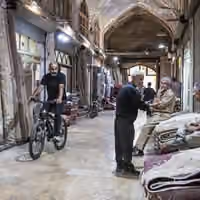
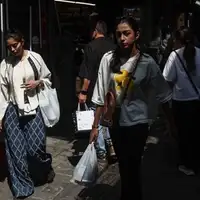
A video circulating on social media appears to show two women confronting people over hijab in Tehran’s Grand Bazaar. The exact date of the footage has not been established, although the Iranian outlet Khabar Online said it was believed to have been recorded recently.
The women’s faces are not clearly visible. One is wearing a medical mask, while another can be seen carrying a radio communication device that is generally unavailable to ordinary citizens in Iran.
Khabar Online said it was not possible to determine from the footage whether she was wearing police insignia, although parts of her clothing resembled police uniform.
[@portabletext/react] Unknown block type "facebook", specify a component for it in the `components.types` prop
Iran’s police have not publicly commented on the incident.
Tehran City Council chairman Mehdi Chamran said any organized activity of this kind in the capital would normally need to be coordinated with municipal authorities, while adding that he had no information about the specific incident at the Bazaar.
Khabar Online also reported that women involved in enforcing Islamic dress rules had appeared in recent days on the sidelines of a nighttime gathering in at least one neighborhood in northeastern Tehran.
The reports come amid broader signs of renewed campaigning over compulsory hijab.
Khabar Online said online activity on the issue has increased in recent weeks, particularly on the Iranian messaging platform Eitaa and on X. Gatherings have also been held in Qom and in the Miankaleh area of Mazandaran demanding action against women who do not observe compulsory hijab.
During a recent visit by Culture Minister Abbas Salehi to Yazd, some participants also chanted in favor of implementing the Islamic Republic’s stalled Hijab and Chastity Law.
At Tehran’s Iran University of Science and Technology, the Student Basij recently protested the presence of unveiled female students at a meeting attended by the head of Iran’s Student Affairs Organization and an adviser to the science minister.
Taken individually, the incidents do not establish that the Islamic Republic has decided to restore the type of morality-police enforcement that became synonymous with compulsory hijab before the 2022 Woman, Life, Freedom protests.
Together, however, they point to renewed pressure over an issue the authorities have struggled to manage since the death of Mahsa Amini in morality police custody in September 2022.
Women appearing in public without headscarves have since become commonplace in major Iranian cities, making defiance of compulsory hijab one of the most visible social changes to emerge from the protests.
While compulsory hijab remains legally in force, authorities have stopped short of fully restoring the extensive street patrols that existed before 2022.
Frustrated hardliners
That restraint has increasingly frustrated parts of the Islamic Republic’s ideological base, for whom enforcing Islamic dress is not simply a social policy but one of the defining obligations of a state that presents itself as Islamic.
Pressure has also returned to parliament.
After Mohsen Rezaei was appointed secretary of the Supreme National Security Council in August, hardline lawmaker Mohammad-Taghi Naghd-Ali publicly questioned whether the council would continue blocking implementation of the Hijab and Chastity Law.
The tougher legislation had been due to take effect in December 2024 before its rollout was halted amid concerns that enforcement could provoke renewed unrest.
UN human rights experts said at the time that the law represented “an intensification of state control over women’s bodies in Iran” and a further assault on women’s rights and freedoms.
The dispute leaves the Islamic Republic facing competing political risks.
A return to aggressive street enforcement could create another source of public anger at a time of severe economic pressure and continued political repression. But allowing widespread non-compliance to continue carries its own cost with the loyalist constituency on which the system relies during elections, official rallies and periods of political crisis.
For the Islamic Republic’s most committed supporters, the disappearance of compulsory hijab from much of everyday public life can be interpreted less as tactical restraint than as ideological retreat.
That helps explain why the state has neither fully restored the pre-2022 enforcement system nor abandoned compulsory hijab.
Instead, enforcement has remained fragmented. Authorities have continued to use pressure on businesses, universities and individuals while avoiding, at least so far, an unambiguous nationwide return of the old morality-police model.
The latest incidents therefore leave a question that Iranian authorities have yet to answer: whether they represent scattered pressure from hardline activists and individual institutions, or the first signs of a broader return to street-level hijab enforcement.