• العربية
  • فارسی
Brand
  • Iran Insight
  • Politics
  • Economy
  • Analysis
  • Special Report
  • Opinion
  • Podcast
  • Live TV
  • Iran Insight
  • Politics
  • Economy
  • Analysis
  • Special Report
  • Opinion
  • Podcast
  • Live TV
  • Theme
  • Language
    • العربية
    • فارسی
  • Iran Insight
  • Politics
  • Economy
  • Analysis
  • Special Report
  • Opinion
  • Podcast
  • Live TV
All rights reserved for Volant Media UK Limited
volant media logo

Iran lawmaker says US naval blockade disrupting imports

Aug 29, 2026, 09:36 GMT+1

A US naval blockade has disrupted Iranian imports that largely relied on southern ports, while the country also faces a daily gasoline shortfall of 15 million to 20 million liters, an Iranian lawmaker said on Saturday.

Jafar Ghaderi, a member of parliament's Economic Commission, said around 83% of Iran's 210 million tons of imports had previously entered through southern ports.

“The US naval blockade has created problems for the country's imports,” Ghaderi said.

He said Iran's gasoline deficit was running at 15 million to 20 million liters a day and that each imported liter cost the government about $1.

Ghaderi said maintaining gasoline supply under the existing system was no longer practical and that authorities should either reduce fuel quotas or adjust prices to bring supply and demand into balance.

Most Viewed

Iran’s oil exports near zero as Persian Gulf flows recover
1
PODCAST

Iran’s oil exports near zero as Persian Gulf flows recover

2
ANALYSIS

War or deal? Rezaei begins to define Iran’s price

3

US targets Egyptian bank in first strike of economic war against Iran

4

Iran threatens US economic interests if maritime blockade continues

5
INSIGHT

Three mediators in three days seek path back to Iran-US talks

Banner
Banner
Banner

Spotlight

  • Iran’s political prisoners are being executed. Why is supporting them controversial?
    PODCAST

    Iran’s political prisoners are being executed. Why is supporting them controversial?

  • Iran’s missing fuel: Can border smuggling explain it all?
    ANALYSIS

    Iran’s missing fuel: Can border smuggling explain it all?

  • Iran bets on China to blunt Trump’s economic offensive
    INSIGHT

    Iran bets on China to blunt Trump’s economic offensive

  • Iran’s oil exports near zero as Persian Gulf flows recover
    PODCAST

    Iran’s oil exports near zero as Persian Gulf flows recover

  • Iran or the dollar? US makes an example of Banque Misr
    ANALYSIS

    Iran or the dollar? US makes an example of Banque Misr

  • War or deal? Rezaei begins to define Iran’s price
    ANALYSIS

    War or deal? Rezaei begins to define Iran’s price

  • Iranians are selling their own graves to pay for living
    INSIGHT

    Iranians are selling their own graves to pay for living

•
•
•

More Stories

Iranian banks remain open in UAE as US campaign squeezes Dubai trade - FT

Aug 29, 2026, 07:17 GMT+1
100%

Iran’s trade with Dubai is showing growing signs of strain under the war and Washington’s new economic campaign, but sanctioned Iranian banks, flights and some commercial routes continue to operate despite calls for a sweeping cutoff, the Financial Times reported Saturday.

Shipping between Dubai Creek and Iranian ports has fallen sharply. At a terminal historically used by wooden dhows trading with Iran, a security guard told the FT vessels were now heading to Oman and India. “No more Iran since last week,” he said.

The disruption matters because Dubai has for decades served as one of Iran’s most important gateways to international trade and finance. Pre-war commerce between Iran and the UAE was worth nearly $30 billion annually.

“The UAE is the only avenue for Iranian imports, as Iran has access to no other major container port other than Jebel Ali in Dubai,” Esfandyar Batmanghelidj of the Bourse & Bazaar Foundation told the FT.

The effects are increasingly visible in Dubai’s traditional trading districts. But the economic break remains far from complete.

Bank Melli and Bank Saderat, both under US sanctions, continue serving customers through more than a dozen UAE branches combined, despite US Treasury Secretary Scott Bessent calling for every Bank Melli branch worldwide to be closed. The two Iranian banks have more than 12 branches between them in the UAE, according to the report.

A Bank Melli employee said daily transactions, lending and letters of credit had seen no significant disruption and that the bank had recently renewed its license with the UAE central bank.

“We’re used to this,” the employee said, referring to previous sanctions.

Iranian airlines are also still flying to Dubai, the Iranian Business Council remains operational and Iranian produce continues to reach markets in the city.

Iranian traders are meanwhile adapting. One Tehran businessman told the FT that goods had been stockpiled in Turkey, some shipments were being rerouted through Oman and cargo could still be sent from Dubai to Bandar Abbas using false destinations on shipping documents.

“We are bypassing the blockade in the same way we have been bypassing sanctions,” he said. “Not much has changed.”

Washington increased the pressure Friday by moving to cut the UAE branches of Egypt’s Banque Misr from access to US financial institutions over alleged Iran-related activity.

The campaign comes after the UAE announced it was suspending trade and financial transactions with Iran. But analysts told the FT that centuries-old commercial ties and Dubai’s reliance on trade make a complete separation difficult.

Iran’s missing fuel: Can border smuggling explain it all?

Aug 29, 2026, 05:25 GMT+1
•
Umud Shokri
100%
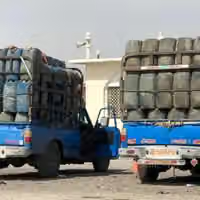
File Photo: Vehicles loaded with fuel containers near Iran’s border, where small-scale cross-border trafficking is the most visible face of a much larger fuel-smuggling economy.

Iran’s large-scale fuel losses appear to go beyond the smuggling cited by officials in Tehran, with evidence pointing to organized diversion within the country’s fuel distribution system.

Iranian officials repeatedly say around 20 million liters of fuel are smuggled out of the country every day, costing Iran between $4 billion and $5.2 billion a year. But the figure is far less precise than it is often presented.

Official statements generally refer to “fuel,” not gasoline alone, and include diesel and other petroleum products. In July 2026, Keramat Veys-Karami, head of the National Iranian Oil Products Distribution Company (NIOPDC), said gasoline was less vulnerable to smuggling than diesel and identified transport allocations as a major source of leakage.

The government has not published the refinery, depot, tanker, customs and station-level data needed to show that 20 million liters physically disappear from the regulated system each day. Without a product-by-product balance, the figure cannot be treated as a measured flow of smuggled gasoline.

Its dollar value is equally uncertain. Twenty million liters a day amounts to 7.3 billion liters a year. Valuing that at $4 billion assumes a loss of about 55 cents per liter; a $5.2 billion estimate puts it at 71 cents. Officials rarely explain whether those figures represent replacement costs, forgone subsidy value, foreign black-market prices or smugglers’ revenue.

What the numbers show

Data released after the war reveal a strained gasoline balance, but do not account for smuggling on the scale claimed.

NIOPDC reported that between March and mid-July 2026, Iranian refineries produced around 109 million liters of gasoline a day, with another 12 million liters supplied through blending. Average consumption stood at 129 million liters.

In late June and early July, daily distribution rose to 134.5 million liters, partly because of increased road travel and Iran’s aging vehicle fleet.

Fuel-card data reveal another problem with interpreting headline numbers. Before the three-tier pricing reform introduced in December 2025, NIOPDC was loading the equivalent of 172 million liters a day in entitlements onto fuel cards belonging to 32 million eligible vehicles, even though actual consumption was around 131 million liters.

The reform reduced those entitlements to about 135 million liters a day and was followed by a six-percent fall in consumption.

But the original gap did not mean that more than 40 million liters of fuel were physically disappearing each day. It was a gap between theoretical entitlements and actual consumption—an important distinction when assessing the scale of diversion.

Establishing how much fuel actually disappears requires comparing refinery dispatches with depot receipts, tanker movements and station-level sales, rather than treating unused or inflated card allocations as physical fuel.

The border-province problem

One argument for the scale of gasoline smuggling focuses on allocations to provinces along or near Iran’s borders. But no published NIOPDC series located for 2025–2026 verifies the claim that Kerman, Hormozgan, Kurdistan and Sistan and Baluchestan together receive 17.5 million liters a day.

Nor can their “normal” demand reliably be put at 14–15 million liters without data on vehicle registrations, fuel-card transactions, agricultural demand and interprovincial traffic.

Available evidence shows why population alone is a poor measure of legitimate demand. Kerman consumed 586 million liters of gasoline during the summer of 2025, equivalent to around six million liters a day, making it one of Iran’s five largest provincial consumers.

In July 2026, the government approved an additional 20-liter third-tier quota for private vehicles in Kerman, Hormozgan and Sistan and Baluchestan, citing long distances and inadequate public transportation.

The provincial figures therefore raise a question rather than provide an explanation. If verified allocations exceed plausible consumption by only a few million liters a day, much of the claimed national leakage must occur elsewhere, or consist of diesel and other fuels rather than gasoline.

An organized supply chain

There is considerably firmer evidence for large-scale organized smuggling and diversion.

Pakistani traders and transporters told RFE/RL in May 2026 that at least six million liters of Iranian gasoline and diesel were entering Pakistan each day. A leaked Pakistani intelligence report identified around 2,000 vehicles and 1,300 boats involved in the trade and described payments moving through hawala networks.

That points to a substantial and organized cross-border economy. But even the six-million-liter estimate accounts for less than one-third of the 20 million liters Iranian officials say are smuggled daily—and it includes both gasoline and diesel.

Evidence from inside Iran points more clearly to the organized networks behind large-scale diversion.

In November and December 2025, judicial officials in Hormozgan said an investigation known as the Toofan case had uncovered 35 interconnected smuggling networks that allegedly moved more than four billion liters of fuel over several years. Authorities opened cases against 753 people described as major participants.

These remain judicial allegations rather than final findings. But the scale and structure described by investigators point to something considerably larger than subsistence smuggling by residents of impoverished border communities.

Where does the fuel disappear?

One of the strongest official clues lies further upstream, in the way fuel allocations are administered.

NIOPDC says around 60 million liters of diesel are allocated to transport operators every day through electronic waybills and acknowledges that inaccurate information about end users creates opportunities for diversion.

The evidence therefore points not to a single route or group of smugglers but to overlapping channels: manipulated fuel entitlements, transport documentation, bulk tanker movements, maritime trafficking and informal payment networks.

That does not establish that Iran’s official estimate of 20 million liters smuggled each day is wrong. It shows that authorities have not published the data necessary to establish what those millions of liters consist of or where they leave the regulated system.

Answering that question would require depot balances, tanker GPS records, station-level sales and provincial allocation data. Until those are published, attributing 20 million liters of daily smuggling chiefly to border communities risks mistaking the visible final carriers for the organized supply system that makes diversion on such a scale possible.

Iran bets on China to blunt Trump’s economic offensive

Aug 29, 2026, 01:00 GMT+1
•
Maryam Sinaiee
100%
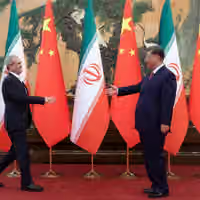
Chinese President Xi Jinping welcomes Iran's president Masoud Pezeshkian

China’s refusal to bow to US sanctions has raised hopes in Tehran that Beijing could blunt Washington’s new economic offensive, but a debate inside Iran reveals doubts over how far China is willing or able to go on Iran’s behalf.

China has warned that it would respond if Chinese companies were targeted by any significant expansion of US secondary sanctions related to Iran, prompting Iranian officials to portray Beijing as a potential obstacle to Washington’s effort to further isolate Tehran economically.

The question has become more pressing as the Trump administration weighs whether to extend its campaign to Chinese financial institutions.

Asked Thursday why Washington had not imposed new sanctions on Chinese banks dealing with Tehran, President Donald Trump suggested such measures could already be under consideration.

“You don’t know if I’m doing it. I don’t have to announce everything,” Trump said.

China’s war too?

Some in Tehran see China’s resistance as part of a much larger struggle with Washington in which Iran has become an important front.

Hasan Ameli, the Supreme Leader’s representative in Ardabil province, argued during Friday prayers that Beijing understood that the United States’ ultimate confrontation was with China rather than Iran.

“China fully understands that America’s main war, and the war of the future, is with China, and this war passes through Iran,” Ameli said. “If America gains control over Iranian oil, it will prepare for war with China.”

He described China’s position as “a major opening for Iran’s economy and a heavy blow to American sanctions,” arguing that Tehran could use it to ease Washington’s economic pressure.

Mohammad-Bagher Ghalibaf, Iran’s parliament speaker and the country’s special representative for China, also welcomed Beijing’s position.

“The Iran-China comprehensive strategic partnership is rooted in mutual respect, win-win cooperation, and a shared vision for a multipolar world. This relationship needs no one’s permission,” he wrote on X.

Alaeddin Boroujerdi, a member of parliament’s National Security and Foreign Policy Committee, pointed to China’s importance as one of Iran’s largest oil buyers and called for faster implementation of the two countries’ 25-year cooperation agreement.

“Given China’s opposition to American sanctions against Iran and its role as one of the largest buyers of Iranian oil, there is considerable potential for expanding trade and economic cooperation,” he said.

China’s interests, not Iran’s

But even among those who see China as an important counterweight to US pressure, there is skepticism over a crucial assumption: that Beijing’s interests and Tehran’s necessarily coincide.

Majid-Reza Hariri, head of the Iran-China Chamber of Commerce, said China was not confronting Washington because of any military or ideological alliance with Iran.

“Rather, its economic and strategic interests require it to preserve its trade independence,” Hariri told Khabar Online.

He acknowledged that intensified US pressure could inflict significant economic damage on Iran, but argued that Washington could not cripple the Iranian economy without broader international cooperation.

Relations with China and Iran’s neighbors, he said, remained important to the country’s economic resilience.

Iranian journalist Ata Bahrami similarly argued that Beijing’s position should be understood primarily as a defense of its own sovereignty and growing power rather than a commitment to Iran.

“Their clear message to Washington is: ‘We have grown stronger and you must respect our sovereignty,’” he said. “In fact, Iran is the starting point for demonstrating this power.”

The Hormuz contradiction

The limits of the partnership become more apparent in the Strait of Hormuz, where Iran’s own actions potentially conflict with Chinese interests.

Moderate journalist Ahmad Zeidabadi questioned whether Beijing could be expected to deepen its support for Tehran while Iran keeps closed a waterway through which China receives more than 40% of its oil.

Zeidabadi also pointed to the fact that Ghalibaf has yet to visit Beijing despite his appointment as Iran’s special representative for China, asking whether the delay could reflect Chinese frustration with Tehran’s refusal to end its threat over Hormuz.

The problem goes beyond political differences. Even if Beijing refuses to comply with US secondary sanctions and Chinese buyers remain willing to purchase Iranian oil, Tehran must still be able to move that oil out of the Persian Gulf under a US maritime blockade.

Overcoming that obstacle would potentially require a level of Chinese involvement in Iran’s confrontation with Washington that Beijing has so far shown no willingness to undertake.

The debate inside Iran therefore exposes the gap between diplomatic resistance to US sanctions and the practical ability to defeat them.

Beijing may be willing to protect Chinese commercial interests and challenge Washington’s extraterritorial sanctions, but that is different from assuming the economic—let alone military—costs of Iran’s confrontation with the United States.

For Tehran, China may be Washington’s biggest obstacle in enforcing its economic campaign, but not necessarily Iran’s economic lifeline.

Iran’s oil exports near zero as Persian Gulf flows recover

Aug 28, 2026, 22:09 GMT+1
•
Negar Mojtahedi
100%
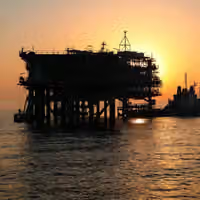
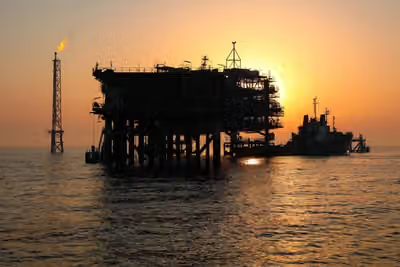
File Photo: Iran's Reshadat oil rig in the Persian Gulf

Iran’s ability to export fresh crude has fallen close to zero under the US maritime blockade, according to Kpler, just as Washington begins targeting the foreign banking networks Tehran relies on to collect the proceeds.

Crude and condensate flows from other Persian Gulf producers have recovered to around 70% of pre-war volumes, while Iran is struggling to move newly loaded crude, Homayoun Falakshahi, head of crude oil analysis at Kpler, told Iran International.

“It’s exactly the opposite scenario compared to the beginning of the war where Iran could export its oil but the neighbors couldn’t,” Falakshahi told Iran International’s English-language podcast Eye for Iran. . “And now it’s actually the contrary. Iran cannot export new oil.”

Goldman Sachs said Friday that oil flows through the Strait of Hormuz had recovered to around two-thirds of pre-war levels, according to Bloomberg, helping contain the impact of the conflict on global crude prices.

The figures point to a striking reversal in the oil war: the Strait is increasingly functioning again for Iran’s neighbors while Tehran itself struggles to get fresh crude to market.

Oil already on the water

The full impact on Iranian revenues, however, will take time to emerge because millions of barrels loaded before restrictions tightened are already outside the blockade zone.

Kpler estimates that roughly 40 million to 50 million barrels of Iranian oil remain on the water in Asia, substantially below an earlier estimate of around 80 million barrels.

Falakshahi said the revision reflects stronger-than-previously-understood discharges in China, now running at close to one million barrels per day.

At that rate, the remaining oil could take roughly 50 days to unload. Chinese buyers generally have another one to two months to pay Iranian sellers, creating a lag between the collapse in fresh exports and the loss of revenue.

If the blockade remains in place, Falakshahi estimated that within roughly three to four months Iran’s revenues from oil exports could effectively fall to zero.

China is central to that calculation. Falakshahi said it buys effectively all of Iran’s crude and condensate exports. When petroleum products and petrochemicals are included, he estimated China’s share of Iranian petroleum exports at roughly 90% to 95%.

From tankers to banks

Even as the blockade squeezes Iran’s ability to get new barrels to market, Washington is beginning to target the other end of the transaction: the foreign financial infrastructure Tehran uses to move the proceeds.

On Friday, the US Treasury Department’s Financial Crimes Enforcement Network proposed using Section 311 of the USA Patriot Act to cut Banque Misr’s UAE branches off from US correspondent banking, the first such action under Operation Economic Outcast.

Treasury said the branches processed approximately $1.8 billion between January 2024 and June 2026 for 103 companies potentially connected to Iranian shadow-banking networks.

According to Treasury, their customers included apparent front companies used by Iran’s Ministry of Defense and the Revolutionary Guards to evade US sanctions, as well as entities used to launder money on behalf of Supreme Leader Mojtaba Khamenei.

Max Meizlish, a former official with the US Treasury Department’s Office of Foreign Assets Control, said the significance of the move lies in Washington beginning to target foreign banks that make Iran’s sanctions-evasion networks possible, rather than focusing primarily on Iranian entities and front companies.

Section 311 allows Treasury to threaten a foreign bank’s access to the US financial system without immediately freezing its assets, while giving the institution and its regulators an opportunity to address the activity before restrictions take effect, he said.

“The real test now is whether this becomes a sustained campaign and whether Treasury is willing to bring the same pressure to bear on Iran’s financial enablers in Hong Kong and China,” Meizlish told Iran International.

That question is particularly important given China’s dominant role in Iran’s remaining oil trade.

Meizlish has identified China’s Bank of Kunlun as one potential target for further US action. The bank has previously faced US restrictions over dealings involving Iran, but he argued Washington could go further by imposing full blocking sanctions.

Treasury Secretary Scott Bessent had signaled that a major action against a financial institution was coming under Operation Economic Outcast.

Friday’s move suggests Washington is beginning to extend its campaign beyond Iran’s physical oil exports to the foreign financial infrastructure that allows Tehran to receive and move its money.

For global markets, the recovery in other Persian Gulf exports is helping blunt the energy shock. For Tehran, the trajectory is moving in the opposite direction: fewer opportunities to export fresh oil, a diminishing stockpile already outside the blockade and growing pressure on the financial networks through which it gets paid.

The blockade is squeezing Iran’s ability to sell its next barrel. Operation Economic Outcast is increasingly aimed at making it harder to collect the money for the barrels that got out.

Iran or the dollar? US makes an example of Banque Misr

Aug 28, 2026, 20:50 GMT+1
•
Mohamad Machine-Chian
100%
A customer exchanges U.S. dollars to Egyptian pounds in a foreign exchange office in central Cairo, Egypt December 27, 2016

The US has opened a new front in its economic campaign against Iran by threatening to cut a major third-country bank out of the dollar system over alleged involvement in Tehran’s shadow-banking network.

The US Treasury on Friday labeled Banque Misr’s UAE branches a “financial institution of primary money laundering concern” and proposed cutting them off from the dollar system, marking the first Section 311 action against a third-country bank under Washington’s new Operation Economic Outcast.

The Treasury’s Financial Crimes Enforcement Network (FinCEN) estimates that between January 2024 and June 2026, Banque Misr UAE processed approximately $1.8 billion in transactions for 103 companies it assesses are potentially part of the Islamic Republic’s “shadow banking” network.

The department described the bank as “a critical node for the Iranian regime’s access to US dollars” and said its customers included front companies working for Iran’s Ministry of Defense and Armed Forces Logistics and the Revolutionary Guards, as well as a company described in media reports as a money-laundering conduit for Mojtaba Khamenei.

“We also warned that Iran’s enablers cannot continue to enjoy access to the US dollar and the global financial system,” Treasury Secretary Scott Bessent said. “Banque Misr UAE decided to find out the hard way.”

The move is the first use of Section 311 under Operation Economic Outcast, which Bessent announced on August 24 with the stated aim of cutting off the Iranian government’s revenue streams worldwide.

Unlike conventional sanctions, however, the FinCEN action involves no asset freezes.

Cutting off the dollar

Section 311 of the USA Patriot Act allows the Treasury to designate a foreign financial institution as being of “primary money laundering concern” and impose special measures restricting its access to the US financial system.

In Banque Misr UAE’s case, FinCEN has proposed the most severe option, known as the fifth special measure.

The measure would not only close the bank’s three direct correspondent accounts with US financial institutions. American banks would also be required to prevent Banque Misr UAE from accessing dollars indirectly through intermediary foreign banks.

The proposal is subject to a 30-day public comment period after publication in the Federal Register before it can be finalized.

The measure applies only to Banque Misr’s five UAE branches — two in Dubai and one each in Abu Dhabi, Sharjah and Ras Al Khaimah. The bank’s Cairo-based parent and operations in other countries are excluded.

Iran-linked transactions

FinCEN named three Banque Misr UAE customers as examples of the activity behind its action.

UAE-based Alpa Trading FZCO conducted more than $32 million in transactions and, according to FinCEN, procured goods on behalf of Iran’s defense ministry and the Revolutionary Guards.

Naba Alzaki Raw Materials Trading LLC processed more than $29 million and was identified as a front for the Iran-based Khandan Exchange. Midas Oil Trading DMCC conducted more than $1 million in transactions and has been described in media reports as a money-laundering conduit for Mojtaba Khamenei.

Of the $1.8 billion in potentially Iran-linked transactions identified by FinCEN, roughly $520 million was processed in the 12 months to June 2026, a period covering the war and tightening US sanctions.

FinCEN described the proportion of suspected Iranian activity relative to the size of Banque Misr UAE as “concerningly high.”

The agency has previously said it identified about $9 billion in potential Iranian shadow-banking activity moving through US correspondent accounts in 2024 alone.

The network relies on exchange houses inside Iran and front companies registered in third countries, particularly the UAE and Hong Kong, to turn revenue from sanctioned Iranian exports into usable currency.

A growing bank

Banque Misr UAE’s audited accounts show that its business was expanding during the period in which FinCEN alleges it became a conduit for Iran’s shadow-banking network.

Total assets rose 11% in 2025 to 23.4 billion dirhams ($6.4 billion), customer deposits increased 9% to 19.1 billion dirhams and loans jumped 60% to 8.8 billion dirhams.

The accounts also show the importance of trade finance to its business. Its books carry more than 1.3 billion dirhams in letters of guarantee and 3.6 billion dirhams in undrawn credit commitments.

Losing dollar correspondent access would therefore strike directly at a business heavily involved in cross-border trade finance, even without freezing any of its assets.

The bank appears well capitalized, with a capital adequacy ratio of 24.7%, well above the UAE central bank’s 10.5% minimum. The immediate threat is therefore not insolvency but the viability of parts of a business dependent on international currency settlement and trade finance.

Banque Misr is Egypt’s second-largest bank and is fully owned by the Egyptian state. That makes Washington’s decision to target its UAE operations particularly significant as the US seeks to persuade foreign financial institutions to stop facilitating Iranian trade.

The move nevertheless stops short of targeting larger financial institutions, particularly major Chinese banks involved in financing Iranian trade, a step Washington has so far avoided amid concerns over wider financial disruption and retaliation.

By threatening a state-owned bank belonging to a major Arab partner with exclusion from the dollar system, Washington is setting out the potential cost for third-country institutions that continue handling business it considers part of Iran’s shadow-banking network.

The warning is now explicit: institutions dealing with Tehran may increasingly have to weigh that business against their access to the dollar.