“Sanctions can't topple a regime on their own. That's not what they're for,” said Bitsoff, who previously worked at the Treasury Department’s Office of Foreign Assets Control, the agency responsible for administering and enforcing US economic sanctions. “They are intended to increase pressure.”
For Bitsoff, who worked on nonproliferation and weapons procurement at OFAC and is now executive director of investigations at TANGOS, the distinction is central to understanding what decades of US sanctions against Iran can and cannot accomplish.
Rather than expecting sanctions themselves to produce political change, she said their effect should be measured by how much they increase the cost and difficulty of the activities Washington is trying to constrain.
“They make everything that the regime does related to those more expensive, slower and more difficult to obtain,” she said, referring to activities such as Tehran’s nuclear and weapons programs. Sanctions, she added, are also intended “to set conditions for something else to happen” and “can't be alone.”
That argument comes after years in which successive US administrations have expanded, eased or more aggressively enforced different layers of sanctions against the Islamic Republic. Washington restored broad nuclear-related sanctions after withdrawing from the 2015 nuclear deal in 2018, targeting areas including Iran’s banking, energy and shipping sectors. President Donald Trump launched a renewed “maximum pressure” policy in February 2025, directing the Treasury Department to pursue a “robust and continual sanctions enforcement campaign” aimed at denying Tehran and its allied groups access to revenue.
Bitsoff said those measures should not be judged simply by how many Iranian individuals, companies or organizations Washington places on sanctions lists.
Enforcement matters more than numbers
“Numbers are not a good measure of the impact of sanctions and whether they are important,” Bitsoff said. “You can sanction thousands of individuals and entities within Russia, within Iran, within North Korea, and that's not really the answer.”
The more meaningful test, she said, is whether sanctions change the behavior of actors outside the targeted country — the banks, buyers, suppliers, shipping companies and intermediaries that allow sanctioned governments to continue obtaining money and material.
That often requires Treasury officials to identify specific weak points in complex networks rather than simply placing restrictions on an entire sector. Bitsoff described sanctions policy as operating on two levels: broad measures designed to restrict areas such as oil revenue or access to the financial system, and day-to-day operational measures targeting individual transactions, companies and procurement networks.
Weapons procurement provides one example of how that pressure works. Sanctions may not stop Iran from producing a missile or drone, Bitsoff said, but they can increase the cost of securing the components needed to build them and force manufacturers to rely on inferior alternatives.
“You raise the cost of procuring parts and components,” she said. “You force them to get worse parts and components, so their finished weapons are less effective.”
The effects can take years to become visible, she said, and may eventually be measured in missile failure rates or the ability of adversaries to jam drones and develop other countermeasures.
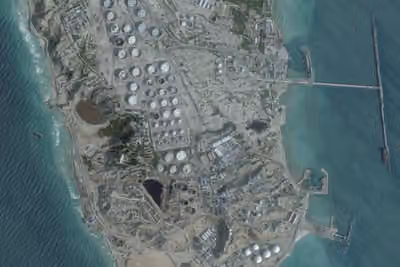
Iran’s reliance on foreign components has remained a focus of US sanctions. Treasury actions in 2025 and 2026 targeted networks in China, Hong Kong, the UAE and elsewhere accused of supplying Iran with drone components, missile propellant ingredients and other military goods. In June, OFAC sanctioned another group of China- and Hong Kong-based individuals and companies it said had supported weapons procurement for the Revolutionary Guards and Iran’s defense ministry.
Oil sanctions work differently, Bitsoff said. Rather than necessarily preventing a barrel of Iranian crude from reaching a customer, the restrictions can make every stage of that journey more expensive.
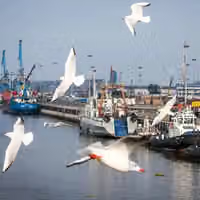
An Iranian shipment may have to pass through several intermediaries, rely on aging tankers carrying higher insurance costs, undergo ship-to-ship transfers and be sold at a discount to a limited pool of buyers willing to accept the risk of dealing in sanctioned oil. Ship managers, operators and others involved in the trade may also demand premiums because they risk becoming sanctions targets themselves.
“By the end of it,” Bitsoff said, Iran can be forced to absorb a “huge discount,” meaning export volumes alone do not provide a complete measure of whether sanctions are working.
The US Treasury has described many of the same methods in its recent actions against Iran’s oil trade, citing front companies, intermediary brokers, ship-to-ship transfers, falsified documents and manipulation of vessel identities. In April, Treasury said China was buying about 90% of Iran’s oil exports and that independent Chinese refineries, commonly known as teapots, accounted for most of those purchases.
Bitsoff said enforcement can therefore be thought of as a dial that Washington can turn up or down even when the underlying sanctions remain on the books.
She pointed to the period after the United States left the nuclear agreement in 2018, when tougher enforcement drove major buyers with exposure to the US financial system away from Iranian oil.
She contrasted that with the early years of the Biden administration, when she argued Washington eased enforcement as it sought to revive negotiations with Tehran, allowing Iran’s oil trade with China to adapt around smaller buyers with less exposure to the US financial system.
“The whole idea is to change behavior,” she said. “You don't wanna just sanction something and then walk away.”
Without continued enforcement, she said, companies treat a designation as a one-time event and find ways to adjust their operations around it. “If you don't keep up with that, if you don't make that enforcement visible, people are just going to keep doing what they want to do.”
Iran's sanctions evasion machine
Keeping up has become more difficult because Iran has spent years developing mechanisms to circumvent the restrictions imposed on it, Bitsoff said, describing a system largely developed by the Revolutionary Guards and the broader state during the intense sanctions pressure of the early 2010s.
“They have a sanctions evasion machine that works pretty well,” she said.
The core of that system has remained relatively consistent, relying on shadow banking, buyers willing to trade with Iran and efforts to avoid transactions vulnerable to the US financial system. But Bitsoff said Tehran has repeatedly adapted the mechanics when new opportunities appear, from deceptive tanker practices and cash smuggling to newer methods involving cryptocurrency.
“The pattern I can discern is that they'll just use anything at their disposal to evade sanctions,” she said.
China now occupies an especially important place in that system, both as the dominant destination for Iranian oil and as a source of components used by Iran’s military industries. The Treasury Department has increasingly targeted Chinese refiners, ports, shipping companies and procurement networks as part of the maximum-pressure campaign, including a June action against China- and Hong Kong-based actors accused of facilitating weapons purchases for the IRGC and defense ministry.
“Most evasion of sanctions, especially related to Iran, happens through China,” Bitsoff said. “Those are the front companies that move money. They're the buyers of oil. They're the suppliers of weapons components.”
That makes pauses in enforcement against China particularly significant, she argued, because companies and intermediaries watch US actions when deciding how much sanctions risk they are prepared to accept.
Bitsoff said this helps explain why sanctions cannot be regarded as an on-off mechanism capable either of completely stopping Iran’s activities or, at the other extreme, being dismissed as ineffective because those activities continue. Their purpose, in her view, is degradation: reducing revenues, increasing costs and making military and nuclear programs harder to sustain.
That pressure also has a domestic dimension, she said, because Iran’s leadership must contend with economic mismanagement while the public sees resources being directed toward military programs and allied armed groups rather than economic opportunity at home.
“The population knows that it's funneling money not to them, not to economic growth, not to opportunities, but back to its proxies, back to its nuclear program, back to its weapons program,” Bitsoff said.
But she stopped short of arguing that economic pressure can determine the Islamic Republic’s political future. Instead, she said sanctions can help establish the conditions in which other forces operate, with political change ultimately depending on Iranians themselves.
“The Iranian people are the ones that have to use that pressure,” Bitsoff said, adding that alongside sanctions, the United States should be “thinking of any possible way we can support that.”