Major UK unions urge Labour government to oppose Iran war


Leaders of 10 major British trade unions representing more than 2 million workers have urged the Labour government to oppose the US-Israeli war on Iran, saying it is worsening Britain’s cost-of-living crisis.
In a letter to the prime minister, the unions called on the government to revoke permission for US air strikes from British territories. They said the average household’s annual energy bill had risen by £221 since the war began, while monthly food bills were forecast to rise by £32.80.
“Ending rather than escalating this war … is essential for the government’s affordability agenda to be a success,” they wrote.
The signatories include UNISON, the UK’s largest union with more than 1.3 million members, alongside the National Education Union, PCS and RMT. Those four alone represent more than 2 million members.
“Opposing this war is a necessity if the cost of living agenda is to succeed,” the letter said.




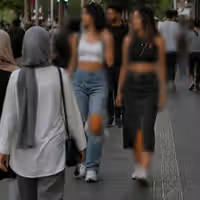
Iranian hardliners are intensifying pressure on authorities to enforce compulsory hijab, as recent cafe closures and online campaigns raise fears of a renewed crackdown despite widespread defiance of the dress code.
Last week, hardline lawmaker Mohammad Naghd-Ali told parliament that another member had told him he cries after every parliamentary session because of the current state of women's dress.
Naghd-Ali fiercely criticized President Masoud Pezeshkian's administration for refusing to implement the controversial hijab law approved in 2024, saying the government was allowing what he described as "nudity” and “immorality" to spread.
Although the new legislation was finalized in 2024, its implementation has been suspended following a decision by the Supreme National Security Council, reportedly out of concern that enforcing it could trigger unrest similar to the nationwide protests that erupted after Mahsa Amini's death in 2022.
Existing compulsory-hijab rules, however, remain legally in force.
Hardline activists have likewise blamed Pezeshkian for what they portray as the country's cultural decline.
"If Pezeshkian's incompetent and secular government continues for another two years, even today's level of dress will become something people long for," conservative commentator Hassan Abbasi wrote on social media. "Pezeshkian is standing against God's command on hijab and wants to return Iran's cultural climate to the Pahlavi era."
Social media campaign seeks broader crackdown
Hardline activists have also intensified an online campaign demanding tougher enforcement.
In recent days they have circulated videos showing unveiled women in tight-fitting sleeveless tops serving customers at a well-known restaurant in Tehran—scenes that would have been almost unimaginable in the capital and other cities until only a few years ago. Such activists frequently describe these styles as "nudity" or "body display."
One hardline X user, allegedly tied to a state institution, wrote: "The first step in confronting unveiled women is confronting cafes and establishments that violate social norms." According to the post, enforcement is currently focused mainly outside Tehran but will gradually expand across the capital.
Hardline journalist Fereshteh Sadeghi similarly shared a photograph of an unveiled woman shopping outside Tehran and criticized those arguing that hijab should not be discussed while the country faces broader security challenges.
"They tell us not to talk about hijab in the middle of a war and not even to take pictures. Then when are we allowed to speak?" she wrote.
Yet Sadeghi also acknowledged the state's failure to restore widespread headscarf compliance.
"The battle to force the hijab back onto women is over; you can't force the hijab on their heads," she wrote in another post, while arguing that authorities should at least establish dress regulations to prevent what she called "body display."
Hijab as a political symbol
For many hardliners, compulsory hijab is not only a religious obligation but also a defining political symbol of the Islamic Republic.
"Hijab is the flag of Islam. Muslim society is recognized through hijab," conservative social media activist Alireza Akbari wrote.
Supporters of compulsory veiling frequently cite a ruling by Supreme Leader Ali Khamenei, who described unveiling as forbidden both religiously and politically.
Journalist Mehrdad Khadir argued in an article published by Asr-e Iran that women's dress is no longer among the public's primary concerns.
"The way women and girls dress is not a concern for the majority of people," he wrote. "The face of the city has changed, and it will not return to what it once was."
According to Khadir, the country's real concerns are the threat of war and the collapse in living standards.
"In the current circumstances," he wrote, "it is unlikely—indeed impossible—that the authorities would surrender their judgment to those tears and turn an issue that has effectively been settled back into a national crisis. If there is anything worth crying over, it is the collapse of people's purchasing power."
Resistance through everyday life
Although enforcement has eased in many areas over recent years, critics argue that this should not be mistaken for legal liberalization because compulsory hijab laws remain fully in force even if they are not consistently applied.
The social landscape has nevertheless changed dramatically. Many women who continue to wear the hijab have also moved away from the traditional all-black chador and highly conservative appearance. Styles often described online as “hijab style” combine headscarves with colorful clothing, modern designs and fashion accessories.
Hardliners reject these styles as well, arguing that they contradict hijab's original purpose of discouraging attention and preserving modesty.
Opponents of compulsory veiling, meanwhile, say the increasingly visible presence of unveiled women reflects persistence rather than freedom.
"The type of clothing women wear in public still depends on the neighborhood, how they travel, even the day and time," one X user wrote. "The fact that we now see bolder styles is the result of the relentless struggle of brave women who accept the risks of dressing that way. Nothing has actually been liberated."
Saudi Arabia, Turkey and Pakistan signed a mutual defense pact in Mecca on Friday that never once named a threat, and within hours Iranian officials and clerics had named it for them, mocking the agreement and promising that "the roar of our missiles" will reach its signatories.
The Mecca Joint Defense Agreement, signed as Crown Prince Mohammed bin Salman hosted Turkish President Recep Tayyip Erdogan and Pakistani Prime Minister Shehbaz Sharif, declares that an armed attack on any of the three will be treated as an attack on all.
A Turkish official called the pact "purely defensive," directed at no specific actor and open to other countries in the region.
The signatories' combined weight explains the attention. Turkey fields NATO's second-largest military, Saudi Arabia is one of the world's top oil exporters and home to Islam's holiest sites, and Pakistan is the only nuclear-armed Muslim state.
The pact caps nearly a year of negotiations and builds on last year's Saudi-Pakistani defense agreement, under which some 8,000 Pakistani troops, fighter jets and an air-defense system have already deployed to the kingdom.
The timing needs little decoding. Since the war began on February 28, Iran and its allies have struck US bases and civilian infrastructure across Saudi Arabia, Kuwait, Bahrain, Qatar, the United Arab Emirates, Oman and Jordan, shut the Strait of Hormuz to most shipping, and, through the Houthis, declared a naval embargo on Saudi ports in the Red Sea.
For Riyadh, three years of regional war have also raised a harder question: whether the American security umbrella it built its plans on still opens.
Tehran answers the question nobody asked
The pact's statement avoided Iran's name. Tehran filled the silence itself.
"The Saudis should know that a paper agreement with Turkey and Pakistan will not bring them security, just as years of one-way nursing of the Americans brought them none," Ebrahim Rezaei, a member of the Iranian parliament's national security committee, wrote on X. "Correct your policies so you no longer need to go begging for security."
The clerical establishment was blunter. "Borrowed security and begging America for security will not save you," Alireza Arafi, the Friday prayer leader in Qom, told regional governments.
"As long as you are with the enemies of Islam and Iran, the roar of our missiles will threaten you."
In Ahvaz, another Friday preacher said Iran was working to extend its missiles' range to 15,000 kilometers so that "the American people, too, will see what it is like to be left in blood and destruction."
For a pact its authors insisted was aimed at no one, the replies arrived from one address.
Riyadh braces, Baghdad moves
The agreement was signed against specific and immediate warnings. A Saudi official told CNN the kingdom is preparing for coordinated attacks on energy facilities, ports and airports by Iraqi militias and Yemen's Houthis "in the very near future," under the guidance of Iran's Revolutionary Guards, citing intelligence that included tracked meetings between militia and Guards personnel and movements of drones and missiles.
Baghdad, unusually, is moving against the same groups. An Iraqi government official told Iran International the country is "on the verge of delivering the final blow" to Iran-backed militias, with intelligence indicating planned operations not only against Saudi Arabia but against Kuwait, Jordan and Syria.
Iraq's armed forces said a security plan is underway to foil any attack on the kingdom, and troops have been ordered to prevent Iraqi territory from being used for missile and drone launches at neighbors.
The warnings follow a week in which the Houthis struck two Saudi tankers in the Red Sea and hit Najran's airport, wounding 11 civilians, including a four-year-old child.
Reporting by Asharq al-Awsat and Israeli media describes a joint Houthi-Iraqi operations room established at Jurf al-Sakhr, the militia stronghold south of Baghdad.
A deal Tehran wants, on terms it dictates
The day's other track ran through Muscat.
Iran's parliament confirmed the framework of an understanding with Oman has been agreed, and lawmaker Ahmad Bakhshayesh Ardestani described its logic with unusual candor: Iran is negotiating with America "in Oman's name," he said, over an arrangement that would leave the strait's management in Iranian hands and charge passing ships a tariff of 7 percent of cargo value, split three-quarters to Tehran and a quarter to Muscat.
President Donald Trump sounded confident and noncommittal at once. "It's obvious they don't want to be hit. They want to make a deal. So, we'll see," he said, adding that gasoline prices would rise only if he had to "do another hit" on Iran.
The Wall Street Journal reported that Arab mediators doubt Iran's diplomats have the authority to deliver any Hormuz deal they sign, as hardliners accuse the negotiating team of giving too much away.
That doubt, in the end, is what Friday's ceremony in Mecca was about. Three of the region's heaviest states have concluded that whatever emerges from the talks, the threat that closed the strait and burned their ports will outlast the paperwork, and they intend to face it attached to one another rather than waiting, separately, for Washington.
Dozens of people detained over Iran's January protests remain in a security ward in the country's northwest, with more than half still awaiting hearings or serving prison sentences of up to five years, the US-based Human Rights Activists News Agency (HRANA) reported on Friday.
HRANA said 54 detainees were being held in Ardabil prison, near Iran's border with Azerbaijan. Of those, 25 have been sentenced to between six months and five years and three months in prison, while 29 remain in custody without having had a hearing in their cases.
Among those convicted, Ahmad Seifi received the longest sentence of five years and three months, while Milad Ashkani was sentenced to four years. Three others received sentences of three years and six months, according to HRANA.
Prosecutors seek harsher sentences
An informed source told HRANA that Ardabil prosecutor Jalal Afaghi considered the sentences handed to 10 of those convicted too lenient and had asked Iran's Supreme Court to increase their punishments.
HRANA said full details of the charges, proceedings and courts responsible for the sentences had not been made public.
Some of the detainees have also been denied telephone calls and family visits, while relatives have faced restrictions in seeking information about their cases or requesting temporary release, the rights group said.
Hundreds detained in northwestern province
Around 800 people were arrested in Ardabil province during the January protests, according to HRANA. The group said about 500 were released during the first 10 days and roughly another 250 were later freed after posting bail or other forms of security.
The cases form part of a much broader judicial crackdown following the protests. Rights groups have estimated that more than 60,000 people were detained across Iran, while some independent sources have put the number summoned, detained or interrogated at more than 100,000.
Iranian judiciary spokesman Asghar Jahangir said in February that authorities had issued more than 10,000 orders sending cases for prosecution and around 9,000 indictments against people detained during the unrest.
The report comes amid mounting international concern over prosecutions and executions connected to the protests.
UN human rights chief Volker Türk said this week that Iran had executed at least 56 people on national security-related charges since March 19, including 27 in protest-related cases. He urged Iranian authorities to halt executions and move towards abolishing the death penalty.
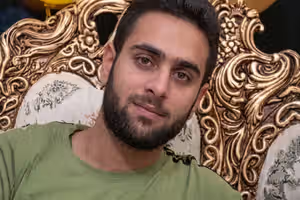
Iran has opened a second case against Ahmad Seyyed-Abdollahi, who is serving a prison term after posting a video urging Donald Trump to protect demonstrators during January’s nationwide protests, sources familiar with the case told Iran International.
The second case was opened in June on the charge of “propaganda against the establishment” and remains at the preliminary investigation stage, the sources said.
Seyyed-Abdollahi, 32, posted the English-language video on January 4, two days after Trump warned that the United States would come to the aid of peaceful protesters if Iranian authorities opened fire on them.
In the video, Seyyed-Abdollahi urged Trump to act quickly, saying many young Iranians had trusted his words and that help would come too late for those killed.
He added that Iranians would remember those who helped them and would seek to repay their friends in the future.
Seyyed-Abdollahi was first arrested on January 14, ten days after posting the video. He was held for about two months in solitary confinement at Borujen Prison and an intelligence detention facility operated by the Islamic Revolutionary Guard Corps in Isfahan.
He was released on bail on March 10.
Branch One of the Borujen Revolutionary Court later convicted him of “engaging in media activities against national security,” sentenced him to seven months in prison and barred him from government and public services for five years.
He was detained again on July 7 to begin serving the sentence and transferred to Borujen Prison in southwestern Iran’s Chaharmahal and Bakhtiari province, where he remains incarcerated.
Seyyed-Abdollahi was denied access to a lawyer of his choosing during his detention and was at times prevented from contacting his family, according to the sources.
He was among several Iranians who appealed directly to Trump for help during the nationwide protests.
Videos sent to Iran International showed one woman holding a sign reading, “Trump, a symbol of peace. Don’t let them kill us,” while another protester urged him to “do something” as security forces opened fire in Yazdanshahr in Isfahan province.
A protester in the northeastern city of Mashhad also addressed Trump directly and appealed for help during the crackdown.
Trump repeated his warning on January 9, telling Iranian authorities: “You better not start shooting because we’ll start shooting too.”
On January 13, he urged Iranians to continue protesting and wrote that “help is on its way.”
Iranian authorities crushed the protests with lethal force and carried out mass arrests.
The US-based rights group HRANA has reported that more than 50,000 people were arrested during just over six weeks of protests and the ensuing crackdown.
Authorities have since intensified their use of the death penalty against protesters. UN human rights chief Volker Türk said Wednesday that Iran had executed at least 56 people on national security-related charges since March 19, including 27 in cases linked to the January protests.
Amnesty International says at least 60 protest-related defendants, including three who were arrested as children, remain at risk of execution.
Five people detained over Iran’s nationwide January protests have been sentenced to death or are at risk of receiving death sentences in the northeastern city of Mashhad and nearby Shandiz, sources familiar with their cases told Iran International.
Mohammad Zanganeh, Mehdi Zarif and Ali Zaghi have been sentenced to death, while Najmeh Amini and Vahid Khedrikhah face charges that could carry capital punishment, sources told Iran International.
The five cases come amid a sharp escalation in Iran’s use of capital punishment against people detained during the January unrest. The UN human rights chief says at least 56 people have been executed on national security-related charges since March 19, including 27 in protest-linked cases.
Najmeh Amini: Facing capital charges over Instagram stories
Amini, a 23-year-old accounting student, was arrested in Mashhad on February 2 over several protest-related Instagram stories.
Sources said she was beaten and arrested while shopping at a market in the city.
She was held in police custody for two days and forced to confess, according to the sources.
Hengaw reported that Amini faces charges including moharebeh, or “waging war against God,” and collaboration with Israel, accusations that could carry the death penalty.
Amini has been denied access to a lawyer throughout her detention and is being held in Mashhad’s Vakilabad Prison.
Mohammad Zanganeh: Prison sentence followed by death ruling
Zanganeh, a 24-year-old protester, is at risk of execution after the Mashhad Revolutionary Court issued a new notice sentencing him to death.
He has gone on hunger strike in Vakilabad Prison in protest against the ruling.
Sources told Iran International that the court, presided over by Judge Hadi Mansouri, recently notified Zanganeh that he had been sentenced to death.
The same court had previously sentenced him in June to three years, six months and one day in prison on charges including acting against internal and external security, chanting slogans against the Islamic Republic, insulting religious sanctities, calling for protests and unrest, damaging public property and setting fire to a banner of former supreme leader Ali Khamenei.
Sources said his condition in prison is “extremely concerning.”
Before recently being allowed to communicate outside the prison, Zanganeh had been held incommunicado for five months, during which his family had received no information about him.
He was denied access to a lawyer and other basic rights as a prisoner throughout that period, sources told Iran International.
Mehdi Zarif: Death sentence imposed under espionage law
Zarif, a 21-year-old dental technician from Shandiz, is at risk of execution after Iran’s Supreme Court upheld his death sentence, a source familiar with his case told Iran International.
He was arrested at his home on February 14 and, after a period in solitary confinement, suffered a heart-related medical complication during questioning, which the source attributed to pressure exerted by interrogators.
Zarif is currently being held in Mashhad’s Vakilabad Prison.
The source said Branch Five of the Mashhad Revolutionary Court, presided over by Judge Yazdankhah, sentenced him to death under legislation introducing harsher penalties for espionage, cooperation with Israel and collaboration with states deemed hostile to Iran’s national security.
The Supreme Court upheld the ruling, and Zarif’s lawyer was denied access to the full judgment and the case documents, according to the source.
Ali Zaghi and Vahid Khedrikhah
Zaghi has been sentenced to death in connection with the January protests, sources told Iran International.
He was arrested on January 12 in Shandiz, a city near Mashhad. No further details about his case were available.
Khedrikhah, a 32-year-old from Mashhad who is being held in Vakilabad Prison, is at risk of being sentenced to death, informed sources told Iran International.
Khedrikhah, who lost both parents at the age of 12, was taken to a friend’s home for treatment after being wounded in the side on January 9.
Security forces went to the house on January 19 and arrested him, the sources said.
According to the sources, he faces charges of “leading the protests” and moharebeh, or “waging war against God,” the latter of which can carry the death penalty.
Use of death penalty against protest detainees
UN human rights chief Volker Türk said on Thursday that executions and death sentences had risen sharply since March, with more than 100 other people facing national security-related charges that could carry the death penalty.
Mai Sato, the UN special rapporteur on human rights in Iran, echoed Türk’s alarm, pointing to a persistent pattern of executing people, including protest participants, on security-related charges.
“The purpose of these executions is to control society by instilling fear through lethal force,” she said.