• العربية
  • فارسی
Brand
  • Iran Insight
  • Politics
  • Economy
  • Analysis
  • Special Report
  • Opinion
  • Podcast
  • Iran Insight
  • Politics
  • Economy
  • Analysis
  • Special Report
  • Opinion
  • Podcast
  • Theme
  • Language
    • العربية
    • فارسی
  • Iran Insight
  • Politics
  • Economy
  • Analysis
  • Special Report
  • Opinion
  • Podcast
All rights reserved for Volant Media UK Limited
volant media logo

US general warns he lacks forces to keep protecting Israel - Washington Post

Aug 1, 2026, 13:03 GMT+1

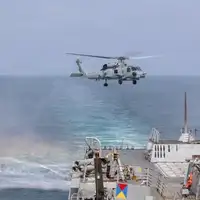
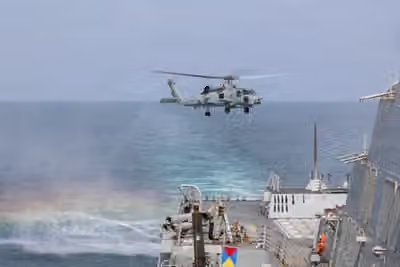
The top US general in Europe has privately warned the Pentagon that he lacks sufficient naval forces to continue defending Israel from Iranian ballistic missile attacks, the Washington Post reported on Saturday, citing officials.

Gen. Alexus Grynkewich, head of US European Command, warned that a shortage of Navy destroyers would force him to prioritize protection of the US homeland, according to the report.

Most Viewed

US offers $15 million reward over IRGC drone network
1

US offers $15 million reward over IRGC drone network

2
INSIGHT

'Western trap': calls for restraint grow in Tehran after Ukraine attack

3
INSIGHT

Why Iran's leaders failed to see this generation coming

4

Iran gambling network helped channel $4 billion through crypto exchange - Reuters

5
VOICES FROM IRAN

Where steak is a dream

Banner
Banner
Banner

Spotlight

  • China helps Iran chip away at US air superiority despite Xi’s no-arms pledge
    ANALYSIS

    China helps Iran chip away at US air superiority despite Xi’s no-arms pledge

  • Why Iran's leaders failed to see this generation coming
    INSIGHT

    Why Iran's leaders failed to see this generation coming

  • Security forces seized Iran hospital, sent wounded protesters to morgue
    EXCLUSIVE

    Security forces seized Iran hospital, sent wounded protesters to morgue

  • Where steak is a dream
    VOICES FROM IRAN

    Where steak is a dream

  • 'Western trap': calls for restraint grow in Tehran after Ukraine attack
    INSIGHT

    'Western trap': calls for restraint grow in Tehran after Ukraine attack

  • From cafes to buskers, Tehran tightens its grip on the fabric of everyday life

    From cafes to buskers, Tehran tightens its grip on the fabric of everyday life

•
•
•

More Stories

Ghalibaf reveals Tehran feared street unrest after Iran International broke Khamenei news

Aug 1, 2026, 09:50 GMT+1
100%
Late Iranian Supreme Leader Ali Khamenei (L) with parliament speaker Mohammad Bagher Ghalibaf.

Iranian parliament speaker Mohammad Bagher Ghalibaf said authorities rushed to announce Ali Khamenei’s death and call supporters onto the streets after “overseas media” broke the news, fearing the situation on the streets could otherwise “take a completely different turn.”

By “overseas media,” Ghalibaf was referring to Persian-language outlets based outside Iran, a term Iranian officials sometimes use to refer to such broadcasters. Iran International was the first outlet to announce Khamenei’s death.

Ghalibaf said officials had initially decided to wait until 8 a.m. the following morning, when they planned to announce his death alongside the formation of a new Leadership Council.

“At 12:30 at night, the television channels abroad announced the martyrdom,” Ghalibaf said, adding that he and Ali Larijani re-established contact around 1 a.m. and decided the original plan could no longer stand.

Officials feared losing control of the streets

Ghalibaf said officials instead decided to announce Khamenei’s death around dawn, while people were eating their pre-dawn Ramadan meal, and immediately call supporters onto the streets.

“We decided that we absolutely had to announce it at dawn, when people were at the suhoor table, and at the same time say: whether you’ve eaten or not, everyone come out into the streets,” he said.

“Otherwise, believe me, the situation in the streets could have taken a completely different turn,” Ghalibaf added.

He described the street as one of four fronts that authorities needed to manage alongside the military, diplomacy and government services. “The military front is one front, diplomacy is one front, services are another, and the street is also a front,” he said.

Street pressure later turned on Ghalibaf

The comments shed new light on the government’s efforts to mobilize supporters immediately after Khamenei’s death. But some of the hardline demonstrators who took to the streets later turned their anger on Ghalibaf and other officials over negotiations with Washington.

The street criticism echoed a revolt among a small but vocal group of ultraconservative lawmakers, who accused Ghalibaf, Iran’s chief negotiator in talks with the United States, of crossing leadership red lines and shielding the negotiations from parliamentary scrutiny.

Iran's hangings are 'murders,' says former UN prosecutor

Aug 1, 2026, 03:37 GMT+1
•
Negar Mojtahedi
100%

Iran's latest wave of public hangings of protesters amounts to "killings" and "murders" that form part of a continuing crime against humanity, former United Nations prosecutor Professor Payam Akhavan told Iran International's Eye for Iran.

His comments came days after Iran publicly hanged two protesters in the central city of Isfahan, prompting renewed international condemnation and a rare display of public defiance.

He argued that the executions cannot be separated from the mass killing of protesters during January's nationwide uprising.

"There is no doubt that we have a crime against humanity," Akhavan told Eye for Iran.

“What we actually have in Iran are arbitrary executions. These are killings. They are murders,” Akhavan said. "Specifically, the case can be made that this is a crime of extermination, given the large scale of the killings."

Akhavan, who testified before the UN Human Rights Council during its January special session on Iran, said the scale and method of the killings could support the more specific charge of extermination.

The crime against humanity of extermination involves mass or large-scale killing. Unlike genocide, it does not require proof that the perpetrators intended to destroy a protected national, ethnic, racial or religious group.

Public hangings provoke defiance in Isfahan

Iran publicly hanged Amirhossein Safari and Abolfazl Sepahi on July 28 in Isfahan's Alikhani Square after accusing them of involvement in the killing of four police officers during the January 8 unrest.

The two men were among a group sentenced to death in connection with the case. Golmohammad Mohammadi and Erfan Esfandiari were executed in prison on July 19, while eight others reportedly remain under sentence of death.

The judiciary says Safari and Sepahi took part in the killings. Rights groups, however, have raised serious concerns about the proceedings, including restrictions on access to lawyers and case files, the rejection of potentially exculpatory evidence and the use of televised confessions that may have been obtained under coercion.

UN human rights experts called on Iran to halt the executions one day before the hangings, warning that coerced confessions must not be admitted as evidence and that broadcasting them before trial violates the presumption of innocence.

Rather than intimidating the public into silence, the hangings triggered a rare display of defiance.

Hundreds of people gathered near the execution site before dawn. Videos showed crowds booing police and chanting “shame on you” as the call to prayer rang out. Security forces later dispersed them through surrounding streets, with witnesses reporting the use of tear gas, Tasers and warning shots.

An online campaign opposing the death penalty was shared hundreds of thousands of times within a day. At Ghezel Hesar prison near Tehran, an estimated 1,500 death-row prisoners also staged a hunger strike as part of the “No to Executions” campaign.

“A death sentence which is carried out without any due process and on legal grounds that are entirely unacceptable is not really a lawful execution,” he said. “It becomes a form of murder or extrajudicial execution.”

International human rights law permits capital punishment only for the most serious crimes in countries that have not abolished it and only following strict respect for due process.

Akhavan said many of Iran’s death sentences instead rely on vague national-security charges, including moharebeh, or “waging war against God,” as well as forced confessions and trials in courts that cannot be considered independent or impartial.

“What we’re witnessing today in this surge in executions is not an isolated phenomenon,” Akhavan said. “It is inextricably connected with the events of January and it is really a continuation of the same criminal transaction.”

Article 7 of the Rome Statute defines crimes against humanity as certain acts committed as part of a widespread or systematic attack directed against a civilian population.

From January’s massacre to extermination

The UN Independent International Fact-Finding Mission on Iran previously concluded that serious violations committed during the 2022 Woman, Life, Freedom uprising amounted to crimes against humanity.

Its investigation into the January 2026 crackdown is ongoing. Akhavan acknowledged that the mission must complete its own investigation before issuing formal conclusions, but said his legal assessment is clear.

He cited the internet blackout, restrictions on reporting, allegations that hospitals were pressured to record gunshot deaths as natural causes and accounts of bodies being transported in refrigerated trucks and potentially buried in unmarked graves.

He also pointed to statements by senior Iranian officials depicting protesters as combatants, foreign agents or people “waging war against God,” language he said effectively created a licence to kill.

There is also evidence of snipers, heavy machine guns and armour-piercing ammunition being used against unarmed protesters.

“The case can be made that this is a crime of extermination, given the large scale of the killings.”

Executions as a display of control

Iran carried out at least 2,159 executions in 2025, Amnesty International has said, most in drug-related cases.

Since the January uprising, rights groups have documented a sharp increase in politically motivated executions. Amnesty says at least 52 people have been arbitrarily executed this year for alleged offences connected to the protests following torture-tainted and grossly unfair Revolutionary Court proceedings. At least 60 others remain at risk, including three who were children at the time of their alleged offences.

Public political executions remain comparatively rare. The last widely reported case was the 2022 hanging of Majidreza Rahnavard during the Woman, Life, Freedom uprising.

Akhavan said the return of cranes as public gallows was therefore particularly shocking and appeared designed to project strength and frighten a population that continues to challenge the state.

“Under cover of war, they are escalating executions in order to create fear,” he said.

“The biggest threat to the Islamic Republic is not the US and Israeli military operations, as damaging and unlawful as they may be. It is the Iranian people first and foremost.”

The authorities have now expanded their pressure beyond those facing execution. Tehran’s prosecutor has opened cases against an unspecified number of people accused of opposing executions or supporting defendants linked to the January uprising and the recent war.

US tightens military and financial pressure as Iran talks falter

Aug 1, 2026, 00:46 GMT+1
100%
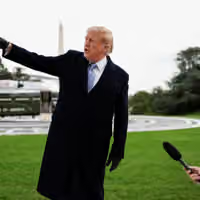
US President Donald Trump speaks during the first televised Cabinet meeting at Camp David, flanked by Secretary of State Marco Rubio and Defense Secretary Pete Hegseth, July 31, 2026.

The Trump administration on Friday outlined military and financial measures against Tehran alongside negotiations that President Donald Trump said were being undermined by Iran’s conduct.

Speaking during the first televised Cabinet meeting at Camp David, Trump, Defense Secretary Pete Hegseth and Treasury Secretary Scott Bessent addressed continued talks, military action aimed at preventing Iran from obtaining a nuclear weapon and a worldwide search for assets linked to its government.

Talks continue as trust erodes

Trump said negotiations with Iran were continuing but that he was “losing faith” in Tehran because “they do lie” and “they do misrepresent.”

“They always want to talk, but they break their words so often,” he said.
Trump said Steve Witkoff, Jared Kushner, Vice President JD Vance and Secretary of State Marco Rubio were involved in the talks. “We have great people talking,” he added.

He said five missiles were fired at a US base in Jordan while negotiations were underway.

“Instead, I got a call from Pete that they just shot five missiles at one of our bases in Jordan,” Trump said.

Asked whether the attacks could continue, Trump said: “I think I’m going to be foolish to say no. You always have to keep your guard up.”

“They get weaker. They get a little stronger, maybe now, but they’ll get weaker, and then they peter out,” he added.

Military pressure and nuclear sites

Hegseth praised Trump for having “the courage to do Midnight Hammer and conclude the 12-day war by obliterating their nuclear sites.”

He said previous presidents had considered such action but “never pulled the trigger because of the complications, because of the challenge, and because of the risk.”

Hegseth said Trump remained committed to ensuring Iran never obtained a nuclear weapon and praised his willingness to negotiate with people who had “shown no willingness to do so honestly.”

Diplomacy under pressure

As hopes for diplomacy flicker, the United States is increasing military and economic pressure on Tehran while Trump and Hegseth continue to voice confidence in the US negotiating team.

“We have great people talking,” Trump said. “We have the best negotiators in the world,” Hegseth added.

Why Iran's leaders failed to see this generation coming

Jul 31, 2026, 21:12 GMT+1
•
Behrouz Turani
100%
Thousands gathered in Tehran's biggest mall to meet YouTuber Nima Tekido, July 25, 2026

A gathering of thousands of teenagers at a Tehran mall to meet a popular YouTuber exposed a widening blind spot in Iran, some sociologists suggested: a generation whose values, social lives and sources of authority increasingly lie beyond the state's understanding.

The chaotic gathering at the luxury shopping complex, where teenagers and young adults—predominantly from Generation Z and Generation Alpha—assembled to meet content creator Nima Tekedo, triggered widespread debate across Iranian media and academic circles.

Although officials were forced to confront Generation Z during the nationwide protests of 2022, several sociologists argue that Generation Alpha remains almost entirely outside the state's field of vision.

Moderate daily Shargh and centrist newspaper Sazandegi both argued that the surprise surrounding the Iran Mall incident reflected a deeper failure to understand younger Iranians.

They warned that repeatedly overlooking new generations had already left authorities unprepared for successive waves of unrest since 2017 and cautioned that the same blind spot persists today.

The gathering had been publicly announced on YouTube, Telegram and Instagram, yet authorities appeared unaware that thousands would attend.

A parallel universe

Sociologist Nima Shojaei told Shargh that over the past two decades traditional forms of political participation, including elections, campaigns and party politics, had steadily lost their appeal among young Iranians, while their social lives increasingly unfolded beyond the state's view.

He argued that reference groups had shifted dramatically, leaving the government unable to understand the evolving identities of younger generations.

Shojaei also pointed to the contradictions of a state that continues to portray all Iranian youth through an ideological lens—via state media, school textbooks and Friday prayer sermons—as devout Muslims committed to official values.

Believing its own narrative, he argued, the state gradually lost sight of the society it sought to govern.

The Iran Mall gathering, Shojaei said, was neither a political protest nor an act of resistance. Rather, it reflected a generation retreating into everyday life after losing faith in conventional politics.

‘Gen Z charting its course’

Another sociologist, Foad Habibi, criticized commentators who responded by blaming or mocking teenagers instead of examining broader social change.

"Attacking powerless youth is the cheapest form of analysis because it carries no personal cost, whereas criticizing state power does," he said.

Habibi agreed that the problem lay not with young people themselves.

"Generation Z has not erred; it has simply charted its own course and moved forward. The failure lies with policymakers and social scientists," he said.

Sazandegi argued that the incident highlighted a broader shift in cultural authority from formal institutions to decentralized online networks.

The paper pointed to similar episodes that had repeatedly caught authorities off guard, including a large gathering in Tehran Pars in 2024 to see hip-hop artist GodPouri.

Unlike traditional mobilization built around parties or hierarchical organizations, the newspaper argued, today's youth assemble rapidly through shared online interests and peer-to-peer communication.

What appears to older generations as a spontaneous crowd is, in reality, a highly networked social world capable of mobilizing thousands within hours.

For Sazandegi, the Iran Mall gathering was therefore less about a celebrity appearance than a glimpse of a generation that no longer looks to political parties, religious institutions or state media for authority, but chooses its own communities, its own heroes and increasingly, its own way of life.

Security forces seized Iran hospital, sent wounded protesters to morgue

Jul 31, 2026, 19:21 GMT+1
•
Farnoosh Faraji
100%

Iranian security forces took control of a hospital in the western city of Khorramabad during January's nationwide crackdown, according to medical staff, transferring dozens of critically wounded protesters to the morgue instead of receiving further treatment.

More than 200 bodies passed through Shohadaye Ashayer Hospital during the crackdown, according to an Iran International investigation based on more than two dozen sources, including medical personnel, eyewitnesses and people close to victims' families, as well as hospital records and videos obtained from inside the facility.

One eyewitness said at least 70 critically wounded protesters who could have been saved were transferred to the morgue instead of receiving further treatment.

Others were removed from treatment wards by security personnel before later reappearing in the morgue with fresh gunshot wounds to the upper body or what staff described as "finishing shots."

Iran International has so far verified the identities of 23 people killed in the city.

Hospital under siege

According to a member of the hospital's medical staff, Shohadaye Ashayer became the only hospital authorized to treat people wounded during the crackdown.

Armed security forces surrounded the hospital while police, intelligence officers and other security personnel operated inside the building. Officers stood over doctors and nurses as they treated patients, confiscated staff mobile phones and prevented them from contacting their families.

Hospital staff were effectively confined inside the facility for three days, the medical worker said. Several employees were arrested, while security forces moved through treatment wards identifying wounded protesters for detention.

Videos obtained by Iran International show dozens of bloodied bodies, many naked or partially unclothed, lying uncovered across the morgue floor and an adjoining room.

Some still had oxygen tubes in their mouths and electrocardiogram pads attached, suggesting they had been receiving treatment before being moved.

Several appeared to have been shot directly in the forehead, while others were covered with pellet wounds. Some had suffered catastrophic head injuries, with parts of their skulls missing. Several bodies also showed severe injuries to the genital area.

Some remained handcuffed despite bearing fatal gunshot wounds.

From operating room to morgue

Eyewitnesses described the hospital as overwhelmed, with blood covering corridors and bodies filling both the courtyard and the morgue. Multiple witnesses estimated that between 200 and 250 bodies passed through the hospital during the crackdown.

A student at Khorramabad University of Medical Sciences who witnessed patients arriving at the hospital described a similar pattern.

According to the student, wounded protesters repeatedly arrived alive on January 8 and 9, only for their deaths to be announced around 20 minutes after they had been taken into operating rooms. The student said the pattern was repeated across numerous patients.

The student also recalled a protester admitted on January 22 with extensive pellet wounds and a severe infection. Before treatment could be completed, security forces removed the patient from the hospital despite objections from the attending physician and took them to an unknown location.

Crackdown beyond the hospital

Witnesses said protests spread across much of Khorramabad on January 8 and 9, drawing tens of thousands of people into the streets.

They described security forces firing military-grade weapons, sniper rifles, shotguns and pellet guns at demonstrators, with several witnesses saying protesters were deliberately shot in the head and chest.

One witness said they personally saw at least five people killed after being struck from behind by bursts of gunfire.

Witnesses said security forces prevented many wounded protesters from reaching medical care, leaving some to bleed to death in the streets. Those who managed to reach Shohadaye Ashayer Hospital remained at risk of arrest, abduction or forced removal.

Witnesses also described an internet shutdown, movement restrictions and the widespread deployment of plainclothes officers, the Basij, the Revolutionary Guards and police units throughout the city.

Families under pressure

Eyewitnesses said bodies accumulated in the courtyard of Shohadaye Ashayer Hospital on January 9 while Basij forces prevented relatives from approaching them.

Some families removed the bodies of loved ones immediately, fearing security forces would seize them.

Among the victims whose identities Iran International has verified was Hossein Yaghmaei, who died after being shot and taken to a nearby home.

Retired municipal employee Hojjat Ahmadian was also among those killed. People familiar with his case said authorities pressured his family to record his death as suicide to avoid losing his pension.