• العربية
  • فارسی
Brand
  • Iran Insight
  • Politics
  • Economy
  • Analysis
  • Special Report
  • Opinion
  • Podcast
  • Iran Insight
  • Politics
  • Economy
  • Analysis
  • Special Report
  • Opinion
  • Podcast
  • Theme
  • Language
    • العربية
    • فارسی
  • Iran Insight
  • Politics
  • Economy
  • Analysis
  • Special Report
  • Opinion
  • Podcast
All rights reserved for Volant Media UK Limited
volant media logo
EXCLUSIVE

Germany limits Tehran embassy services as it urges citizens to leave Iran

Jul 24, 2026, 11:38 GMT+1Updated: 15:27 GMT+1

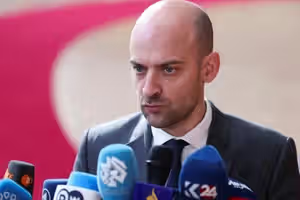
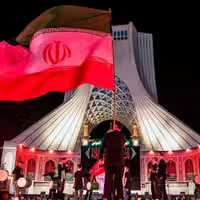
Germany has scaled back operations at its embassy in Tehran while again urging its citizens to leave Iran, the German Foreign Ministry told Iran International on Friday.

The embassy remains open, but its consular and visa services are currently operating only on an emergency basis and with limited capacity, the ministry said.
Continue reading…

Most Viewed

Iran bears biggest economic cost of Hormuz closure
1
ANALYSIS

Iran bears biggest economic cost of Hormuz closure

2
INSIGHT

Trump threat to hit Pickaxe renews calls in Iran for nuclear bomb, NPT exit

3

Rubio says Trump’s Iran policy is ‘a head for an eye’

4

Unpaid wages push Iranian workers to brink

5

Hormuz traffic falls to one as US-Iran fighting escalates

Banner
Banner
Banner

Spotlight

  • Tehran braces for possible new phase of war
    INSIGHT

    Tehran braces for possible new phase of war

  • Cafés close, tolerance ends: Iran’s post-war shift on compulsory hijab
    INSIGHT

    Cafés close, tolerance ends: Iran’s post-war shift on compulsory hijab

  • Iran bears biggest economic cost of Hormuz closure
    ANALYSIS

    Iran bears biggest economic cost of Hormuz closure

  • Iran-US rhetoric shifts from ships to infrastructure

    Iran-US rhetoric shifts from ships to infrastructure

  • Russia’s gasoline imports add pressure to Iran’s strained fuel market
    ANALYSIS

    Russia’s gasoline imports add pressure to Iran’s strained fuel market

  • Raid on Tehran's cafés was a show of contempt
    TEHRAN INSIDER

    Raid on Tehran's cafés was a show of contempt

•
•
•

More Stories

Paris weighs reducing embassy staff in Tehran, source says

Jul 21, 2026, 11:59 GMT+1
100%
French embassy in Tehran

France is reviewing whether to reduce staffing at its embassy after two French diplomats were detained, interrogated and allegedly abused by Iranian security forces in Tehran, according to information obtained by Iran International on Tuesday.

French Foreign Minister Jean-Noël Barrot had already confirmed that two members of the French embassy were detained for several hours on Sunday, calling the episode "serious and unacceptable" and warning it "cannot go without consequences."

"One of them was physically abused," Barrot said, describing the detention as an "extremely serious act of intimidation" and a "flagrant violation of diplomatic immunity."

According to a source familiar with the matter who spoke to Iran International, Iranian security forces detained the two diplomats, took them to an undisclosed location and interrogated them. Both were subjected to psychological pressure during their detention and questioning, and that at least one was physically assaulted, the source said.

The episode has heightened concern among staff at the French embassy in Tehran, with several employees asking to return to France before completing their assignments, although their postings have not officially ended, according to the source.

French authorities are now considering whether to end some diplomatic assignments early and reduce the embassy's presence in Tehran, the source added.

Paris seeks answers

Iran International has sent a formal request to the French Foreign Ministry seeking comment on the condition of the two diplomats, Paris' planned response and the possible impact on embassy operations in Tehran.

100%
Demonstrators gather outside the French Embassy in Tehran in October 2020, protesting the publication of caricatures of the Prophet Muhammad. Protesters hold placards depicting French President Emmanuel Macron, burn his image, and call for a boycott of French goods.

The ministry had not responded by the time of publication.

Barrot said he had raised the matter directly with Iranian Foreign Minister Abbas Araghchi, telling him the detention represented a serious breach of diplomatic immunity protected under international law.

According to Barrot, the two diplomats were responsible for French programs supporting Iranian civil society, particularly artists and scientists. Both were released and are expected to return to France.

Relations deteriorate

The detention comes as relations between Paris and Tehran continue to worsen over Iran's nuclear program, regional policies and the imprisonment of French nationals.

France has said it opposes lifting sanctions on Iran unless Tehran abandons its nuclear program and changes what Paris describes as destabilizing regional policies. Paris has also called for a broader European role in negotiations over Iran.

The dispute follows years of friction over French nationals held in Iran. Paris has repeatedly called for the release of Cécile Kohler and Jacques Paris, who have been detained since 2022, describing their imprisonment as arbitrary and accusing Iran of using foreign detainees to seek diplomatic concessions.

Earlier this year, France brought a case against Iran before the International Court of Justice over alleged violations of consular rights.

  • France accuses Iran of assaulting diplomat, warns of consequences

    France accuses Iran of assaulting diplomat, warns of consequences

The detention of accredited embassy staff broadens the dispute from French citizens held in Iran to diplomats protected under international law, adding another point of strain in relations between Paris and Tehran.

Iranian authorities had not publicly commented on the case by the time of publication.

Wave of Iran plots drove UK action against IRGC, terror law tsar says

Jul 15, 2026, 21:04 GMT+1
•
Azadeh Akbari
100%

Britain's decision to create a new legal framework targeting Iran's Revolutionary Guards was driven less by political pressure than by the scale of alleged Iranian activity on British soil, according to Jonathan Hall, the UK government's independent reviewer of terrorism laws.

"There’s been a lot of pressure for some time to do something about the activities of the Revolutionary Guard Corps," Jonathan Hall KC told Iran International.

But while political calls to act had grown louder, he said the more important factor was the number of alleged Iranian plots disrupted by Britain's intelligence services and the public concern they generated.

"If you listen to what the director general of MI5 has been saying, there's been an extraordinary number of plots in the last few years that the intelligence services have had to disrupt and deal with," Hall said.

The government says MI5 identified at least 20 potentially lethal Iran-backed plots against people in Britain over the course of a year. It says the IRGC has used proxies and criminal networks to target Iranian dissidents and members of the Jewish community overseas.

Terrorism law 'never suitable'

Hall said the government had wanted to take stronger action against the IRGC but could not simply proscribe it under the Terrorism Act 2000 because the legislation was never designed to apply to the military or intelligence institutions of another state.

"The Terrorism Act was never suitable," Hall said. "It was never designed to deal with state bodies."

The Terrorism Act allows the government to proscribe organizations, making membership and various forms of support criminal offences. Hall said Parliament had never intended those powers to be used against the official institutions of foreign states.

The home secretary commissioned Hall in December 2024 to examine whether Britain's counterterrorism powers could be adapted to address state threats. His review concluded that they could not and instead recommended creating a separate designation regime under national security legislation.

"So rather than proscribing the IRGC or any other state body under the Terrorism Act, there's now a new piece of legislation," he said.

The National Security (State Threats) Act 2026 received royal assent on July 8, amending the National Security Act 2023 to allow the home secretary to designate bodies involved in foreign power threat activity where necessary to protect the UK's safety or interests.

The government laid draft regulations before Parliament on July 13 to designate the IRGC, the Iran-linked Islamic Movement of Companions of the Right and Russia's GRU Volunteer Corps. The House of Commons approved the regulations on Wednesday, while the House of Lords is due to consider them on Thursday.

The designations cannot take effect without the Lords' approval.

Targeting paid proxies

Hall said the primary aim of the new framework is to deter people in Britain from accepting money to conduct surveillance, violence or other activities on behalf of the IRGC.

"We know that the way that the Iranian regime operates in the UK is usually through proxies," he said. "These are individuals obviously willing to take money to carry out certain conduct."

He said the legislation could apply to someone paid to conduct reconnaissance outside the home of a television journalist, follow and stab an Iranian dissident or set fire to a synagogue.

A person could face prosecution if they knew, or should reasonably have known, that their conduct was likely to assist the IRGC.

"It's about credibly saying to people who might take £500, £1,000 or whatever to do that sort of thing: you are at risk of committing a National Security Act offence," Hall said.

"The desire is that people should be deterred. And, of course, if they do carry out that sort of proxy activity, they will then go to prison for a long time and be convicted under an exceptionally serious piece of legislation."

The law creates offences relating to supporting or assisting a designated body, or receiving a material benefit from one, carrying maximum prison terms of 14 years.

People convicted of espionage, sabotage or foreign interference carried out for, on behalf of, or with the intention of benefiting a designated body could face life imprisonment. Prosecutors would also no longer have to establish a separate foreign-power connection in every case.

Conscripts not criminalized

Hall said the legislation deliberately avoids creating a criminal offence of membership in a designated state body, partly to avoid penalizing Iranian men who had to complete military service in IRGC units.

"This conscription point was quite influential on me when I did my analysis," he said.

Hall said membership of a proscribed terrorist organization could be criminalized because an individual generally chooses whether to join or remain in such a group. That approach would be inappropriate for someone compelled to serve in a state institution.

"That obviously wouldn't be right in the case of someone who's got no choice about whether they are a member of a state body," he said.

Asked whether the law could affect Iranian men required to complete military service in IRGC units, Hall replied: "The answer is this law doesn't apply in any way."

Protecting communities targeted by the IRGC

Hall said the new measures are intended to make it riskier for IRGC proxies to target journalists, Iranian dissidents and members of the Jewish community in Britain.

"It's not just about finances," he said. "What it does is it provides a little bit extra."

"From the perspective of journalists and dissidents and Jews in the UK, the point actually is to make it more risky for proxies to act and to make it tougher for them to operate."

Prime Minister Keir Starmer said the government would not allow foreign states to use Britain to spread fear, division and violence, while Home Secretary Shabana Mahmood said the new powers would make it easier to prosecute people carrying out hostile activities on behalf of Iran, Russia and other foreign actors.

The government has cited alleged IRGC-linked plots targeting two Iran International journalists in Britain as an example of the activity the new framework is intended to address.

It also says the Islamic Movement of Companions of the Right claimed responsibility for seven attacks against sites linked to Jewish and Israeli communities and Persian-language media between March and May, with members of the IRGC's Quds Force "almost certainly" directing the group's activities across Europe.

For Hall, however, the legislation's purpose is ultimately straightforward: to close a gap in British law by giving authorities a tool specifically designed to tackle hostile state organizations—something he says terrorism legislation was never intended to do.

January protesters trapped in 'hell' of Greater Tehran prison, inmates say

Jul 13, 2026, 13:22 GMT+1
•
Saba Heidarkhani
100%
File photo shows inmates sitting inside an overcrowded prison ward in Iran.

January protesters held in Greater Tehran Penitentiary are being kept in severely overcrowded and unsanitary conditions without adequate medical care, clean drinking water or sufficient food, according to multiple inmates and eyewitnesses who spoke to Iran International.

Several security prisoners held in Wards 1, 2 and 4 of Unit 6 described conditions that they said have worsened in recent months as authorities transferred growing numbers of detainees arrested during the January protests to the prison.

“Bedbugs crawl all over prisoners, and everyone is exposed to disease,” one inmate said. “Because of the overcrowding, if one person gets sick, the entire ward becomes ill.”

Overcrowding doubles prison capacity

According to the prisoners, each ward contains 15 rooms equipped with 15 beds, providing space for about 210 inmates after accounting for shared storage areas.

Authorities are housing roughly 500 prisoners in the same space, they said, forcing about half the inmates to sleep on floors or in corridors.

The overcrowding has contributed to infestations of bedbugs and lice and accelerated the spread of infectious illnesses, inmates said.

Former prisoners have previously described similar conditions at Greater Tehran Penitentiary, warning of severe overcrowding, inadequate healthcare and shortages of medical staff.

One former inmate said families often supply medicines because the prison clinic provides little treatment.

“The clinic does nothing,” the former prisoner said. “Only when someone is close to death are they transferred for medical care.”

Water, food and hygiene shortages

Prisoners said they have no reliable access to clean drinking water and must purchase bottled water from the prison store.

During the current summer period, however, the store has at times gone up to three days without bottled water, forcing inmates to drink tap water that they believe is unsafe.

Several inmates also described prison food as poor quality and said meals are occasionally not served, with one or two meals sometimes skipped every few days.

Political prisoners in Ward 6 also reported earlier this month that water supplies had been cut, air conditioning switched off and showers closed, which they said was intended to increase pressure on detainees. They also said weekly family visits had been suspended.

Cold showers, blocked toilets

Prisoners told Iran International that hot water is unavailable in prison showers throughout the year.

When inmates complain, prison officials tell them they cannot provide hot water and that prisoners must accept the conditions, according to the witnesses.

They also described blocked toilets that sometimes remain unusable for days, as well as shortages of cleaning supplies.

Dirty bedding, carpets and shared facilities have contributed to outbreaks of scabies and other contagious skin diseases, prisoners said.

Outdoor confinement in extreme heat

Witnesses also described mandatory outdoor exercise under direct sunlight during summer temperatures approaching 40 degrees Celsius.

100%

Prisoners are required to remain in an uncovered yard for at least two hours each day and are not permitted to return indoors before the allotted time.

“The same happens in winter,” one inmate said. “Even if you were freezing, they would not allow you back inside.”

Protest detainees held alongside other prisoners

According to inmates, conditions deteriorated after authorities transferred large numbers of January protesters to Greater Tehran Penitentiary as prisons in the capital filled beyond capacity.

Some detainees said protest prisoners were placed in wards previously occupied by inmates convicted of theft and drug-related offenses.

Unlike Tehran's Evin Prison, where political prisoners often manage their own wards, Unit 6 at Greater Tehran Penitentiary is overseen by inmates convicted of ordinary crimes.

Several witnesses said that some of those inmates verbally abused protest detainees, encouraged confrontations and, in some cases, carried out violent attacks with the acquiescence of prison guards.

One witness said two protesters were stabbed during a confrontation, leaving one with severe hand injuries.

Several inmates said many of those arrested during the January protests are young adults, adding that the conditions inside the prison have left them in severe psychological distress while many remain in detention awaiting trial without being granted temporary release on bail.