• العربية
  • فارسی
Brand
  • Iran Insight
  • Politics
  • Economy
  • Analysis
  • Special Report
  • Opinion
  • Podcast
  • Iran Insight
  • Politics
  • Economy
  • Analysis
  • Special Report
  • Opinion
  • Podcast
  • Theme
  • Language
    • العربية
    • فارسی
  • Iran Insight
  • Politics
  • Economy
  • Analysis
  • Special Report
  • Opinion
  • Podcast
All rights reserved for Volant Media UK Limited
volant media logo

After Hormuz, are Iran-backed Houthis closing another vital strait?

Jul 21, 2026, 20:27 GMT+1
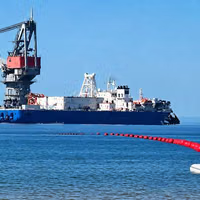
File photo: Greek-registered tanker ship Sounion burns after an attack by Yemen's Iran-aligned Houthi militants in the Red Sea, September 6, 2024 in this satellite image. 2024 Planet Labs Inc via REUTERS

Several tankers carrying Saudi crude oil reversed course on Tuesday after Tehran-backed Houthis declared a blockade on shipping through Bab el-Mandeb, raising fears that the US-Iran war could disrupt a second major energy chokepoint.

Yemen’s Houthis, who control much of northern and western Yemen and its coastline near the southern entrance to the Red Sea, declared a maritime embargo against Saudi Arabia on Monday, potentially opening another front in the widening regional conflict.

The order targets Saudi-linked shipping rather than all vessels passing through Bab el-Mandeb. The strait has not been closed, and a US Navy-led maritime information center said Tuesday that there had been no confirmed attacks on vessels in the Red Sea over the previous 48 hours.

But the announcement was already affecting commercial shipping.

In a letter sent to shipping companies and seen by Reuters, the Houthis warned that vessels loading or discharging oil at Saudi ports could be attacked anywhere within the reach of their forces.

The group described the measure as a “blockade for blockade,” accusing Saudi Arabia of imposing land, sea and air restrictions on Yemen and targeting Houthi-controlled ports and airports, including Sanaa International Airport.

US President Donald Trump said Tuesday that the Houthis had not yet shut Bab el-Mandeb, known as the “Gate of Tears,” but warned that Washington would respond if they did.

“So far it hasn’t happened. Might happen, but we take care of things,” Trump said. “If something like that happens, we take care of it.”

Tankers alter course after Houthi threat

Two tankers that had loaded Saudi crude at the Red Sea port of Yanbu for customers in China and India reversed course Tuesday, heading north toward the Suez Canal rather than south through Bab el-Mandeb into the Indian Ocean.

The vessels, Xin Long Yang and Rodos, had both been sailing south through the Red Sea before turning around. A third tanker, New Prime, which had been heading empty toward Yanbu, also reversed course off Oman.

British maritime risk-management company Vanguard described them as the first confirmed changes to commercial tanker routes following the Houthi announcement and warned of growing disruption to Saudi crude exports and regional shipping.

No evidence has emerged that the vessels were directly threatened, but their diversions showed that shipping companies were already responding to the risk of Houthi attacks.

Saudi Arabia pledges to protect shipping

Riyadh rejected the Houthis’ accusations as false and said it would take all necessary measures to protect its vessels under international law and the 1982 UN Convention on the Law of the Sea.

The Saudi-led coalition in Yemen said threats against ships passing through Bab el-Mandeb would be dealt with firmly and that measures were being implemented to safeguard commercial traffic.

Riyadh accused the Houthis of exploiting the wider regional conflict to pursue their own agenda, worsen the suffering of Yemenis and threaten regional security.

Hormuz disruption raises Red Sea stakes

With traffic through the Strait of Hormuz severely reduced by the US-Iran war, Saudi Arabia has increasingly relied on its East-West Pipeline to transport crude across the kingdom to Yanbu for export through the Red Sea.

Saudi Arabia has shipped an average of more than 4.5 million barrels per day of crude and fuel from Yanbu since April, with about 70% destined for Asia, according to data cited by Reuters.

A successful Houthi effort to close Bab el-Mandeb would remove Saudi Arabia’s main alternative to Hormuz and leave much of its oil exports facing lengthy diversions.

Tankers unable to sail south from the Red Sea would have to travel north toward the Suez Canal and the Mediterranean before circling Africa to reach Asian customers. Analysts said the detour could delay some deliveries by about a month and sharply increase freight and insurance costs.

Oil prices rose more than 2% Tuesday, with Brent crude trading above $91 a barrel and US gasoline prices returning to more than $4 a gallon.

Most Viewed

Rubio signals diplomacy as US-Iran war escalates
1

Rubio signals diplomacy as US-Iran war escalates

2
ANALYSIS

Beyond espionage: Araghchi says spies seek to shape Iran's decisions

3

Araghchi interview draws fire from Iran hardliners

4
INSIGHT

Qatar, Pakistan push Iran-US diplomacy as war escalates

5
INSIGHT

Iran economists say war is turning malaise into crisis

Banner
Banner
Banner

Spotlight

  • Why Iran’s Pickaxe Mountain has become Trump’s next target
    ANALYSIS

    Why Iran’s Pickaxe Mountain has become Trump’s next target

  • Araghchi interview draws fire from Iran hardliners

    Araghchi interview draws fire from Iran hardliners

  • Iran economists say war is turning malaise into crisis
    INSIGHT

    Iran economists say war is turning malaise into crisis

  • Beyond espionage: Araghchi says spies seek to shape Iran's decisions
    ANALYSIS

    Beyond espionage: Araghchi says spies seek to shape Iran's decisions

  • Qatar, Pakistan push Iran-US diplomacy as war escalates
    INSIGHT

    Qatar, Pakistan push Iran-US diplomacy as war escalates

  • Family of executed protester says he was tortured into false confession

    Family of executed protester says he was tortured into false confession

•
•
•

More Stories

Paris weighs reducing embassy staff in Tehran, source says

Jul 21, 2026, 11:59 GMT+1
100%
French embassy in Tehran

France is reviewing whether to reduce staffing at its embassy after two French diplomats were detained, interrogated and allegedly abused by Iranian security forces in Tehran, according to information obtained by Iran International on Tuesday.

French Foreign Minister Jean-Noël Barrot had already confirmed that two members of the French embassy were detained for several hours on Sunday, calling the episode "serious and unacceptable" and warning it "cannot go without consequences."

"One of them was physically abused," Barrot said, describing the detention as an "extremely serious act of intimidation" and a "flagrant violation of diplomatic immunity."

According to a source familiar with the matter who spoke to Iran International, Iranian security forces detained the two diplomats, took them to an undisclosed location and interrogated them. Both were subjected to psychological pressure during their detention and questioning, and that at least one was physically assaulted, the source said.

The episode has heightened concern among staff at the French embassy in Tehran, with several employees asking to return to France before completing their assignments, although their postings have not officially ended, according to the source.

French authorities are now considering whether to end some diplomatic assignments early and reduce the embassy's presence in Tehran, the source added.

Paris seeks answers

Iran International has sent a formal request to the French Foreign Ministry seeking comment on the condition of the two diplomats, Paris' planned response and the possible impact on embassy operations in Tehran.

100%
Demonstrators gather outside the French Embassy in Tehran in October 2020, protesting the publication of caricatures of the Prophet Muhammad. Protesters hold placards depicting French President Emmanuel Macron, burn his image, and call for a boycott of French goods.

The ministry had not responded by the time of publication.

Barrot said he had raised the matter directly with Iranian Foreign Minister Abbas Araghchi, telling him the detention represented a serious breach of diplomatic immunity protected under international law.

According to Barrot, the two diplomats were responsible for French programs supporting Iranian civil society, particularly artists and scientists. Both were released and are expected to return to France.

Relations deteriorate

The detention comes as relations between Paris and Tehran continue to worsen over Iran's nuclear program, regional policies and the imprisonment of French nationals.

France has said it opposes lifting sanctions on Iran unless Tehran abandons its nuclear program and changes what Paris describes as destabilizing regional policies. Paris has also called for a broader European role in negotiations over Iran.

The dispute follows years of friction over French nationals held in Iran. Paris has repeatedly called for the release of Cécile Kohler and Jacques Paris, who have been detained since 2022, describing their imprisonment as arbitrary and accusing Iran of using foreign detainees to seek diplomatic concessions.

Earlier this year, France brought a case against Iran before the International Court of Justice over alleged violations of consular rights.

  • France accuses Iran of assaulting diplomat, warns of consequences

    France accuses Iran of assaulting diplomat, warns of consequences

The detention of accredited embassy staff broadens the dispute from French citizens held in Iran to diplomats protected under international law, adding another point of strain in relations between Paris and Tehran.

Iranian authorities had not publicly commented on the case by the time of publication.

Iran MP says government considering petrol price rise despite war and inflation

Jul 21, 2026, 09:09 GMT+1
100%

Iranian officials are discussing a possible increase in petrol prices, although no proposal has yet been formally presented to parliament, the spokesman for parliament’s Energy Committee said.

Reza Sepahvand told ILNA that discussions were taking place within the government and the Plan and Budget Organization, but said raising fuel prices while Iran faces war and severe inflation would be “in no way advisable.”

Sepahvand said the government has the legal authority to change energy prices and that officials from the Oil Ministry and the National Iranian Oil Products Distribution Company were expected to discuss the issue with lawmakers this week.

“No issue has yet been raised with parliament or the Energy Committee,” he said, adding that lawmakers would seek a clearer answer from ministry officials.

Iran currently sells the first 60 liters of monthly petrol allocated to private cars at 15,000 rials per liter, equivalent to about $0.008 at an open-market exchange rate of about 1.9 million rials to the dollar.

A further 100 liters are available at 30,000 rials per liter, or about $0.016, while additional petrol purchased using station fuel cards costs 50,000 rials per liter, about $0.026.

Sepahvand warned that even from this heavily subsidized base, an increase could push up transport costs and the prices of goods and services.

“Any increase in petrol prices could fuel a new wave of price rises and place additional pressure on people’s livelihoods,” he said.

He urged the government to avoid changing petrol prices while households are already dealing with the economic effects of war and what he described as runaway inflation.

Petrol pricing is one of the most politically dangerous economic issues for the Islamic Republic. Iranian officials have repeatedly approached even limited changes cautiously because higher fuel costs quickly feed into transport, food and other prices, while falling real wages leave households with little capacity to absorb another shock.

The caution is rooted in the nationwide unrest of November 2019. A sudden overnight increase raised the subsidized petrol price by 50% and tripled the price charged above the monthly quota, setting off demonstrations within hours in cities and towns across Iran. The protests quickly broadened from anger over fuel costs into demands directed against the political system.

Authorities responded by cutting Iran off from the global internet for nearly a week and using lethal force against protesters. Amnesty International has documented 321 men, women and children killed by security forces, while Reuters, citing Iranian Interior Ministry officials, reported that about 1,500 people died.

The memory of those protests continues to shape government calculations. A petrol price increase during war and severe inflation would risk being viewed not simply as a fuel-policy change but as another sudden transfer of the state’s economic burden onto households already facing collapsing purchasing power.

Beyond espionage: Araghchi says spies seek to shape Iran's decisions

Jul 21, 2026, 02:24 GMT+1
•
Negar Mojtahedi
100%
Senior Iranian officials pay their respects before the coffin of Supreme Leader Ali Khamenei during funeral ceremonies in Tehran. Foreign Minister Abbas Araghchi is seen at far left, July 2, 2026

Foreign intelligence penetration of Iran is hardly a secret. But Iranian Foreign Minister Abbas Araghchi has now suggested the operation goes beyond locating officials or stealing information and seeks to influence decision-making inside the Islamic Republic itself.

The remark marked a subtle but significant shift. Iranian officials have long acknowledged espionage and intelligence breaches, particularly after the precision with which senior commanders, nuclear scientists and political leaders have been located and targeted exposed profound vulnerabilities within Iran's security establishment.

Speaking in the first part of a nearly 90-minute podcast interview, Araghchi suggested foreign intelligence activity inside Iran may be something more ambitious than gathering intelligence: shaping the decisions of the state itself.

He made the remarks when asked by establishment podcaster Javad Mogoei about the opening hours of the war, when coordinated strikes killed Iran's supreme leader along with several senior military, security and political figures.

"I believe this security breach is not limited merely to infiltration and obtaining information," Araghchi said.

"Sometimes it also exists in influencing the decision-making process itself. And even more importantly, it extends to shaping our psychological environment and public perception."

Araghchi did not identify any foreign intelligence service or explain how such influence might operate, although Israel appeared to be the implied actor in the discussion.

To Alex Vatanka, a senior fellow at the Middle East Institute, that distinction was the most revealing part of the interview.

"The job of these assets isn't just to leak the location of leaders in a certain place to be killed," Vatanka told Iran International. "It is to influence decision-making. It's to influence the policy process."

Vatanka believes Araghchi's remarks were directed as much at Iran's internal political debate as at foreign intelligence operations.

"He's hinting that elements inside the regime are openly arguing for policies that the enemy—the United States and Israel—prefer," he said. "Is he talking about the pro-war hawks? Is this part of scoring points against one another? Could well be."

"These things are obviously not accidental," he added. "This is very much messaging at a moment of war."

Mogoei nevertheless raised another possibility, invoking Masoud Kashmiri, the alleged infiltrator who rose through the ranks of the Islamic Republic before the 1981 bombing that killed President Mohammad Ali Rajai and Prime Minister Mohammad-Javad Bahonar.

"Perhaps we have another Kashmiri," he suggested.

Araghchi did not endorse the comparison, saying Iran's adversaries had become familiar with the supreme leader's routine and that the Intelligence Ministry meeting may simply have coincided by chance.

Whether Araghchi was describing a sophisticated foreign influence operation or speaking more broadly about the effect of outside pressure on Iran's internal politics is where analysts begin to diverge.

Omid Memarian, an Iran analyst at DAWN, said one possible manifestation of the kind of influence Araghchi described would be officials advocating policies that prolong the war despite the damage continued conflict causes to the Islamic Republic's own interests.

"Some of the decisions they are making are exactly the things that Israelis might wish for," Memarian told Iran International.

"When it comes to Iran's national security and national interests, they don't make sense,” he added. "We see the smoke. We don't see the fire."

Behnam Ben Taleblu, senior director of the Iran Program at the Foundation for Defense of Democracies, said Araghchi's comments should also be viewed through the lens of Iran's internal political rivalries.

"That doesn't mean these guys are doves by any measure," Taleblu told Iran International. "But it does mean that they have different views about how best to preserve, protect and defend the Islamic Republic."

Taleblu said public acknowledgments of security failures are often aimed less at the Iranian public than at rival political factions or security institutions, with officials defending their own approach while criticizing competing strategies.

He said Araghchi's comments also highlighted a less discussed aspect of intelligence operations: their ability to shape leaders' perceptions rather than merely gather information.

"Influence is to shape their decision-making, perhaps by lulling the Supreme Leader's office into a false sense of security and back into the routines that existed before," he said.

Rubio signals diplomacy as US-Iran war escalates

Jul 20, 2026, 04:02 GMT+1
100%
U.S. President Donald Trump and Secretary of State Marco Rubio attend a meeting with oil industry executives, at the White House in Washington, D.C., U.S., January 9, 2026.

The United States intensified its military campaign against Iran after the first confirmed American combat deaths of the conflict, while Secretary of State Marco Rubio insisted Washington remained open to diplomacy with Tehran.

The renewed offensive, which entered its ninth consecutive night, came as Iranian media reported explosions across the country's southern coastline and, for the first time in the latest campaign, in the northwestern city of Tabriz, suggesting the geographic scope of the strikes may be expanding.

US president Donald Trump said the latest attacks honoured "probably three great patriots" killed in the conflict, describing them as soldiers who had fought to ensure "Iran cannot have a nuclear weapon."

"We hit them very hard again tonight," he told reporters after returning to Washington following the World Cup final.

US Central Command later said it had completed its ninth consecutive night of strikes, targeting Iranian military command centres, air defence and coastal surveillance sites, maritime capabilities, missile and drone launch sites, and communications networks to further degrade Tehran's ability to threaten shipping through the Strait of Hormuz.

Despite the escalation, Rubio reiterated that the United States remained open to a diplomatic solution, maintaining the administration's position that military pressure and negotiations can proceed in parallel.

The widening conflict also rippled through global energy markets. Brent crude rose more than 3% on Monday, climbing above $90 a barrel for the first time since June 11 as attacks on shipping and uncertainty over the Strait of Hormuz intensified.

Iran broadens its threats

Iran, meanwhile, adopted an increasingly confrontational tone in a series of statements issued by the Islamic Revolutionary Guard Corps.

State media reported fresh missile launches from Lorestan province toward what were described as "enemy targets", while the IRGC claimed it had carried out a surprise strike on the US base at al-Tanf in Syria in retaliation for American attacks that killed Iranian conscript soldiers near Iranshahr.

US Central Command previously denied an earlier Iranian claim that the base had been attacked.

In another statement, the IRGC claimed two oil tankers attempting to transit the Strait of Hormuz had exploded after trying to use what it described as an unsafe route under US pressure.

It warned that the waterway would remain unsafe "for even a single drop of oil and gas" as long as US military operations continued and threatened further "punitive" action against American forces.

The force also claimed Jordanians had provided intelligence that enabled attacks on US military facilities at al-Azraq and Aqaba. Those claims could not be independently verified.

Escalationm vs diplomacy

The widening military campaign has fuelled speculation in Washington that the strikes are intended to pave the way for a broader phase of the conflict if diplomacy ultimately fails.

Yet the political messaging from both capitals points to a more complicated picture.

Rubio's remarks echoed comments earlier this week by Vice President JD Vance, who argued that military pressure and diplomacy should proceed together. Iran's chief negotiator and parliament speaker, Mohammad-Bagher Ghalibaf, similarly described war and negotiations as complementary tools for defending national interests.

The parallel rhetoric suggests both governments may be seeking to strengthen their bargaining positions ahead of another round of talks rather than abandoning diplomacy altogether—even as the battlefield widens.

Whether that strategy succeeds may depend not only on developments on the ground but also on mounting economic pressure.

New US troop deaths, Iran’s MoU suspension push war into darker phase

Jul 18, 2026, 21:55 GMT+1
100%
File photo shows a US Marine Corps carry team transferring the remains of Marine Lance Cpl. Kevin Melendez of Fort Worth, Texas, March 4, 2026, who was killed in the Iran war.

The deaths of two US service members in Iranian attacks on Jordan, Tehran’s suspension of its commitments under the memorandum with Washington and a new threat from Iran’s Supreme Leader have raised fears that the war is entering a darker and more dangerous phase.

US Central Command said in a statement the two service members were killed in action on July 17 as US and partner forces defended against Iranian ballistic missile and drone attacks in Jordan. One American service member remained missing in action.

Four other US service members were medically evacuated to hospitals in Jordan and later discharged, CENTCOM said. Other personnel evaluated for minor injuries had returned to duty.

This brings the total number of American service members killed since the Iran war began in late February to 16, with more than 430 wounded, according to official figures.

“Godspeed, heroes. Their sacrifice only stiffens our resolve,” US Secretary of War Pete Hegseth said in a post on X.

The deaths came as Iran expanded missile and drone attacks against US-linked facilities across the region, targeting sites in Jordan, Kuwait and Bahrain. Jordan said it intercepted 10 missiles early Saturday, while Kuwait reported injuries and damage to a power and desalination plant.

The Gulf Cooperation Council condemned the attacks as a dangerous escalation and said infrastructure and civilian facilities had been hit. GCC Secretary General Jasem Mohamed Albudaiwi said the bloc stood with Bahrain, Kuwait and Jordan in measures taken to defend their security and sovereignty.

Tehran also intensified its warnings to Arab governments along the Persian Gulf. Seyed Majid Mousavi, commander of the IRGC Aerospace Force, advised the rulers of those states to take Iran’s “final warning” seriously.

Separately, an unnamed Iranian security official warned that Dubai and Abu Dhabi airports, along with the ports of Fujairah and Jebel Ali, should be evacuated immediately if the United States struck civilian infrastructure in Iran, the IRGC-affiliated Fars news agency reported.

Mojtaba Yousefi, a member of parliament’s Construction Committee, said Israel and Persian Gulf states were more vulnerable than Iran if infrastructure became a target. He said Tehran could strike Israeli railways and bridges.

Collapse of Iran-US MoU

The threats unfolded alongside the breakdown of the diplomatic understanding between Tehran and Washington. Iranian officials said the country had suspended its commitments under the Islamabad memorandum of understanding after accusing the United States of violating the agreement.

Deputy Foreign Minister Kazem Gharibabadi said Washington had “trampled all of its commitments” and that Iran was therefore no longer implementing its own obligations. He said there was no new information about possible talks with the United States, adding that Tehran was focused on defending the country.

Foreign Ministry spokesman Esmaeil Baghaei said Iran was still pursuing diplomacy while keeping its armed forces fully prepared. He said the MoU had operated on the basis of “commitment for commitment” and that Tehran no longer regarded itself as bound by it after what he called the US breach and the start of military attacks.

Iran’s announcement came as the United States continued striking infrastructure and military-linked sites inside Iran during a seventh consecutive night of operations.

US attacks hit bridges, a road tunnel, surveillance sites, underground weapons storage facilities and maritime infrastructure. A strike on the Mirzaei tunnel in Hormozgan province severely disrupted telecommunications, causing widespread phone and internet outages in northern Bandar Abbas, local authorities said.

Officials in Hormozgan urged residents to avoid unnecessary road travel because of the possibility of renewed US attacks.

Khamenei vows ‘unforgettable lessons’ for US

Iran’s Supreme Leader Mojtaba Khamenei, who has not appeared in public since being reportedly injured in the February 28 attack on his father’s office, issued his latest written message, saying: “The Great Satan’s repeated breaches of understandings prove just how worthless and invalid the US president’s signature is.”

He accused Washington of bullying, expansionism and brutality, said the United States had once again revealed its “true face” and warned that Iran had “unforgettable lessons” for Washington if the US continued its military escalation and accepted heavier costs.

Khamenei’s message reinforced Tehran’s argument that the diplomatic track had collapsed because Washington could not be trusted. It also tied the formal suspension of the MoU to a broader warning that the conflict would continue both inside Iran and across the region.