Iran vows to attack regional energy sites if US strikes its infrastructure
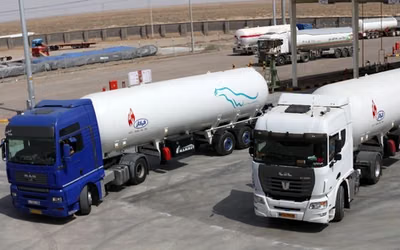
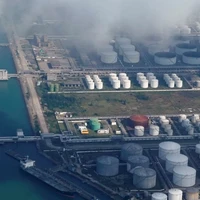
Iran’s joint military command said the Strait of Hormuz remained closed and warned that regional oil, gas, electricity and economic infrastructure would be targeted if the United States carried out President Donald Trump’s threats against Iranian infrastructure.
“The Strait of Hormuz remains closed, and if any vessel is to pass through it, it must travel only along the designated route and in accordance with the arrangements previously announced,” Iran’s Khatam al-Anbiya Central Headquarters said in a statement.
It added that Iran’s armed forces would not allow “even a single drop of oil” to be exported from the region if the US threats were carried out.
The command said repeated threats by the United States and its military would lead only to an expansion of the war across the region “and even beyond it.”
People talk and work at Nook Cafe in Tehran, Iran in this file photo from September 2024
The latest round of café closures in Tehran is a reminder to ordinary Iranians that wartime or otherwise, those in power still decide how much space they are allowed to occupy.
On Sunday morning, authorities sealed several well-known cafés on Sanaei Street in central Tehran, with reports of similar closures in nearby Iranshahr. Among them were Dobar, 1401, Sam Café, Jo Café and Café Man.
The website Emtedad reported that each café was given a different explanation. Some were told it was because of hijab. Others because they served sandwiches. Others because they had chairs on the pavement.
The variety of reasons almost felt more revealing than any single one.
Hamed, who manages one of the affected cafés, says staff had already been warned that officials would come to seal the premises before inspectors even arrived.
"They told us they were coming," he says. "Now I'm trying to work out how we're supposed to pay wages, rent and everything else. First there was the war. Now this. Every few weeks there's another blow for small businesses and ordinary people."
The official explanations seemed almost secondary. The decision, many felt, had already been made.
Sanaei has become a familiar place in these dispatches because it represents something increasingly scarce in Tehran: a refuge. Its cafés are not cheap, often more expensive than many young people can comfortably afford. Yet they remain full. Students spend hours over a single coffee. Couples linger. Friends argue about politics, music and migration.
After weeks of war, blackouts and an internet that barely functioned, the street had slowly begun to feel alive again. For a few weeks, Sanaei almost felt like itself again. That, many people now believe, was precisely the problem.
Shiva, 33, who regularly meets friends there, says cafés are more than businesses. They are among the last places where the city still feels like a city.
"The war could have brought people together," she says. "Instead, it feels as though they're using its aftermath to settle scores with people they don't see as loyal."
Whether that is the authorities' intention is impossible to know. What is striking is how many people independently reached almost the same conclusion.
Many believe the authorities fear respite almost as much as dissent. When a city begins to relax, people gather, talk, laugh and slowly reclaim public life. Moments like Sunday's, they believe, are periodic reminders that no part of that life exists beyond the state's reach.
Ladan, a 28-year-old nurse who rarely visits Sanaei anymore because cafés have become too expensive, nevertheless took the closures personally.
"It almost feels as though someone decided the war hadn't put enough pressure on people," she says. "So they went after the places where people still gathered. It's difficult not to feel that ordinary life itself has become the target."
That helps explain why the closures provoked such bitterness. It was not the inconvenience, but the contempt. Many people felt that after months of war, inflation, blackouts and uncertainty, the authorities' instinct was still not to ask what society needed, but to remind society who remained in charge.
The Islamic Republic has already lost many of the social battles it once fought so fiercely, at least in Tehran. Compulsory hijab is openly challenged. Young men and women mix freely. Cafés remain among the few places where a generation battered by protests, repression and war can still carve out something resembling an ordinary life.
But losing the social argument is not the same as losing the power to enforce it. That may be the real message behind Sunday's closures: not that chairs on the pavement or sandwiches suddenly became intolerable, but that almost any pretext can be enough to take away a business, a meeting place or simply somewhere people had begun to feel at ease.
Hamed shrugs when asked whether the cafés will eventually reopen.
"They probably will," he says. "But that's not really the point anymore."
Perhaps he is right. After everything people have lived through, the instinct of those in power still seems to be not to give society a little more room to breathe, but to remind it that even breathing remains a privilege, not a right.
A view the panel at Iran International town hall in Washington, DC (July 2026)
The US may be peeling away layers of Iran's leadership, but without a plan for what comes next, bombing the coast and seizing islands cannot reach the problem in Tehran, and risk delivering an IRGC takeover rather than real change, experts said at an Iran International town hall.
The panel, held at Iran International's Washington headquarters and moderated by Fardad Farahzad, brought together Michael Rubin of the American Enterprise Institute, Ilan Berman of the American Foreign Policy Council, and Iranian-American analyst Fereshteh Pezeshk.
The discussion came amid renewed US strikes, with attacks tearing through bridges and infrastructure across Iran's south.
Is Washington heading for a ground operation?
The question hanging over the room was whether the air campaign is a prelude to something larger. Rubin framed the choice in stark terms.
"When you have a hornet's nest, you have two good options. One is to leave it alone. The other one is to get rid of it," he said. "The last thing you want to do is sit underneath it lightly tapping it with a stick, and we're getting to the point where that stick tapping is over."
The open question, he added, is "are we heading to boots on the ground? And if we're heading to boots on the ground, are we simply talking about the islands in the Persian Gulf, or are we talking about some of the ports?"
Pezeshk talked about the risks. A move onto Iranian soil, she argued, would be "disastrous," and not only in military terms. "A very good population of Iranians, unlike the rest of the Middle East, are pro-American," she said, describing "a chasm between the people and the Islamic Republic" after the killing on Iran's streets.
Michael Rubin of the American Enterprise Institute at Iran International town hall in Washington
An occupation, she warned, could close that chasm rather than widen it. "The solution is in Tehran, not on the coasts. You've got to resolve that problem."
Berman placed the same question inside American politics, noting that gasoline prices and looming midterm elections are shaping every decision the administration makes.
The task now, he said, is to establish what military planners call escalation dominance, "to show the Iranian regime that they have more firepower and they have politically more will to stay and to fight."
Regime change or transformation?
The most contested idea of the evening came from Berman, who argued that a quieter transformation has already taken place inside the Islamic Republic.
The current rulers, he said, "have a different DNA. They behave differently, they negotiate differently," a shift he traced in part to a war that opened at the very top of the escalation ladder with the killing of the supreme leader.
However, he pointed out that the change has not produced true regime change. “The Trump administration hasn’t dug deep enough... “You haven’t had regime change as most of us have historically thought about it – a transition from the Islamic Republic to a fundamentally different governing system.”
Rubin pushed the logic toward the machinery of power, describing an effort to peel away the leadership layer by layer. With the Revolutionary Guards numbering well over 100,000, he argued, "somewhere along those ranks there is someone who wants to enrich himself" and would deal with Washington.
But he cautioned that the administration may not know who actually runs the country, comparing its approach to "negotiating with the doorman in a skyscraper rather than negotiating with the owner."
Both men returned to a warning that any transition badly managed could produce something worse.
Iranian-American analyst Fereshteh Pezeshk at Iran International town hall
Pezeshk offered the strongest caution against treating decapitation strikes as a complete regime-change strategy. “You have to resolve the political issue in Tehran, not the manifestation.”
She pressed the point harder: removing the leadership without a plan for the day after risks chaos. "How do you ensure it's not going to be a Taliban-like power that comes in? Are you working with the opposition? Are you inclusive enough?" She saw little sign of that groundwork.
"The guy sitting in Tehran is going to be there forever until they die. The US president, two and a half years from now, is gone."
The next uprising, and a fumbled chance
If there was a shared conviction, it was that Iran's streets, not its negotiators, will decide the outcome, and that Washington keeps missing its moments there.
Berman described unrest in Iran as a cyclical force, erupting roughly every two and a half years and accelerating. The lesson of the past six months, he said, is that the US was caught flat-footed when it mattered.
When the internet went dark in January, he recounted, the administration assumed it could "just pierce that veil" with Starlink units and VPNs. Instead it found the jamming, aided by Russia and China, far more robust than expected, and its own tools not prepositioned.
"One of the most important lessons that this last half year has brought is we should be thinking now about the next round of protests, because the next protest is going to start."
Pezeshk argued it already had. She credited the January protests, set off in part by an opposition call to the streets, as "one of the biggest protests ever in Iranian history," met with a killing she put at around 40,000. Her frustration was that such a force draws so little attention in Washington.
The Kurds, the islands, and a mafia state
Asked whether the US might arm Kurdish or other groups to open a ground front, the panel was wary. Rubin noted Washington's long reluctance to back separatist movements in the region, and Pezeshk attributed the on-again, off-again talk to "the chaos of the Trump administration."
Berman said officials he had spoken to were "very nervous about the steadfastness and the resolve of these elements."
Ilan Berman of the American Foreign Policy Council
Rubin, speaking "as an analyst rather than advocate," sketched where a limited campaign might fall: not the ports, but strategic islands, from Abu Musa and the Tunbs to Kish and Qeshm, "the gateway to Bandar Abbas."
He warned that seizing Iranian territory could backfire by rallying a fiercely nationalist public. The Islamic Republic, he argued, would not be moved by the loss of land the way a normal state would.
"They act like a mafia. They don't care if part of the country is gone as long as they're still in power."
Pezeshk’s argument was that territorial occupation – whether by US forces, Kurdish groups or another regional actor – could unite Iranians around national sovereignty.
Can an ideological system make a lasting deal?
Rubin argued that the Islamic Republic’s political identity limits its ability to reach the kind of pragmatic agreement sought by the Trump administration. Rubin argued that the Islamic Republic’s political identity limits its ability to reach the kind of pragmatic agreement sought by the Trump administration.
Pezeshk was skeptical any lasting deal is possible with a system she sees as ideological to its core.
Persian Gulf states, she said, want development, not confrontation, "they do not want to go back to the 18th century," while the Islamic Republic "has a tolerance for absorbing a lot of pain just because they don't care about their people."
Whether the war ends at the table or on the coast, the panel's consensus held that its true resolution lies elsewhere.
As Rubin put it, the nuclear file, the missiles and the proxies are all "the manifestation of the root cause, which is the Islamic Republic."
US Secretary of State Marco Rubio speaks during a press conference on the sidelines of the Association of Southeast Asian Nations (ASEAN) Foreign Ministers' Meeting in Pasay, Philippines on July 22, 2026.
US Secretary of State Marco Rubio said on Wednesday that Iran was under severe economic and military pressure but the United States would continue targeting its ability to attack commercial shipping while remaining open to a negotiated solution.
"Iran's in a lot of trouble," Rubio told reporters on the sidelines of the ASEAN summit.
He said Iran was facing "hyperinflation, runaway inflation, high food costs," adding that the country's military infrastructure had suffered "a tremendous amount of damage."
Rubio accused Tehran of spending "every penny they have" over the past two decades "not spending it on their country," but instead "sponsoring terrorist groups and building up their missiles and their drone systems."
He said those missile and drone capabilities had been intended to shield Iran's nuclear ambitions.
"A year from now, Iran would have had so many missiles and drones that they would have been behind a conventional shield that would have given them immunity to do whatever they wanted."
Shipping campaign
Rubio said the United States was focused on protecting commercial shipping and reducing Iran's ability to threaten maritime traffic.
"Ships are trying to go through the Straits and they're getting blown up. Commercial ships are going through the Straits and they're being blown up," he said.
"The United States is defending that shipping and, in addition, is targeting the places that are launching against those ships that continue to degrade Iran's ability to target and harm global shipping."
"So that's what's happening there, and that's what we're focused on."
Memorandum of understanding
Asked about Iran's announcement that it had suspended its commitments under the Islamabad memorandum of understanding with the United States, Rubio said agreements depended on compliance.
"If you make a deal, if you sign on to an agreement, and then you violate the agreement, the agreement's no longer valid," he said.
"That doesn't mean you can't have a future agreement, but ultimately, that future agreement will have to be judged on whether or not you're complying with the conditions."
Rubio said the memorandum "called for the opening of the Straits, free and fair navigation."
"In fact, they were supposed to put out a statement to that regard a week and a half ago, and instead, on the day they were supposed to put out that statement, instead of doing that, they targeted and hit a ship."
Diplomacy remains possible
Rubio said Washington had not abandoned diplomacy despite the military campaign.
"We remain open to diplomacy. We remain open to working it out in a negotiated way."
"But right now, they don't seem to be serious about that, and so we're going to continue to protect shipping."
He added that other countries should join the effort.
"We think other countries should join us in that endeavor. We don't need them to, but they should because they're more impacted by it than we are."
"And at the same time, we are going to, when the opportunity presents itself, degrade their ability to target global shipping."
China and the Strait of Hormuz
Rubio said China's actions had not changed the course of the conflict with Iran and suggested Beijing opposed any disruption to navigation through the Strait of Hormuz.
"Nothing that's happened, nothing that China has done, has in any way changed the trajectory of what you're seeing in terms of the conflicts we're having with Iran," he said.
"I don't think they're big fans of what Iran is trying to do in the Straits."
"They've said so publicly that they oppose tolling or any sort of restraint on freedom of navigation in the Straits, and we hope they'll continue to say that. It's important that other countries say that as well."
A satellite view shows an overview of the Natanz nuclear facility and Pickaxe Mountain, near Natanz, Iran, June 30, 2026. Vantor/Handout via REUTERS
President Donald Trump vowed Tuesday to strike Iran’s Pickaxe Mountain, but experts say the deeply buried nuclear facility, potentially central to Tehran’s efforts to restore enrichment, may be far harder to disable than his warning suggests.
“The new site that they’re talking about, they’re trying to possibly reconstitute a site, we’ll hit that site,” Trump told reporters Tuesday during an Oval Office meeting with Lebanese President Joseph Aoun.
“Any site where they’re even thinking about nuclear, we’ll be hitting it very, very powerfully.”
Hours after the US president’s warning, Iran’s joint military command warned that any US attack on Iran’s nuclear or other sensitive sites would widen the regional war, according to state media.
US interests and those of countries supporting Washington would face a “powerful assault” by Iran’s armed forces, Khatam al-Anbiya Central Headquarters said.
Raja News, a hardline Tehran outlet, went further, calling for Iran to publish a list of vital infrastructure across the region, particularly in the United Arab Emirates, and strike the targets if the United States attacks Pickaxe Mountain.
The outlet said Iran should not wait for an attack before responding and urged officials to present a practical plan for withdrawing from the Nuclear Non-Proliferation Treaty.
Trump’s warning followed an Israeli intelligence assessment, first reported by The Wall Street Journal, that Iran moved thousands of uranium-enrichment centrifuges into Pickaxe Mountain last fall.
Israel shared the assessment with Washington, but the allegation has not been independently verified, and neither country has publicly disclosed the evidence supporting it.
If accurate, the reported transfer would make Pickaxe one of the most strategically important surviving sites in Iran’s nuclear program.
Centrifuges enrich uranium by spinning uranium hexafluoride gas at extremely high speeds and are essential for producing nuclear fuel or weapons-grade material.
“When you assemble centrifuges like that, the next step is to put them in an enrichment plant,” David Albright, president of the Institute for Science and International Security, told Iran International.
Iran began building Pickaxe Mountain after an explosion in 2020 damaged an above-ground advanced centrifuge assembly facility at Natanz in an attack widely attributed to Israel. Tehran said the underground complex would replace the damaged assembly plant.
Satellite imagery has shown years of continued construction. Albright said the underground complex appears significantly larger than would be required for centrifuge assembly alone, leading his institute to assess that it could eventually also house a uranium-enrichment plant.
If centrifuges are being stored there, experts say the facility could provide Tehran with a pathway to restore uranium enrichment despite months of US and Israeli military strikes.
A difficult target
Its depth also makes Pickaxe one of Iran’s most difficult nuclear facilities to attack.
Andrea Stricker, deputy director of the Foundation for Defense of Democracies’ Nonproliferation Program, said the facility is estimated to sit roughly 300 to 450 feet beneath a granite mountain, potentially placing it beyond the reach of conventional US bunker-buster bombs.
“Essentially, Pickaxe is where Iran could reconstitute a nuclear weapons pathway,” Stricker told Iran International.
Rather than attempting to penetrate the mountain itself, experts say military planners could seek to disable the facility by targeting its tunnel entrances, ventilation systems and electrical infrastructure.
“You don’t look to get a bunker buster to pass through the mountain. I mean, that’s just not possible,” Albright said.
But he added that the complex was “not immune from destruction or shutting it down.”
“If they have centrifuges in there and they can’t use them, then that is a step forward to try to keep Iran from building nuclear weapons,” he said.
Stricker said another option would be to destroy access through the eastern and western tunnel entrances, preventing Iran from re-entering the complex while allowing the site to be monitored for renewed activity.
Preventing reconstitution
For Rebeccah Heinrichs, a senior fellow at the Hudson Institute, Pickaxe represents a different phase of the military campaign.
While Washington still has conventional military targets it can strike from the air, Heinrichs said Pickaxe presents a more complex challenge because of its depth and its potential role in rebuilding Iran’s nuclear program.
If Trump concludes that airpower alone cannot prevent Iran from restoring its nuclear capabilities, Heinrichs said any use of US forces on the ground would more likely involve a limited special-operations mission than a conventional invasion.
"This would be a special operations mission on the ground," she toldEye for Iran, suggesting any such operation would likely be conducted alongside Israel to secure or remove sensitive nuclear material.
There is no public evidence that Washington is planning such an operation.
Heinrichs also suggested that the United States may have deliberately avoided striking Pickaxe so far to preserve the possibility of entering or securing the complex, although Washington has not publicly indicated that this was its reasoning.
Whether Trump ultimately orders an attack remains uncertain, and his warning may be intended partly to deter Iran from activating the facility.
But the president’s remarks, the Israeli intelligence assessment and mounting concern among nuclear experts have placed Pickaxe Mountain at the center of a broader strategic question: how to prevent Iran from rebuilding its nuclear program after months of military strikes.
A US Air Force pilot conducts pre-flight checks on an F-16 fighter jet in an image published by US Central Command on X.
Bulgaria moved Tuesday toward allowing US aerial refueling aircraft to support Middle East operations, drawing a warning from Tehran and raising the risk of the NATO member being pulled into the Iran-US conflict.
The parliamentary Defense Committee approved a government proposal permitting up to eight US tanker aircraft and 250 American military personnel to be stationed at Bezmer Air Base in southeastern Bulgaria, CNN reported.
Bulgarian President Iliana Iotova said on Tuesday hosting up to eight US KC-135 refueling aircraft and 250 military personnel at Bezmer Air Base would not make Bulgaria a party to the war in Iran.
She added that parliamentary approval was required by law and that the government was following the proper procedure.
The United States requested that the deployment run from July 24 to October 1 in support of operations in the Middle East, according to CNN. Aerial refueling tankers allow other military aircraft to remain airborne longer and operate at greater distances.
The report said that US Central Command declined to discuss the proposed deployment, adding, “For operational security reasons, we do not discuss troop movements or speculate on future force posture.”
The move builds on an established military relationship between Sofia and Washington. Under a bilateral Defense Cooperation Agreement signed in 2006, Bulgaria designated Bezmer as a facility for joint use by Bulgarian and US forces.
The agreement provides a framework for an American military presence at the base, but the scale and stated purpose of the latest deployment have brought Bulgaria closer to the confrontation between Washington and Tehran.
Iran warns Sofia against involvement
Iranian Foreign Ministry spokesperson Esmaeil Baghaei warned Bulgaria not to allow its territory or military facilities to be used in support of US operations targeting Iran.
Baghaei said any participation in planning or carrying out such operations would amount to complicity in what he called “the crime of aggression and war crimes.” He urged Bulgaria’s full parliament to reject the proposal.
Bulgaria’s NATO membership adds a wider security dimension. Article 5 of the North Atlantic Treaty states that an armed attack on one member is considered an attack on all.
If Bulgaria were attacked, each NATO ally would be required to assist by taking, individually and with the other members, the action it deemed necessary. That response could include the use of armed force, but would not automatically require every ally to enter the conflict in the same way.
In the 11 days since the Islamabad memorandum of understanding expired, Iran has repeatedly attacked Persian Gulf states and other countries in the region, saying it was targeting US military bases used in operations against it.
That record, combined with the emerging diplomatic confrontation between Tehran and Sofia, raises the possibility that Bulgaria could be drawn more directly into the conflict if its territory is used to support US military operations against Iran.