The renewed offensive, which entered its ninth consecutive night, came as Iranian media reported explosions across the country's southern coastline and, for the first time in the latest campaign, in the northwestern city of Tabriz, suggesting the geographic scope of the strikes may be expanding.
US president Donald Trump said the latest attacks honoured "probably three great patriots" killed in the conflict, describing them as soldiers who had fought to ensure "Iran cannot have a nuclear weapon."
"We hit them very hard again tonight," he told reporters after returning to Washington following the World Cup final.
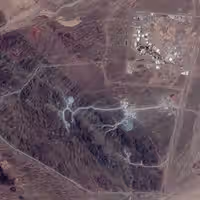
US Central Command later said it had completed its ninth consecutive night of strikes, targeting Iranian military command centres, air defence and coastal surveillance sites, maritime capabilities, missile and drone launch sites, and communications networks to further degrade Tehran's ability to threaten shipping through the Strait of Hormuz.
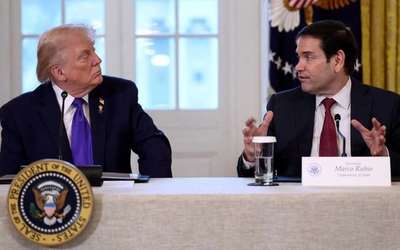
Despite the escalation, Rubio reiterated that the United States remained open to a diplomatic solution, maintaining the administration's position that military pressure and negotiations can proceed in parallel.
The widening conflict also rippled through global energy markets. Brent crude rose more than 3% on Monday, climbing above $90 a barrel for the first time since June 11 as attacks on shipping and uncertainty over the Strait of Hormuz intensified.
Iran broadens its threats
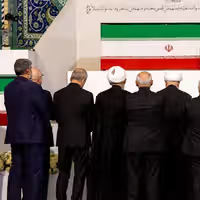
Iran, meanwhile, adopted an increasingly confrontational tone in a series of statements issued by the Islamic Revolutionary Guard Corps.
State media reported fresh missile launches from Lorestan province toward what were described as "enemy targets", while the IRGC claimed it had carried out a surprise strike on the US base at al-Tanf in Syria in retaliation for American attacks that killed Iranian conscript soldiers near Iranshahr.
US Central Command previously denied an earlier Iranian claim that the base had been attacked.
In another statement, the IRGC claimed two oil tankers attempting to transit the Strait of Hormuz had exploded after trying to use what it described as an unsafe route under US pressure.
It warned that the waterway would remain unsafe "for even a single drop of oil and gas" as long as US military operations continued and threatened further "punitive" action against American forces.
The force also claimed Jordanians had provided intelligence that enabled attacks on US military facilities at al-Azraq and Aqaba. Those claims could not be independently verified.
Escalationm vs diplomacy
The widening military campaign has fuelled speculation in Washington that the strikes are intended to pave the way for a broader phase of the conflict if diplomacy ultimately fails.
Yet the political messaging from both capitals points to a more complicated picture.
Rubio's remarks echoed comments earlier this week by Vice President JD Vance, who argued that military pressure and diplomacy should proceed together. Iran's chief negotiator and parliament speaker, Mohammad-Bagher Ghalibaf, similarly described war and negotiations as complementary tools for defending national interests.
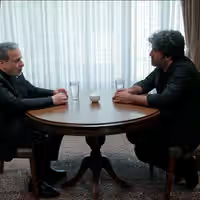
The parallel rhetoric suggests both governments may be seeking to strengthen their bargaining positions ahead of another round of talks rather than abandoning diplomacy altogether—even as the battlefield widens.
Whether that strategy succeeds may depend not only on developments on the ground but also on mounting economic pressure.