Israel monitoring Iran developments, ready to resume fighting, military chief says


Israel’s military is closely monitoring developments in Iran and maintaining a high level of readiness, Chief of Staff Lt. Gen. Eyal Zamir said on Sunday.
Zamir said the military had monitored a launch toward Aqaba, a Jordanian port city on the Red Sea, earlier in the day and that Israel’s air defense array was on alert to protect the country’s citizens.
“We are prepared to immediately resume fighting and will act with great force against anyone who harms us,” he said during a visit to the West Bank, according to remarks released by the military.
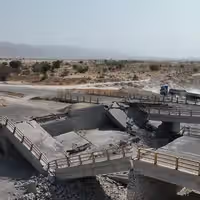



The Atomic Energy Organization of Iran said the United States struck the construction site of the Darkhovin nuclear power plant early on Sunday.
The organization said the US military targeted the site with "a number of projectiles" in an attack carried out early on Sunday.
The Darkhovin nuclear power plant site is under construction in Iran's southwestern Khuzestan province.
The US embassy in Jordan said on Sunday that Aqaba's international airport and seaport had been evacuated because of a "specific and credible threat."
"We strongly advise all Americans to refrain from travelling to either the airport or seaport. Continue to follow all Jordanian authorities' security directives," the embassy said in a post on X.
Aqaba lies next to the Israeli port city of Eilat. Air raid sirens sounded across Jordan hours earlier following Iranian attacks.
Iranian Foreign Minister Abbas Araghchi said the Supreme Leader has the final authority to decide whether Iran goes to war or agrees to a ceasefire.
"The Supreme National Security Council is responsible for assessing the situation regarding war or a ceasefire, but the final decision rests with the Supreme Leader," Araghchi said.
Araghchi, who has faced criticism from rival political factions following the temporary understanding with the United States, said Iran agreed to resume negotiations after Washington again demanded zero uranium enrichment and threatened military action.
"The decision was made to restart negotiations to make clear that Iran had exhausted diplomatic options," Araghchi said.
In the same interview with a YouTube channel, Araghchi said he had never met Sureme Leader Mojtaba Khamenei in person.
"Only a handful of people have met him," Araghchi said.
Iranian Parliament Speaker Mohammad Bagher Ghalibaf called for national unity on Sunday, saying it was essential for confronting the country's enemies, after messages attributed to Sureme Leader Mojtaba Khamenei prompted criticism from hardline supporters of the Islamic Republic.
In a post on X, Ghalibaf urged Iranians to regard "obedience to the Supreme Leader's orders" as part of their historic role in national resistance and governing the country.
The comments followed a temporary understanding between Iran and the United States and the publication of a message attributed to Mojtaba Khamenei, the son of slain Supreme Leader Ali Khamenei, who has rarely appeared in public. The message said he had "in principle" held a different view but accepted the understanding, prompting criticism from some supporters of the Islamic Republic.
Another message attributed to Mojtaba Khamenei has recently circulated, stressing the need to preserve unity.
Iran’s Revolutionary Guards said two vessels were disabled and two others abandoned an attempted passage through what it described as an unsafe route in the Strait of Hormuz.
“Several hours ago, four violating vessels, with the support of American forces, switched off their navigation systems and ignored warnings from the Revolutionary Guards’ Strait of Hormuz control base,” the Guards’ navy said.
Two of the vessels were involved in accidents and remained stationary, while the other two turned back, the navy said.
The Revolutionary Guards added that it retained full control of the strait and that vessels could safely transit only through a route designated by Iranian forces.
“Not a single drop of oil, gas or chemical fertiliser will pass through the Strait of Hormuz without coordination and permission,” the navy said.
The statement warned that vessels entering routes Iran considers unsafe would face accidents.


