• العربية
  • فارسی
Brand
  • Iran Insight
  • Politics
  • Economy
  • Analysis
  • Special Report
  • Opinion
  • Podcast
  • Iran Insight
  • Politics
  • Economy
  • Analysis
  • Special Report
  • Opinion
  • Podcast
  • Theme
  • Language
    • العربية
    • فارسی
  • Iran Insight
  • Politics
  • Economy
  • Analysis
  • Special Report
  • Opinion
  • Podcast
All rights reserved for Volant Media UK Limited
volant media logo

Ahmadinejad attended Iran Expediency Council meeting, says outlet close to him

Jul 14, 2026, 08:28 GMT+1

Former Iranian President Mahmoud Ahmadinejad attended an Expediency Council economic commission meeting on Saturday, Dolat-e Bahar, a website closely associated with the former president, reported on Tuesday.

The outlet said Ahmadinejad shared his experience and views with commission members during the July 11 meeting.

The announcement followed a Monday report by Haaretz, saying Israel’s Mossad had recruited Ahmadinejad and chosen him to lead Iran after a planned operation to overthrow the Islamic Republic.

Most Viewed

Trump reinstates Iran naval blockade, notifies Congress of renewed fighting
1

Trump reinstates Iran naval blockade, notifies Congress of renewed fighting

2

Mossad recruited Ahmadinejad for Iran regime-change plot - report

3
ANALYSIS

Why so few Iranians have jobs despite low unemployment

4

UK says support for Iran's IRGC outlawed under new state threats law

5
INSIGHT

Iran risks its most valuable Arab partner over Hormuz

Banner
Banner
Banner

Spotlight

  • One flight, two chokepoints: why Iran wants an air bridge to Yemen
    ANALYSIS

    One flight, two chokepoints: why Iran wants an air bridge to Yemen

  • Iran parliament drops two hardline critics of US talks from security panel posts

    Iran parliament drops two hardline critics of US talks from security panel posts

  • Iran risks its most valuable Arab partner over Hormuz
    INSIGHT

    Iran risks its most valuable Arab partner over Hormuz

  • Why so few Iranians have jobs despite low unemployment
    ANALYSIS

    Why so few Iranians have jobs despite low unemployment

  • January protesters trapped in 'hell' of Greater Tehran prison, inmates say
    EXCLUSIVE

    January protesters trapped in 'hell' of Greater Tehran prison, inmates say

•
•
•

More Stories

China urges de-escalation after US blockade on Iran

Jul 14, 2026, 08:22 GMT+1

China is highly concerned about the resumption of military conflict following the US blockade on Iran and will continue to work to help ease tensions, the Chinese foreign ministry said on Tuesday.

"We are highly concerned about the resumption of military conflict," a foreign ministry spokesperson said when asked about the US blockade on Iran.

The spokesperson said China would continue to make efforts to help cool the situation.

Bahrain says it intercepts Iranian aerial attacks targeting civilians

Jul 14, 2026, 08:13 GMT+1

Bahrain's Defense Force said on Tuesday its air defense systems intercepted and destroyed several Iranian aerial attacks targeting civilians in the kingdom earlier in the day.

In a statement, the military accused Iran of continuing "its systematic hostile approach" through attacks targeting civilians in Bahrain.

It said all military branches and units were at the highest level of readiness to defend the kingdom.

The military urged residents to avoid approaching any suspicious objects or debris resulting from what it described as the Iranian attack and to report them immediately. It said Royal Field Engineering personnel were prepared to safely handle any such objects.

The statement said the use of missiles and drones to target civilians and private property was a "flagrant violation" of international humanitarian law.

Against restraint: Iran's hardliners rewrite the rules of confrontation

Jul 14, 2026, 08:11 GMT+1
•
Behrouz Turani
100%
Mourners sit beneath a banner depicting US President Donald Trump, with a bullet aimed at his portrait and the slogan, "We have a blood feud with America," during funeral ceremonies for former Supreme Leader Ali Khamenei in Ahvaz, southern Iran, July 9, 2026

As renewed fighting pushes Iran and the United States away from diplomacy and back toward full-scale confrontation, influential hardline voices in Tehran are openly arguing that political assassination and a more aggressive foreign policy are both justified and necessary.

The revenge-laden rhetoric that dominated the week-long mourning ceremonies for former Supreme Leader Ali Khamenei is rapidly evolving into something broader.

State media have published images depicting not only US officials but also European leaders, including France’s Emmanuel Macron and Italy’s Giorgia Meloni, as targets.

On Monday, July 13, Ali Mahdian, a hardline seminarian and academic associated with the late Ayatollah Mohammad-Taqi Mesbah Yazdi, the ideological father of the ultraconservative Paydari Front, went further still, seeking to provide a religious justification for political assassination.

Writing in the Tehran municipality’s daily Hamshahri, Mahdian presented the killing of Western leaders and those he held responsible for the deaths of senior Iranian figures not as terrorism but as a “divine mission.”

Citing Ayatollah Khomeini’s fatwa against author Salman Rushdie, he rejected the argument that a sovereign state should not engage in targeted killings. Referring to remarks by Quds Force commander Esmail Qaani, Mahdian even suggested that an actor inside the United States might carry out such an attack.

“This is a global wrath… an era in which the head of Satan must be cut off,” he concluded with an apocalyptic call to action. “Everyone must help: scholars, clerics, preachers, speakers, broadcasters, channel writers, officials, Iranians, Iraqis, everyone.”

The significance lies less in the practicality of his appeal than in how openly such arguments are now being advanced in an established state newspaper.

Late last week, US forces resumed strikes on Iranian military infrastructure, while Iran retaliated against American bases across the Persian Gulf. President Donald Trump announced a renewed blockade of Iranian shipping, saying the United States would keep the Strait of Hormuz open.

Tehran, meanwhile, says transit through the strait is no longer possible because of US military action and insists it retains control over the strategic waterway, while threatening further retaliation.

The same day, Kayhan offered a strategic counterpart to Mahdian’s theological argument.

In a commentary by Alireza Mashouri, introduced as a scholar of international relations, the newspaper called for Iran to abandon its longstanding policy of “strategic patience” in favour of what he termed “offensive diplomacy.”

“When a state exercises restraint, enemies do not see it as moral high ground or peace-loving nature; they calculate it as a lack of capability or will to respond,” he wrote.

Mashouri argued that Iran’s year of compliance after the US withdrawal from the 2015 nuclear deal convinced its adversaries that Tehran lacked the will to respond, paving the way for “maximum pressure,” targeted assassinations and progressively bolder military attacks.

“In global politics, there is no such thing as a moral ledger where a state is rewarded later for its past good behavior,” Mashouri wrote. “This does not mean starting a war; it means making the cost of aggression real for the enemy.”

None of this necessarily means that Tehran has adopted political assassination or uncontrolled escalation as formal policy.

Iran has a long history of violence against opposition figures and regional adversaries, but public appeals for the killing of sitting Western leaders represent a notable escalation in the language emerging from influential hardline circles.

More significant than the rhetoric itself may be the erosion of the political and ideological case for restraint. As US and Iranian forces exchange attacks and the dispute over Hormuz becomes another front in the war, hardline voices increasingly portray negotiation not as a means of protecting Iran but as proof of weakness.

What began as funeral rhetoric is becoming something more consequential: an argument that the era of strategic patience is over, and that peace now demands a justification war no longer does.
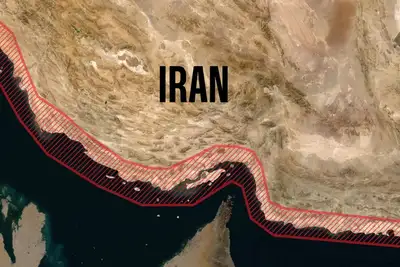

Iran authorities say 23 crew rescued after ship collision near Qeshm island

Jul 14, 2026, 07:24 GMT+1

Twenty-three crew members were rescued after a bulk carrier collided with another vessel north of Iran’s Qeshm island early on Tuesday, the Hormozgan ports authority said.

According to the statement, the collision caused one of the ships to take on water and prompted an emergency evacuation. The crew were transferred safely to Qeshm island.

A pilot boat and a tug were sent to the scene to manage the situation and investigate the accident, read the statement.

IRGC says it strikes US air base in Jordan with ballistic missiles

Jul 14, 2026, 07:20 GMT+1

Iran’s Revolutionary Guards said on Tuesday that they targeted a US air base in Jordan with ballistic missiles, claiming the facility had been used in attacks against Iran.

In a statement addressed to the Jordanian public, the Guards said Iran had no hostility toward Jordan and urged people there to demand the removal of US military bases.

The IRGC also accused the United States of using bases in Jordan during earlier attacks on Iran.