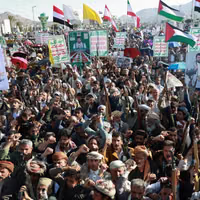
IRGC says it strikes US air base in Jordan with ballistic missiles
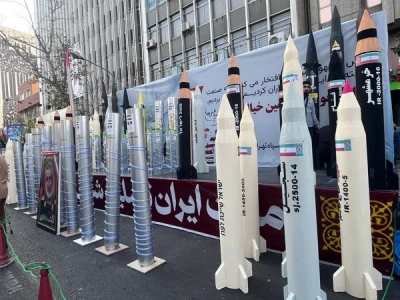
Iran’s Revolutionary Guards said on Tuesday that they targeted a US air base in Jordan with ballistic missiles, claiming the facility had been used in attacks against Iran.
In a statement addressed to the Jordanian public, the Guards said Iran had no hostility toward Jordan and urged people there to demand the removal of US military bases.
The IRGC also accused the United States of using bases in Jordan during earlier attacks on Iran.
Mahmoud Ahmadinejad, seen here in 2024, is said to have learned English and tried to improve his image after falling out with the Iranian regime. Photograph: Majid Asgaripour/Reuters
The alleged recruitment of Mahmoud Ahmadinejad by Mossad reads like a spy thriller and has been denied by his office. But it has renewed interest in Iran's most controversial president—and the ruthless infighting that turned a Leader’s darling into a political outcast.
On Monday, The New York Times and Haaretz alleged that Mossad cultivated Ahmadinejad as an intelligence asset and even considered him for a role leading Iran if the Islamic Republic collapsed.
The office of the former president swiftly dismissed the reports as Hollywood material that was hardly worth denying.
For those who followed Ahmadinejad's trajectory after leaving office, however, the allegation itself is less surprising than the path that may have led to it.
"He certainly was very ambitious and wanted power. And it was clear that there was no way he could get to power so long as Khamenei and the regime were in charge," historian and author Arash Azizi, who remained in contact with Ahmadinejad for years after he left office, told Iran International.
Whether Ahmadinejad was ever a credible candidate to lead Iran is a separate question. So, too, is why an alleged intelligence relationship of such sensitivity is now being described publicly in remarkable detail.
"If Ahmadinejad was their person indeed... you burn this stuff 20 years later. What's the insistence on doing it right now?" Azizi said.
From president to political outsider
Ahmadinejad served as Iran's president from 2005 to 2013, rising to power with the backing of Ali Khamenei and becoming one of the Islamic Republic's most recognizable figures. His presidency was marked by Holocaust denial, calls for Israel's destruction and the violent crackdown that followed the disputed 2009 presidential election.
But his relationship with the political establishment that brought him to power steadily deteriorated.
Meir Javedanfar, an Iran lecturer at Reichman University who co-authored a biography of Ahmadinejad, said Ahmadinejad increasingly believed he deserved more authority than Iran's political system allowed him.
"He believed that he had the intellectual capability and charisma and public support to have much more authority and much more power than the regime was giving him," Javedanfar told Iran International.
That frustration became visible in 2011, when Ahmadinejad boycotted official duties for 11 days after Khamenei overruled his attempt to dismiss intelligence minister Heydar Moslehi — one of the most public challenges to the supreme leader by a sitting president.
The rupture accelerated after he left office. Close allies, including Esfandiar Rahim Mashaei, were arrested, while Ahmadinejad himself was repeatedly barred from returning to the presidential race.
"After he left office, this frustration was supplemented by anger towards the regime," Javedanfar said.
"And this is why I think he would have been open to recruitment by foreign intelligence agencies... because of the tremendous anger he had towards the regime."
The New York Times reported a similar trajectory. According to the report, Ahmadinejad eventually concluded he could not return to power while the existing political system remained in place.
An associate told the newspaper Ahmadinejad envisioned returning to power with foreign backing and, if successful, would recognize Israel and normalize relations under the Abraham Accords.
Mahmoud Ahmadinejad, seen here in 2005, was frequently condemned by Human Rights Watch for his treatment of Iranian protesters. Photograph: Ho New/Reuters
A transformation seen up close
Azizi began speaking regularly with Ahmadinejad and members of his circle after the former president left office. By then, he said, Ahmadinejad's faction had begun drifting away from the conservative establishment. His circle appeared less Islamist and more nationalist while reaching out to journalists and political figures outside the Islamic Republic's traditional orbit.
"What I saw in Ahmadinejad all these years was someone who was very ambitious, who wanted power, who understood Iranian public sentiments very well, almost masterfully," Azizi said.
He also appeared increasingly aware that his record on Israel would complicate any political comeback. Azizi recalled arranging an interview between Ahmadinejad and an Israeli journalist and said the former president repeatedly expressed an interest in discussing Jewish history and Israel.
"He seemed to be open to normalization with Israel," Azizi said.
Azizi said Ahmadinejad became noticeably more secluded around 2024 — roughly the same period The New York Times reported that his contacts with Israeli intelligence intensified.
The alleged recruitment
It remains unclear exactly when Israeli intelligence first approached Ahmadinejad.
The New York Times reported that Iranian officials traced at least some of Ahmadinejad's contacts with Israeli intelligence to a 2023 trip to Guatemala. The following year, he traveled to Budapest to attend a climate conference at Ludovika University of Public Service.
According to the newspaper, the conference served as cover for meetings with Israeli intelligence operatives. Former US officials cited by the newspaper said then-Mossad director David Barnea personally traveled to Budapest to meet Ahmadinejad and that Mossad later informed the CIA it was in contact with him.
The newspaper also reported that Israel paid for some of Ahmadinejad's travel and accommodation and that operatives met him abroad on several occasions.
Haaretz, meanwhile, reported that Ahmadinejad formed part of a broader Israeli plan to destabilize the Islamic Republic. The plan reportedly combined influence operations inside Iran, support for Kurdish forces in Iraq and efforts to activate pressure on the government from multiple directions.
Ahmadinejad was envisioned as one possible political figure who could emerge if the system collapsed.
But the newspaper said the proposal faced considerable skepticism within Israel's own security establishment. Senior Military Intelligence officials reportedly judged the plan unlikely to succeed, while National Security Adviser Tzachi Hanegbi is said to have dismissed parts of it as resembling "science fiction."
Cabinet ministers also questioned why Israel would seek to replace the Islamic Republic with one of its best-known former hardliners. According to Haaretz, Mossad argued that Ahmadinejad's years of conflict with the leadership had transformed him into an opposition figure.
Recruitable does not mean viable
Jason Brodsky, policy director at United Against Nuclear Iran, said it was plausible that Ahmadinejad attracted the attention of foreign intelligence services after becoming estranged from Iran's leadership.
"Do I think Ahmadinejad was a person of interest to certain foreign intelligence organizations because of his status as someone who has been burned by the Iranian leadership? Yes," Brodsky told Iran International.
"Do I believe that Mossad and other intelligence agencies were interested in talking with him? Yeah, I do."
But Brodsky drew a distinction between cultivating Ahmadinejad as a potential intelligence source and building a broader regime-change strategy around him.
"Does that mean that he was the grand Israeli regime change strategy for the Islamic Republic? Not necessarily," he said.
Brodsky argued that Ahmadinejad lacked one critical ingredient for any successful transition: support inside Iran's security establishment capable of triggering defections.
"Defections would be part of any regime change strategy," he said.
The plan falls apart
According to The New York Times, the operation reached its most dramatic point on Feb. 28, when an Israeli strike hit Ahmadinejad's compound, targeting a building used by his bodyguards and his armored vehicle.
The newspaper reported that a black Peugeot arrived shortly afterwards and that Mossad operatives extracted Ahmadinejad from the scene, transporting him to a safe house inside Iran.
US and Iranian officials cited by the newspaper said Ahmadinejad later became disillusioned with the plan to return him to power and eventually left the safe house under circumstances that remain unclear.
The broader regime-change strategy likewise failed to unfold as envisioned. According to Haaretz, plans to combine internal unrest with armed pressure from outside Iran never materialized.
Ahmadinejad resurfaced last week at Khamenei's funeral after weeks out of public view. The New York Times, citing four senior Iranian officials, reported that he is now under house arrest after Iranian authorities uncovered much of his alleged interaction with Israel. His current status has not been independently confirmed.
Why reveal it now?
The reports raise one final question: why reveal such an alleged intelligence relationship now?
"There's always a motive in this," Azizi said. "Why are they so eager to burn Ahmadinejad?"
Brodsky suggested the answer may lie partly inside Israel, pointing to rivalries between Mossad and Military Intelligence, divisions within Mossad itself and the increasingly charged political atmosphere ahead of October's elections.
Whether the allegations are ultimately borne out or not, Ahmadinejad's political trajectory is no longer in dispute. Over more than a decade he moved from one of the Islamic Republic's most loyal servants to one of its most isolated former presidents.
The question now is whether Israeli intelligence merely sought to exploit that rupture—or whether those behind the reported operation fundamentally overestimated what Ahmadinejad could ultimately deliver.
Iranian Foreign Minister Abbas Araqchi meets Sultan of Oman Haitham bin Tariq Al Said at Al Baraka Palace in Muscat, Oman, April 26, 2026.
Iran's attack on facilities supporting US naval operations in Oman has plunged relations with one of Tehran's closest regional partners into their deepest crisis in decades, turning a dispute over shipping through the Strait of Hormuz into a direct military confrontation.
Relations deteriorated sharply after Iran's Revolutionary Guards (IRGC) said they had launched a "heavy and surprise attack" on logistical support facilities and aircraft carrier refueling infrastructure at the Omani port of Duqm on Sunday.
Oman condemned what it described as "irresponsible acts" and summoned Iran's ambassador in protest, marking a dramatic deterioration in relations between the two countries.
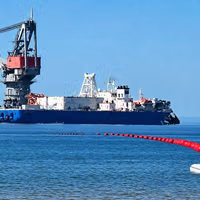
The military escalation appears to have followed the collapse of negotiations over a proposed framework for managing maritime traffic through the Strait of Hormuz.
According to a CNN report, Oman proposed maintaining the existing system for vessels using the southern shipping lane through Omani territorial waters. Ships entering Iranian territorial waters, however, would require Tehran's approval, though they would not pay transit fees.
The proposal appears to have fallen short of Tehran's broader ambition to assert greater authority over traffic through the strategic waterway, including a reported plan to charge ships for "management services."
Iranian officials confirmed that such discussions had taken place.
Foreign Minister Abbas Araghchi said he had discussed “management of the Strait of Hormuz and maritime traffic" with Omani counterpart Badr Albusaidi. Foreign Ministry spokesman Esmail Baghaei later confirmed the talks had failed, blaming US pressure on Oman.
"Our effort was to reach, through consultations with Oman, a mechanism that would ensure the safe passage of ships through the Strait of Hormuz. Unfortunately, because of overt and covert US pressure on Oman, this was not achieved," he said.
Tehran hardens its position
The collapse of negotiations was followed by increasingly confrontational rhetoric from Iranian military officials and hardline politicians.
On Tuesday, the spokesman for Iran's Khatam al-Anbiya Central Headquarters warned that Iran's armed forces would respond forcefully to "any disruption or insecurity affecting commercial vessels and oil tankers by the US military outside the routes designated by Iran and without authorization from the armed forces."
He also warned regional states that "any cooperation with the United States and logistical support for its military will be regarded as a war against Iran's sovereignty and national security," adding that any wider conflict would engulf the region.
Ali Khezriyan, a member of parliament's National Security Committee, declared that Iran would pursue control of the Strait of Hormuz "with or without Oman." He warned that if Muscat failed to cooperate or secretly assisted Iran's adversaries, "its territory will not be safe from Iranian missiles."
Other lawmakers echoed the message. Ebrahim Rezaei said Oman should recognize Iran as the region's dominant power, while Mahmoud Nabavian argued that the IRGC should impose "exclusive management" of the strait, rejecting any arrangement requiring Iran to share authority with Oman.
Beyond Hormuz
Analysts suggested the confrontation extends well beyond the immediate military exchange.
Middle East analyst Ahmad Taqaddosi noted that Duqm sits on the Arabian Sea, outside the Strait of Hormuz, allowing US naval vessels to dock, refuel and undergo maintenance without entering the Gulf. Under a 2019 agreement, the United States has access to both Duqm and Salalah.
"From this perspective, Iran's claimed attack targeted not merely a port but part of the US Navy's operational rear base in the northern Indian Ocean," he wrote.
Energy analyst Abdollah Babakhani argued that the dispute ultimately reflects Tehran's fear of losing strategic leverage.
"Any mechanism that creates a permanent and independent route through Omani waters for the bulk of global energy trade could, over the long term, reduce Iran's geopolitical weight in Hormuz," he wrote, arguing that restoring the traditional shared shipping corridor would better preserve Iran's strategic position.
Debate inside Iran
Hardliners argued that allowing unrestricted passage through Omani waters while requiring authorization only for ships entering Iranian waters would surrender Tehran's leverage, insisting that management of the Strait of Hormuz must remain exclusively in Iranian hands.
Critics countered that Oman has long served as one of Tehran's most important diplomatic intermediaries.
One moderate commentator wrote: "The Strait of Hormuz is not our exclusive property. Oman's territorial waters are part of it, and Oman's wishes must also be respected. Claiming absolute control is adventurism and folly."
Others warned that another regional war could leave Tehran simultaneously alienating its own population, undermining relations with mediators such as Oman and Pakistan, and weakening its strategic position in the strait.
The confrontation leaves Tehran facing a strategic paradox. Its effort to convert military leverage in Hormuz into political control over regional shipping has pushed it into conflict with one of its closest Gulf partners while encouraging alternatives to the very influence it is trying to preserve.
People walk in a crowded street in central Tehran in this undated file photo
Barely 37 percent of working-age Iranians have a job. Yet the government's official unemployment rate is only 7.5 percent. The gap between those two figures reveals less about Iran's labour market than about the way it is measured.
On paper, Iran does not have a jobs problem. A 7.5 percent unemployment rate is the sort of figure many governments would happily defend. But fewer than four in ten working-age Iranians are actually employed.
According to the International Labour Organization, the global employment rate is about 58 percent. Roughly six out of every ten working-age adults worldwide have a job. In Iran, it is fewer than four.
The explanation lies in how unemployment is calculated.
Of Iran's 87 million people, about 66 million are of working age. Around 24 million have jobs and two million are officially unemployed, meaning they are actively looking for work. The remaining 40 million are classified as economically inactive and excluded from the unemployment rate altogether.
That apparent contradiction rests on two statistical rules.
Anyone who worked for just one hour during the survey week counts as employed. A motorbike courier who completed two deliveries is counted alongside a salaried engineer with full benefits.
Only people actively searching for work are considered unemployed. Someone who searched for years before giving up disappears from the calculation entirely.
The more people lose hope, the healthier the official unemployment rate appears.
Not everyone outside the labour force should be counted as unemployed. Many are students, retirees or people who choose not to work.
Iran's own statistics provide some insight, although they have not published a detailed breakdown of the inactive population since 2017.
That census identified roughly 12 million students and 3.7 million retirees or people living on pensions or other non-employment income.
Retirement explains only part of the picture. Iran remains a relatively young country, with an average age of about 32 and only around seven percent of the population over 65.
University enrolment has also fallen sharply—from just under five million students a decade ago to just over three million today—meaning fewer young people are remaining in education while waiting for jobs.
The largest category was around 20 million "homemakers." In Iran, women have outnumbered men at university for years, yet only around 12 percent of working-age women participate in the labour market, compared with roughly 50 percent globally. That reflects not only personal choice but also decades of bureaucratic and social barriers limiting women's employment.
Another 3.7 million people could not be clearly classified at all: they were neither employed, studying, retired nor looking for work.
Even before the latest conflict, Iran's labour market was deteriorating.
In the Persian year ending in March 2025, economic growth of about three percent produced 298,000 net jobs. The following year, the figure collapsed to just 34,000, while around 800,000 people left the labour force altogether.
The official unemployment rate nevertheless fell to 7.5 percent.
The forty-day war with Israel and the United States then dealt another severe blow. Deputy Labour Minister Gholamhossein Mohammadi says more than one million jobs were destroyed and around two million people became unemployed. Labour economist Hamid Haj-Esmaili estimates the true losses could reach between three and four-and-a-half million within months.
The International Monetary Fund expects Iran's economy to contract by 6.1 percent this year. Taken together, those figures raise a broader question: how can unemployment remain at just 7.5 percent?
Start with the government's own baseline: two million unemployed in a labour force of 26 million equals about 7.5 percent.
Now add only what the deputy labour minister himself acknowledges—two million newly unemployed because of the war. The unemployment rate immediately doubles to roughly 15 percent.
Use labour economists' higher estimates of wartime job losses and it rises to around one in four.
The picture darkens further when considering the large number of people who have simply stopped looking for work.
Around 60 percent of Iranian workers are employed informally, without contracts or unemployment insurance. Of the millions believed to have lost their livelihoods during the war, only about 290,000 were eligible to claim unemployment benefits.
Even without counting every economically inactive Iranian as unemployed, it becomes increasingly difficult to reconcile an official jobless rate of 7.5 percent with the broader condition of the labour market.
Independent analysts estimate that, once discouraged workers and wartime job losses are taken into account, effective unemployment may now approach one in three people participating—or seeking to participate—in Iran's labour market.
Whether that estimate proves correct or not, the broader trend is unmistakable.
The government's headline unemployment rate increasingly reflects who is counted rather than who actually has work.
Historically, recessions push unemployment sharply higher. An economy expected to contract by more than six percent would normally produce a noticeable rise in joblessness. Yet many newly unemployed Iranians are likely to follow the same path as the 800,000 who left the labour force last year: stop searching for work and disappear from the statistics.
By March 2027, Tehran may still be reporting single-digit unemployment.
The more revealing figure may remain the one at the beginning of the story: barely 37 percent of working-age Iranians have a job.
President Donald Trump on Monday reinstated a naval blockade against Iran after notifying Congress that US military action against the Islamic Republic had resumed, amid fresh blasts in southern Iran and continued ship attacks near Hormuz.
Trump said Monday that the United States would once again block ships belonging to the Islamic Republic or serving its customers from entering or leaving Iranian ports, while keeping the Strait of Hormuz open to traffic bound for other countries.
US Central Command said the blockade would take effect at 4 p.m. ET on Tuesday and apply to vessels traveling to or from Iranian ports and coastal areas. American forces would continue supporting ships in regional waters that were not violating the restrictions, CENTCOM added.
The US Navy-led Joint Maritime Information Center said the measure would cover Iran’s entire coastline, including ports and oil terminals. Neutral vessels traveling through Hormuz to non-Iranian destinations would be allowed to pass, while humanitarian shipments would be permitted after inspection.
The announcement came days after Trump informed congressional leaders that “military action commenced on July 7 against the government of the Islamic Republic.”
In his July 10 letter which was released on Monday, Trump said US forces launched “defensive strikes” after Iranian forces attacked several neutral-flagged commercial vessels in the Strait of Hormuz. The targets included missile launch sites, air defenses, maritime military assets, military-support infrastructure and command-and-control capabilities.
Trump said no American ground forces were involved and described the attacks as limited and measured. He nevertheless said US forces remained positioned to carry out further action, indicating that the July 7 operation marked the resumption of a military campaign rather than an isolated retaliatory strike.
The notification could further intensify a dispute between the White House and Congress over Trump’s authority to continue the war without legislative approval. Both chambers have voted to direct him to end the fighting or seek congressional authorization, while the administration says the president is acting within his constitutional powers as commander in chief.
US strikes have continued since the renewed campaign began. CENTCOM said American forces used one-way attack surface drones in combat for the first time on Sunday, striking a submarine and ship-maintenance facility at the Bandar Abbas Naval Base.
Three Corsair unmanned vessels hit the facility and degraded the Islamic Republic’s ability to attack commercial shipping, according to the US military.
Explosions in southern Iran
Fresh explosions were reported Monay across southern and southeastern Iran, within a coastal zone highlighted by CENTCOM.
A map released by US Central Command highlights a broad stretch of Iran’s southern coastline along the Persian Gulf and Gulf of Oman, hinting at the general range of ongoing US strikes.
The state-run Islamic Republic News Agency said the sound of four missile impacts was heard near Konarak, with the blasts also audible in Chabahar and Dashtiari.
The IRGC-affiliated Tasnim News Agency reported six loud explosions in Chabahar and Konarak and said areas around Chabahar had been targeted by the US military in recent nights. It also reported explosions and the activation of air defenses in Bandar Abbas.
Iran’s state broadcaster later denied that explosions had occurred in Bandar Abbas, Larak and several other southern locations, contradicting earlier reports by IRNA and Tasnim. No immediate casualty figures were announced.
The confrontation also continued at sea, with Tasnim reporting that several vessels accused of violating Iranian restrictions had been targeted in the Strait of Hormuz.
Iran’s armed forces warned they would respond forcefully to US interference with shipping and said regional governments providing logistical support to Washington could be regarded as participants in the war.
Trump, meanwhile, declared the United States the “Guardian of the Hormuz Strait” and proposed charging the equivalent of 20% of cargo shipped through the waterway, a plan rejected by the UN’s shipping agency as lacking a legal basis.
Trump also said the United States would hit Iran hard on Monday night and Tuesday, in an interview with conservative radio host Hugh Hewitt.
Asked about the memorandum of understanding, Trump said it had been a test for Iran and that Tehran had failed to honor it.
Iran's former supreme leader Ali Khamenei (left) and then-president Mahmoud Ahmadinejad
Israel’s Mossad recruited former Iranian President Mahmoud Ahmadinejad and chose him to lead Iran after a planned operation to overthrow the Islamic Republic, Haaretz reported Monday, citing more than 30 political, defense, diplomatic and foreign sources.
The relationship began taking shape in 2022 after the Mossad gathered intelligence indicating shifts in Ahmadinejad’s views, the report said.
Israel focused on his belief that Iran could not continue under sanctions and that its nuclear program had become a burden rather than an asset.
A team of Mossad agents continued a mission involving Ahmadinejad after landing abroad on October 7, 2023, and learning of the Hamas attack on Israel, according to the report.
Then-Mossad chief David Barnea personally oversaw the operation and at one point skipped a security consultation with Prime Minister Benjamin Netanyahu to focus on developments involving Ahmadinejad, the report said.
By early 2026, Ahmadinejad had become one of Israel’s most significant assets and was chosen to take power after “Operation Puss in Boots,” which was intended to overthrow Iran’s government, end its pursuit of nuclear weapons and install a new leadership.
According to the report, the wider plan included influence operations inside Iran, arming and training Kurdish forces in Iraq, mobilizing minorities, recruiting collaborators and creating a land corridor for militia movements. Israel also sought to draw Azerbaijan into the war.
The plan faced opposition from Military Intelligence chief Shlomi Binder, Research Division head Ofir Mizrahi Rosen and then-national security adviser Tzachi Hanegbi, the report said.
Three days before H-hour, the disagreements reached such a boiling point that IDF Chief of Staff Eyal Zamir ordered everything halted. Nevertheless, Prime Minister Benjamin Netanyahu decided to proceed.
The plan collapsed before Kurdish forces fired a single shot, the report said.
Ahmadinejad, a hardline conservative known for fiercely anti-Israel rhetoric, was Iran’s president from 2005 to 2013. During his two terms, he allegedly denied the Holocaust, advocated Israel’s destruction and suggested Tehran could develop nuclear weapons if it decided to do so.
After leaving office, he was repeatedly barred from standing in presidential elections. Over time, Ahmadinejad distanced himself from the political establishment and criticized the system under Ali Khamenei, accusing senior figures of corruption, mismanagement and failing the public.
He also adopted a softer public image, portraying himself as a defender of ordinary Iranians and their economic and social concerns.
Ahmadinejad’s current status is unclear. Last week, he attended a state-run funeral for slain Supreme Leader Ali Khamenei in Tehran, months after an alleged airstrike on his residence which, reportedly set him free from a house arrest.