• العربية
  • فارسی
Brand
  • Iran Insight
  • Politics
  • Economy
  • Analysis
  • Special Report
  • Opinion
  • Podcast
  • Iran Insight
  • Politics
  • Economy
  • Analysis
  • Special Report
  • Opinion
  • Podcast
  • Theme
  • Language
    • العربية
    • فارسی
  • Iran Insight
  • Politics
  • Economy
  • Analysis
  • Special Report
  • Opinion
  • Podcast
All rights reserved for Volant Media UK Limited
volant media logo

Hardline lawmaker says negotiations have always benefited Iran’s enemies

Jul 11, 2026, 12:25 GMT+1

Mahmoud Nabavian, a member of parliament’s national security and foreign policy committee, said the Islamic Republic’s negotiations had repeatedly ended in deception and gains for its enemies.

“The record of negotiations has always ended with broken promises, deception and benefits for the enemy, leaving only a bitter experience,” Nabavian wrote on X.

Posting an image pairing Parliament Speaker Mohammad Bagher Ghalibaf and Foreign Minister Abbas Araghchi with former president Hassan Rouhani and former foreign minister Mohammad Javad Zarif, he said negotiations were themselves “a form of war.”

Nabavian warned that trust, optimism and poorly drafted agreements could allow an adversary to turn what he described as victory on the battlefield into defeat.

Most Viewed

A remote bridge shows how US-Iran war is expanding
1
ANALYSIS

A remote bridge shows how US-Iran war is expanding

2
INSIGHT

US strikes, Hormuz clashes push Iran deal to brink

3

Ali Khamenei buried in Mashhad after days-long funeral

4
INSIGHT

Tehran torn between war and deal as Khamenei is buried

5

Iran turns Friday prayers into nationwide campaign for revenge

Banner
Banner
Banner

Spotlight

  • Iran faces region’s harshest mix of wartime contraction and inflation

    Iran faces region’s harshest mix of wartime contraction and inflation

  • Is the Iran-US MoU dead – or are we asking the wrong question?
    PODCAST

    Is the Iran-US MoU dead – or are we asking the wrong question?

  • For many Iranians, paychecks now barely cover food
    INSIGHT

    For many Iranians, paychecks now barely cover food

  • Iran’s economic pain deepens as factions trade blame
    INSIGHT

    Iran’s economic pain deepens as factions trade blame

  • A remote bridge shows how US-Iran war is expanding
    ANALYSIS

    A remote bridge shows how US-Iran war is expanding

•
•
•

More Stories

Is the Iran-US MoU dead – or are we asking the wrong question?

Jul 11, 2026, 12:18 GMT+1
•
Negar Mojtahedi
100%
Smoke rises from boats on fire at a fishing pier in Banood, Bushehr Province, Iran, after a U.S. projectile struck the area around Iran's Bushehr nuclear power plant on Thursday, according to the deputy governor of Bushehr Province, in this screengrab from a video obtained from social media and released on July 9, 2026. Social Media via Reuters

Less than three weeks after Washington and Tehran began implementing a 60-day memorandum, the ceasefire is broken, commercial ships have again come under attack in the Strait of Hormuz, and US forces have struck Iran. Yet the two sides are still talking.

President Donald Trump declared the ceasefire over after the Islamic Revolutionary Guard Corps fired on three merchant vessels, but said negotiations would continue because Iran “wants to make a deal so badly.”

The contradiction suggests the memorandum may be doing something narrower than ending the conflict. It has failed to prevent renewed violence, but may still provide a structure through which Washington and Tehran can contain escalation, preserve communication and negotiate between military exchanges.

The latest crisis has already damaged one of the memorandum’s main objectives: restoring safe commercial passage through the Strait of Hormuz while the two sides pursued a broader agreement over Iran’s nuclear program and other disputes.

The question is no longer simply whether the ceasefire survived. It is whether the memorandum was ever a peace agreement, or a system for managing an unfinished war.

Experts who spoke to Iran International’s Eye for Iran podcast differed over whether the arrangement remains viable, but broadly agreed that both Washington and Tehran still have reasons to prevent the confrontation from returning to full-scale war.

Jonatan Sayeh, a research analyst at the Foundation for Defense of Democracies, said Tehran may have calculated that it could test US limits, absorb a contained response and retain many of the economic benefits it secured under the agreement.

“That to them was a gamble that was kind of worth it,” Sayeh said.

From the IRGC’s perspective, the outcome may still fall short of its worst-case scenario. Iran was struck, but the broader maritime blockade has not been fully restored, Tehran can continue selling oil to China, and the confrontation did not immediately return to all-out war.

Sayeh also questioned claims that Iran’s civilian government had simply lost control of the Guards.

Tehran may instead be using a new version of its longstanding “good cop, bad cop” strategy, he said, with civilian officials seeking concessions while presenting the IRGC as an independent force they cannot fully restrain.

Historian and Atlantic contributing writer Arash Azizi said the attacks had not necessarily destroyed the broader framework.

“I certainly don’t think it was doomed to fail,” Azizi said. “And I don’t, in fact, think it has failed actually yet.”

Neither Washington nor Tehran appears eager to resume full-scale war, he said. That shared interest could preserve negotiations even after the immediate ceasefire collapsed.

Azizi said hardline pressure on President Masoud Pezeshkian and Foreign Minister Abbas Araghchi may also help explain the attacks. Factions opposed to the agreement could fear that 60 days of normal traffic through Hormuz would make it harder for Iran to reassert control of the waterway as a source of leverage.

Fatima Al-Asrar, a senior policy analyst at Ideology Machine, argued that the memorandum’s ambiguity may have benefited the IRGC from the outset.

She called it a “memorandum of undoing,” saying it postponed or weakened earlier US demands concerning Iran’s nuclear program, armed allies and regional conduct.

“The MoU gives you this kind of maybe false sense of progress, and I think it’s performative mostly,” Al-Asrar said. “It’s a truce, and that’s great, but it’s driven by short-term political wins.”

Rather than removing Iran’s capacity to threaten shipping, she said, the arrangement may have allowed Tehran to retain what amounts to a geopolitical switch.

Iran can reduce tensions when it seeks sanctions relief, oil revenue or diplomatic concessions, then disrupt the strait again when it wants greater leverage.

The consequences extend far beyond Washington and Tehran. Disruption in Hormuz raises shipping and energy costs and can affect fertilizer supplies and food prices across Asia and other import-dependent regions.

Itai Reuveni, director of communications at NGO Monitor, described the memorandum as a deliberately flexible answer to the immediate needs of all sides.

Iran wanted to stop US and Israeli strikes before they threatened the survival of the Islamic Republic. Washington wanted to avoid another prolonged Middle Eastern war. Israel had demonstrated its ability to strike Iran but also faced the costs and risks of a sustained campaign.

The agreement reduced the intensity of the war without settling the disputes that caused it.

“It seems to me that the line is always being pushed,” Reuveni said.

The United States, Israel and Iran may now be entering a prolonged cycle in which each side tests how far it can go without triggering another major war.

That may explain why military action and diplomacy are continuing at the same time.

The memorandum did not create a conventional peace process in which violence stopped before negotiations began. It created a framework in which strikes, threats, retaliation and mediation could unfold alongside one another.

The attacks in Hormuz have damaged that framework and increased the danger of miscalculation. Another round of fighting could be broader and more destructive.

But whether the memorandum is dead depends on what it was expected to achieve.

The ceasefire may be over. The managed confrontation it created may only be beginning.

Episode 111 of Eye for Iran is available on YouTube and all major podcast platforms.
Mojtaba Khamenei vows global revenge for father’s killing

Jul 11, 2026, 11:58 GMT+1

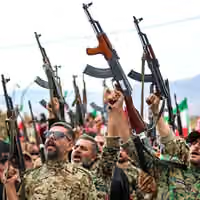
Iran’s Supreme Leader Mojtaba Khamenei said revenge for the killing of his father and others killed in the two recent wars would be carried out regardless of whether he or other officials remained in office.

“We pledge to avenge your pure blood and the blood of all the martyrs of these two wars against the criminal and disgraced killers,” Khamenei said. “This revenge is the demand of our nation, and it must certainly take place.”

He said those responsible would “take the hope of a peaceful death in their beds to the grave,” adding that retaliation did not depend on his own presence or that of other officials.

“Whether we are here or not, this will be achieved, and soon individuals among the freedom-seekers across the world will each carry out part of this divine mission,” he said.

The message was dated July 9, the day Ali Khamenei was buried in Mashhad, but was released on Saturday.

Iran MP accuses Ghalibaf of shielding Araghchi from parliament

Jul 11, 2026, 11:58 GMT+1

Hardline Iranian lawmaker Hamid Rasaei accused Parliament Speaker Mohammad Bagher Ghalibaf of preventing Foreign Minister Abbas Araghchi from answering lawmakers’ questions during more than four months of war, ceasefire and negotiations.

Rasaei wrote on Telegram that Ghalibaf had kept parliament out of session for four and a half months and had not allowed Araghchi to face even half an hour of questioning.

He contrasted this with a US congressional hearing involving Democratic Representative Seth Moulton and CENTCOM commander Admiral Brad Cooper, saying Iran’s parliament had held no oversight session on the war, ceasefire or memorandum signed with Washington.

Iran will not enter talks until US retreats from positions – IRGC media

Jul 11, 2026, 11:31 GMT+1

Tehran will not enter negotiations with the United States unless Washington retreats from its current positions, the IRGC-affiliated Fars News Agency reported Saturday, citing a source close to Iran’s negotiating team.

The source said the Islamic Republic had not requested talks with Washington and would judge any US retreat by whether previously agreed arrangements were implemented.

Those conditions include establishing a special working group on Lebanon aimed at ending the war and securing a withdrawal, resolving navigation through the Strait of Hormuz under arrangements sought by Tehran, and restoring oil exports and flows to normal levels, Fars reported.

Iran hardliner says negotiations are a tool, not a goal

Jul 11, 2026, 11:09 GMT+1
100%

Influential hardline politician Saeed Jalili said negotiations should be judged solely by whether they strengthen Iran, describing diplomacy as a tool rather than an objective.

“Negotiation is a tool, not a goal. It may be effective at one point and ineffective at another,” Jalili, the Supreme Leader’s representative to the Supreme National Security Council, wrote on X.

“If it consolidates and increases the country’s power, it is valuable. If it weakens the country’s power, it is harmful,” he added.