Iran security chief warns of retaliation if infrastructure is attacked
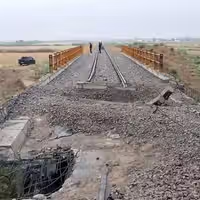
Iran's Supreme National Security Council Secretary Mohammad Bagher Zolghadr warned that any attack on the country's infrastructure would be met with retaliation after US President Donald Trump said Washington was considering strikes on Iranian electrical manufacturing facilities, power plants and desalination plants if tensions escalated.
"Any attack on infrastructure will be met with reciprocal action, and Israel, which is behind these acts of aggression, will not be spared the response of our fighters," Zolghadr said in a statement.
He also described Trump as "the world's most hated figure" and criticized remarks he said were directed at the Iranian people.
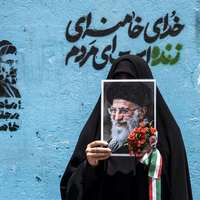
A senior Iranian cleric said the mass funeral for the country's slain supreme leader sent a message to the world that Iranians regarded seeking revenge as a "legal and religious right."
"The massive funeral for the martyred leader conveyed the message of the Iranian nation's legal and religious demand for blood vengeance to the world," Qom Friday prayer Imam Alireza Arafi said.
Arafi also said those who believed the network of Iran-backed armed groups across the Middle East had ended were mistaken, adding that "the resistance front is still alive and its new growth will become evident in different countries across the region," according to the Mehr news agency.
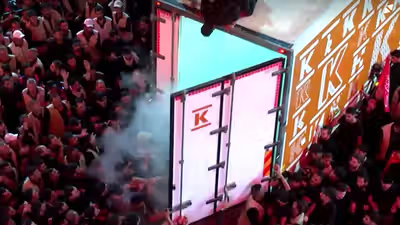
People hold a banner reading “Kill Trump” during Ali Khamenei’s funeral procession in Tehran.
Iranian officials are calling for national unity after Ali Khamenei’s death, but the message is increasingly being shaped by demands for revenge, attacks on officials accused of compromise and warnings that internal division serves the enemy.
The emerging message is not unity around solving Iran’s deepening economic, security and diplomatic crises, but unity around revenge, resistance and obedience to the new leadership.
The Islamic Revolutionary Guard Corps put that message in explicit terms after Khamenei’s funeral ceremonies in Iran and Iraq, describing the processions as a display of loyalty, unity and resistance.
In a statement thanking the public and officials involved in the ceremonies, the IRGC said “blood vengeance” for Khamenei and others killed was a “certain, legitimate and unforgettable demand.”
It said punishment of the “agents, commanders and supporters” of the killing would remain in the memory of the Islamic community and the so-called resistance front until what it called justice was achieved.
Banners and posters threatening Trump, including calls to kill him and references to bounties, were a recurring theme during the week-long funeral processions for Khamenei, turning the language of vengeance into one of the ceremony’s most visible messages.
1 / 7
The IRGC statement did not name Trump, but its language echoed a wider funeral narrative in which the US president was repeatedly cast as a target of vengeance.
It also framed the funeral processions in Najaf and Karbala as proof of the bond between Iran, Iraq and Tehran’s regional network, and said the IRGC and allied forces would continue Khamenei’s path under Supreme Leader Mojtaba Khamenei.
The message came as hardliners inside Iran were also targeting officials involved in diplomacy with Washington.
The tension has been visible since the announcement of the memorandum with Washington, which hardliners rejected from the outset with slogans such as “We do not accept.” What began as opposition to the agreement soon turned into direct attacks on President Masoud Pezeshkian, Foreign Minister Abbas Araghchi and Parliament Speaker Mohammad Bagher Ghalibaf.
According to ILNA, the confrontation peaked during Khamenei’s funeral ceremonies, which authorities had sought to present as a symbol of unity and political continuity. Instead, groups in the crowd chanted “Death to the compromiser” and slogans against Pezeshkian, Araghchi and Ghalibaf.
Footage from the ceremonies showed Pezeshkian being addressed with insulting chants. Another video showed people throwing stones toward Araghchi and shouting abuse at him, drawing reactions from political figures and media outlets inside Iran.
ILNA warned that national unity cannot be preserved through insults, vilification and polarization, saying some hardliners had moved beyond political criticism into efforts to deepen internal divides.
Mohammad Mohajeri, a conservative political activist, called the chants against Araghchi and Ghalibaf an “Israeli sedition” and warned that silence by Mohammad Bagher Zolghadr, secretary of the Supreme National Security Council, and other council members could be read as complicity.
Hesamodin Ashna, a former adviser to Hassan Rouhani, also reacted to the attacks on Araghchi, writing on X: “The same person you are stoning is standing up for you.”
Mohammad-Saleh Jokar, head of parliament’s internal affairs and councils committee, told ILNA the country needed unity “more than ever” and said polarization was what the enemy wanted.
But his definition of unity also centered on retaliation.
“If we are to avenge the blood of the martyrs and the martyred Imam, this will certainly be achieved in the shadow of unity,” Jokar said.
He said Iranians should direct their anger at the United States, adding that “criminal America” must be held accountable and that the nation would not leave alone those who had committed “evil and crime.”
Jokar said the funeral ceremonies had displayed the “strength and power” of the nation and angered the enemy. “We must act in such a way that it dies of this anger,” he said, adding that the “blood of our martyrs” must be avenged.
Some hardline lawmakers have pushed the message further. Hossein Samsami, a member of parliament’s economic committee, told Didban Iran that taking revenge for Khamenei’s death required strengthening Iran’s offensive and defensive capabilities and reconsidering the country’s nuclear doctrine.
“A change in our nuclear doctrine is one of the requirements for taking revenge,” he said, implying that Iran should make nuclear weapons.
Samsami also said those responsible for Khamenei’s killing should be treated like Salman Rushdie, referring to Ruhollah Khomeini’s fatwa calling for Rushdie’s death.
He accused Washington of using diplomacy and the funeral period to gather intelligence on Iranian officials, saying the ceasefire and funeral ceremonies were used to identify their residences for future assassinations.
“The enemy enters through the door of peace to break your neck,” he said.
These remarks show how the language of revenge is spreading beyond military retaliation into broader demands for a harder ideological, nuclear and security line.
That shift comes as ordinary Iranians face the consequences of renewed confrontation, from economic pressure and insecurity to the risk of wider war.
ILNA warned that whenever politics has moved toward harsh polarization and the elimination of rivals, “the whole society has paid the price.”
For now, however, the loudest official language around unity is not focused on that price. It is focused on revenge, loyalty and the claim that disagreement itself may serve the enemy.
A senior Iranian cleric said Friday prayers across the country would from now on include calls for revenge over the killing of the country's slain supreme leader.
"From now on, every Friday, with the holding of Friday prayers, we will raise the call for revenge and blood vengeance," Shahr-e Kord Friday prayer leader Abolhassan Fatemi said.
Fatemi said "revenge against the oppressors must remain at the forefront of the Islamic Republic's actions," according to the ISNA news agency.
The European Association of Nuclear Medicine (EANM) has barred Iranian citizens from attending its congresses, regardless of where they live, citing European Union sanctions, according to a letter obtained by Iran International.
The letter, sent by the association's head of international customer relations and seen by Iran International, said Iranian nationals cannot be accepted because of "international sanctions and legal requirements."
"This decision is not based on personal considerations but has been taken to comply with the binding legal framework of the European Union," the letter said.
The EANM is a Europe-wide professional organization representing physicians, scientists and healthcare professionals working in nuclear medicine. It organizes one of the field's largest annual scientific congresses and promotes research, education and clinical standards in nuclear medicine.
The association said EU restrictive measures against Iran include sanctions targeting individuals and entities, adding that admitting participants who could fall under those rules could expose the organization to legal and sanctions risks.
To ensure full compliance with EU law, the letter said, registration and participation by all Iranian nationals would not be accepted, regardless of their current country of residence.
The policy makes no distinction between Iranian citizens living in Iran and those residing or holding permanent residence abroad, making Iranian nationality alone the basis for exclusion from the congress.
A senior Iranian cleric said the funeral for the country's slain supreme leader reflected the "collective patience" of the Iranian and Iraqi people and strengthened the Muslim world.
"This great, historic and transformative event created by the great nation of Iran and the nation of Iraq was a manifestation of collective patience," Tehran's interim Friday prayer leader Mohammad Hassan Aboutorabi Fard said.
He also said the Muslim world was stronger after the funeral than before it, adding that "this power is the result of collective patience," according to the Fars news agency.