Satellite images show Iran may be rebuilding nuclear sites - CNN
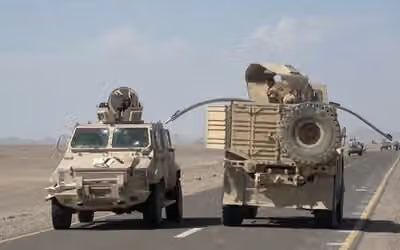
Iran may be repairing or rebuilding facilities at several nuclear and missile sites, including damage at the Parchin military complex southeast of Tehran, CNN reported Friday citing satellite imagery from Vantor.
A CNN visual investigation found repair and reconstruction work at Taleghan 2, a site inside Parchin where experts believe explosive material for nuclear weapons is stored. Images from June 22 and July 7 showed work on several impact holes left by US-Israeli strikes.
Separate imagery from June 21 showed vehicles entering and leaving tunnels at Pickaxe Mountain, a suspected underground nuclear site near Isfahan, while a June 17 memorandum with the United States was in effect.
People stand along the partially refilled bed of the Zayandeh Roud river in Isfahan after water briefly returned to the long-dry river, June 2026
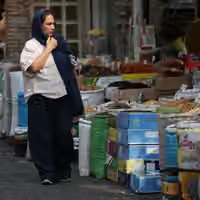
As Iran navigates renewed confrontation with the United States and uncertainty over a fragile diplomatic process, a deeper crisis is returning to the center of public debate: how much longer ordinary Iranians can absorb the economic cost.
Outlets from different political camps are warning of mounting pressure from inflation, falling purchasing power, unemployment and infrastructure failures, even as they sharply disagree over who is responsible.
Independent and reformist-leaning publications such as Sharq, Etemad and Tose’e Irani have focused on the rising cost of basic goods, reporting that food prices have surged far beyond wage growth.
They point to basic commodities such as bread, poultry and vegetable oil rising between 130% and more than 200%, while wages cover only a fraction of estimated household costs.
Even outlets close to the government, including ILNA and Etemad, have highlighted the growing gap between income and survival, noting that the minimum wage of around 16.6 million tomans covers less than 40% of the estimated 45-million-toman basic subsistence basket for an average family.
Beyond inflation and market instability, Iranian media have also focused on a worsening infrastructure crisis.
Severe rolling summer blackouts have returned, disrupting factories, increasing pressure on businesses and making daily life harder during peak heat.
The search for blame mirrors Tehran’s broader political divisions.
Moderate and reformist outlets such as Sharq, Etemad and Arman Melli emphasize structural failures, isolation and the economic toll of years of confrontation.
They argue that sanctions, conflict, damaged infrastructure and policy failures have intensified pressure on the economy.
Some commentators have warned of an “inflation bomb” and questioned whether decision-makers understand the “accumulation of public dissatisfaction.”
Earlier this week, Jahan Sanat published industrial analyst Alireza Mahdiyeh’s commentary under the headline “The sound of an inflation bomb,” citing Central Bank figures that he said showed the economy facing one of its worst periods in decades.
“Inflation has now reached even the price of bread,” he wrote. “Bread is still available, but more expensive than before. Yet inflation in bread does not give the baker more bread. It only means that what reaches people’s tables is smaller and less than before.”
Moderate outlets have also pointed to domestic policy decisions, including severe internet restrictions and blackouts, arguing they have damaged the digital economy and created widespread “hidden unemployment.”
Hardline dailies Kayhan and Resalat offered a different diagnosis, placing responsibility on the United States and Israel.
They argue that Washington’s declaration that the June interim agreement is “dead,” combined with renewed military pressure, proves that Western economic warfare is driving instability.
These outlets have also accused “economic saboteurs,” domestic speculators and merchants of manipulating currency markets and hoarding essential goods.
The proposed solutions reveal two competing visions for Iran’s future.
Hardliners have called for a “resistance economy,” including tighter controls on markets, action against price gouging and expanded rationing networks.
Moderate economists and commentators writing for outlets such as Donya-ye-Eghtesad argue that internal crackdowns cannot solve deeper structural problems.
They say economic stability depends on reducing tensions, restoring international trade, easing restrictions on businesses and creating conditions for investment and reconstruction.
But optimism remains limited as the damaged diplomatic process between Tehran and Washington offers little immediate relief.
As economist Mehdi Pazouki told reform-leaning Fararu, further escalation could push the country into even more dangerous territory.
“If Israel’s warmongering policies and the hardline approaches of certain actors inside Iran intensify, there is a serious possibility that we will move toward hyperinflation and the dollarization of the economy,” he said.
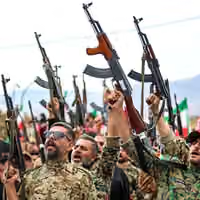
Friday prayers across Iran became a synchronized campaign for revenge on Friday, with clerics rejecting further negotiations with Washington, defending Tehran’s control of the Strait of Hormuz and demanding visible retaliation for the killing of Ali Khamenei.
The message had been set in advance by the Friday Prayer Policy Council, which announced that weekly services nationwide would become “Fridays of Blood Vengeance and Revenge” until those blamed for Khamenei’s killing were punished.
The council said revenge was not an emotional response but a “strategic” and religious duty, explicitly naming US President Donald Trump and Israeli Prime Minister Benjamin Netanyahu.
“Carrying out retribution against the principal criminals – particularly the criminal Trump and the child-killing Netanyahu – is an unchanging element of divine justice,” its statement said.
It went further, saying every person or group with the ability to act had a duty to “rise for jihad” and carry out the task without delay. The council said banners calling for vengeance for Khamenei would remain beside Friday prayer pulpits until retribution was achieved.
The language was repeated across major cities.
In Mashhad, where Khamenei was buried, Friday prayer leader Ahmad Alamolhoda said retaliation must be seen by the public rather than remain an unfulfilled promise.
“Revenge and blood vengeance for the martyred leader must remain before the eyes of the people, and the people must see it with their own eyes,” he said. “Only then will real revenge have been taken.”
Saeed Jalili, the Supreme Leader’s representative to the Supreme National Security Council, told worshippers in Mashhad that revenge was a national right and a responsibility for officials.
“If you say Iran’s assets must be released, the greatest asset of our nation was its beloved leader,” Jalili said. “Today, the nation’s right is to defend this great asset through revenge, and it is the duty of officials to pursue it.”
Bushehr’s interim Friday prayer leader Yousef Jamali said worshippers would continue chanting for revenge until the United States and Israel were punished.
“We will stand alongside the officials and the armed forces and, God willing, bring the White House down on its occupants,” Jamali said. “Know that the sword of our revenge will fall upon the oppressors.”
In Rasht, cleric Rasoul Falahati linked revenge to the dispute over the US-Iran memorandum and navigation through the Strait of Hormuz.
“Negotiating in the middle of a war is meaningless,” he said. “Under the recent understanding, we opened the Strait of Hormuz, but America fulfilled none of its commitments and instead moved to further reinforce its bases.”
He said Muslims and “free nations” around the world were ready to take revenge on Trump and Netanyahu and urged Iran’s armed forces to respond firmly to any further US action.
Tehran Friday prayer leader Mohammad Hassan Aboutorabi Fard also accused Washington of violating the memorandum and rejected any US role in the strategic waterway.
“We explicitly declare that under no circumstances will the United States be allowed to interfere in the affairs of the Strait of Hormuz,” he said.
In Qom, Alireza Arafi described revenge against those who carried out and ordered Khamenei’s killing as a legal and religious right that would not be forgotten.
Shiraz interim Friday prayer leader Adel Hajipour used almost identical language, saying the destruction of those responsible was a public demand.
In Malayer, Mohammad-Ali Arzandeh said Friday prayers would remain “Fridays of revenge and blood vengeance” until Israel was destroyed and those blamed for regional insecurity were eliminated.
People hold a banner reading “Kill Trump” during Ali Khamenei’s funeral procession in Tehran.
Iranian officials are calling for national unity after Ali Khamenei’s death, but the message is increasingly being shaped by demands for revenge, attacks on officials accused of compromise and warnings that internal division serves the enemy.
The emerging message is not unity around solving Iran’s deepening economic, security and diplomatic crises, but unity around revenge, resistance and obedience to the new leadership.
The Islamic Revolutionary Guard Corps put that message in explicit terms after Khamenei’s funeral ceremonies in Iran and Iraq, describing the processions as a display of loyalty, unity and resistance.
In a statement thanking the public and officials involved in the ceremonies, the IRGC said “blood vengeance” for Khamenei and others killed was a “certain, legitimate and unforgettable demand.”
It said punishment of the “agents, commanders and supporters” of the killing would remain in the memory of the Islamic community and the so-called resistance front until what it called justice was achieved.
Banners and posters threatening Trump, including calls to kill him and references to bounties, were a recurring theme during the week-long funeral processions for Khamenei, turning the language of vengeance into one of the ceremony’s most visible messages.
1 / 7
The IRGC statement did not name Trump, but its language echoed a wider funeral narrative in which the US president was repeatedly cast as a target of vengeance.
It also framed the funeral processions in Najaf and Karbala as proof of the bond between Iran, Iraq and Tehran’s regional network, and said the IRGC and allied forces would continue Khamenei’s path under Supreme Leader Mojtaba Khamenei.
The message came as hardliners inside Iran were also targeting officials involved in diplomacy with Washington.
The tension has been visible since the announcement of the memorandum with Washington, which hardliners rejected from the outset with slogans such as “We do not accept.” What began as opposition to the agreement soon turned into direct attacks on President Masoud Pezeshkian, Foreign Minister Abbas Araghchi and Parliament Speaker Mohammad Bagher Ghalibaf.
According to ILNA, the confrontation peaked during Khamenei’s funeral ceremonies, which authorities had sought to present as a symbol of unity and political continuity. Instead, groups in the crowd chanted “Death to the compromiser” and slogans against Pezeshkian, Araghchi and Ghalibaf.
Footage from the ceremonies showed Pezeshkian being addressed with insulting chants. Another video showed people throwing stones toward Araghchi and shouting abuse at him, drawing reactions from political figures and media outlets inside Iran.
ILNA warned that national unity cannot be preserved through insults, vilification and polarization, saying some hardliners had moved beyond political criticism into efforts to deepen internal divides.
Mohammad Mohajeri, a conservative political activist, called the chants against Araghchi and Ghalibaf an “Israeli sedition” and warned that silence by Mohammad Bagher Zolghadr, secretary of the Supreme National Security Council, and other council members could be read as complicity.
Hesamodin Ashna, a former adviser to Hassan Rouhani, also reacted to the attacks on Araghchi, writing on X: “The same person you are stoning is standing up for you.”
Mohammad-Saleh Jokar, head of parliament’s internal affairs and councils committee, told ILNA the country needed unity “more than ever” and said polarization was what the enemy wanted.
But his definition of unity also centered on retaliation.
“If we are to avenge the blood of the martyrs and the martyred Imam, this will certainly be achieved in the shadow of unity,” Jokar said.
He said Iranians should direct their anger at the United States, adding that “criminal America” must be held accountable and that the nation would not leave alone those who had committed “evil and crime.”
Jokar said the funeral ceremonies had displayed the “strength and power” of the nation and angered the enemy. “We must act in such a way that it dies of this anger,” he said, adding that the “blood of our martyrs” must be avenged.
Some hardline lawmakers have pushed the message further. Hossein Samsami, a member of parliament’s economic committee, told Didban Iran that taking revenge for Khamenei’s death required strengthening Iran’s offensive and defensive capabilities and reconsidering the country’s nuclear doctrine.
“A change in our nuclear doctrine is one of the requirements for taking revenge,” he said, implying that Iran should make nuclear weapons.
Samsami also said those responsible for Khamenei’s killing should be treated like Salman Rushdie, referring to Ruhollah Khomeini’s fatwa calling for Rushdie’s death.
He accused Washington of using diplomacy and the funeral period to gather intelligence on Iranian officials, saying the ceasefire and funeral ceremonies were used to identify their residences for future assassinations.
“The enemy enters through the door of peace to break your neck,” he said.
These remarks show how the language of revenge is spreading beyond military retaliation into broader demands for a harder ideological, nuclear and security line.
That shift comes as ordinary Iranians face the consequences of renewed confrontation, from economic pressure and insecurity to the risk of wider war.
ILNA warned that whenever politics has moved toward harsh polarization and the elimination of rivals, “the whole society has paid the price.”
For now, however, the loudest official language around unity is not focused on that price. It is focused on revenge, loyalty and the claim that disagreement itself may serve the enemy.
The European Association of Nuclear Medicine (EANM) said Monday that Iranian nationals are not barred from attending its 2026 congress, clarifying that restrictions apply only to invitation letters issued in support of visa applications.
The statement followed an Iran International report based on a letter from the association that said registration and participation by Iranian citizens could not be accepted, regardless of where they lived, because of European Union sanctions and legal requirements.
EANM said the responses cited in the report had been sent to several people requesting invitation letters for visa applications and had subsequently been interpreted as reflecting a broader policy toward Iranian participants.
“We sincerely apologize to our Iranian colleagues and partners for the confusion and concern this has caused,” the association said in a statement published on July 13.
EANM said it has no policy restricting registration, individual participation, abstract submissions or scientific review on the basis of nationality or country of residence.
“Iranian nationals who do not require an EANM invitation letter for visa purposes are not affected by this measure,” it said.
The association added that it is currently unable to provide official invitation letters supporting visa applications by Iranian citizens because it must comply with applicable legal and regulatory obligations.
The clarification differs substantially from the wording of the letter obtained by Iran International, which said Iranian nationals could not be accepted because of “international sanctions and legal requirements.”
“This decision is not based on personal considerations but has been taken to comply with the binding legal framework of the European Union,” the original letter said.
The letter also said that, to ensure full compliance with EU law, registration and participation by all Iranian nationals would not be accepted, regardless of their country of residence.
It said EU restrictive measures against Iran included sanctions targeting individuals and entities and that admitting participants who might fall under those measures could expose the organization to legal and sanctions risks.
The original wording appeared to make Iranian nationality alone the basis for exclusion, without distinguishing between citizens living in Iran and those residing or holding permanent residence elsewhere.
EANM now says the measure relates solely to visa documentation and “does not constitute a restriction on scientific participation based on nationality.”
The association said abstract submissions and scientific evaluations are conducted through a fully blinded peer-review process and are not influenced by nationality or residence.
EANM is a Europe-wide professional organization representing physicians, scientists and healthcare professionals working in nuclear medicine. It organizes one of the field’s largest annual scientific congresses and promotes research, education and clinical standards.
File photo shows a shopkeeper using a gas-powered lantern inside a darkened store during a power outage in Iran.
Power and water outages have returned to several parts of Iran, residents across the country told Iran International on Friday, describing hours-long blackouts during intense summer heat despite official assurances the electricity network remains stable.
The complaints came as the energy ministry called for consumers to reduce electricity use by at least 10%, warning that high temperatures are expected to push demand above 75,500 megawatts in the coming days.
"Electricity has been out since 2 a.m. and it's now 5 a.m. We still don't have power," one resident in Islamshahr, near Tehran wrote.
Average temperatures, the ministry said, are forecast to reach around 41 degrees Celsius between July 14 and July 18 and remain unusually high through the following week. It urged households to set air conditioners to 25 degrees Celsius, switch off unnecessary electrical appliances and move heavy electricity use outside peak hours to preserve grid stability.
The outages come against the backdrop of a widening structural energy deficit. The latest Statistical Review of World Energy by the Energy Institute found Iran's electricity generation increased by only 1% last year and natural gas production by 1.3%, a sharp slowdown from the previous decade and well below the pace needed to meet rising demand.
Years of underinvestment, delayed infrastructure projects and international sanctions have left the country increasingly unable to meet its own energy needs despite holding some of the world's largest oil and gas reserves.
Residents report outages across Iran
Accounts shared pointed to repeated outages in Tehran province, Alborz, Khuzestan and Fars, with many residents saying electricity was cut for two to three hours at a time.
"Power in Fardis of Karaj went out twice on Thursday – first from 7 a.m. to 7:50 a.m. and then again from 10 until 12:10 p.m.," one resident wrote.
Another in Shiraz said electricity was cut shortly after 1 a.m. on Thursday, while residents in Karaj, in the vicinity of Tehran, also reported another evening blackout.
Several messages came from the southern Khuzestan province, where temperatures regularly climb well above 40 degrees Celsius during the summer.
"They've started the two-hour power cuts again in this unbearable heat," one citizen wrote. "Then they ask what we're supposed to do if power plants are hit."
Another resident questioned why shortages persist despite the province's energy resources.
"With this intense heat in Khuzestan, why should a country this rich suffer shortages of water and electricity?" the resident wrote. "They've started cutting both for at least three hours a day again. Inflation has already broken people's backs."
One person in Masjed Soleyman, Khuzestan province, described losing both electricity and water for three hours, ending the message with a call for public protests.
Food, water and daily life affected
Several said the outages were disrupting everyday life beyond the inconvenience of losing air conditioning.
File photo shows a patient lying on a hospital stretcher during a power outage at a medical facility in Iran.
"I went through so much hardship and debt to buy meat and fish," one resident wrote. "By the time I got home, the electricity went out and we've been without power for three hours. The meat I struggled to buy is spoiling."
Another wrote: "Every day it's either the water or the electricity, or they dig up the streets and take forever to fix them. We live in a city with abundant oil, yet there's poverty and unemployment."
The energy ministry said climate studies show the southern provinces of Hormozgan, Bushehr, Khuzestan, Sistan and Baluchestan and Ilam experience the country's longest periods of extreme heat, placing the greatest strain on the electricity network during the summer.
Officials said reducing air-conditioner settings by one degree and improving energy efficiency could significantly lower demand, urging consumers to conserve electricity to help maintain supplies during the prolonged heatwave.
Messages from Shiraz and Mashhad also described overnight or daytime power cuts, while another resident complained that either electricity or water was being interrupted almost daily.
Officials say prolonged high temperatures have sharply increased electricity demand, particularly in southern provinces, where cooling accounts for a large share of consumption.
Energy experts cited by state media say raising air-conditioner settings by one degree Celsius could reduce cooling demand by roughly 2.5%, while improving the efficiency of cooling equipment and buildings could further lower electricity consumption.