• العربية
  • فارسی
Brand
  • Iran Insight
  • Politics
  • Economy
  • Analysis
  • Special Report
  • Opinion
  • Podcast
  • Iran Insight
  • Politics
  • Economy
  • Analysis
  • Special Report
  • Opinion
  • Podcast
  • Theme
  • Language
    • العربية
    • فارسی
  • Iran Insight
  • Politics
  • Economy
  • Analysis
  • Special Report
  • Opinion
  • Podcast
All rights reserved for Volant Media UK Limited
volant media logo
OPINION

Iran's nuclear threat is greater than reported - JNS

Jul 10, 2026, 06:35 GMT+1

Iran's nuclear capabilities have been "vastly understated," an opinion article by Jarrow L. Rogovin published by JNS argued, calling for US action against both the country's nuclear program and its government.

"The disturbing fact is that Iran potentially has at least 35 nukes. Almost no one mentions its 20% enriched material, and no one is talking about its 5% trove," Rogovin wrote.

He also added that "Iran should have no access to nuclear material other than imports for medical uses" and argued that "it's not just Iran's nuclear ambitions that need to be thwarted, but also the regime itself."

"Thus, the United States should vet, arm and train a domestic insurgency," Rogovin wrote.

Most Viewed

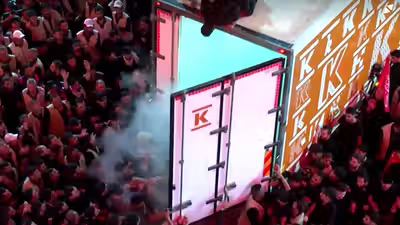
Finnish grocery brand drawn into Khamenei funeral spectacle in Iraq
1

Finnish grocery brand drawn into Khamenei funeral spectacle in Iraq

2

Iran summons British ambassador after London calls in senior diplomat

3
ANALYSIS

A remote bridge shows how US-Iran war is expanding

4
INSIGHT

US strikes, Hormuz clashes push Iran deal to brink

5
INSIGHT

Iran uses Khamenei funeral in Iraq to claim regional reach

Banner
Banner
Banner

Spotlight

  • For many Iranians, paychecks now barely cover food
    INSIGHT

    For many Iranians, paychecks now barely cover food

  • Iran’s economic pain deepens as factions trade blame
    INSIGHT

    Iran’s economic pain deepens as factions trade blame

  • Tehran torn between war and deal as Khamenei is buried
    INSIGHT

    Tehran torn between war and deal as Khamenei is buried

  • A remote bridge shows how US-Iran war is expanding
    ANALYSIS

    A remote bridge shows how US-Iran war is expanding

  • Trump's rhetoric U-turn leaves Iranians between dread, hope and memes
    VOICES FROM IRAN

    Trump's rhetoric U-turn leaves Iranians between dread, hope and memes

  • We live through decisions we don't make
    TEHRAN INSIDER

    We live through decisions we don't make

•
•
•

More Stories

Iran's Pride Match is about visibility, not politics

Jun 26, 2026, 17:20 GMT+1
•
Omid Iravanipour
100%
Soccer Football - FIFA World Cup 2026 - Group G - Iran v New Zealand - Los Angeles Stadium, Inglewood, California, U.S. - June 15, 2026 Iran fans celebrate after the match

Iran’s World Cup match against Egypt has become a test not only of FIFA’s approach to inclusion but also of whether LGBTQ+ Iranians can claim visibility on one of the world’s biggest sporting stages.

The game has been designated as the tournament’s “Pride Match” by local organizers to acknowledge and celebrate the LGBTQ+ community.

The designation has no official standing with FIFA and was determined by Seattle’s local organizing committee. Still, the Iran Football Federation objected, as did Egypt’s. Iran’s football chief labeled the match’s designation an “irrational move that supports a certain group.”

That opposition is unsurprising. It represents a continuation of the Islamic Republic’s efforts to erase our community and deny our existence.

In Iran under the Islamic Republic, being LGBTQ+ can quite literally be a death sentence. Under Articles 234–239 of Iran’s Islamic Penal Code, same-sex acts between men can be punished by death.

I never came out publicly in Iran, but I didn’t have to. People could “sense” it, they’d say. The harassment, the threats and the fear were constant. I could have been arrested—or worse.

After fleeing to the United States, I began speaking out—mostly for those who still can’t. In June 2019, when New York City hosted WorldPride to mark the 50th anniversary of the Stonewall Uprising, I had the privilege of marching through the streets of Manhattan alongside my fellow Iranian queers and my family.

It was the first time WorldPride had ever been held in the United States, but for me it meant even more. After 23 years of living under an oppressive state, I was finally able to publicly and proudly be myself—both as a proud Iranian and a gay man.

From that day forward, I committed myself to using the privileges I have as an American citizen to amplify the voices of the Iranian LGBTQ+ community to the world. Our community faces severe legal and social discrimination, state-sanctioned violence and persecution, and unyielding efforts to erase our existence.

I quickly came to understand that it would be reductive to speak about the Iranian LGBTQ+ community outside the context of Iranian identity and Iranian politics. The two cannot be separated.

This is exactly why the 2026 FIFA World Cup has become such a charged and meaningful moment for our community. The news felt like a moment in which we could bring visibility to our plight on one of the world’s largest stages.

But the Pride Match represents only one controversy surrounding Iran in this year’s World Cup. Ahead of the tournament, FIFA made the decision to ban the historic Lion and Sun flag from all venues because it reportedly viewed the flag as “political” in nature.

That flag served as Iran’s official flag until the regime seized power in 1979 and replaced the Lion and Sun image with its current emblem. For millions of Iranians, including myself, the Lion and Sun is not a political symbol but one of cultural identity and resistance to a government that has never represented us.

Despite FIFA’s decision, dozens of brave Iranian fans defied the ban at the national team’s opening match, waving the flags proudly across SoFi Stadium in Los Angeles. While some fans displayed the flags without issue, others were stopped by security while trying to enter the stadium.

One young boy who was stopped said the flag “means freedom,” while another asked: “What do they expect us to do? Support a regime that we do not believe in?”

That question deserves an answer from FIFA. By banning the Lion and Sun, FIFA risked reinforcing the regime’s preferred narrative by treating a symbol many Iranians see as cultural identity as merely political.

The broader conduct of the Iranian Football Federation at this tournament should also give FIFA pause. The Iranian team’s send-off ceremony in Tehran was held at an IRGC-affiliated rally hosted by a sanctioned official who described the World Cup as a “war battlefield” and urged players to compete in memory of those who “stood by Iran’s missile defense systems and ballistic missile launchers.”

This is the organization whose preferences FIFA appears to have reflected when it banned the Lion and Sun flag.

Iran has now threatened to walk off the field entirely if it faces Pride symbols or dissenting slogans at the match, and FIFA has left local organizers to hold the line alone. Iran’s sports minister says they have been “assured that no disruptive incidents will occur in the stadium,” but it remains to be seen how FIFA will handle the situation during the match.

FIFA should avoid repeating that mistake. The Pride Match was intended to affirm visibility and inclusion, not to make a statement about Iranian politics.

For LGBTQ+ Iranians, that visibility is not symbolic. It is something they are denied at home under threat of imprisonment, violence and even death. Allowing that visibility to be erased on US soil would leave them wondering whether their existence remains negotiable when confronted by political pressure.

MoU's forgotten casualty is the Iranian people

Jun 22, 2026, 03:41 GMT+1
100%

The Memorandum of Understanding between Iran and the United States may strengthen the Revolutionary Guards, weaken Persian Gulf security and deepen China's access to Iranian energy. Above all, however, it leaves Iranians to face the Islamic Republic on their own.

Paragraph 2 of the MOU effectively enshrines the abandonment of the Iranian people by committing both sides to "refrain from interfering in each other's internal affairs."

This clause stands in direct contrast to many of President Trump's previous statements regarding the Iranian people and his repeated condemnations of the regime's brutality.

In 2017, Trump described Iranians as "a proud people" forced to submit to extremist rule. In 2018, he tweeted: "Such respect for the people of Iran as t

hey try to take back their corrupt government. You will see great support from the United States at the appropriate time!"

Read the full article here.

MoU's forgotten casualty is the Iranian people

Jun 22, 2026, 01:16 GMT+1
•
Eric Mandel
100%
Iranian demonstrators gather in a street during a protest over the collapse of the currency's value, in Tehran, Iran, January 8, 2026.

The Memorandum of Understanding between Iran and the United States may strengthen the Revolutionary Guards, weaken Persian Gulf security and deepen China's access to Iranian energy. Above all, however, it leaves Iranians to face the Islamic Republic on their own.

Paragraph 2 of the MOU effectively enshrines the abandonment of the Iranian people by committing both sides to "refrain from interfering in each other's internal affairs."

This clause stands in direct contrast to many of President Trump's previous statements regarding the Iranian people and his repeated condemnations of the regime's brutality.

In 2017, Trump described Iranians as "a proud people" forced to submit to extremist rule. In 2018, he tweeted: "Such respect for the people of Iran as they try to take back their corrupt government. You will see great support from the United States at the appropriate time!"

Following the June 2025 strikes on Iranian nuclear facilities, he posted: "If the current Iranian Regime is unable to MAKE IRAN GREAT AGAIN, why wouldn't there be a Regime change? MIGA."

In January 2026, he urged Iranians to continue protesting and "take over your institutions," adding that "help is on its way." The following month, during major opposition demonstrations, he again appealed directly to Iranians: "When we are finished, take over your government. It will be yours to take."

Today, however, the MOU represents a dramatic reversal of those positions. The agreement abandons a population Trump repeatedly encouraged to reclaim its country and signals that the United States is no longer willing to support internal pressure against the regime.

The contrast is particularly striking because it comes after a period in which Iran was arguably more vulnerable than at any point in decades.

Following military setbacks, economic pressure and growing domestic dissatisfaction, the regime faced mounting challenges both externally and internally. Yet rather than using that leverage to pursue broader political change, Washington appears to have chosen accommodation.

Trump now speaks of Iran's leaders as "very smart" and "strong," describing them as pragmatic negotiating partners. According to PBS NewsHour, a US official said Iran would be rewarded for "acting like a normal country."

That raises a fundamental question: after 47 years of repression, terrorism, hostage-taking, regional destabilization and the deaths of many Americans linked to Iran and its proxy network, is Tehran now being offered normalization without accountability?

The agreement appears poised to provide sanctions relief, access to frozen assets and expanded oil sales. Much of that oil is likely to flow to China. Additional revenue could strengthen the IRGC, reinforce domestic repression and increase support for armed allies such as Hezbollah and Hamas.

Supporters of the agreement argue that diplomacy is preferable to conflict and that negotiated limits are better than perpetual confrontation. Yet history suggests that agreements with the Islamic Republic are only as effective as the enforcement mechanisms behind them and the willingness to use them.

If substantial benefits are delivered before key obligations are fully verified, leverage disappears while risks increase.

This concern is not new. When President Obama declined to support Iran's Green Movement following the disputed 2009 election, many critics viewed the decision as both a betrayal of democratic values and a missed strategic opportunity to weaken the regime from within.

The current debate echoes many of the same arguments. But what Trump has done may prove even more consequential.

After authorizing actions that significantly degraded Iran's nuclear infrastructure, ballistic missile capabilities and military assets, he achieved what many previous administrations were unwilling or unable to attempt.

Yet by rapidly transitioning from maximum pressure to accommodation, he risks transforming a major tactical victory into a strategic mistake.

At the moment Iran appeared most vulnerable and many Iranians seemed most willing to challenge the regime, the United States chose not to prioritize support for opposition movements or increase pressure on the IRGC from within.

Whether such efforts would have succeeded is unknowable, but abandoning them entirely removed a source of leverage that would have, at the very least, strengthened America's negotiating position.

A different strategy would have required a sustained effort to explain to the American people why supporting the aspirations of ordinary Iranians serves both value-based American principles and long-term US security interests.

Genuine stability in the Middle East is unlikely to emerge solely from agreements with authoritarian rulers. Lasting stability comes when governments enjoy legitimacy among their own populations, especially populations that are likely to be among the most pro-American in the Muslim world.

Instead, the administration chose strategic impatience. In doing so, it not only disheartened many Iranians who hoped for greater international support, but also created uncertainty among Gulf allies and Israel.

Several regional and foreign-policy experts argue that Persian Gulf states may now reassess the reliability of American security guarantees and adapt accordingly.

The art of diplomacy is not surrendering hard-won leverage before a final agreement is fully negotiated and enforceable.

A 60-day ceasefire could easily become months of inconclusive negotiations while Iran replenishes its finances, strengthens the IRGC, suppresses domestic dissent and supports regional proxies.

But one thing is already clear: the agreement's most overlooked consequence is not what it says about centrifuges, missiles or sanctions. It is what it says about the people of Iran and American assurances.

For years, American leaders, including President Trump, spoke of supporting Iranians seeking freedom from Islamist authoritarian rule. The MOU signals a different set of priorities.

By pledging noninterference in Iran's internal affairs while offering the regime a pathway toward normalization and economic relief, Washington appears to have chosen engagement with Tehran over support for political change.

Whether that choice ultimately produces peace or merely postpones a larger confrontation remains to be seen. But for millions of Iranians who believed the United States stood with them against their oppressors, the message of this agreement is unmistakable: they are now largely on their own.

Arab states can no longer pretend Tehran’s threat is manageable

Jun 6, 2026, 04:11 GMT+1
•
Saeed Ghasseminejad , Navid Mohebbi
100%
Saudi Arabia's Crown Prince Mohammed bin Salman welcomes Qatar's Emir Sheikh Tamim bin Hamad al-Thani upon his arrival to attend the Persian Gulf Cooperation Council's (GCC) 41st Summit in Al-Ula, Saudi Arabia January 5, 2021

For decades, a dangerous illusion governed the Persian Gulf. Arab capitals knew the Islamic Republic was hostile. Yet, they believed the threat could be managed.

They treated Tehran’s subversion as a chronic illness, not a fatal one. The Arab states of the Persian Gulf opted for quiet diplomacy. Tehran opted for proxies and intimidation. This tense balance was always a house of cards.

That house has collapsed.

The recent war between the United States, Israel, and the Islamic Republic changed everything. It did more than degrade Iran’s military. It shattered a long diplomatic illusion. The regime is not just a disruptive actor. It is a direct existential threat. Specifically, it threatens the economic foundations and long-term stability of the Arab states of the Persian Gulf.

Look closely at the targets the regime chose. Before the war, Saudi Arabia, the United Arab Emirates, and Qatar all signaled a desire for peace. Some lobbied against escalation. Others kept direct lines open to Tehran. Qatar even acted as a mediator.

None of it mattered. Iranian missiles still struck Qatari LNG infrastructure. They targeted Riyadh, the Saudi capital. The United Arab Emirates, historically a vital economic lifeline for Iran, absorbed the most brutal strikes on its primary commercial hubs.

This was a calculated message. Goodwill is no shield when your economic success is the actual target. Tehran does not just view the Arab states of the Persian Gulf as geopolitical rivals. It views their development as an existential threat to its own legitimacy.

For decades, the regime blamed its economic misery on outside enemies. It preached permanent revolution and resistance. Yet, just across the water, the Arab states of the Persian Gulf chose a different path. They built world-class infrastructure, trade, and global growth.

This contrast is terrifying to the Islamic Republic. Ordinary Iranians look across the Persian Gulf and ask a dangerous question: Why does our country, with far greater natural resources, deliver nothing but poverty?

Tehran has no answer. It cannot match the economic model of its neighbors, so it resorts to economic vandalism. If the regime cannot build prosperity at home, it must destroy it next door to level the playing field.

This reality explains why the conflict has evolved beyond mere proxy warfare. The Arab states of the Persian Gulf are accustomed to dealing with asymmetric threats. They have managed Iranian-backed groups like Hezbollah, Iraqi militias, and the Houthis for years.

The current crisis targets something deeper. It is not a standard security dispute. It is a direct assault on the economic model of the Arab states of the Persian Gulf.

Look at the closure of the Strait of Hormuz. Tehran views this vital waterway as a geopolitical jugular. The regime knows that prosperity in the Persian Gulf relies on global investor confidence, open trade, and energy exports. By shutting the Strait, Tehran is holding the entire region's future hostage. If the Islamic Republic cannot climb out of its own economic grave, it will drag its neighbors down into it.

The old playbook is broken. De-escalation, mediation, and managed coexistence are no longer viable strategies. They hold diplomatic utility, but they cannot replace a core security doctrine. The regime proved it will eagerly strike the very neighbors who tried to contain the flames.

The Arab states of the Persian Gulf are confronting a reality they long sought to defer. The Islamic Republic is not a wild animal that can be tamed or managed indefinitely. It is a systemic threat. History shows that treating an expansionist power as a mere management problem only invites more aggressive escalation.

This shift does not require a reckless rush to war. It does mean the Arab states of the Persian Gulf can no longer remain passive observers while others carry the burden. The United States and Israel have already initiated a confrontation. The implications extend far beyond the regime's nuclear ambitions. Leaving this conflict unfinished is highly dangerous. It merely hands Tehran a life support system, giving it time to recover, rebuild, and repeat its destructive cycles.

A deeper transformation is also underway. The strategic interests of key Arab states of the Persian Gulf now directly align with the aspirations of the Iranian people. The average Iranian derives no benefit from the regime’s foreign adventures. Instead, citizens pay the ultimate price through brutal domestic repression, systemic corruption, and engineered economic ruin. The regime behaves like an absentee landlord, burning its own house down for insurance money to fund foreign militias.

By now, the pattern is undeniable. The Islamic Republic’s hostility is not a temporary phase. It stems from a profound systemic insecurity. A neighborhood defined by stability, economic growth, and global integration acts as a mirror. It exposes the regime’s self-inflicted failures. Tehran simply cannot survive the comparison. The old assumptions are officially dead.

The Arab states of the Persian Gulf are not dealing with a conventional rival. They are facing an existential adversary. This adversary views their prosperity and international alignments as an active threat to its survival.

Neutrality is no longer a shield. The Arab states of the Persian Gulf cannot afford to be passive spectators while their future is decided by others. True security will not come from managing the threat from a distance. It will come from actively building a region where totalitarian vandalism can no longer sabotage human progress.

To achieve this, the Arab states of the Persian Gulf can mobilize three vital partners. The first is the Iranian people, who are eager to liberate themselves from their oppressors. The second is Israel, which faces the exact same existential threat but possesses advanced capabilities to directly confront the regime. The third is the United States, whose strategic support remains entirely irreplaceable.

The Arab monarchies of the Persian Gulf should actively coordinate with this triad, first behind the scenes and then openly. Together, they can finally bring down the Islamist regime in Tehran. Only after the Iranian people establish a representative government can the region breathe and find a true partner for peace, regional security, and shared prosperity in Iran.

Trump vs Tehran: how not signing became the deal

May 25, 2026, 04:10 GMT+1
•
Kambiz Hosseini
100%
US President Donald Trump at the White House in this file photo

US President Trump’s approach toward Iran may better be explained by the political timing of the World Cup and the culture of New York real estate dealmaking: performance, delay, leverage and spectacle.

The cadence of Trump’s remarks about Iran belongs less to the world of foreign policy than to the culture that shaped him long before politics did: New York real estate, tabloid combat, and public brinkmanship treated as performance art.

The comparison that comes closest may not come from diplomacy at all, but from David Mamet’s Glengarry Glen Ross, that ruthless portrait of American real-estate sales culture, where power belongs not to the wisest man in the room, but to the most psychologically relentless.

In the film’s most famous scene appears Blake, the sleek corporate predator whose confidence and aggression are treated as forms of intelligence. He does not simply sell real estate. He sells power, status, and the fantasy of invulnerability itself.

Trump comes from that exact culture, though he did not invent it. He emerged from it.

It is difficult to understand Trump’s approach to Iran through the traditional frameworks of Republican foreign policy because Trump does not instinctively speak that language. He speaks the language of the deal, more specifically, the language of the New York deal.

To diplomats, consistency creates stability and ambiguity introduces risk. For Trump, unpredictability is leverage. Negotiation is a psychological contest in which pressure, timing, perception, and dominance become instruments of power.

One week, a deal appears close. The next, Tehran faces catastrophic consequences if it refuses American demands. To conventional policymakers, the reversals can appear chaotic. But those familiar with the culture of aggressive American salesmanship recognize the game: create urgency, destabilize expectations, project strength, keep the other side uncertain.

But Trump’s instincts are tied not only to commerce, but to performance.

The United States is approaching the 2026 FIFA World Cup, one of the largest international spectacles ever hosted on American soil. Beginning next June, the tournament will unfold across multiple cities before a global audience measured not in millions, but billions.

That context may help explain the curious patience embedded in some of his recent remarks on Iran.

In a Truth Social post on Sunday, Trump insisted negotiators should “not rush into a deal” because “time is on our side.” Pressure on Iran, he wrote, would remain in place until an agreement was “reached, certified, and signed.”

In other words: “get them to sign on the line which is dotted.”

The negotiations with Iran may therefore be less about immediate resolution than about the management of instability until after the World Cup final, a spectacle Trump instinctively understands.

A regional escalation or collapsing diplomatic process in the weeks leading up to the tournament would threaten precisely the atmosphere Trump values most: the image of American strength, prosperity, and control.

This does not mean the negotiations are insincere or a deal is impossible. But it does suggest observers should be cautious about interpreting every public signal as evidence of imminent breakthrough or collapse.

He is not fundamentally opposed to negotiation with Iran. On the contrary, he appears deeply attracted to the possibility of a grand bargain. What he seeks, however, is not simply a workable agreement, but a visible triumph dramatic enough to dominate headlines and simple enough to market politically.

This may be the most distinctly American dimension of Trump’s foreign policy: the belief that geopolitical success must also function as branding. Trump wants ownership of the moment as much as he wants a deal. He wants the image of resolution itself: Iran returning to the table, concessions publicly framed as victories, history compressed into a photograph.

But history rarely cooperates with theatrical instincts. Foreign policy does not bend as easily as commercial real-estate negotiation because nations are not distressed assets waiting to be restructured.

The Islamic Republic measures survival differently: absorbing pressure can itself become a form of victory.

Salesmanship can generate headlines, pressure, and even temporary breakthroughs. But there are crises in which personality eventually collides with structure. That may be the clearest lesson of Trump’s long and unfinished confrontation with Tehran.

The art of the deal becomes far more complicated when the other side sees the conflict as a question of historical survival, when the only thing both sides have in common is a profound sense of mistrust.

Whether there will be a hostile takeover after the World Cup remains unclear. But one does not need to be a geopolitical genius to recognize the underlying logic of pressure if one understands the culture from which Trump emerged.

As Blake says in Glengarry Glen Ross, “The only thing that counts in this life is to get them to sign on the line which is dotted.”