• العربية
  • فارسی
Brand
  • Iran Insight
  • Politics
  • Economy
  • Analysis
  • Special Report
  • Opinion
  • Podcast
  • Live TV
  • Iran Insight
  • Politics
  • Economy
  • Analysis
  • Special Report
  • Opinion
  • Podcast
  • Live TV
  • Theme
  • Language
    • العربية
    • فارسی
  • Iran Insight
  • Politics
  • Economy
  • Analysis
  • Special Report
  • Opinion
  • Podcast
  • Live TV
All rights reserved for Volant Media UK Limited
volant media logo

Shooting during Khamenei burial leaves two Basij members killed - reports

Jul 9, 2026, 22:03 GMT+1Updated: 01:07 GMT+1

Two Basij members were killed in a shooting in Mashhad after two unidentified men in military clothing opened fire on them with handguns, according to IRGC-affiliated Sabereen News.

The shooting reportedly took place on Fakouri Boulevard, while gunfire was also heard near the Imam Reza shrine.

One of the Basij members was killed at the scene and another died later in hospital, the reports said. The attackers fled, and security forces are searching for those behind the attack.

Most Viewed

Iran's central bank says it is not hyperinflation. Economists are not convinced
1
INSIGHT

Iran's central bank says it is not hyperinflation. Economists are not convinced

2

IRGC chief backs state broadcaster amid clashes with Pezeshkian, Ghalibaf

3
VOICES FROM IRAN

Iranians voice economic despair as dollar hits 2 million rials

4

Iran security chief hints at nuclear doctrine shift after US attacks

5

Iran executes another January protest detainee

Banner
Banner
Banner

Spotlight

  • Will Iran bend or escalate as US launches economic war?
    PODCAST

    Will Iran bend or escalate as US launches economic war?

  • Iran leader’s absence gives war camp room to shape policy
    ANALYSIS

    Iran leader’s absence gives war camp room to shape policy

  • Iran's central bank says it is not hyperinflation. Economists are not convinced
    INSIGHT

    Iran's central bank says it is not hyperinflation. Economists are not convinced

  • Ghalibaf's hunger warning sparks hardline backlash over showing weakness
    INSIGHT

    Ghalibaf's hunger warning sparks hardline backlash over showing weakness

  • Iran crude loadings plunge to one-seventh of pre-war level as blockade bites
    ANALYSIS

    Iran crude loadings plunge to one-seventh of pre-war level as blockade bites

•
•
•

More Stories

US strikes, Hormuz clashes push Iran deal to brink

Jul 9, 2026, 21:43 GMT+1
•
Maryam Sinaiee
100%
A US fighter jet on board a US warship in this CENTCOM handout

The fragile memorandum between Tehran and Washington is facing its biggest test yet after two days of US strikes on targets along Iran’s southern coast and Iranian attacks on commercial shipping near the Strait of Hormuz raised fears of a return to full-scale war.

Iranian officials have threatened severe retaliation, while analysts warn that disputes over sanctions, maritime routes and the future of the agreement could push both sides into another major confrontation.

Mohsen Jalilvand, a professor of international relations, said the continued US military presence in the region and Tehran's insistence on controlling shipping through the Strait of Hormuz have significantly increased the risk of war.

"When both sides continue to stand by their positions, and there are no signs of retreat, it is only natural that the likelihood of a broader confrontation increases," he told the news website Fararu.

"Overall, I see the outlook moving less toward an agreement and more toward escalating tensions and a greater possibility of a major conflict."

‘Abandon MoU’

Senior officials and hardline media reacted angrily after the latest US attacks, which the Iranian Health Ministry said killed 14 people and injured 78 others. Several senior figures demanded tougher retaliation or called for formally abandoning the memorandum with Washington.

Parliament Speaker and Iran's chief negotiator Mohammad-Bagher Ghalibaf wrote on X that "America still has not learned that bullying and breaking its commitments no longer come without a cost."

"Let me be clear: if you strike, you will be struck. Stop struggling in vain—you will only sink deeper. The Strait of Hormuz will be reopened only under Iranian arrangements, not American threats."

Alaeddin Boroujerdi, a member of parliament's National Security and Foreign Policy Committee, told state broadcaster IRIB that Iran's response would be "more severe" and warned that continued confrontation would ultimately harm the United States.

The hardline Kayhan newspaper argued that repeated US attacks, the revocation of Iran's oil export waiver and what it described as violations of the agreed shipping arrangements in Hormuz had rendered the agreement meaningless.

"When Iran's armed forces tighten their grip on the world's energy artery in the Strait of Hormuz and play the Bab al-Mandab card, the West's economic lifeline will be cut, and Trump will beg for a ceasefire more desperately than ever," the newspaper wrote.

Kayhan urged the Foreign Ministry to formally declare the memorandum void so the armed forces could "settle Trump's account once and for all."

Tensions with Oman

The latest escalation followed Iranian attacks on vessels using a route south of the Strait of Hormuz, on the Omani side, while under US naval escort rather than the shipping corridor designated by Tehran.

Deputy Foreign Minister Kazem Gharibabadi accused Washington of pressuring Oman to open an alternative southern shipping lane despite what he said was an agreement that Iran would regulate maritime traffic during the memorandum's 60-day implementation period.

"From our perspective, America's insistence on creating a parallel route disrupted implementation of the memorandum," Gharibabadi said. “The Revolutionary Guards' response was entirely lawful and legitimate."

Iran's Khatam al-Anbiya Central Headquarters warned that any party providing military support for US attacks on Iran would constitute a legitimate target.

“The only safe shipping route through the Strait of Hormuz is the one designated by the Islamic Republic," the statement said.

Oman, however, told the International Maritime Organization on Thursday that it opposed the imposition of transit charges on ships using the strait and reiterated that "the right of transit passage through straits used for international navigation is guaranteed under international law."

Gharibabadi said Iranian officials had informed Omani and Qatari authorities—and indirectly Washington—that the southern route was "completely illegal," violated Clause 5 of the memorandum and "must be closed."

Public exhaustion

Although Tehran and most major Iranian cities have not been targeted since the ceasefire, apart from areas along the southern coastline, the renewed fighting has had an immediate economic impact.

The Iranian rial weakened sharply on Thursday, with the US dollar rising from about 1.6 million rials to more than 1.8 million rials. According to the Central Bank of Iran's latest figures, point-to-point inflation has reached nearly 83 percent.

Despite growing fears of renewed conflict, many Iranians appear more subdued than during previous crises after experiencing two wars within a year. Online discussions suggest widespread exhaustion and emotional numbness rather than panic.

"Is it just my algorithm, or does nobody actually care that the war has started again?" one X user wrote.

Another user, Sina, wrote: "Do we really have to hear fighter jets and explosions over Tehran before we believe the war has resumed?"

A third user commented: "Iranian cities were bombed last night. That means we're officially at war. But our minds are so exhausted, and we've suffered so much, that we're collectively choosing denial."

A reader commenting on Khabar Online wrote: "I just came to say we're exhausted. By God, we're exhausted. How much more tension and pressure can we take? Are you really going to bring another war down on our heads?”

US-Iran conflict widens with fresh strikes and Persian Gulf attacks

Jul 9, 2026, 14:09 GMT+1
100%
Photo published on social media shows smoke and flames rising after explosions during overnight strikes on Iranshahr in Iran's southeastern Sistan and Baluchestan Province, Wednesday night. Iranian authorities said the attack targeted facilities at Iranshahr Airport.

The United States and Iran expanded their military confrontation over the past 24 hours with fresh strikes, missile and drone attacks across the Persian Gulf and growing disruption to shipping through the Strait of Hormuz despite diplomatic efforts to preserve a ceasefire.

The latest US strikes hit southern Iran on Thursday, with a provincial official saying an attack on a pier in Sirik killed three people and wounded 15 others. Iranian media also reported explosions near Bandar Abbas, while a Bushehr official said projectiles struck areas around the province's nuclear power plant.

The attacks followed a broader US campaign against Iranian military infrastructure along the country's southern coast.

US Central Command said it struck around 90 military targets, including coastal surveillance systems, air defenses, anti-ship missile positions, drone and missile storage sites, logistics infrastructure and dozens of Islamic Revolutionary Guards Corps naval vessels, saying the operation was intended to reduce Iran's ability to threaten shipping in the Strait of Hormuz.

Iran responded by announcing missile and drone attacks on what it called US military facilities in Bahrain, Kuwait and Qatar, saying it targeted air defense systems, fuel storage sites and other military infrastructure in retaliation for the US strikes.

Bahrain and Kuwait said their air defenses intercepted incoming missiles and drones, while Jordan activated nationwide air raid sirens after missiles and drones entered its airspace.

The US Embassy in Amman urged Americans to seek shelter indoors, and Qatar condemned Iranian attacks on Bahrain, Jordan and Kuwait while urging all sides to return to diplomacy.

Strait of Hormuz

The confrontation increasingly centered on the Strait of Hormuz, one of the world's most important energy corridors.

Bloomberg reported commercial traffic through the waterway had slowed to a near standstill, while CBS News, citing vessel-tracking data, said only three fuel tankers were observed transiting the strait on Thursday.

The IRGC Navy said shipping had recovered to about half of pre-war levels under routes designated by Iran but warned any US attempt to control maritime traffic would receive a "crushing response."

Oil prices climbed to their highest levels in about three weeks as traders weighed the risks to global energy supplies.

Diplomacy falters

President Donald Trump said the United States had struck Iran "much harder" after attacks on commercial ships and warned further Iranian action would trigger an even stronger response.

He also questioned whether Tehran could be trusted to uphold any future agreement despite saying Iran had again sought negotiations.

Axios reported the White House was preparing for the possibility of a military exchange lasting days or even weeks depending on Iran's next moves in the Strait of Hormuz.

Iran accused Washington of violating the memorandum of understanding reached after April's ceasefire and appealed to the UN Security Council, arguing the latest strikes breached both the agreement and the UN Charter.

Qatar urged both Washington and Tehran to honor the memorandum and return to dialogue, while Iraq said it was seeking to promote rapprochement between the two countries.

Funeral ceremonies continue

Military operations unfolded alongside the final stage of funeral ceremonies for former Supreme Leader Ali Khamenei.

After processions in Tehran, Qom, Najaf and Karbala, Khamenei's coffin was flown from Iraq to Mashhad for burial. Iranian authorities presented the ceremonies as a demonstration of regional solidarity, while IRGC-affiliated media published photographs it said showed Quds Force commander Esmail Qaani attending the funeral.

The past day's events showed how the confrontation has shifted beyond Iran's nuclear program, with the Strait of Hormuz emerging as the military and economic center of the conflict.

Trump's rhetoric U-turn leaves Iranians between dread, hope and memes

Jul 9, 2026, 12:23 GMT+1
•
Hooman Abedi
100%
US President Donald Trump leaves following a press conference at the end of his participation in the NATO leaders summit in Ankara, Turkey, July 8, 2026.

President Donald Trump’s tougher rhetoric toward Iran and renewed US strikes have stirred mixed reactions among Iranians, from hopes for political change to fears of another long and unresolved conflict after months of living between war and peace.

The responses shared with Iran International and posted on X and Instagram pointed less to enthusiasm for military escalation than to exhaustion after nearly four months of conflict. Many described life in a state of “neither war nor peace,” where even short-term decisions have been put on hold.

  • We live through decisions we don't make

    We live through decisions we don't make

They spoke of worsening economic pressure, constant anxiety and tighter security conditions, as the United States and Iran traded a fresh round of attacks on Wednesday and Thursday, throwing their fragile agreement to end the war into deeper doubt.

The US military said it struck about 90 targets across Iran after Trump said the interim deal with Tehran is over for him, citing Iranian attacks on shipping in the Strait of Hormuz.

  • Trump says Iran memorandum is over, calls Tehran leaders 'scums'

    Trump says Iran memorandum is over, calls Tehran leaders 'scums'

Iran responded with strikes on US-linked targets in Qatar, Bahrain and Kuwait, as both sides accused each other of violating the interim agreement.

The Pentagon said it targeted Iranian military sites involved in attacks on commercial shipping.

Iran’s foreign ministry said the US strikes hit civilian infrastructure, including two railway bridges on the route to Mashhad, where authorities planned to bury former Supreme Leader Ali Khamenei on Thursday. Fars said one was the Aq Taqeh Khan railway bridge in Golestan province, part of a northern route to China and Russia that became more important after the US blockade of Iran’s Persian Gulf ports.

Many messages sent to Iran International linked the timing of the strikes to Khamenei’s funeral, saying they disrupted what the Islamic Republic had tried to stage as a show of unity and political continuity.

“I hope this time the war makes a difference and this cancer is removed from the root. We’re all suffering,” one citizen wrote.

Others saw Trump’s tougher language as a sign that diplomacy with Tehran had reached a dead end.

“Should we tell Trump, ‘We told you so,’ or is it still too early?” one message read.

Another wrote: “Mr. Trump seems to have only just realized what kind of creature he is dealing with.”

Several urged Trump not to return to negotiations.

“Mr. Trump, Mr. Netanyahu and NATO leaders, have you realized yet that negotiating with the Islamic Republic is a waste of time?” one message said.

Another person in Tehran wrote: “Mr. Trump, you say bad days are coming for Iran. Come here for one day. If you find even one good day under the Islamic Republic, you’ll see the hell they have created for the people.”

Hope tempered by fear

Despite welcoming Trump's apparent shift away from diplomacy, several said they feared another drawn-out conflict that would deepen economic hardship without bringing meaningful political change.

"Mr. Trump, please stop. We don't know whether to worry about war, inflation, the dollar or our future," one citizen wrote.

Another said: "I'm only worried that war starts again but nothing changes. If war is inevitable, I hope it benefits the people of Iran."

Some openly encouraged stronger military action.

"President Trump, please finish the job quickly. People, don't lose hope. Our day of freedom is near," one message read.

Another added: "I'm a Trump supporter. I like him. He's a superpower that nobody can challenge. But sometimes he goes off script. Please, President Trump, finish the job this time. It's hard living in your own country with a group of criminals."

Others remained skeptical, saying Trump's previous preference for negotiations made them doubt whether the latest strikes would ultimately produce lasting change.

'Mohammad Something' becomes an instant meme

Trump's remarks on Wednesday also generated a wave of satire after he seemingly referred to chief negotiator Mohammad-Bagher Ghalibaf as "Mohammad something" while describing US surveillance of Iran's nuclear facilities.

The phrase quickly became one of the most widely shared jokes among Persian-language users on X, spawning countless memes aimed at senior Iranian officials.

X user Amin Parvin wrote: "We are living in a state of no war, no peace, no ceasefire and Mohammad Something."

Another user wrote: "Mohammad Something, Mojtaba (Khamenei) Nothing. You've become the laughing stock of the world."

  • Trump says Iran is 'finished', experts say Tehran won big

    Trump says Iran is 'finished', experts say Tehran won big

Many directed the joke at Ghalibaf’s page after Trump appeared unable to recall his name.

"Mohammad Something, write your will. Trump didn't even bother learning your surname," one post said.

Another wrote: "Mohammad Something, it looks like this time it's your turn."

Reading Trump's strategy

Beyond the humor, users also debated whether Trump's harsher rhetoric signaled the abandonment of diplomacy or a negotiating tactic designed to force Iranian concessions.

"Trump is playing cat and mouse with them. He doesn't want a full-scale war yet. He's waiting for their response before deciding what to do next," one X user wrote.

Another posted: "I'm genuinely happy Trump is finally seeing their true nature."

Others argued Trump still preferred a negotiated settlement but believed military pressure had become his principal leverage.

"Trump loves being able to say he defeated them without war, so he's trying to disarm them through negotiations," one user wrote. "But their file is closed. Trump himself has said they'll lose their uranium either through negotiations or through war."
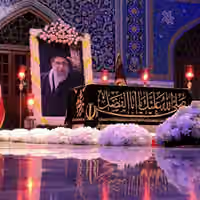
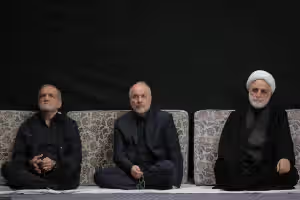
Iran uses Khamenei funeral in Iraq to claim regional reach

Jul 9, 2026, 11:28 GMT+1
•
Maryam Sinaiee
100%
Clerics wait for the arrival of the coffin of Iran's late Supreme Leader Ali Khamenei at the Imam Ali Shrine in Najaf, Iraq, July 8, 2026.

The Islamic Republic sought to turn Ali Khamenei’s funeral ceremonies in Iraq into a regional show of loyalty, using processions in Najaf and Karbala to suggest that his authority reached beyond Iran even as Tehran’s allied network faces growing pressure.

After funeral processions in Tehran and Qom, the coffins of Khamenei and several members of his family, who were killed in the February 28 US-Israeli attack, were taken on Tuesday to Najaf, home to the shrine of Imam Ali, one of the holiest sites in Shiite Islam.

They were transferred on Wednesday to Karbala, home to the shrine of Imam Hussein. Both cities carry deep religious symbolism for Shiites, especially in narratives of martyrdom, sacrifice and political defiance.

Political analyst Iman Aghayari told Iran International that the Islamic Republic was using the ceremonies to present Khamenei’s influence as extending beyond Iran’s borders.

He said Tehran also wanted to signal to Western governments that its influence in countries hosting allied armed groups “is not confined to those proxy forces, but is rooted among the people of those countries as well.”

A funeral staged across Shiite centers

A number of current and former Iraqi officials, including Prime Minister Ali al-Zaidi, along with Shiite and Sunni political, military and religious figures, welcomed the funeral delegation at Najaf airport.

The delegation was led by Khamenei’s eldest son, Mostafa Khamenei, and accompanied by President Masoud Pezeshkian, who cut short his visit and returned to Tehran early Wednesday following renewed US military strikes.

The Iraqi government declared Wednesday a public holiday to facilitate attendance and organized transportation for mourners traveling to Najaf and Karbala.

Iranian state media, citing Iraqi officials and the Popular Mobilization Forces, said more than two million people attended the ceremony in Najaf, while participation in Karbala was reported to be more than double that number.

The figures could not be independently verified.

100%
People attend a funeral procession for Iran's slain Supreme Leader Ali Khamenei during a funeral procession in Karbala, Iraq, July 9, 2026.

A claimed display of strength

Supporters of the Islamic Republic portrayed the ceremonies as proof of regional solidarity behind the so-called Axis of Resistance, Tehran’s network of allied governments, militias and political movements across the Middle East.

Esmail Qaani, commander of the IRGC’s Quds Force, said the funeral procession in Iraq would “make the red line of vengeance more prominent” and “further strengthen the united resolve of the Iraqi and Iranian peoples against American conspiracies.”

Defa Press, a news agency affiliated with Iran’s armed forces, described the ceremonies as “a transnational display of the Axis of Resistance’s power and confidence,” saying they showed political unity between Iran and Iraq.

Writing for the IRGC-affiliated Fars News Agency, political commentator Aghil Emami argued that the funeral proved the two nations’ loyalty to “shared ideals and the transnational leadership of the Islamic Revolution.”

100%
People attend a funeral procession for Iran's late Supreme Leader Ali Khamenei at the Imam Ali Shrine in Najaf, Iraq, July 8, 2026.

Religious symbolism and political messaging

Holding funeral ceremonies in Iraq – home to one of the world’s largest Shiite populations after Iran – carried both religious and political value for the Islamic Republic.

Iranian state media and some Iraqi Shiite politicians and outlets framed the processions through the language of Imam Hussein’s martyrdom, presenting Shiites as a unified political community confronting what they called “American arrogance” across the region.

For Tehran, the symbolism was especially important after Khamenei’s death and amid uncertainty over the future of its regional network.

The ceremonies allowed Iranian officials and supporters to link Khamenei’s legacy to the shrines of Najaf and Karbala, while also trying to reinforce the religious legitimacy of the Islamic Republic and of his successor.

The hardline X account Rah-e Deylami argued that Iraq, once Iran’s wartime enemy in the 1980s, had become “one of the pillars of the Axis of Resistance thanks to the blood of the martyred leader” and his policies.

It also pointed to mourners carrying photographs of Mojtaba Khamenei, saying the funeral had become “a ceremony of allegiance to his worthy successor” and that “Khamenei’s Iraqi followers have come to declare that they will continue this path.”

Such claims are difficult to measure against actual public sentiment in Iraq, where attitudes toward Iran and Iran-backed groups have long been mixed and politically contested.

Finnish grocery brand drawn into Khamenei funeral spectacle in Iraq

Jul 9, 2026, 08:30 GMT+1
100%
Screengrab from a Reuters video shows a refrigerated vehicle carrying the coffin of Iran’s former Supreme Leader Ali Khamenei in Karbala, Iraq, on July 9, 2026.

A Finnish supermarket group has found itself unexpectedly drawn into Ali Khamenei’s funeral ceremonies after footage from Iraq appeared to show his coffin being unloaded from a refrigerated truck carrying K-Group branding.

The scene, filmed in Karbala and circulated by Reuters, showed a large crowd surrounding a refrigerated truck marked with orange-and-white logos resembling those of Finland’s K Group, part of the retail giant Kesko. Men in dark clothing then pulled a coffin from the frosted rear compartment and carried it above the crowd.

100%
Supermarket K Market, Kallio, Helsinki

The footage was filmed during the Iraqi leg of Khamenei’s funeral processions, which moved through Najaf and Karbala before his planned burial in Mashhad on July 9.

The image quickly drew attention in Finland, where Finnish tabloid Ilta-Sanomat described the sight as “incredible” and said Finns may have had to “rub their eyes” when they saw what looked like familiar K-Market-style branding in the middle of Khamenei’s funeral. Helsingin Sanomat, Finland’s largest daily newspaper, also reported the story.

Yle, Finland’s public broadcaster, ran the story under the headline: “Was Khamenei’s coffin pulled from a K-Group vehicle in Iraq?” It said the Reuters video showed a cold transport truck with orange coloring and repeated K letters that appeared to resemble K Group logos.

Kesko told Yle it had no information about the vehicle and had only become aware of the case through the images.

The company said its deliveries are handled by partner-owned vehicles and that Kesko does not have its own fleet. It suggested one possibility was that a transport partner had sold a vehicle onward without removing K-Group markings.

“This may be a situation where one of our transport partners failed to remove decals referring to us when selling equipment onward,” Kesko told Yle by email.

The company said it would remind transport operators that such decals must be removed before vehicles are sold.

There is no indication that Kesko or K-Market had any involvement in Khamenei’s funeral procession or that the company owned or operated the truck.

The strange visual detail stood out because of the contrast: one of the Islamic Republic’s most symbolic funeral ceremonies, a coffin kept cold after months of delayed burial, and what appeared to be the branding of a Finnish grocery chain on the vehicle carrying it through Karbala.