• العربية
  • فارسی
Brand
  • Iran Insight
  • Politics
  • Economy
  • Analysis
  • Special Report
  • Opinion
  • Podcast
  • Iran Insight
  • Politics
  • Economy
  • Analysis
  • Special Report
  • Opinion
  • Podcast
  • Theme
  • Language
    • العربية
    • فارسی
  • Iran Insight
  • Politics
  • Economy
  • Analysis
  • Special Report
  • Opinion
  • Podcast
All rights reserved for Volant Media UK Limited
volant media logo

Trump says Iran memorandum is over, calls Tehran leaders 'scums'

Jul 8, 2026, 09:11 GMT+1
US President Donald Trump during a meeting with NATO Secretary General Mark Rutte (not pictured) on the sidelines of the NATO summit in Ankara, Turkey, 08 July 2026.

US President Donald Trump said on Wednesday a memorandum of understanding with Iran aimed at ending the conflict was over, describing Iran's leaders as "liars and scums" and saying he no longer wanted to negotiate with them.

"As far as I'm concerned, it's over," Trump told reporters in Ankara before a NATO summit.

"I don't want to deal with them anymore. They're scum... they're sick people, they're led by sick people, and they're vicious, violent people."

Trump said he would allow US negotiators to continue talks if they wished but signaled he no longer believed diplomacy would succeed.

"They want to negotiate. They're good people... but they have to come back to me," he said. "As far as I'm concerned, it's just a waste of time dealing with them, they're liars."

Last month, Washington and Tehran had signed a memorandum of understanding setting out a framework to end the conflict, including steps toward a ceasefire and renewed talks over Iran's nuclear program.

Trump defends overnight strikes

Trump defended US strikes carried out overnight, saying they came after Iran launched missiles at ships a day earlier.

"We hit them very hard last night, very hard," he said. "I told them every time you hit, we hit."

He said Iran targeted commercial shipping after Washington had allowed time for funeral ceremonies for supreme leader Ali Khamenei following earlier fighting.

"We said, 'Go and do your funeral stuff,' and instead of that they start shooting rockets at ships yesterday."

'We're going to denuke it'

Trump repeated that Iran could never be allowed to obtain a nuclear weapon.

"They can't have a nuclear weapon," he said. "We're going to denuke it. We're not going to let them."

He said Iran killed US troops through proxy attacks and blamed former Iranian military commander Qassem Soleimani for supplying roadside bombs that killed American soldiers.

"They've killed thousands and thousands of our soldiers," Trump said. "They've killed hundreds of thousands of innocent people."

Trump also said Iran had sought to kill him.

"I saw things this morning. I'm on every single one of their lists," he said. "So far I guess I've been lucky."

He described Iran's leaders as "evil, sick people" and compared the country to "cancer."

"You've got to cut out cancer early."

'They killed 54,000 people'

Trump also said Iran's authorities killed thousands of protesters during anti-establishment demonstrations.

"They killed 54,000 people as of now that were protesting," he said.

"When people say, 'How come they haven't taken over?' They can't take over because they're dead."

He also added that Iran repeatedly breaks agreements.

"We make a deal... everyone's agreed, no nuclear weapon... they go outside, talk to the press, they say we never even talked about it," Trump said.

"There's something wrong with them. They're cuckoo."

Criticizes NATO allies

Trump also renewed criticism of NATO, saying several allies refused to support the United States during the conflict with Iran.

He said Britain, Germany and France declined requests to assist Washington during the fighting.

"They said, 'We don't want to help you now, but we'll help you when the war is over,'" Trump said.

He said the United States had been "treated unfairly" by NATO and paid "billions and billions of dollars too much" for the alliance's defense.

Trump also repeated criticism of Spain, calling it "a terrible partner in NATO" and saying he wanted to end US trade with the country.

The remarks came after the United States carried out a new wave of strikes on military targets in Iran in response to attacks on commercial shipping in the Strait of Hormuz. Iran later launched missile and drone attacks on US military sites in Bahrain and Kuwait, further eroding the memorandum signed earlier this week to halt the fighting.

Most Viewed

Iran's costly farewell for supreme leader draws backlash
1
VOICES FROM IRAN

Iran's costly farewell for supreme leader draws backlash

2
ANALYSIS

The end of one-man rule? Iran tests life after Khamenei

3

Revenge rhetoric dominates Khamenei funeral despite US talks push

4
INSIGHT

Khamenei funeral struggles to stay on script

5

Commercial ships hit near Strait of Hormuz as Iran-US talks stall

Banner
Banner
Banner

Spotlight

  • Potential state TV shakeup tests Iran’s willingness to rein in hardliners
    ANALYSIS

    Potential state TV shakeup tests Iran’s willingness to rein in hardliners

  • Alleged IRGC plot sought woman to burn kosher shop, German court hears

    Alleged IRGC plot sought woman to burn kosher shop, German court hears

  • The end of one-man rule? Iran tests life after Khamenei
    ANALYSIS

    The end of one-man rule? Iran tests life after Khamenei

  • Iran's costly farewell for supreme leader draws backlash
    VOICES FROM IRAN

    Iran's costly farewell for supreme leader draws backlash

  • Iran’s energy growth slows to a crawl as demand races ahead
    INSIGHT

    Iran’s energy growth slows to a crawl as demand races ahead

  • Tailored Quran verses at Khamenei funeral spark diplomatic debate

    Tailored Quran verses at Khamenei funeral spark diplomatic debate

  • US ends Iran's brief oil opening after Hormuz tanker attacks

    US ends Iran's brief oil opening after Hormuz tanker attacks

  • Commercial ships hit near Strait of Hormuz as Iran-US talks stall

    Commercial ships hit near Strait of Hormuz as Iran-US talks stall

•
•
•

More Stories

Alleged IRGC plot sought woman to burn kosher shop, German court hears

Jul 7, 2026, 14:37 GMT+1
•
Ahmad Samadi
Alleged IRGC plot sought woman to burn kosher shop, German court hears
100%

A German court heard that an alleged IRGC-linked operative sought a Palestinian or Somali woman in financial need to burn a Jewish kosher shop for about €4,000, as police detailed a wider plot against Jewish figures in Germany.

The testimony came Monday during the second hearing in the trial of two men accused of cooperating with the Quds Force of the Islamic Revolutionary Guard Corps. The case is being heard in room 237 of Hamburg’s Higher Regional Court and is expected to continue through October.

Ali S., a 54-year-old Afghan-born Danish national, is the main defendant. Tawab M., a 42-year-old Afghan national, is the second defendant. Both are represented by lawyers of Iranian origin.

German prosecutors charged Ali S. in May with espionage, espionage for sabotage purposes, and attempted participation in murder and arson. Tawab M. was charged with attempted participation in murder.

In the courtroom, reporters and members of the public are separated from the judges, defendants and lawyers by a clear acrylic wall. The three-member court panel, made up of two judges and a clerk, is all female.

Volker Beck, head of the German-Israeli Society and one of the alleged targets in the case, sat in the public section, listening closely and taking notes.

Paid arson plan

A senior official from Germany’s Federal Criminal Police Office, or BKA, told the court that Ali S. had been instructed to set fire to a Jewish kosher grocery store.

According to the testimony, the attack was supposed to be carried out by someone with two qualities: financial need and hatred toward Jews or Israel.

Investigators said Ali S. asked his daughter whether she knew a Palestinian or Somali woman who needed money and would be willing to carry out the arson attack for 30,000 Danish kroner, roughly €4,000.

The BKA witness said the alleged arson plan formed part of a broader operation that included surveillance of Jewish targets and discussions about obtaining a weapon.

The court is expected to examine the weapons issue in future hearings. Investigators believe it could point to possible plans for killings as well as arson.

Iran trips and surveillance

The BKA witness, a senior female investigator who described the case without reading from notes, gave detailed testimony on how investigators traced the alleged operation through phone data, travel records, surveillance images and Telegram contacts.

According to the testimony, Ali S.’s mobile phones had been monitored for a long period, and German security officers followed him during several trips.

Investigators said he traveled repeatedly to Iran over the past year and met senior Islamic Republic officials and people linked to the Quds Force.

In one trip last January, he traveled from Berlin to Turkey and then to Iran, where he allegedly met his handlers. The BKA witness said Ali S. had also met the Quds Force official responsible for Israel-related affairs.

Much of the evidence presented in court came from Ali S.’s iPhones. Investigators said he searched for Jewish-owned kosher shops before traveling to Berlin.

Surveillance officers later watched him standing outside one of the shops and filming the site with his phone.

“On the surface, it looked as if Ali was making a phone call, but we knew he was actually filming the location,” the BKA witness told the court.

Investigators also said Ali S. searched for the address of Josef Schuster, head of the Central Council of Jews in Germany, after returning from Iran.

Images and screenshots from Ali S.’s phone were shown on a large courtroom screen, including saved photos of Beck. The BKA witness said the material strengthened the suspicion that an attack on Beck had been planned.

The court was also shown high-quality surveillance images of meetings between Ali S. and Tawab M. at a McDonald’s restaurant. Investigators said the two often met there without realizing how closely they were being watched.

The BKA witness identified several alleged contacts used by Ali S., including figures referred to as Haji Ali, Kazem and Vahid. Profile images linked to some contacts, shown in court, carried antisemitic and anti-Israeli symbols.

Telegram was one of the tools allegedly used for communication between the suspects and their suspected IRGC-linked handlers.

Investigators portrayed Tawab M. as someone Ali S. allegedly brought in because he could be trusted and had anti-Jewish and anti-Israeli motivation.

Neither defendant appeared visibly worried in court. Both sat without handcuffs and were able to consult freely with their lawyers.

For Beck, the hearing marked the second time he had seen the faces of men accused of helping plan his possible murder.

He said he was satisfied that the alleged would-be attackers had been arrested, but added that he was not at peace.

German security agencies have warned in recent months of a growing threat from the Islamic Republic in Europe. Germany’s domestic intelligence agency has said Tehran may expand intelligence and terrorist operations in Europe after recent regional developments, a warning security officials view this case as helping illustrate.

Khamenei funeral marred by Tehran route change, Iraq prayer dispute

Jul 7, 2026, 11:56 GMT+1
Khamenei funeral marred by Tehran route change, Iraq prayer dispute
100%
Pro-establishment participants gather during the funeral procession for slain Supreme Leader Ali Khamenei in Tehran on July 6, 2026.

Ali Khamenei’s funeral has been marred by confusion from Tehran to Najaf, after organizers abruptly shortened the procession route in the Iranian capital and conflicting accounts emerged over who would lead prayers when ceremonies move to Iraq.

The funeral convoy had been scheduled to move from Enghelab Street toward Azadi Square, but organizers changed the route without prior notice and sent it along Azadi Street instead, significantly shortening the procession.

Hassan Hassanzadeh, commander of the Islamic Revolutionary Guards Corps in Tehran, apologized to pro-establishment supporters on Tuesday, saying organizers had wanted the convoy to pass through Enghelab Street to allow more people to take part.

But he said “the large public presence and blocked roads” made the original route impossible.

The explanation came only hours after Hassanzadeh had denied any change to the route and said “all necessary arrangements” were in place.

Ali-Akbar Pourjamshidian, secretary of the funeral organizing committee, said the route was altered to protect the "security, safety and well-being" of participants.

State news agency IRNA reported that pro-establishment people had gathered since early morning near Enghelab Square expecting the procession to begin there and voiced frustration when the convoy instead departed from Azadi Street.

The change also drew criticism from figures close to the Islamic Republic. Hardline lawmaker Hamid Rasaei accused organizers of lacking honesty, while Mehdi Fazaeli, a member of Khamenei's office, said supporters "feel they have been misled at funeral."

Social media users offered a different explanation, arguing the route was shortened because turnout was lower than expected and that organizers sought to limit images of sparse crowds.

"The ceremony was so poorly attended that officials were forced to change Khamenei's funeral route so they could at least fill a few hundred meters of one street, but the emptiness of Azadi Square ruined that deception," an X user identified as Ali Reza wrote.

  • Iran's costly farewell for supreme leader draws backlash

    Iran's costly farewell for supreme leader draws backlash

"The blood of those killed in the Bloody January protests did not let go of the lowly dictator, even in the depths of hell," he added.

Another X user wrote that a successful display of public support "doesn't require this much justification, apology and finger-pointing."

"But when media outlets close to the government spend hours explaining why the crowd was small, why the route changed, why people were left wandering and why supporters were unhappy, the display itself has failed," the user wrote, adding that what had been intended as the Islamic Republic's biggest show of legitimacy "became a propaganda disaster."

Questions over Najaf funeral prayers

Funeral ceremonies are due to continue in the Iraqi city of Najaf on Wednesday, but that stage of the proceedings has also been overshadowed by conflicting reports over who will lead prayers over Khamenei's body.

The Islamic Revolutionary Guards-affiliated Fars News Agency reported on Monday that Mohammad Reza al-Sistani, son of Grand Ayatollah Ali al-Sistani, had sent a message to the office of Iran's supreme leader saying it would have been appropriate for his father to lead the funeral prayer but that his health prevented him from doing so.

Pro-establishment participants gather during the funeral procession for Ali Khamenei in Tehran on July 6, 2026.
100%
Pro-establishment participants gather during the funeral procession for Ali Khamenei in Tehran on July 6, 2026.

A day later, several Iranian media outlets, citing Iraqi networks, reported that the remarks attributed to Mohammad Reza al-Sistani were inaccurate.

The conflicting accounts have fueled questions about whether media close to the Iranian authorities sought to explain Grand Ayatollah Sistani's absence from the ceremony.

Sistani, 95, is regarded by many Shiites as the foremost religious authority and has led funeral prayers only once before, for his teacher.

Several Iranian media outlets said the funeral prayer in Najaf would instead be led by another cleric Muhammad Taqi al-Hakim.

Khamenei was killed on February 28, the first day of the recent war. The Assembly of Experts subsequently selected his son, Mojtaba Khamenei, as Iran's third supreme leader.

Mojtaba Khamenei has not appeared in public since his appointment and was absent from funeral ceremonies held in both Tehran and Qom.

Commercial ships hit near Strait of Hormuz as Iran-US talks stall

Jul 7, 2026, 10:21 GMT+1
Commercial ships hit near Strait of Hormuz as Iran-US talks stall
100%
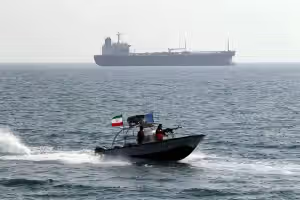
An IRGC speedboat sailing in Iran's southern waters

Commercial vessels were hit by missiles near the Strait of Hormuz early Tuesday as stalled negotiations between Iran and the United States over security in the strategic waterway came under renewed strain, with Tehran and Washington offering different accounts of the attacks.

The United Kingdom Maritime Trade Operations (UKMTO) later listed three tanker attacks near the Strait of Hormuz on Tuesday, including an LNG tanker hit by an unknown projectile eight nautical miles east of Limah, Oman, causing a fire in its port-side engine room.

The advisory also listed a VLCC hit east of Khor Fakkan, UAE, with no crew injuries reported, and a third tanker struck east of Oman’s Musandam Peninsula, sustaining minor structural damage with no casualties or environmental impact reported.

Maritime security sources said a Saudi-flagged crude oil tanker was among the vessels damaged close to the coast of Oman on Tuesday and was believed to be the Wedyan supertanker.

US officials told Axios and The Wall Street Journal that Iran's Islamic Revolutionary Guards Corps fired missiles at two commercial ships transiting the Strait of Hormuz. Both vessels, the officials said, sustained significant damage but there were no reported casualties.

Iranian state television offered a different account, reporting that one tanker had ignored repeated warnings while using a maritime route near the Omani coast backed by the United States. The tanker, it said, was struck after failing to heed those warnings.

100%

One of the targeted vessels appeared to be Al Rekayyat, a liquefied natural gas tanker linked to Qatar's LNG industry, according to The Wall Street Journal. Marine radio recordings cited by the newspaper indicated the ship suffered a fire near its engine room but that all crew members were safe.

Talks lose momentum

The attacks came less than three weeks after Tehran and Washington signed a memorandum of understanding under which Iran agreed to halt attacks on shipping in the Strait of Hormuz during negotiations over a broader agreement. A separate one-week arrangement aimed at preventing attacks in the waterway has since expired.

Indirect talks in Doha last week ended without significant progress on maritime security, according to US officials.

Iranian Foreign Minister Abbas Araghchi said Tuesday that negotiations on a final agreement would not begin while threats against Iran continued, urging Washington to "honor your signature" under the memorandum of understanding.

Separately, senior Iranian lawmaker Alaeddin Boroujerdi said legislation to formalize Iran's management of the Strait of Hormuz would be introduced in parliament, adding that any arrangement concerning the waterway without coordination with Tehran was "doomed to fail."

  • Ship attack in Hormuz tests fragile US-Iran understanding

    Ship attack in Hormuz tests fragile US-Iran understanding

The reported attacks unfolded during the fifth day of funeral ceremonies for former Supreme Leader Ali Khamenei, showing the fragility of efforts to stabilize one of the world's busiest energy shipping corridors.

The end of one-man rule? Iran tests life after Khamenei

Jul 7, 2026, 02:04 GMT+1
•
Negar Mojtahedi
The end of one-man rule? Iran tests life after Khamenei
100%
Senior Iranian officials attend the funeral of slain supreme leader Ali Khamenei. From left to right: foreign minister Abbas Araghchi, parliament speaker and lead negotiator Mohammad Bagher Ghalibaf, chief justice Gholamhossein Mohseni Eejei, and president Masoud Pezeshkian, July 4, 2026

As Iran adjusts to life after Ali Khamenei, a question once considered unthinkable is moving into the open: is the role of Supreme Leader itself being redefined?

For nearly half a century, the Islamic Republic has rested on one central principle: the Supreme Leader has the final word.

Presidents, parliament, the judiciary and the military could disagree. Institutions could compete. Factions could fight. But ultimately, Iran’s Supreme Leader settled the argument.

That assumption now appears shaken—and is being openly questioned from inside the system itself.

The debate began with what appeared to be a dispute over the government’s memorandum with the United States.

Vice President for Executive Affairs Mohammad-Jafar Ghaempanah argued that Supreme Leader Mojtaba Khamenei’s views were subject to institutional review rather than automatic implementation.

“If every opinion expressed by the Leader were implemented without question, there would be no need for institutions such as Parliament or the Supreme National Security Council,” Ghaempanah said.

Ultra-hardliners accused Ghaempanah of attacking the doctrine of Velayat-e Faqih, or Guardianship of the Islamic Jurist, arguing that he had reduced the Supreme Leader’s judgment to the level of other officials.

“It’s a very new thought,” said Patrick Clawson, deputy director for research at the Washington Institute for Near East Policy, “the idea that the Supreme Leader is not the one who makes the final decision.”

Clawson cautioned against overstating Ghaempanah’s personal influence. Although he holds the title of vice president, the position functions largely as a presidential adviser rather than one of Iran’s principal decision-makers.

The significance, he said, lies not with the messenger but with the idea itself.

“There has always been some collective element,” Clawson said. “But the Supreme Leader has been the final decision-maker.”

The suggestion that institutional decisions might themselves become definitive, without requiring the Leader’s final approval, would represent “a very new and different way of doing things,” he added.

Historian Arash Azizi said the controversy reflects a deeper problem.

“The Islamic Republic's constitutional design has had a tension or a contradiction built into it from the beginning,” Azizi said, arguing that the office of Supreme Leader was built around a “philosopher-king” model: an unelected cleric standing above politics and resolving disputes between competing institutions.

Under Ali Khamenei, that contradiction largely disappeared.

“He effectively turned Iran into an autocracy ... a personalistic system really, where his final word just carried the ultimate weight,” Azizi said.

But no successor, he argues, was likely to inherit that degree of authority.

“It had long been clear that there would be no smooth succession,” Azizi said. “It had also long been clear that it is much more likely that the future of leadership in the Islamic Republic would be less clerical and more collective.”

According to Azizi, that transition had already begun before Ali Khamenei’s death.

Following the 12-day war, he argued, day-to-day authority increasingly shifted toward the Supreme National Security Council, where Iran’s major institutions, including the presidency, judiciary, IRGC and intelligence services, are represented.

In that context, Ghaempanah’s remarks become more than a defense of negotiations with Washington.

They suggest the office of Supreme Leader itself may be evolving from the unquestioned source of authority into one power center among several.

If that trend continues, Azizi believes the constitutional framework itself may eventually need to change.

“I believe that in the next few years, they'll change the constitution and perhaps get rid of the position of Supreme Leader, merge it with the president, or fundamentally change the constitution of the Islamic Republic.”

Janatan Sayeh, a research analyst at the Foundation for Defense of Democracies, sees another force behind the shift.

“No one had undermined the Supreme Leader's role like this,” he said.

“The military establishment does not feel the need to appease the clergy as much as they used to,” Sayeh added.

Rather than replacing the office of Supreme Leader, Sayeh argues, the Islamic Revolutionary Guard Corps benefits from preserving it as a source of religious and constitutional legitimacy while real power increasingly flows through security institutions.

“Ideally they want a Velayat-e Faqih that's IRGC-dominated and not influenced by the clergy,” he said.

The government insists Ghaempanah’s comments have been distorted and that he never challenged the Supreme Leader’s authority.

Yet the debate his remarks unleashed reveals something almost unimaginable under Ali Khamenei.

For decades, Iran’s institutions competed beneath a single unquestioned authority. Today, the competition increasingly appears to be over that authority itself.

Whether power ultimately settles with the Supreme National Security Council, the IRGC or another coalition of political elites remains uncertain.

The deeper question is whether the office of Supreme Leader, as it functioned under Ali Khamenei, can survive the man who defined it.

Revenge rhetoric dominates Khamenei funeral despite US talks push

Jul 6, 2026, 22:56 GMT+1
Revenge rhetoric dominates Khamenei funeral despite US talks push
100%
Mourners carry an anti-Trump banner at the funeral ceremonies for Iran's slain supreme leader Ali Khamenei, Tehran, July 5, 2026

Calls for revenge and threats targeting US President Donald Trump and other American public figures featured prominently during Ali Khamenei’s funeral procession in Tehran on Monday, as mourners demanded retaliation for the slain Supreme Leader’s killing.

Participants carried placards resembling assassination target lists, with red crosshairs superimposed on the faces of several US and pro-Israel figures.

Those pictured included Trump, Republican Senator Lindsey Graham, conservative commentator Ben Shapiro, activist Laura Loomer, Israeli-American billionaire Miriam Adelson, Foundation for Defense of Democracies chief Mark Dubowitz, investor Peter Thiel and others.

The placards read: “Sooner or later, your heads will roll.”

Participants also hanged an effigy of Trump, while others carried a large banner reading “Kill Trump – $100 Million Iranian Bounty” in front of the vehicle carrying Khamenei’s coffin.

A video published online showed Islamic Republic supporters throwing stones at a poster of Trump before tearing it apart.

In another video from the procession, mourners chanted: “We don't want a deal, we want Trump's head,” underscoring the contrast between public calls for revenge and the Islamic Republic’s parallel ceasefire and negotiation track with Washington.

The IRGC-affiliated Fars News Agency separately published footage showing supporters waving red flags and calling for revenge over Khamenei’s killing, reinforcing the retaliation theme that ran through the procession.

A large English-language poster depicting Trump and Israeli Prime Minister Benjamin Netanyahu as wanted men was also displayed among the crowds, featuring threats including “There will be blood” and “Kill Trump” alongside images of the two leaders marked with crosshairs.

Iranian officials and pro-government figures have repeatedly called for revenge over Khamenei’s killing, while insisting that retaliation is separate from the country’s ceasefire and negotiation process.

Inside Tehran’s metro system, Islamic Republic supporters chanted slogans against negotiations with the United States, including: “We did not give martyrs to make peace, or to praise the murderer Trump.”

Another group chanted: “Death to the foreign-backed Pahlavi,” referring to exiled prince Reza Pahlavi, who has called for the end of the Islamic Republic.

The funeral, staged as a mass display of loyalty to the Islamic Republic’s slain leader, became a platform for threats against US and Israeli figures and against Iranian opposition figures abroad.