Saudi Arabia weighs pipeline expansion to bypass Hormuz – Reuters
Saudi Arabia is considering expanding the capacity of its crude oil pipeline to the western Red Sea coast, allowing it and possibly neighboring states to move more oil without crossing the Strait of Hormuz, Reuters reported on Tuesday, citing five sources close to the matter.
The country is in preliminary talks with some neighbors about a potential capacity increase of up to 2 million barrels per day, according to the report.
It was unclear whether the plan would involve upgrades to existing infrastructure or a new pipeline. One source said the expansion would include a smaller second pipe for oil products.
The project could take years, cost billions of dollars and require changes to Saudi crude pricing, another source said, according to the report.

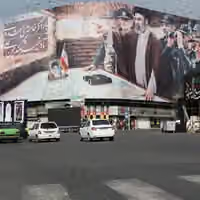
Ali Khamenei’s funeral has been marred by confusion from Tehran to Najaf, after organizers abruptly shortened the procession route in the Iranian capital and conflicting accounts emerged over who would lead prayers when ceremonies move to Iraq.
The funeral convoy had been scheduled to move from Enghelab Street toward Azadi Square, but organizers changed the route without prior notice and sent it along Azadi Street instead, significantly shortening the procession.
Hassan Hassanzadeh, commander of the Islamic Revolutionary Guards Corps in Tehran, apologized to pro-establishment supporters on Tuesday, saying organizers had wanted the convoy to pass through Enghelab Street to allow more people to take part.
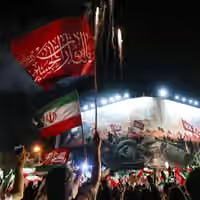
Pro-establishment participants gather during the funeral procession for slain Supreme Leader Ali Khamenei in Tehran on July 6, 2026.
Ali Khamenei’s funeral has been marred by confusion from Tehran to Najaf, after organizers abruptly shortened the procession route in the Iranian capital and conflicting accounts emerged over who would lead prayers when ceremonies move to Iraq.
The funeral convoy had been scheduled to move from Enghelab Street toward Azadi Square, but organizers changed the route without prior notice and sent it along Azadi Street instead, significantly shortening the procession.
Hassan Hassanzadeh, commander of the Islamic Revolutionary Guards Corps in Tehran, apologized to pro-establishment supporters on Tuesday, saying organizers had wanted the convoy to pass through Enghelab Street to allow more people to take part.
But he said “the large public presence and blocked roads” made the original route impossible.
The explanation came only hours after Hassanzadeh had denied any change to the route and said “all necessary arrangements” were in place.
Ali-Akbar Pourjamshidian, secretary of the funeral organizing committee, said the route was altered to protect the "security, safety and well-being" of participants.
State news agency IRNA reported that pro-establishment people had gathered since early morning near Enghelab Square expecting the procession to begin there and voiced frustration when the convoy instead departed from Azadi Street.
The change also drew criticism from figures close to the Islamic Republic. Hardline lawmaker Hamid Rasaei accused organizers of lacking honesty, while Mehdi Fazaeli, a member of Khamenei's office, said supporters "feel they have been misled at funeral."
Social media users offered a different explanation, arguing the route was shortened because turnout was lower than expected and that organizers sought to limit images of sparse crowds.
"The ceremony was so poorly attended that officials were forced to change Khamenei's funeral route so they could at least fill a few hundred meters of one street, but the emptiness of Azadi Square ruined that deception," an X user identified as Ali Reza wrote.
"The blood of those killed in the Bloody January protests did not let go of the lowly dictator, even in the depths of hell," he added.
Another X user wrote that a successful display of public support "doesn't require this much justification, apology and finger-pointing."
"But when media outlets close to the government spend hours explaining why the crowd was small, why the route changed, why people were left wandering and why supporters were unhappy, the display itself has failed," the user wrote, adding that what had been intended as the Islamic Republic's biggest show of legitimacy "became a propaganda disaster."
Questions over Najaf funeral prayers
Funeral ceremonies are due to continue in the Iraqi city of Najaf on Wednesday, but that stage of the proceedings has also been overshadowed by conflicting reports over who will lead prayers over Khamenei's body.
The Islamic Revolutionary Guards-affiliated Fars News Agency reported on Monday that Mohammad Reza al-Sistani, son of Grand Ayatollah Ali al-Sistani, had sent a message to the office of Iran's supreme leader saying it would have been appropriate for his father to lead the funeral prayer but that his health prevented him from doing so.
Pro-establishment participants gather during the funeral procession for Ali Khamenei in Tehran on July 6, 2026.
A day later, several Iranian media outlets, citing Iraqi networks, reported that the remarks attributed to Mohammad Reza al-Sistani were inaccurate.
The conflicting accounts have fueled questions about whether media close to the Iranian authorities sought to explain Grand Ayatollah Sistani's absence from the ceremony.
Sistani, 95, is regarded by many Shiites as the foremost religious authority and has led funeral prayers only once before, for his teacher.
Several Iranian media outlets said the funeral prayer in Najaf would instead be led by another cleric Muhammad Taqi al-Hakim.
Khamenei was killed on February 28, the first day of the recent war. The Assembly of Experts subsequently selected his son, Mojtaba Khamenei, as Iran's third supreme leader.
Mojtaba Khamenei has not appeared in public since his appointment and was absent from funeral ceremonies held in both Tehran and Qom.
The family of British nationals Lindsay and Craig Foreman said on Tuesday they were “desperately worried” after reports that the couple were being denied medical care and basic supplies during a hunger strike in Tehran’s Evin prison.
The family said Craig had been on hunger strike for nine weeks and Lindsay for eight weeks, with both suffering severe weight loss.
Their son, Joe Bennett, is due to meet British MPs in Parliament on Wednesday to press for urgent action.
The family urged the UK government to demand independent medical access, delivery of withheld supplies and the couple’s release.
The funeral procession for Iran’s former Supreme Leader Ali Khamenei in Iraq will deepen calls for revenge and strengthen unity between the two countries against the United States, IRGC Quds Force commander Esmail Ghaani said on Tuesday.
He added that plans by Iraq’s government to hold funeral ceremonies for Khamenei showed the depth of ties between the two countries.
Ghaani said the funeral for Khamenei in Iraq would tighten “the clenched fists” of both counties against what he called American plots and make “the red line of blood vengeance” more pronounced.
File photo shows an Islamic Revolutionary Guards Corps (IRGC) speedboat patrolling near a commercial tanker in the Strait of Hormuz.
Commercial vessels were hit by missiles near the Strait of Hormuz early Tuesday as stalled negotiations between Iran and the United States over security in the strategic waterway came under renewed strain, with Tehran and Washington offering different accounts of the attacks.
The United Kingdom Maritime Trade Operations (UKMTO) later listed three tanker attacks near the Strait of Hormuz on Tuesday, including an LNG tanker hit by an unknown projectile eight nautical miles east of Limah, Oman, causing a fire in its port-side engine room.
The advisory also listed a VLCC hit east of Khor Fakkan, UAE, with no crew injuries reported, and a third tanker struck east of Oman’s Musandam Peninsula, sustaining minor structural damage with no casualties or environmental impact reported.
Maritime security sources said a Saudi-flagged crude oil tanker was among the vessels damaged close to the coast of Oman on Tuesday and was believed to be the Wedyan supertanker.
US officials told Axios and The Wall Street Journal that Iran's Islamic Revolutionary Guards Corps fired missiles at two commercial ships transiting the Strait of Hormuz. Both vessels, the officials said, sustained significant damage but there were no reported casualties.
Iranian state television offered a different account, reporting that one tanker had ignored repeated warnings while using a maritime route near the Omani coast backed by the United States. The tanker, it said, was struck after failing to heed those warnings.
One of the targeted vessels appeared to be Al Rekayyat, a liquefied natural gas tanker linked to Qatar's LNG industry, according to The Wall Street Journal. Marine radio recordings cited by the newspaper indicated the ship suffered a fire near its engine room but that all crew members were safe.
Talks lose momentum
The attacks came less than three weeks after Tehran and Washington signed a memorandum of understanding under which Iran agreed to halt attacks on shipping in the Strait of Hormuz during negotiations over a broader agreement. A separate one-week arrangement aimed at preventing attacks in the waterway has since expired.
Indirect talks in Doha last week ended without significant progress on maritime security, according to US officials.
Iranian Foreign Minister Abbas Araghchi said Tuesday that negotiations on a final agreement would not begin while threats against Iran continued, urging Washington to "honor your signature" under the memorandum of understanding.
Separately, senior Iranian lawmaker Alaeddin Boroujerdi said legislation to formalize Iran's management of the Strait of Hormuz would be introduced in parliament, adding that any arrangement concerning the waterway without coordination with Tehran was "doomed to fail."
The reported attacks unfolded during the fifth day of funeral ceremonies for former Supreme Leader Ali Khamenei, showing the fragility of efforts to stabilize one of the world's busiest energy shipping corridors.