• العربية
  • فارسی
Brand
  • Iran Insight
  • Politics
  • Economy
  • Analysis
  • Special Report
  • Opinion
  • Podcast
  • Iran Insight
  • Politics
  • Economy
  • Analysis
  • Special Report
  • Opinion
  • Podcast
  • Theme
  • Language
    • العربية
    • فارسی
  • Iran Insight
  • Politics
  • Economy
  • Analysis
  • Special Report
  • Opinion
  • Podcast
All rights reserved for Volant Media UK Limited
volant media logo

Khamenei funeral marred by Tehran route change, Najaf prayer dispute

Jul 7, 2026, 11:56 GMT+1
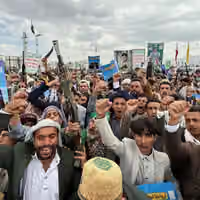
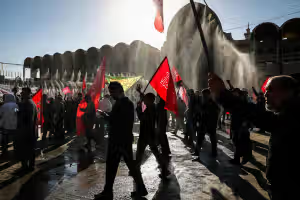
Pro-establishment participants gather during the funeral procession for slain Supreme Leader Ali Khamenei in Tehran on July 6, 2026.

Ali Khamenei’s funeral has been marred by confusion from Tehran to Najaf, after organizers abruptly shortened the procession route in the Iranian capital and conflicting accounts emerged over who would lead prayers when ceremonies move to Iraq.

The funeral convoy had been scheduled to move from Enghelab Street toward Azadi Square, but organizers changed the route without prior notice and sent it along Azadi Street instead, significantly shortening the procession.

Hassan Hassanzadeh, commander of the Islamic Revolutionary Guards Corps in Tehran, apologized to pro-establishment supporters on Tuesday, saying organizers had wanted the convoy to pass through Enghelab Street to allow more people to take part.

But he said “the large public presence and blocked roads” made the original route impossible.

The explanation came only hours after Hassanzadeh had denied any change to the route and said “all necessary arrangements” were in place.

Ali-Akbar Pourjamshidian, secretary of the funeral organizing committee, said the route was altered to protect the "security, safety and well-being" of participants.

State news agency IRNA reported that pro-establishment people had gathered since early morning near Enghelab Square expecting the procession to begin there and voiced frustration when the convoy instead departed from Azadi Street.

The change also drew criticism from figures close to the Islamic Republic. Hardline lawmaker Hamid Rasaei accused organizers of lacking honesty, while Mehdi Fazaeli, a member of Khamenei's office, said supporters "feel they have been misled at funeral."

Social media users offered a different explanation, arguing the route was shortened because turnout was lower than expected and that organizers sought to limit images of sparse crowds.

"The ceremony was so poorly attended that officials were forced to change Khamenei's funeral route so they could at least fill a few hundred meters of one street, but the emptiness of Azadi Square ruined that deception," an X user identified as Ali Reza wrote.

"The blood of those killed in the Bloody January protests did not let go of the lowly dictator, even in the depths of hell," he added.

Another X user wrote that a successful display of public support "doesn't require this much justification, apology and finger-pointing."

"But when media outlets close to the government spend hours explaining why the crowd was small, why the route changed, why people were left wandering and why supporters were unhappy, the display itself has failed," the user wrote, adding that what had been intended as the Islamic Republic's biggest show of legitimacy "became a propaganda disaster."

Questions over Najaf funeral prayers

Funeral ceremonies are due to continue in the Iraqi city of Najaf on Wednesday, but that stage of the proceedings has also been overshadowed by conflicting reports over who will lead prayers over Khamenei's body.

The Islamic Revolutionary Guards-affiliated Fars News Agency reported on Monday that Mohammad Reza al-Sistani, son of Grand Ayatollah Ali al-Sistani, had sent a message to the office of Iran's supreme leader saying it would have been appropriate for his father to lead the funeral prayer but that his health prevented him from doing so.

Pro-establishment participants gather during the funeral procession for Ali Khamenei in Tehran on July 6, 2026.
100%
Pro-establishment participants gather during the funeral procession for Ali Khamenei in Tehran on July 6, 2026.

A day later, several Iranian media outlets, citing Iraqi networks, reported that the remarks attributed to Mohammad Reza al-Sistani were inaccurate.

The conflicting accounts have fueled questions about whether media close to the Iranian authorities sought to explain Grand Ayatollah Sistani's absence from the ceremony.

Sistani, 95, is regarded by many Shiites as the foremost religious authority and has led funeral prayers only once before, for his teacher

Several Iranian media outlets said the funeral prayer in Najaf would instead be led by another cleric Muhammad Taqi al-Hakim.

Khamenei was killed on February 28, the first day of the recent war. The Assembly of Experts subsequently selected his son, Mojtaba Khamenei, as Iran's third supreme leader.

Mojtaba Khamenei has not appeared in public since his appointment and was absent from funeral ceremonies held in both Tehran and Qom.

Most Viewed

Iran buries Khamenei as fight over his power continues
1
ANALYSIS

Iran buries Khamenei as fight over his power continues

2
VOICES FROM IRAN

Iran's costly farewell for supreme leader draws backlash

3
INSIGHT

Iran’s energy growth slows to a crawl as demand races ahead

4
ANALYSIS

The end of one-man rule? Iran tests life after Khamenei

5

Revenge rhetoric dominates Khamenei funeral despite US talks push

Banner
Banner
Banner

Spotlight

  • Khamenei funeral struggles to stay on script
    INSIGHT

    Khamenei funeral struggles to stay on script

  • The end of one-man rule? Iran tests life after Khamenei
    ANALYSIS

    The end of one-man rule? Iran tests life after Khamenei

  • Iran's costly farewell for supreme leader draws backlash
    VOICES FROM IRAN

    Iran's costly farewell for supreme leader draws backlash

  • Iran’s energy growth slows to a crawl as demand races ahead
    INSIGHT

    Iran’s energy growth slows to a crawl as demand races ahead

  • Behind the funeral: Khamenei’s coffin becomes stage for Iran’s wounded power
    ANALYSIS

    Behind the funeral: Khamenei’s coffin becomes stage for Iran’s wounded power

  • Iran's costly farewell for supreme leader draws backlash

    Iran's costly farewell for supreme leader draws backlash

•
•
•

More Stories

The end of one-man rule? Iran tests life after Khamenei

Jul 7, 2026, 02:04 GMT+1
•
Negar Mojtahedi
The end of one-man rule? Iran tests life after Khamenei
100%
Senior Iranian officials attend the funeral of slain supreme leader Ali Khamenei. From left to right: foreign minister Abbas Araghchi, parliament speaker and lead negotiator Mohammad Bagher Ghalibaf, chief justice Gholamhossein Mohseni Eejei, and president Masoud Pezeshkian, July 4, 2026

As Iran adjusts to life after Ali Khamenei, a question once considered unthinkable is moving into the open: is the role of Supreme Leader itself being redefined?

For nearly half a century, the Islamic Republic has rested on one central principle: the Supreme Leader has the final word.

Presidents, parliament, the judiciary and the military could disagree. Institutions could compete. Factions could fight. But ultimately, Iran’s Supreme Leader settled the argument.

That assumption now appears shaken—and is being openly questioned from inside the system itself.

The debate began with what appeared to be a dispute over the government’s memorandum with the United States.

Vice President for Executive Affairs Mohammad-Jafar Ghaempanah argued that Supreme Leader Mojtaba Khamenei’s views were subject to institutional review rather than automatic implementation.

“If every opinion expressed by the Leader were implemented without question, there would be no need for institutions such as Parliament or the Supreme National Security Council,” Ghaempanah said.

Ultra-hardliners accused Ghaempanah of attacking the doctrine of Velayat-e Faqih, or Guardianship of the Islamic Jurist, arguing that he had reduced the Supreme Leader’s judgment to the level of other officials.

“It’s a very new thought,” said Patrick Clawson, deputy director for research at the Washington Institute for Near East Policy, “the idea that the Supreme Leader is not the one who makes the final decision.”

Clawson cautioned against overstating Ghaempanah’s personal influence. Although he holds the title of vice president, the position functions largely as a presidential adviser rather than one of Iran’s principal decision-makers.

The significance, he said, lies not with the messenger but with the idea itself.

“There has always been some collective element,” Clawson said. “But the Supreme Leader has been the final decision-maker.”

The suggestion that institutional decisions might themselves become definitive, without requiring the Leader’s final approval, would represent “a very new and different way of doing things,” he added.

Historian Arash Azizi said the controversy reflects a deeper problem.

“The Islamic Republic's constitutional design has had a tension or a contradiction built into it from the beginning,” Azizi said, arguing that the office of Supreme Leader was built around a “philosopher-king” model: an unelected cleric standing above politics and resolving disputes between competing institutions.

Under Ali Khamenei, that contradiction largely disappeared.

“He effectively turned Iran into an autocracy ... a personalistic system really, where his final word just carried the ultimate weight,” Azizi said.

But no successor, he argues, was likely to inherit that degree of authority.

“It had long been clear that there would be no smooth succession,” Azizi said. “It had also long been clear that it is much more likely that the future of leadership in the Islamic Republic would be less clerical and more collective.”

According to Azizi, that transition had already begun before Ali Khamenei’s death.

Following the 12-day war, he argued, day-to-day authority increasingly shifted toward the Supreme National Security Council, where Iran’s major institutions, including the presidency, judiciary, IRGC and intelligence services, are represented.

In that context, Ghaempanah’s remarks become more than a defense of negotiations with Washington.

They suggest the office of Supreme Leader itself may be evolving from the unquestioned source of authority into one power center among several.

If that trend continues, Azizi believes the constitutional framework itself may eventually need to change.

“I believe that in the next few years, they'll change the constitution and perhaps get rid of the position of Supreme Leader, merge it with the president, or fundamentally change the constitution of the Islamic Republic.”

Janatan Sayeh, a research analyst at the Foundation for Defense of Democracies, sees another force behind the shift.

“No one had undermined the Supreme Leader's role like this,” he said.

“The military establishment does not feel the need to appease the clergy as much as they used to,” Sayeh added.

Rather than replacing the office of Supreme Leader, Sayeh argues, the Islamic Revolutionary Guard Corps benefits from preserving it as a source of religious and constitutional legitimacy while real power increasingly flows through security institutions.

“Ideally they want a Velayat-e Faqih that's IRGC-dominated and not influenced by the clergy,” he said.

The government insists Ghaempanah’s comments have been distorted and that he never challenged the Supreme Leader’s authority.

Yet the debate his remarks unleashed reveals something almost unimaginable under Ali Khamenei.

For decades, Iran’s institutions competed beneath a single unquestioned authority. Today, the competition increasingly appears to be over that authority itself.

Whether power ultimately settles with the Supreme National Security Council, the IRGC or another coalition of political elites remains uncertain.

The deeper question is whether the office of Supreme Leader, as it functioned under Ali Khamenei, can survive the man who defined it.

Iran keeps Ejei as judiciary chief, preserving hardline course

Jul 6, 2026, 11:42 GMT+1
•
Naeimeh Doostdar
Iran keeps Ejei as judiciary chief, preserving hardline course
100%
Iran's Judiciary Cheif Gholamhossein Mohseni Ejei

Gholamhossein Mohseni Ejei was recently reappointed as judiciary chief for another five-year term, reinforcing the Islamic Republic’s security-focused judicial system and offering an early indication of how Supreme Leader Mojtaba Khamenei intends to manage power.

The appointment, issued under Article 157 of Iran’s constitution, leaves one of the Islamic Republic’s longest-serving judicial and intelligence figures at the head of an institution that has played a central role in prosecuting dissent, overseeing political cases and implementing the state’s domestic security policies.

Mohseni Ejei, 69, has spent more than four decades moving between the Revolutionary Courts, the Intelligence Ministry and the judiciary, making him one of the few senior officials with experience across all three pillars of Iran’s security establishment.

Unlike many first-generation clerics who rose through purely religious institutions, Mohseni Ejei also earned a master's degree in private international law. That legal education, however, has done little to shape his public image, which has instead been defined by security cases, political prosecutions and harsh judicial policies.

  • Mass arrests, intensifying crackdown sweep Iran amid attacks

    Mass arrests, intensifying crackdown sweep Iran amid attacks

His rise began during the 1980s, when he served as an investigator in the case against Mehdi Hashemi, the brother-in-law of the late Grand Ayatollah Hossein Ali Montazeri. The prosecution helped weaken Montazeri's political standing before he was removed as the designated successor to the Islamic Republic's founder, Ruhollah Khomeini.

That early role established Mohseni Ejei as an official closely associated with politically sensitive investigations, forced confessions and cases that blurred the boundary between judicial procedure and national security.

Security insider

Official biographies highlight his studies at the Haqqani Seminary and his involvement in prominent corruption prosecutions during the 1990s, including cases involving businessman Fazel Khodadad and former Tehran mayor Gholamhossein Karbaschi.

His career expanded further when he became intelligence minister under President Mahmoud Ahmadinejad before being dismissed in 2009. He was subsequently appointed prosecutor general, later became first deputy judiciary chief and assumed the judiciary's top post in 2021.

The combination of intelligence, prosecutorial and judicial experience has made Mohseni Ejei one of the Islamic Republic's most trusted officials for handling politically sensitive files involving opposition figures, corruption allegations and national security matters.

Supporters portray him as an experienced administrator familiar with every layer of Iran's judicial system. Critics argue his career reflects the increasing integration of intelligence agencies and the courts, turning judicial institutions into instruments for enforcing political control.

Mohseni Ejei has also maintained an unusually low public profile outside official duties. Unlike many senior Iranian politicians, he rarely projects a personal image or family life through the media, appearing primarily in court proceedings, official meetings and state broadcasts.

'The man who bites'

Among many Iranians, Mohseni Ejei's public reputation extends beyond his judicial decisions.

One of the most enduring stories surrounding him dates to 2004, when journalist Isa Saharkhiz accused Mohseni Ejei of throwing a cube-sugar bowl and biting his shoulder during a dispute at a meeting of Iran's Press Supervisory Board. The account became one of the defining anecdotes associated with his public image.

His international profile, however, has been shaped more by human rights concerns than by personal controversies.

The United States Department of the Treasury sanctioned Mohseni Ejei in September 2010 over his role in serious human rights abuses following Iran's disputed 2009 presidential election. The sanctions placed him alongside other senior Iranian security officials accused of involvement in post-election repression.

The European Union also imposed human rights sanctions on him, citing his role in unfair trials and severe prison and death sentences against political activists and protesters.

Judiciary under scrutiny

During his first term as judiciary chief, Mohseni Ejei said wants to promote themes including judicial reform, anti-corruption efforts and reducing court delays.

Judiciary Chief Gholamhossein Mohseni Ejei, recently appointed to a new five-year term, attends a ceremony alongside President Masoud Pezeshkian (left) and Parliament Speaker Mohammad Bagher Ghalibaf (center).
100%
Judiciary Chief Gholamhossein Mohseni Ejei, recently appointed to a new five-year term, attends a ceremony alongside President Masoud Pezeshkian (left) and Parliament Speaker Mohammad Bagher Ghalibaf (center).

Human rights organizations, however, have argued the judiciary became more deeply involved in suppressing political opposition, particularly following the 2022 Woman, Life, Freedom protests triggered by the death of Mahsa Amini in morality police custody.

Mohseni Ejei publicly defended death sentences imposed on some protesters after those demonstrations.

Amnesty International said in September 2025 that Iran had executed more than 1,000 people that year, describing it as the highest annual total recorded by the organization in at least 15 years. The group said authorities had increasingly relied on capital punishment following the Woman, Life, Freedom protests.

The Iran Human Rights annual report recorded at least 1,639 executions during 2025, saying more than 93% were never officially announced and that Revolutionary Courts handed down 852 execution sentences during the year.

Following the recent conflict involving Israel and the United States, rights groups have also accused Iranian authorities of accelerating political prosecutions under wartime conditions.

Amnesty International said in May 2026 that Iranian authorities had intensified mass arrests, expedited trials and politically motivated executions, documenting at least 42 executions on political charges since late February after proceedings it described as unfair.

  • Amnesty says Iran drove global surge in executions in 2025

    Amnesty says Iran drove global surge in executions in 2025

Mohseni Ejei's reappointment follows days of speculation that Iran's new leadership might replace him to demonstrate a change of direction. Instead, retaining him suggests continuity rather than restructuring at the judiciary.

The decision shows that, at least in the early phase of Mojtaba Khamenei's leadership, judicial authority will remain closely aligned with Iran's security institutions, reinforcing a model in which the courts continue to play a central role in maintaining political control rather than signaling a broader opening of the country's legal system.

After the war, Iran’s rulers face their biggest question

Jul 4, 2026, 22:20 GMT+1
•
Negar Mojtahedi
After the war, Iran’s rulers face their biggest question
100%
Iranian officials at Ali Khamenei's funeral on July 3, 2026. From left to right: Abbas Araghchi, Sadegh Amoli Larijani, Gholamhossein Mohseni Ejei, Mohammad Bagher Ghalibaf, Masoud Pezeshkian, Mohsen Rezaei

The Iran-US truce has exposed a deeper battle inside Tehran, where public rifts over censorship, negotiations and the system’s future point to a survival debate that could reshape or further destabilize the regime, experts told the Eye for Iran podcast.

In the days since the fighting subsided, Iran's political establishment has offered an unusually public glimpse into divisions that have long remained largely behind closed doors.

State television abruptly cut short a pre-recorded interview with Parliament Speaker Mohammad Bagher Ghalibaf as he discussed the use of blocked Iranian funds abroad, prompting accusations that politically sensitive remarks had been censored. State broadcaster IRIB insisted the interview had always been scheduled to air in two parts.

Elsewhere, hardliners heckled Foreign Minister Abbas Araghchi during a visit to Karbala, chanting "death to the appeaser" and "we don't want pretense" as Tehran pursues negotiations with Washington. Establishment commentators have also begun openly discussing ideas that, until recently, would have been politically difficult to imagine entering the public conversation.

Individually, each episode could be dismissed as another example of factional politics inside the Islamic Republic.

Taken together, however, they point to something more significant.

They suggest the post-war debate inside Tehran is no longer simply about diplomacy, sanctions or military strategy.

It is increasingly about how the Islamic Republic must adapt if it is to preserve power in the wake of one of the greatest shocks in its 47-year history.

"The question isn't whether they're engaging in soul-searching," Alex Vatanka, a senior fellow at the Middle East Institute, told Eye for Iran. "They have to."

For Vatanka, the significance of this moment is not that the Islamic Republic has suddenly embraced reform.

It is that the war appears to have stripped away old assumptions.

"I think there is a lot more clarity today than there was before the war," he said. "The regime knows the old model failed. The question now is what comes next."

He believes survival—not reform—is driving the conversation.

"If you're in the business of surviving, you don't want this to happen to you again," he said. "Maybe this is the moment you change course."

That should not be mistaken for moderation.

"You don't do it because you love the people of Iran," Vatanka said. "You do it because you want to survive."

The debate itself could prove destabilizing.

"When the knives are out within the regime, they go after each other in vicious ways," Vatanka warned, arguing that competition between rival factions could intensify as different camps attempt to shape the Islamic Republic's post-war future.

Behnam Ben Taleblu, senior director of the Iran Program at the Foundation for Defense of Democracies, argues that understanding those debates first requires understanding the nature of the political system itself.

"It is not straight-up Islamic theocracy," he said.

Instead, he described the Islamic Republic as a political project drawing on multiple ideological traditions.

"A traditional Shia marja has basically taken Karl Marx, the Quran and Plato and put it together and created a political system on top of that."

That, Taleblu argues, is why outsiders should be careful not to confuse adaptation with transformation.

"I think it is a real battle within this regime of how best to preserve the prerogatives and the privileges of power while also sacrificing as little as possible on the ideology."

Even if institutions evolve, he says, the guiding principles may not.

"Real transformation comes with behavior. It comes with substance—not style."

Historian Shahram Kholdi remains skeptical that the current debate represents a genuine break with the past.

"Any difference that has existed between any of these people, in my opinion, has always been one of degree rather than in kind," he said. "Tactics are different. Worldviews, strategies, expectations and demands are all the same."

Rather than seeing reform, Kholdi sees a political elite trying to preserve the system after one of its most serious crises.

But he also believes the post-war period could intensify competition among rival centers of power.

"If Ghalibaf and his ilk manage to get the upper hand... the rest of the gang would feel completely insecure, and that intra-conflict then would materialize into a hot conflict within them," he said.

"And that may very well spell their final doom once and for all."

Whether that prediction proves correct remains to be seen.

What is already clear is that the conversation unfolding inside Tehran has moved beyond the immediate consequences of the war.

It has become a debate about the future of the Islamic Republic itself.

In July 2006, Henry Kissinger argued that Iran's leaders would eventually have to decide whether they were governing "a cause or a nation."

Today, that question is no longer being asked only by foreign observers. Increasingly, it appears to be one the Islamic Republic is asking itself.

Behind the funeral: Khamenei’s coffin becomes stage for Iran’s wounded power

Jul 4, 2026, 11:14 GMT+1
•
Naeimeh Doostdar
Behind the funeral: Khamenei’s coffin becomes stage for Iran’s wounded power
100%
A man attending Ali Khamenei’s funeral ceremonies displays images of the former Supreme Leader and his successor Mojtaba Khamenei on his clothing on July 4, 2026

As Ali Khamenei’s coffin is carried through days of state-orchestrated mourning, the Islamic Republic is trying to recast a humiliating wartime death as martyrdom, continuity and power, and repair a system wounded by war and public distrust.

The funeral is not simply the burial of a dead ruler. It is an attempt to rebuild the image of a damaged power structure.

The Islamic Republic lost its leader in the first blow of the war, at the heart of its own power network and alongside members of his family.

Now it is trying to use a coffin, flags, religious elegies, organized crowds and the language of sacrifice to change the meaning of that defeat.

Whether Khamenei’s actual body is inside the coffin may matter less than what the coffin is being made to carry.

That uncertainty is itself part of the Islamic Republic’s new condition: a system that hides the truth, manages death and turns opacity into political ritual.

The coffin is therefore more than a funeral object. It is a message. The system wants to show that it can still stage power, mobilize crowds and manufacture a national narrative.

  • Classified warning projected up to 3,000 deaths at Khamenei funeral - Die Welt

    Classified warning projected up to 3,000 deaths at Khamenei funeral - Die Welt

A coffin in place of authority

In life, Khamenei was the final symbol of unaccountable power in the Islamic Republic.

For decades, he oversaw repression, executions, the elimination of opponents, control over women’s bodies, engineered elections and security violence. But the way he died broke the image of invulnerability built around him.

A leader who presented himself as commander of the “resistance” and the center of regional power was not killed on a battlefield. He was targeted in a moment that exposed the vulnerability of the structure he ruled.

That is why the Islamic Republic has to rewrite the scene of his death.

  • Funeral expenses deepen anger over Ali Khamenei's week-long burial

    Funeral expenses deepen anger over Ali Khamenei's week-long burial

The funeral is meant to replace the image of defeat with another image: a slain leader, a grieving religious community, a foreign enemy and a system that still stands after being struck.

As so often in the Islamic Republic, religious ritual becomes a tool of political survival.

In the Islamic Republic’s political culture, death is rarely allowed to remain death. If it can serve power, it is turned into martyrdom.

The state is now trying to reconstruct Khamenei not as the repressive ruler of the past four decades, but as a sacred and wronged figure killed by an external enemy.

But the problem for the Islamic Republic is that society’s memory has not been erased.

For millions of Iranians, Khamenei’s name is tied to the January 2026 killings, the suppression of the Woman, Life, Freedom movement, the bloody crackdown of November 2019, the execution of protesters, mass poverty, forced migration, structural corruption and the reduction of ordinary life to survival.

  • Khamenei funeral preparations draw complaints of forced attendance

    Khamenei funeral preparations draw complaints of forced attendance

The government wants the sound of elegies and the image of crowds to cover that memory. But official mourning is not the same as social grief.

A crowd gathered through buses, public holidays, state resources, administrative pressure, round-the-clock propaganda and networks linked to the Basij and other government bodies is not proof of public love.

It is proof of the state’s capacity, and insistence, on organizing the street.

The Islamic Republic wants to turn bodies present in public space into evidence of loyalty, even if many of those bodies are there because of fear, coercion, benefit, habit or indifference.

  • Iran media urged to avoid spotlighting political disputes during Khamenei funeral

    Iran media urged to avoid spotlighting political disputes during Khamenei funeral

A ritual for political survival

The timing of the ceremonies during the holy Shiite month of Muharram gives the state a powerful symbolic opportunity.

Since its birth, the Islamic Republic has narrated politics through the language of Ashura: oppression, blood, enemies, sacrifice and martyrdom.

It is now trying to place Khamenei’s death inside the same structure of meaning.

In that narrative, a ruler responsible for many deaths is recast as a victim whose blood must be avenged. This reversal is the core of the propaganda.

The real victims are removed from the scene, while the agent of repression is placed in the position of the wronged.

The mothers of those killed, political prisoners, suppressed women and the families of executed protesters are absent from this stage.

The scene is designed for only one authorized form of mourning: grief for humiliated power.

  • Past funeral disasters cast a shadow over Khamenei's burial

    Past funeral disasters cast a shadow over Khamenei's burial

But the state’s urgent need for religious spectacle also exposes weakness. If political authority were enough, why would the system need so much ritual, spending, closure, security and propaganda to prove that it continues?

The answer is that after Khamenei’s death, the fracture in the image of power has become visible.

His funeral is the first major test of the Islamic Republic after Khamenei.

The system wants to show that his death has not produced collapse, paralysis or a vacuum, and that it can still occupy the street.

The ceremonies are a postwar maneuver by a state that has suffered a military blow, lost much of its social legitimacy and faces a deeply distrustful society.

That is why Khamenei’s funeral is not the end of an era. It is an attempt to control the narrative of how that era ended.

The Islamic Republic knows that the way Khamenei died symbolizes weakness. It is trying to make the way he is buried symbolize power.

But the project contains a central contradiction. A system trying to build authority from Khamenei’s coffin is admitting, without saying so, that authority alone is no longer enough.

If real legitimacy existed, such a vast display would not be necessary. If society were truly grieving, this level of organization would not be needed.

If Khamenei were genuinely loved, the state would not have to rewrite his death with such a volume of propaganda, ritual and security control.

Classified warning projected up to 3,000 deaths at Khamenei funeral - Die Welt

Jul 4, 2026, 08:53 GMT+1
Classified warning projected up to 3,000 deaths at Khamenei funeral - Die Welt
100%
A view from Tehran’s Mosalla where Ali Khamenei’s week-long funeral ceremonies started on July 4, 2026

Iranian authorities are preparing for the possibility that Ali Khamenei’s week-long funeral ceremonies could leave between 1,500 and 3,000 people dead, Germany’s WELT reported, citing a classified document and municipal sources in Tehran.

The report, written from Tehran by an anonymous author whose identity is known to WELT’s editors, said officials have drawn up contingency plans for a possible mass-casualty disaster during the processions for the slain former Supreme Leader.

According to WELT, a classified letter from the Iranian Red Crescent and the national crisis management organization to First Vice President Mohammad-Reza Aref projected between 1,500 and 3,000 possible deaths.

The report said a special unit had been set up to handle the dead and missing, while thousands of new graves had been prepared at Tehran’s Behesht-e Zahra cemetery.

One Tehran municipality employee, identified under a pseudonym for security reasons, told WELT that colleagues in the city’s crisis headquarters had confirmed the preparations.

  • Funeral expenses deepen anger over Ali Khamenei's week-long burial

    Funeral expenses deepen anger over Ali Khamenei's week-long burial

“The prepared graves really exist,” she was quoted as saying. “Those responsible were told that up to 3,000 dead would be okay. With such a large crowd and this extreme heat, no one knows what will happen.”

The claims have not been independently confirmed.

Khamenei’s funeral ceremonies began in Tehran on Saturday and are expected to continue through Qom, the Iraqi cities of Najaf and Karbala, and finally Mashhad, where he is due to be buried on Thursday.

WELT said the authorities were planning a sweeping security and logistical operation in Tehran, including movement restrictions, possible disruption to air travel, thousands of buses, temporary kitchens and the use of schools and mosques to house participants.

  • Khamenei funeral preparations draw complaints of forced attendance

    Khamenei funeral preparations draw complaints of forced attendance

The report said officials had spoken of as many as 20 million people attending, a figure that is difficult to verify and is often used by Iranian authorities to portray state ceremonies as displays of mass support.

According to WELT, Tehran Municipality, led by hardline mayor Alireza Zakani, is playing a central role in the preparations, deploying 11,000 buses and keeping metro and bus rapid transit lines free and operating around the clock.

Municipal employees told the newspaper that each Tehran district had been allocated the equivalent of around 500,000 to 650,000 euros for the three days of ceremonies, excluding additional funds for bodies such as the fire department, parks organization, transport authorities and construction units.

Government-linked journalists cited by WELT estimated the budget at about 15 million euros for Tehran alone, with another five million euros each for Qom and Mashhad. With ceremonies also planned in Najaf and Karbala, the report said the funeral could become one of the most expensive state burials in modern history.

  • Past funeral disasters cast a shadow over Khamenei's burial

    Past funeral disasters cast a shadow over Khamenei's burial

The scale of the preparations has raised concern because Iran has a recent history of deadly funeral crushes. At least 56 people were killed and more than 200 injured during the 2020 funeral for IRGC commander Qasem Soleimani in Kerman, while Ruhollah Khomeini’s 1989 funeral also descended into chaos, leaving at least eight people dead and hundreds injured.

WELT also described deep political tension around the ceremonies, saying radical supporters of the Islamic Republic have used nightly gatherings to denounce the US-Iran memorandum and threaten senior officials involved in negotiations, including Foreign Minister Abbas Araghchi and Parliament Speaker Mohammad Bagher Ghalibaf.

Some participants have demanded continued war to avenge Khamenei’s killing, while videos circulating online showed hardline religious speakers making militant speeches, with some attendees carrying rifles.

The funeral is taking place during a fragile ceasefire and amid growing public frustration over the cost of the ceremonies, economic hardship and the government’s mobilization of state resources for political display.