IRGC Quds Force chief says Khamenei funeral in Iraq will deepen anti-US revenge drive
The funeral procession for Iran’s former Supreme Leader Ali Khamenei in Iraq will deepen calls for revenge and strengthen unity between the two countries against the United States, IRGC Quds Force commander Esmail Ghaani said on Tuesday.
He added that plans by Iraq’s government to hold funeral ceremonies for Khamenei showed the depth of ties between the two countries.
Ghaani said the funeral for Khamenei in Iraq would tighten “the clenched fists” of both counties against what he called American plots and make “the red line of blood vengeance” more pronounced.
File photo shows an Islamic Revolutionary Guards Corps (IRGC) speedboat patrolling near a commercial tanker in the Strait of Hormuz.
Commercial vessels were hit by missiles near the Strait of Hormuz early Tuesday as stalled negotiations between Iran and the United States over security in the strategic waterway came under renewed strain, with Tehran and Washington offering different accounts of the attacks.
The United Kingdom Maritime Trade Operations (UKMTO) later listed three tanker attacks near the Strait of Hormuz on Tuesday, including an LNG tanker hit by an unknown projectile eight nautical miles east of Limah, Oman, causing a fire in its port-side engine room.
The advisory also listed a VLCC hit east of Khor Fakkan, UAE, with no crew injuries reported, and a third tanker struck east of Oman’s Musandam Peninsula, sustaining minor structural damage with no casualties or environmental impact reported.
Maritime security sources said a Saudi-flagged crude oil tanker was among the vessels damaged close to the coast of Oman on Tuesday and was believed to be the Wedyan supertanker.
US officials told Axios and The Wall Street Journal that Iran's Islamic Revolutionary Guards Corps fired missiles at two commercial ships transiting the Strait of Hormuz. Both vessels, the officials said, sustained significant damage but there were no reported casualties.
Iranian state television offered a different account, reporting that one tanker had ignored repeated warnings while using a maritime route near the Omani coast backed by the United States. The tanker, it said, was struck after failing to heed those warnings.
One of the targeted vessels appeared to be Al Rekayyat, a liquefied natural gas tanker linked to Qatar's LNG industry, according to The Wall Street Journal. Marine radio recordings cited by the newspaper indicated the ship suffered a fire near its engine room but that all crew members were safe.
Talks lose momentum
The attacks came less than three weeks after Tehran and Washington signed a memorandum of understanding under which Iran agreed to halt attacks on shipping in the Strait of Hormuz during negotiations over a broader agreement. A separate one-week arrangement aimed at preventing attacks in the waterway has since expired.
Indirect talks in Doha last week ended without significant progress on maritime security, according to US officials.
Iranian Foreign Minister Abbas Araghchi said Tuesday that negotiations on a final agreement would not begin while threats against Iran continued, urging Washington to "honor your signature" under the memorandum of understanding.
Separately, senior Iranian lawmaker Alaeddin Boroujerdi said legislation to formalize Iran's management of the Strait of Hormuz would be introduced in parliament, adding that any arrangement concerning the waterway without coordination with Tehran was "doomed to fail."
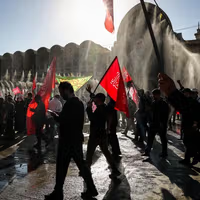
The reported attacks unfolded during the fifth day of funeral ceremonies for former Supreme Leader Ali Khamenei, showing the fragility of efforts to stabilize one of the world's busiest energy shipping corridors.
A Saudi-flagged crude oil tanker was damaged near the Strait of Hormuz off Oman after a Qatari liquefied natural gas tanker was struck in the same area, Reuters reported on Tuesday, citing maritime security sources.
The cause of the blast was not known, and the crude tanker was believed to be the supertanker Wedyan, the sources said.
Ship-tracking data on MarineTraffic showed the Wedyan’s last position was inside the Persian Gulf on July 3, according to Reuters.
European chemical makers are using a brief refinancing window opened by the Iran war to extend debt maturities, Bloomberg reported on Tuesday, citing Lazard’s Katja Ksoll.
Ksoll said supply chain disruptions caused by the war had temporarily improved sentiment toward European producers, which are less exposed to feedstock shortages than Asian rivals.
She said strong liquidity in credit markets had also boosted investor demand for new debt deals, giving cash-strapped chemical companies a chance to refinance even as the sector’s broader downturn continues.
Any move related to the Strait of Hormuz without coordination with Iran is doomed to fail, a senior Iranian lawmaker said on Tuesday.
Alaeddin Boroujerdi, a member of parliament’s national security and foreign policy committee, said a decision to change the governing regime of the Strait of Hormuz had been made at the highest levels of the Islamic Republic in response to the latest war.
He said legislation on managing the strait would be approved by parliament at the earliest opportunity and that relevant bodies would be required to fully implement it.
The MP said Iran would pursue any action related to the Strait of Hormuz within the framework of its national interests and security.
Iranian Foreign Minister Abbas Araghchi said on Tuesday that negotiations with the United States on a final deal would not begin if threats against Iran continued.
Araghchi said in a post on X that part 13 of the Tehran-Washington memorandum of understanding was clear, adding that, "Negotiations on final Deal will not commence if threats continue.”
He also addressed the other side to “honor your signature.”
He said millions of Iranians had rallied to honor former Supreme Leader Ali Khamenei and that neither the public nor Iran’s armed forces were moved by threats.