The end of one-man rule? Iran tests life after Khamenei


As Iran adjusts to life after Ali Khamenei, a question once considered unthinkable is moving into the open: is the role of Supreme Leader itself being redefined?
For nearly half a century, the Islamic Republic has rested on one central principle: the Supreme Leader has the final word.
Presidents, parliament, the judiciary and the military could disagree. Institutions could compete. Factions could fight. But ultimately, Iran’s Supreme Leader settled the argument.
That assumption now appears shaken—and is being openly questioned from inside the system itself.
Vice President for Executive Affairs Mohammad-Jafar Ghaempanah argued that Supreme Leader Mojtaba Khamenei’s views were subject to institutional review rather than automatic implementation.
Read the full article here.





As Iran adjusts to life after Ali Khamenei, a question once considered unthinkable is moving into the open: is the role of Supreme Leader itself being redefined?
For nearly half a century, the Islamic Republic has rested on one central principle: the Supreme Leader has the final word.
Presidents, parliament, the judiciary and the military could disagree. Institutions could compete. Factions could fight. But ultimately, Iran’s Supreme Leader settled the argument.
That assumption now appears shaken—and is being openly questioned from inside the system itself.
The debate began with what appeared to be a dispute over the government’s memorandum with the United States.
Vice President for Executive Affairs Mohammad-Jafar Ghaempanah argued that Supreme Leader Mojtaba Khamenei’s views were subject to institutional review rather than automatic implementation.
“If every opinion expressed by the Leader were implemented without question, there would be no need for institutions such as Parliament or the Supreme National Security Council,” Ghaempanah said.
Ultra-hardliners accused Ghaempanah of attacking the doctrine of Velayat-e Faqih, or Guardianship of the Islamic Jurist, arguing that he had reduced the Supreme Leader’s judgment to the level of other officials.
“It’s a very new thought,” said Patrick Clawson, deputy director for research at the Washington Institute for Near East Policy, “the idea that the Supreme Leader is not the one who makes the final decision.”
Clawson cautioned against overstating Ghaempanah’s personal influence. Although he holds the title of vice president, the position functions largely as a presidential adviser rather than one of Iran’s principal decision-makers.
The significance, he said, lies not with the messenger but with the idea itself.
“There has always been some collective element,” Clawson said. “But the Supreme Leader has been the final decision-maker.”
The suggestion that institutional decisions might themselves become definitive, without requiring the Leader’s final approval, would represent “a very new and different way of doing things,” he added.
Historian Arash Azizi said the controversy reflects a deeper problem.
“The Islamic Republic's constitutional design has had a tension or a contradiction built into it from the beginning,” Azizi said, arguing that the office of Supreme Leader was built around a “philosopher-king” model: an unelected cleric standing above politics and resolving disputes between competing institutions.
Under Ali Khamenei, that contradiction largely disappeared.
“He effectively turned Iran into an autocracy ... a personalistic system really, where his final word just carried the ultimate weight,” Azizi said.
But no successor, he argues, was likely to inherit that degree of authority.
“It had long been clear that there would be no smooth succession,” Azizi said. “It had also long been clear that it is much more likely that the future of leadership in the Islamic Republic would be less clerical and more collective.”
According to Azizi, that transition had already begun before Ali Khamenei’s death.
Following the 12-day war, he argued, day-to-day authority increasingly shifted toward the Supreme National Security Council, where Iran’s major institutions, including the presidency, judiciary, IRGC and intelligence services, are represented.
In that context, Ghaempanah’s remarks become more than a defense of negotiations with Washington.
They suggest the office of Supreme Leader itself may be evolving from the unquestioned source of authority into one power center among several.
If that trend continues, Azizi believes the constitutional framework itself may eventually need to change.
“I believe that in the next few years, they'll change the constitution and perhaps get rid of the position of Supreme Leader, merge it with the president, or fundamentally change the constitution of the Islamic Republic.”
Janatan Sayeh, a research analyst at the Foundation for Defense of Democracies, sees another force behind the shift.
“No one had undermined the Supreme Leader's role like this,” he said.
“The military establishment does not feel the need to appease the clergy as much as they used to,” Sayeh added.
Rather than replacing the office of Supreme Leader, Sayeh argues, the Islamic Revolutionary Guard Corps benefits from preserving it as a source of religious and constitutional legitimacy while real power increasingly flows through security institutions.
“Ideally they want a Velayat-e Faqih that's IRGC-dominated and not influenced by the clergy,” he said.
The government insists Ghaempanah’s comments have been distorted and that he never challenged the Supreme Leader’s authority.
Yet the debate his remarks unleashed reveals something almost unimaginable under Ali Khamenei.
For decades, Iran’s institutions competed beneath a single unquestioned authority. Today, the competition increasingly appears to be over that authority itself.
Whether power ultimately settles with the Supreme National Security Council, the IRGC or another coalition of political elites remains uncertain.
The deeper question is whether the office of Supreme Leader, as it functioned under Ali Khamenei, can survive the man who defined it.
As Iran holds week-long funeral ceremonies for Ali Khamenei, the political dynamics unfolding behind the scenes point to a striking reality: the succession question that dominated elite politics for more than a decade did not end with his death.
The rapid elevation of his son Mojtaba within ten days was intended to close that chapter. Instead, with the new Supreme Leader still absent from public view, it appears to have opened a new one.
Roughly twenty messages attributed to Mojtaba Khamenei since his succession have failed to convince many Iranians that he is truly exercising power.
Efforts by officials and supporters to prove his presence have often been contradictory, deepening rather than resolving the uncertainty.
Read the full article here.
As Iran holds week-long funeral ceremonies for Ali Khamenei, the political dynamics unfolding behind the scenes point to a striking reality: the succession question that dominated elite politics for more than a decade did not end with his death.
The rapid elevation of his son Mojtaba within ten days was intended to close that chapter. Instead, with the new Supreme Leader still absent from public view, it appears to have opened a new one.
Roughly twenty messages attributed to Mojtaba Khamenei since his succession have failed to convince many Iranians that he is truly exercising power.
Efforts by officials and supporters to prove his presence have often been contradictory, deepening rather than resolving the uncertainty.
A growing number of Iran analysts argue that, regardless of Mojtaba’s invisibility, Ali Khamenei has effectively been replaced by a constellation of elite networks built around family ties, wartime relationships dating back to the Iran–Iraq War, and geographic power bases in provinces such as Tehran, Isfahan, Khuzestan and Khorasan.
These networks, spanning civilian officials, senior IRGC commanders, clerics and younger ideological politicians, existed for decades but were ultimately contained by Ali Khamenei’s authority.
One example was the IRGC high command, which repeatedly shifted between officers from Khuzestan and Isfahan during Khamenei’s 38 years in power, before he appointed Hossein Salami from the Golpayegan region in April 2019 in what many saw as an attempt to contain an increasingly damaging rivalry.
The old reformist–conservative divide has largely faded. Following former President Ebrahim Raisi’s “purification” project, Iran’s political landscape is increasingly shaped by competition between what parliament speaker Mohammad Bagher Ghalibaf has described as “revolutionaries” and “super-revolutionaries.”
The shift has been so dramatic that even Hossein Shariatmadari, the outspoken editor of the hardline daily Kayhan and long seen as a symbol of uncompromising conservatism, is now warning against threats to national cohesion and criticizing hardliners opposing the agreement with the United States.
The struggle in Tehran is no longer over whether engagement with Washington is acceptable. Instead, competing factions are trying to claim ownership of the decision to negotiate.
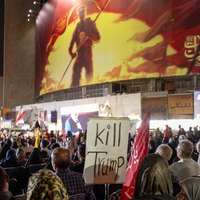
Even some hardliners who until late June accused pragmatists such as Ghalibaf and Foreign Minister Abbas Araghchi of seeking talks with “the killer of Khamenei” now argue that Iran must secure its financial interests through an understanding with Washington, even if that requires delaying decisions on parts of its nuclear program.
The most uncompromising factions inside and around the IRGC have argued that Iran’s priority should now be preserving its missile program as its remaining strategic asset.
Yet figures including MP Esmail Kowsary and Supreme National Security Council secretary Mohammad Bagher Zolghadr continue to insist Iran must also seek revenge for Khamenei’s killing.
In Mojtaba Khamenei’s continued absence, networks that once operated beneath Ali Khamenei’s centralized and uncompromising decision-making appear to be competing to define the future direction of the Islamic Republic — and to claim ownership of the very diplomatic opening many of them opposed only days earlier.
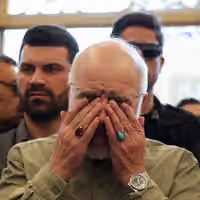
As Ali Khamenei’s coffin is carried through days of state-orchestrated mourning, the Islamic Republic is trying to recast a humiliating wartime death as martyrdom, continuity and power, and repair a system wounded by war and public distrust.
The funeral is not simply the burial of a dead ruler. It is an attempt to rebuild the image of a damaged power structure.
The Islamic Republic lost its leader in the first blow of the war, at the heart of its own power network and alongside members of his family.
As Ali Khamenei’s coffin is carried through days of state-orchestrated mourning, the Islamic Republic is trying to recast a humiliating wartime death as martyrdom, continuity and power, and repair a system wounded by war and public distrust.
The funeral is not simply the burial of a dead ruler. It is an attempt to rebuild the image of a damaged power structure.
The Islamic Republic lost its leader in the first blow of the war, at the heart of its own power network and alongside members of his family.
Now it is trying to use a coffin, flags, religious elegies, organized crowds and the language of sacrifice to change the meaning of that defeat.
Whether Khamenei’s actual body is inside the coffin may matter less than what the coffin is being made to carry.
That uncertainty is itself part of the Islamic Republic’s new condition: a system that hides the truth, manages death and turns opacity into political ritual.
The coffin is therefore more than a funeral object. It is a message. The system wants to show that it can still stage power, mobilize crowds and manufacture a national narrative.
A coffin in place of authority
In life, Khamenei was the final symbol of unaccountable power in the Islamic Republic.
For decades, he oversaw repression, executions, the elimination of opponents, control over women’s bodies, engineered elections and security violence. But the way he died broke the image of invulnerability built around him.
A leader who presented himself as commander of the “resistance” and the center of regional power was not killed on a battlefield. He was targeted in a moment that exposed the vulnerability of the structure he ruled.
That is why the Islamic Republic has to rewrite the scene of his death.
The funeral is meant to replace the image of defeat with another image: a slain leader, a grieving religious community, a foreign enemy and a system that still stands after being struck.
As so often in the Islamic Republic, religious ritual becomes a tool of political survival.
In the Islamic Republic’s political culture, death is rarely allowed to remain death. If it can serve power, it is turned into martyrdom.
The state is now trying to reconstruct Khamenei not as the repressive ruler of the past four decades, but as a sacred and wronged figure killed by an external enemy.
But the problem for the Islamic Republic is that society’s memory has not been erased.
For millions of Iranians, Khamenei’s name is tied to the January 2026 killings, the suppression of the Woman, Life, Freedom movement, the bloody crackdown of November 2019, the execution of protesters, mass poverty, forced migration, structural corruption and the reduction of ordinary life to survival.
The government wants the sound of elegies and the image of crowds to cover that memory. But official mourning is not the same as social grief.
A crowd gathered through buses, public holidays, state resources, administrative pressure, round-the-clock propaganda and networks linked to the Basij and other government bodies is not proof of public love.
It is proof of the state’s capacity, and insistence, on organizing the street.
The Islamic Republic wants to turn bodies present in public space into evidence of loyalty, even if many of those bodies are there because of fear, coercion, benefit, habit or indifference.
A ritual for political survival
The timing of the ceremonies during the holy Shiite month of Muharram gives the state a powerful symbolic opportunity.
Since its birth, the Islamic Republic has narrated politics through the language of Ashura: oppression, blood, enemies, sacrifice and martyrdom.
It is now trying to place Khamenei’s death inside the same structure of meaning.
In that narrative, a ruler responsible for many deaths is recast as a victim whose blood must be avenged. This reversal is the core of the propaganda.
The real victims are removed from the scene, while the agent of repression is placed in the position of the wronged.
The mothers of those killed, political prisoners, suppressed women and the families of executed protesters are absent from this stage.
The scene is designed for only one authorized form of mourning: grief for humiliated power.
But the state’s urgent need for religious spectacle also exposes weakness. If political authority were enough, why would the system need so much ritual, spending, closure, security and propaganda to prove that it continues?
The answer is that after Khamenei’s death, the fracture in the image of power has become visible.
His funeral is the first major test of the Islamic Republic after Khamenei.
The system wants to show that his death has not produced collapse, paralysis or a vacuum, and that it can still occupy the street.
The ceremonies are a postwar maneuver by a state that has suffered a military blow, lost much of its social legitimacy and faces a deeply distrustful society.
That is why Khamenei’s funeral is not the end of an era. It is an attempt to control the narrative of how that era ended.
The Islamic Republic knows that the way Khamenei died symbolizes weakness. It is trying to make the way he is buried symbolize power.
But the project contains a central contradiction. A system trying to build authority from Khamenei’s coffin is admitting, without saying so, that authority alone is no longer enough.
If real legitimacy existed, such a vast display would not be necessary. If society were truly grieving, this level of organization would not be needed.
If Khamenei were genuinely loved, the state would not have to rewrite his death with such a volume of propaganda, ritual and security control.