Iran buries Khamenei as fight over his power continues
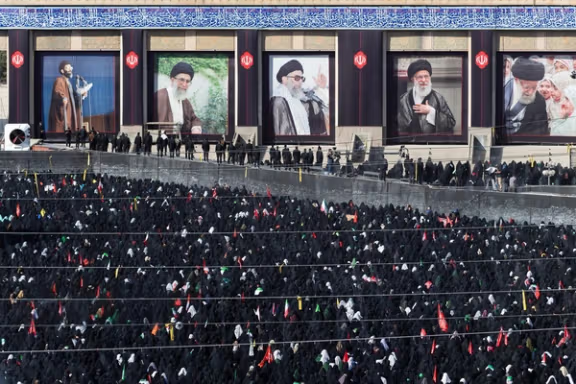

As Iran holds week-long funeral ceremonies for Ali Khamenei, the political dynamics unfolding behind the scenes point to a striking reality: the succession question that dominated elite politics for more than a decade did not end with his death.
The rapid elevation of his son Mojtaba within ten days was intended to close that chapter. Instead, with the new Supreme Leader still absent from public view, it appears to have opened a new one.
Roughly twenty messages attributed to Mojtaba Khamenei since his succession have failed to convince many Iranians that he is truly exercising power.
Efforts by officials and supporters to prove his presence have often been contradictory, deepening rather than resolving the uncertainty.
Read the full article here.





As Iran holds week-long funeral ceremonies for Ali Khamenei, the political dynamics unfolding behind the scenes point to a striking reality: the succession question that dominated elite politics for more than a decade did not end with his death.
The rapid elevation of his son Mojtaba within ten days was intended to close that chapter. Instead, with the new Supreme Leader still absent from public view, it appears to have opened a new one.
Roughly twenty messages attributed to Mojtaba Khamenei since his succession have failed to convince many Iranians that he is truly exercising power.
Efforts by officials and supporters to prove his presence have often been contradictory, deepening rather than resolving the uncertainty.
A growing number of Iran analysts argue that, regardless of Mojtaba’s invisibility, Ali Khamenei has effectively been replaced by a constellation of elite networks built around family ties, wartime relationships dating back to the Iran–Iraq War, and geographic power bases in provinces such as Tehran, Isfahan, Khuzestan and Khorasan.
These networks, spanning civilian officials, senior IRGC commanders, clerics and younger ideological politicians, existed for decades but were ultimately contained by Ali Khamenei’s authority.
One example was the IRGC high command, which repeatedly shifted between officers from Khuzestan and Isfahan during Khamenei’s 38 years in power, before he appointed Hossein Salami from the Golpayegan region in April 2019 in what many saw as an attempt to contain an increasingly damaging rivalry.
The old reformist–conservative divide has largely faded. Following former President Ebrahim Raisi’s “purification” project, Iran’s political landscape is increasingly shaped by competition between what parliament speaker Mohammad Bagher Ghalibaf has described as “revolutionaries” and “super-revolutionaries.”
The shift has been so dramatic that even Hossein Shariatmadari, the outspoken editor of the hardline daily Kayhan and long seen as a symbol of uncompromising conservatism, is now warning against threats to national cohesion and criticizing hardliners opposing the agreement with the United States.
The struggle in Tehran is no longer over whether engagement with Washington is acceptable. Instead, competing factions are trying to claim ownership of the decision to negotiate.
Even some hardliners who until late June accused pragmatists such as Ghalibaf and Foreign Minister Abbas Araghchi of seeking talks with “the killer of Khamenei” now argue that Iran must secure its financial interests through an understanding with Washington, even if that requires delaying decisions on parts of its nuclear program.
The most uncompromising factions inside and around the IRGC have argued that Iran’s priority should now be preserving its missile program as its remaining strategic asset.
Yet figures including MP Esmail Kowsary and Supreme National Security Council secretary Mohammad Bagher Zolghadr continue to insist Iran must also seek revenge for Khamenei’s killing.
In Mojtaba Khamenei’s continued absence, networks that once operated beneath Ali Khamenei’s centralized and uncompromising decision-making appear to be competing to define the future direction of the Islamic Republic — and to claim ownership of the very diplomatic opening many of them opposed only days earlier.
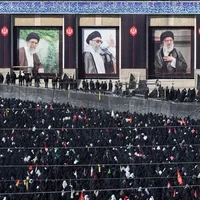
As Ali Khamenei’s coffin is carried through days of state-orchestrated mourning, the Islamic Republic is trying to recast a humiliating wartime death as martyrdom, continuity and power, and repair a system wounded by war and public distrust.
The funeral is not simply the burial of a dead ruler. It is an attempt to rebuild the image of a damaged power structure.
The Islamic Republic lost its leader in the first blow of the war, at the heart of its own power network and alongside members of his family.
As Ali Khamenei’s coffin is carried through days of state-orchestrated mourning, the Islamic Republic is trying to recast a humiliating wartime death as martyrdom, continuity and power, and repair a system wounded by war and public distrust.
The funeral is not simply the burial of a dead ruler. It is an attempt to rebuild the image of a damaged power structure.
The Islamic Republic lost its leader in the first blow of the war, at the heart of its own power network and alongside members of his family.
Now it is trying to use a coffin, flags, religious elegies, organized crowds and the language of sacrifice to change the meaning of that defeat.
Whether Khamenei’s actual body is inside the coffin may matter less than what the coffin is being made to carry.
That uncertainty is itself part of the Islamic Republic’s new condition: a system that hides the truth, manages death and turns opacity into political ritual.
The coffin is therefore more than a funeral object. It is a message. The system wants to show that it can still stage power, mobilize crowds and manufacture a national narrative.
A coffin in place of authority
In life, Khamenei was the final symbol of unaccountable power in the Islamic Republic.
For decades, he oversaw repression, executions, the elimination of opponents, control over women’s bodies, engineered elections and security violence. But the way he died broke the image of invulnerability built around him.
A leader who presented himself as commander of the “resistance” and the center of regional power was not killed on a battlefield. He was targeted in a moment that exposed the vulnerability of the structure he ruled.
That is why the Islamic Republic has to rewrite the scene of his death.
The funeral is meant to replace the image of defeat with another image: a slain leader, a grieving religious community, a foreign enemy and a system that still stands after being struck.
As so often in the Islamic Republic, religious ritual becomes a tool of political survival.
In the Islamic Republic’s political culture, death is rarely allowed to remain death. If it can serve power, it is turned into martyrdom.
The state is now trying to reconstruct Khamenei not as the repressive ruler of the past four decades, but as a sacred and wronged figure killed by an external enemy.
But the problem for the Islamic Republic is that society’s memory has not been erased.
For millions of Iranians, Khamenei’s name is tied to the January 2026 killings, the suppression of the Woman, Life, Freedom movement, the bloody crackdown of November 2019, the execution of protesters, mass poverty, forced migration, structural corruption and the reduction of ordinary life to survival.
The government wants the sound of elegies and the image of crowds to cover that memory. But official mourning is not the same as social grief.
A crowd gathered through buses, public holidays, state resources, administrative pressure, round-the-clock propaganda and networks linked to the Basij and other government bodies is not proof of public love.
It is proof of the state’s capacity, and insistence, on organizing the street.
The Islamic Republic wants to turn bodies present in public space into evidence of loyalty, even if many of those bodies are there because of fear, coercion, benefit, habit or indifference.
A ritual for political survival
The timing of the ceremonies during the holy Shiite month of Muharram gives the state a powerful symbolic opportunity.
Since its birth, the Islamic Republic has narrated politics through the language of Ashura: oppression, blood, enemies, sacrifice and martyrdom.
It is now trying to place Khamenei’s death inside the same structure of meaning.
In that narrative, a ruler responsible for many deaths is recast as a victim whose blood must be avenged. This reversal is the core of the propaganda.
The real victims are removed from the scene, while the agent of repression is placed in the position of the wronged.
The mothers of those killed, political prisoners, suppressed women and the families of executed protesters are absent from this stage.
The scene is designed for only one authorized form of mourning: grief for humiliated power.
But the state’s urgent need for religious spectacle also exposes weakness. If political authority were enough, why would the system need so much ritual, spending, closure, security and propaganda to prove that it continues?
The answer is that after Khamenei’s death, the fracture in the image of power has become visible.
His funeral is the first major test of the Islamic Republic after Khamenei.
The system wants to show that his death has not produced collapse, paralysis or a vacuum, and that it can still occupy the street.
The ceremonies are a postwar maneuver by a state that has suffered a military blow, lost much of its social legitimacy and faces a deeply distrustful society.
That is why Khamenei’s funeral is not the end of an era. It is an attempt to control the narrative of how that era ended.
The Islamic Republic knows that the way Khamenei died symbolizes weakness. It is trying to make the way he is buried symbolize power.
But the project contains a central contradiction. A system trying to build authority from Khamenei’s coffin is admitting, without saying so, that authority alone is no longer enough.
If real legitimacy existed, such a vast display would not be necessary. If society were truly grieving, this level of organization would not be needed.
If Khamenei were genuinely loved, the state would not have to rewrite his death with such a volume of propaganda, ritual and security control.
The absence of top leaders from major powers at the funeral of Iran's former Supreme Leader Ali Khamenei reflects the country's international isolation, counterterrorism expert Mohammed Omar told Fox News.
"No major power is sending its top leader," Omar, of the George Washington Program on Extremism, told Fox News.
"For a regime that claims to lead a front stretching from Beirut to Sanaa, a regional turnout at its founder-successor's funeral is the isolation showing through the pageantry," he said.
India, despite an invitation from Iranian President Masoud Pezeshkian to Prime Minister Narendra Modi, is sending a delegation led by a deputy foreign minister and a state governor. China and Pakistan have also announced lower-level delegations.
Since becoming Supreme Leader, Mojtaba Khamenei has repeatedly used ba’sat, a term rooted in divine mission, to cast Iranians not just as citizens but as a force tasked with carrying forward the Islamic Republic’s project at home and beyond.
Around 20 messages and written statements have been issued in Mojtaba Khamenei’s name since the Assembly of Experts named him Iran’s new Supreme Leader on March 8.
Some have been routine: condolences, formal greetings and remarks for official occasions. But at least half go further, offering an early view of his political and ideological vocabulary.
They cover a wide range of subjects, from the army, parliament and the Persian language to Hajj, Shiite’s anniversary of Eid al-Ghadir, the Persian Gulf, the US-Iran memorandum of understanding and the so-called Axis of Resistance.
Read together, one word stands out: ba’sat (be’that).
In Islamic tradition, ba’sat refers to being chosen and sent on a divine mission. It is most closely associated with prophethood: the moment a prophet is commissioned to carry a message and fulfill a sacred duty.
In Mojtaba Khamenei’s messages, however, the word is not used only as a religious expression. It becomes a political language for describing the role of the people.
A sacred word enters politics
Mojtaba Khamenei has used ba’sat in several forms: the ba’sat of the Iranian nation, the ba’sat of the people, the ba’sat of artists, a mission-bearing nation and even a commissioned Islamic ummah.
The ummah, in Islamic political language, refers to the wider Muslim community beyond national borders.
In this framework, Iranians are not presented merely as citizens of a country, voters in a political system or supporters of the Islamic Republic.
They are described as bearers of a historical mission. That is where ba’sat becomes politically important.
It casts the people as the human force of a larger ideological project, rather than simply as a society expected to support the government.
The first clear example appeared in Mojtaba Khamenei’s Hajj message in late May.
He wrote that after the killing of Ali Khamenei, the Iranian nation experienced a divine ba’sat and astonished the world by appearing wherever its presence was needed.
The more revealing line came later. Following the ba’sat of the Iranian nation and the Axis of Resistance, he wrote, the ba’sat of the Islamic ummah would follow.
In a single sequence, he linked the Iranian people, Tehran’s regional network of allied forces and the wider Muslim world.
The message was not only that Iranians had awakened. It was that they had been assigned a role in a project extending beyond Iran’s borders.
People or a mission-bearing nation?
The same pattern appears in other messages. In a statement marking Ferdowsi Day, artists were asked to carry out their own ba’sat in continuation of the people’s ba’sat, and to record the story of this uprising for history.
In a message marking the start of the third year of the 12th parliament, the legislature was told to bring itself into line with a mission-bearing nation.
The chain is revealing.
The mission begins with the people, moves into culture and art, enters formal institutions such as parliament, and is then projected outward toward the Islamic ummah and the Axis of Resistance.
This is not just ceremonial language. In Mojtaba Khamenei’s early vocabulary, the people are not treated simply as a source of legitimacy or as a crowd mobilized for elections, funerals and rallies.
They are framed as a force expected to move the system forward.
That role is tied to resistance against the United States and Israel, support for Tehran’s regional allies, and the claim that Iran is helping shape a new regional and global order.
People inside an old project
This language also connects Mojtaba Khamenei to one of Ali Khamenei’s central ideological themes.
For years, the former Supreme Leader spoke of a five-stage process leading to a new Islamic civilization.
In that theory, the Islamic Revolution was only the beginning.
It was to be followed by an Islamic system, an Islamic government, an Islamic society and, finally, a new Islamic civilization.
Institutions alone were never enough for that project. The theory required society itself to be transformed, with people seeing themselves not merely as subjects of a government but as participants in a long ideological struggle.
Mojtaba Khamenei’s use of ba’sat appears to supply that missing human engine.
If Ali Khamenei’s five-stage theory was the roadmap, ba’sat is Mojtaba Khamenei’s way of describing the people expected to carry it forward.
The Iranian nation becomes mission-bearing. Artists must narrate that mission. Parliament must adjust itself to it. The Axis of Resistance gives it regional depth. And the Islamic ummah gives it a transnational horizon.
Resistance remains central
This is why ba’sat matters beyond the number of times it appears.
Terms such as resistance, America, Israel and the Iranian nation have long been central to the Islamic Republic’s political vocabulary.
Ba’sat does something more specific. It redefines the relationship between people and power.
In this view, people are not only expected to obey, vote, mourn, rally or endure.
They are said to have been commissioned into a larger project, one that links domestic loyalty to regional confrontation and an imagined future order.
In Mojtaba Khamenei’s first message after becoming Supreme Leader, he described the Axis of Resistance as an inseparable part of the values of the Islamic Revolution.
In later messages, he returned to Lebanon, Palestine, Iraq and Yemen.
After the US-Iran memorandum, he said he had initially opposed the agreement but allowed its implementation because the president and the Supreme National Security Council had pledged to protect both the rights of the Iranian nation and those of the Axis of Resistance.
In his Persian Gulf message, he linked the policy of resistance and a strong Iran to the beginning of a new regional and global order.
Mojtaba Khamenei is not abandoning the ideological architecture of his predecessor. He is recasting it in a new vocabulary, with the people placed more explicitly at the center of the mission.
If this reading is correct, ba’sat is more than a religious flourish.
It may be the connecting term between the second and third leaders of the Islamic Republic: a word that preserves Ali Khamenei’s project of a new Islamic civilization while giving Mojtaba Khamenei a language of his own.
The result is not an ideological break. It is an effort to continue the same project with a sharper definition of the people’s role in it: not simply as supporters of the Islamic Republic, but as a people told they have been given a mission.