Behind the funeral: Iran tries to bury the meaning of Khamenei’s death
As Ali Khamenei’s coffin is carried through days of state-orchestrated mourning, the Islamic Republic is trying to recast a humiliating wartime death as martyrdom, continuity and power, and repair a system wounded by war and public distrust.
The funeral is not simply the burial of a dead ruler. It is an attempt to rebuild the image of a damaged power structure.
The Islamic Republic lost its leader in the first blow of the war, at the heart of its own power network and alongside members of his family.
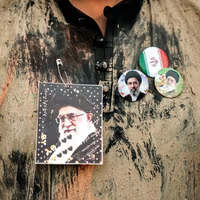
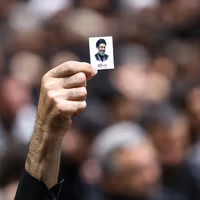
رجل يشارك في مراسم تشييع علي خامنئي يعرض على ملابسه صور المرشد السابق وخلفه مجتبى خامنئي- 4 يوليو (تموز) 2026
As Ali Khamenei’s coffin is carried through days of state-orchestrated mourning, the Islamic Republic is trying to recast a humiliating wartime death as martyrdom, continuity and power, and repair a system wounded by war and public distrust.
The funeral is not simply the burial of a dead ruler. It is an attempt to rebuild the image of a damaged power structure.
The Islamic Republic lost its leader in the first blow of the war, at the heart of its own power network and alongside members of his family.
Now it is trying to use a coffin, flags, religious elegies, organized crowds and the language of sacrifice to change the meaning of that defeat.
Whether Khamenei’s actual body is inside the coffin may matter less than what the coffin is being made to carry.
That uncertainty is itself part of the Islamic Republic’s new condition: a system that hides the truth, manages death and turns opacity into political ritual.
The coffin is therefore more than a funeral object. It is a message. The system wants to show that it can still stage power, mobilize crowds and manufacture a national narrative.
In life, Khamenei was the final symbol of unaccountable power in the Islamic Republic.
For decades, he oversaw repression, executions, the elimination of opponents, control over women’s bodies, engineered elections and security violence. But the way he died broke the image of invulnerability built around him.
A leader who presented himself as commander of the “resistance” and the center of regional power was not killed on a battlefield. He was targeted in a moment that exposed the vulnerability of the structure he ruled.
That is why the Islamic Republic has to rewrite the scene of his death.
The funeral is meant to replace the image of defeat with another image: a slain leader, a grieving religious community, a foreign enemy and a system that still stands after being struck.
As so often in the Islamic Republic, religious ritual becomes a tool of political survival.
In the Islamic Republic’s political culture, death is rarely allowed to remain death. If it can serve power, it is turned into martyrdom.
The state is now trying to reconstruct Khamenei not as the repressive ruler of the past four decades, but as a sacred and wronged figure killed by an external enemy.
But the problem for the Islamic Republic is that society’s memory has not been erased.
For millions of Iranians, Khamenei’s name is tied to the January 2026 killings, the suppression of the Woman, Life, Freedom movement, the bloody crackdown of November 2019, the execution of protesters, mass poverty, forced migration, structural corruption and the reduction of ordinary life to survival.
The government wants the sound of elegies and the image of crowds to cover that memory. But official mourning is not the same as social grief.
A crowd gathered through buses, public holidays, state resources, administrative pressure, round-the-clock propaganda and networks linked to the Basij and other government bodies is not proof of public love.
It is proof of the state’s capacity, and insistence, on organizing the street.
The Islamic Republic wants to turn bodies present in public space into evidence of loyalty, even if many of those bodies are there because of fear, coercion, benefit, habit or indifference.
But the state’s urgent need for religious spectacle also exposes weakness. If political authority were enough, why would the system need so much ritual, spending, closure, security and propaganda to prove that it continues?
The answer is that after Khamenei’s death, the fracture in the image of power has become visible.
His funeral is the first major test of the Islamic Republic after Khamenei.
The system wants to show that his death has not produced collapse, paralysis or a vacuum, and that it can still occupy the street.
The ceremonies are a postwar maneuver by a state that has suffered a military blow, lost much of its social legitimacy and faces a deeply distrustful society.
That is why Khamenei’s funeral is not the end of an era. It is an attempt to control the narrative of how that era ended.
The Islamic Republic knows that the way Khamenei died symbolizes weakness. It is trying to make the way he is buried symbolize power.
But the project contains a central contradiction. A system trying to build authority from Khamenei’s coffin is admitting, without saying so, that authority alone is no longer enough.
If real legitimacy existed, such a vast display would not be necessary. If society were truly grieving, this level of organization would not be needed.
If Khamenei were genuinely loved, the state would not have to rewrite his death with such a volume of propaganda, ritual and security control.
The absence of top leaders from major powers at the funeral of Iran's former Supreme Leader Ali Khamenei reflects the country's international isolation, counterterrorism expert Mohammed Omar told Fox News.
"No major power is sending its top leader," Omar, of the George Washington Program on Extremism, told Fox News.
"For a regime that claims to lead a front stretching from Beirut to Sanaa, a regional turnout at its founder-successor's funeral is the isolation showing through the pageantry," he said.
India, despite an invitation from Iranian President Masoud Pezeshkian to Prime Minister Narendra Modi, is sending a delegation led by a deputy foreign minister and a state governor. China and Pakistan have also announced lower-level delegations.
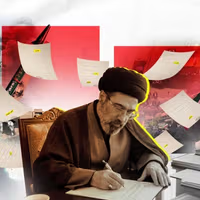
Since becoming Supreme Leader, Mojtaba Khamenei has repeatedly used ba’sat, a term rooted in divine mission, to cast Iranians not just as citizens but as a force tasked with carrying forward the Islamic Republic’s project at home and beyond.
Around 20 messages and written statements have been issued in Mojtaba Khamenei’s name since the Assembly of Experts named him Iran’s new Supreme Leader on March 8.
Some have been routine: condolences, formal greetings and remarks for official occasions. But at least half go further, offering an early view of his political and ideological vocabulary.
They cover a wide range of subjects, from the army, parliament and the Persian language to Hajj, Shiite’s anniversary of Eid al-Ghadir, the Persian Gulf, the US-Iran memorandum of understanding and the so-called Axis of Resistance.
Read together, one word stands out: ba’sat (be’that).
In Islamic tradition, ba’sat refers to being chosen and sent on a divine mission. It is most closely associated with prophethood: the moment a prophet is commissioned to carry a message and fulfill a sacred duty.
In Mojtaba Khamenei’s messages, however, the word is not used only as a religious expression. It becomes a political language for describing the role of the people.
People walk in front of a banner of Supreme Leader Mojtaba Khamenei in Tehran (May 2026)
A sacred word enters politics
Mojtaba Khamenei has used ba’sat in several forms: the ba’sat of the Iranian nation, the ba’sat of the people, the ba’sat of artists, a mission-bearing nation and even a commissioned Islamic ummah.
The ummah, in Islamic political language, refers to the wider Muslim community beyond national borders.
In this framework, Iranians are not presented merely as citizens of a country, voters in a political system or supporters of the Islamic Republic.
They are described as bearers of a historical mission. That is where ba’sat becomes politically important.
It casts the people as the human force of a larger ideological project, rather than simply as a society expected to support the government.
The first clear example appeared in Mojtaba Khamenei’s Hajj message in late May.
He wrote that after the killing of Ali Khamenei, the Iranian nation experienced a divine ba’sat and astonished the world by appearing wherever its presence was needed.
The more revealing line came later. Following the ba’sat of the Iranian nation and the Axis of Resistance, he wrote, the ba’sat of the Islamic ummah would follow.
In a single sequence, he linked the Iranian people, Tehran’s regional network of allied forces and the wider Muslim world.
The message was not only that Iranians had awakened. It was that they had been assigned a role in a project extending beyond Iran’s borders.
People or a mission-bearing nation?
The same pattern appears in other messages. In a statement marking Ferdowsi Day, artists were asked to carry out their own ba’sat in continuation of the people’s ba’sat, and to record the story of this uprising for history.
In a message marking the start of the third year of the 12th parliament, the legislature was told to bring itself into line with a mission-bearing nation.
The chain is revealing.
The mission begins with the people, moves into culture and art, enters formal institutions such as parliament, and is then projected outward toward the Islamic ummah and the Axis of Resistance.
This is not just ceremonial language. In Mojtaba Khamenei’s early vocabulary, the people are not treated simply as a source of legitimacy or as a crowd mobilized for elections, funerals and rallies.
They are framed as a force expected to move the system forward.
That role is tied to resistance against the United States and Israel, support for Tehran’s regional allies, and the claim that Iran is helping shape a new regional and global order.
People inside an old project
This language also connects Mojtaba Khamenei to one of Ali Khamenei’s central ideological themes.
For years, the former Supreme Leader spoke of a five-stage process leading to a new Islamic civilization.
In that theory, the Islamic Revolution was only the beginning.
It was to be followed by an Islamic system, an Islamic government, an Islamic society and, finally, a new Islamic civilization.
Institutions alone were never enough for that project. The theory required society itself to be transformed, with people seeing themselves not merely as subjects of a government but as participants in a long ideological struggle.
Mojtaba Khamenei’s use of ba’sat appears to supply that missing human engine.
If Ali Khamenei’s five-stage theory was the roadmap, ba’sat is Mojtaba Khamenei’s way of describing the people expected to carry it forward.
The Iranian nation becomes mission-bearing. Artists must narrate that mission. Parliament must adjust itself to it. The Axis of Resistance gives it regional depth. And the Islamic ummah gives it a transnational horizon.
Resistance remains central
This is why ba’sat matters beyond the number of times it appears.
Terms such as resistance, America, Israel and the Iranian nation have long been central to the Islamic Republic’s political vocabulary.
Ba’sat does something more specific. It redefines the relationship between people and power.
In this view, people are not only expected to obey, vote, mourn, rally or endure.
They are said to have been commissioned into a larger project, one that links domestic loyalty to regional confrontation and an imagined future order.
In Mojtaba Khamenei’s first message after becoming Supreme Leader, he described the Axis of Resistance as an inseparable part of the values of the Islamic Revolution.
In later messages, he returned to Lebanon, Palestine, Iraq and Yemen.
After the US-Iran memorandum, he said he had initially opposed the agreement but allowed its implementation because the president and the Supreme National Security Council had pledged to protect both the rights of the Iranian nation and those of the Axis of Resistance.
In his Persian Gulf message, he linked the policy of resistance and a strong Iran to the beginning of a new regional and global order.
Mojtaba Khamenei is not abandoning the ideological architecture of his predecessor. He is recasting it in a new vocabulary, with the people placed more explicitly at the center of the mission.
If this reading is correct, ba’sat is more than a religious flourish.
It may be the connecting term between the second and third leaders of the Islamic Republic: a word that preserves Ali Khamenei’s project of a new Islamic civilization while giving Mojtaba Khamenei a language of his own.
The result is not an ideological break. It is an effort to continue the same project with a sharper definition of the people’s role in it: not simply as supporters of the Islamic Republic, but as a people told they have been given a mission.
IRGC commanders Ahmad Vahidi (right) and Reza Sahaban stand before portraits of slain commanders in an event in Tehran, January 25, 2026
Comments by an establishment pundit suggesting the Islamic Revolutionary Guard Corps (IRGC) could be dismantled from within have raised an extraordinary question: is Tehran preparing to reinvent one of the pillars of the Islamic Republic?
The idea would have sounded almost unthinkable just months ago.
But the remarks by Mehdi Khorratian, who has close ties to Iran's hardline establishment, have fueled speculation that at least some in Tehran may be considering a major overhaul of the Islamic Republic's power structure.
Experts interviewed by Iran International say the more revealing question is not whether the IRGC disappears—it is what, if anything, replaces it.
Some believe any restructuring would amount to little more than a rebranding designed to preserve the Guard's power while shedding some of its political and economic baggage. Others see the debate as evidence that Iran's leadership understands the country cannot emerge from the recent war unchanged.
Constitutional obstacle
Historian Shahram Kholdi argues dismantling the IRGC is far more complicated than simply abolishing a military organization.
"The IRGC is not called the Revolutionary Guard Corps of Iran. It is called the Islamic Revolutionary Guard Corps. That is very important," he said.
The obstacle, he argues, lies in the constitution. Article 150 of the Islamic Republic's constitution establishes the Guard not as a conventional military force but as the institution responsible for "guarding the revolution and its achievements."
That ideological mandate makes outright dissolution highly unlikely.
Instead, Kholdi believes the leadership would preserve the system while adapting its structure.
"They will not allow any disruption in the continuity of the Islamic Republic, but they will turn it into what it has been over the past 30 years: a fully military oligarchy disguised as a theocracy," he said.
Kholdi argues restructuring could also serve a practical purpose. As Western governments continue to designate the IRGC as a terrorist organization, folding it into a broader military structure could make it easier for Iranian officials to participate in future international security arrangements linked to any agreement with Washington while complicating efforts to isolate the organization itself.
"It would actually make things much more flexible for them," he said.
A toxic brand
Political analyst Omid Memarian says the IRGC itself has become a liability.
"The IRGC has become a huge liability, both domestically and internationally," he said.
Domestically, he argues, the Guard has become associated with economic mismanagement, political repression and deep involvement across nearly every sector of Iranian life. Internationally, sanctions and terrorism designations have made the organization increasingly costly for Tehran to defend.
"The brand name has become a liability for Iran more and more over the past few years," Memarian said.
That does not necessarily mean the institution itself is disappearing. Rather, he says, it could signal an effort to package the same power structure differently.
"The same people who created this system are doing the rebranding," he said.
Memarian nevertheless believes the debate reflects something larger than institutional reform.
"There is an unwritten consensus that Iran needs a massive departure from the pre-war era," he said.
The debate is unfolding alongside unusually sharp criticism from ultrahardline figures aligned with Saeed Jalili, who have portrayed the post-war political direction as an internal "coup" against Supreme Leader Mojtaba Khamenei. They accuse figures linked to Parliament Speaker Mohammad Bagher Ghalibaf and President Masoud Pezeshkian of steering the Islamic Republic away from its revolutionary course.
Name change or real change?
For Behnam Ben Taleblu, senior director of the Iran Program at the Foundation for Defense of Democracies, the debate begins with a literary question.
"All of this reminds me of the Shakespeare quote from Romeo and Juliet: 'What's in a name?' What is in the name of the Islamic Revolutionary Guard Corps? Its mission is in the name: to preserve, protect and defend the Islamic Revolution."
He does not believe the IRGC is likely to disappear. Instead, he cautions Western governments against confusing cosmetic changes with genuine reform.
"Real transformation comes with behavior. It comes with substance—not style," Ben Taleblu said.
"The West has to distinguish fake transformation from real transformation."
Whether the organization is renamed or folded into another military structure matters less, he argues, than whether it continues sponsoring militant groups abroad, dominating Iran's economy and serving as the central pillar of the Islamic Republic's security apparatus.
"Substance is whether the entity—whatever it's called—continues to act like the IRGC," he said.
A post-war identity crisis
Ultimately, the debate over the IRGC reflects the broader question confronting the Islamic Republic after the recent war: can the system reinvent itself without changing its fundamentals?
Kholdi believes any restructuring would further entrench military rule beneath a religious façade. Memarian argues the leadership recognizes that the pre-war model is no longer sustainable but doubts the same political elite can fundamentally transform the system they built. Ben Taleblu, meanwhile, warns against mistaking pragmatism for moderation.
"People mistake Ghalibaf's opportunism for moderation," he said.
For now, the discussion reveals less about the imminent disappearance of the IRGC than about the Islamic Republic's search for a model capable of surviving its deepest crisis in decades.
Whether that future involves genuine reform or simply a new name for an old institution remains an open question.
Global oil prices have fallen back to around where they stood before the Iran war. But the decline reflects not a recovery in supply but a combination of emergency measures including strategic reserve releases, alternative export routes and, above all, weakening global demand.
According to the International Energy Agency (IEA), the massive supply shock triggered by disruptions in the Persian Gulf has been partially offset by excess oil production accumulated last year and in early 2026, emergency stock releases by industrialized countries, Saudi Arabia's and the UAE's use of export routes bypassing the Strait of Hormuz, and a sharp decline in global oil demand led by China.
The scale of the disruption remains enormous. Oil production across the Persian Gulf has fallen by more than 10 million barrels per day over recent months, resulting in a cumulative production loss of roughly 1.3 billion barrels.
At the same time, global oil demand contracted by about 5.5 million barrels per day in the second quarter of 2026 as economic activity slowed.
China, the world's largest crude importer, has reduced its oil imports by roughly 40 percent—or about 4.6 million barrels per day—over recent months, making weaker demand one of the biggest reasons prices have retreated.
Even so, the region's oil exports remain about 25 percent below their February levels, and restoring pre-war export capacity is likely to take many months. In some cases—particularly Qatar's damaged liquefied natural gas (LNG) facilities—a full recovery could take years.
Another temporary buffer has come from floating storage. Iran alone holds around 150 million barrels of crude at sea, while Washington's two-month waiver allowing Iranian oil exports has also helped ease market tensions.
Those inventories are helping cushion the supply shock, but they cannot replace the region's lost production capacity.
Meanwhile, production of crude oil and other petroleum liquids across the Persian Gulf region remains roughly 45 percent below February levels. Even Saudi Arabia—which can bypass the Strait of Hormuz through its East-West pipeline to the Red Sea—is producing well below pre-war levels, underscoring the scale of the disruption.
In total, the loss of roughly 1.3 billion barrels of production has only been partially offset by the release of more than 300 million barrels from the strategic reserves of industrialized countries.
Even under the most optimistic scenario, repairing the damage inflicted on global oil markets by the Strait of Hormuz crisis is unlikely before the middle of next year.
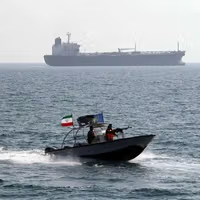
Geopolitical risks also remain elevated. Thursday's attack on a commercial vessel near Oman underscored how fragile maritime security remains despite the ceasefire. Shipping costs in waters south of Iran have risen to roughly 5.5 times their pre-war levels, while tanker charter rates have surged to nearly nine times their pre-war levels.
The disruption extends well beyond crude oil. Exports of petrochemicals, metals, fertilizers, helium and other raw materials from the Arab Gulf continue to face severe constraints, with implications for global industry, agriculture, supply chains and international trade.
Oil prices returning to the $72–74 range should therefore not be interpreted as evidence that the crisis has passed. They instead reflect a market being sustained by emergency inventories and demand destruction rather than recovering supply.
Until shipping through the Strait of Hormuz returns to normal and Persian Gulf production fully recovers, the global economy will remain vulnerable to renewed energy shocks and heightened market volatility.