Iran official says talks with US do not rule out revenge
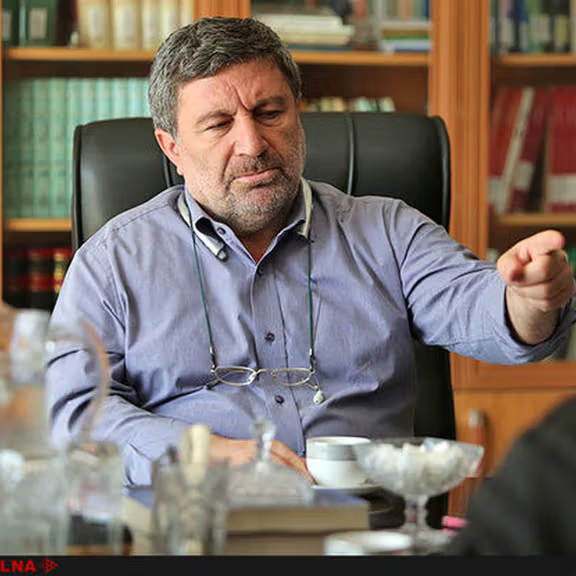
A senior Iranian government official said on Saturday that any future negotiations with the United States would not change Iran's determination to seek revenge following the recent conflict.
"Even if we sit at the negotiating table, we negotiate with bitterness, not with pleasure," Elias Hazrati, head of the government's information council, said.
"Although a ceasefire has been established, the principle of revenge must remain in our hearts," he said, adding that Iran would "fight, negotiate and sign agreements" when necessary to serve the country's interests.




The funeral is not simply the burial of a dead ruler. It is an attempt to rebuild the image of a damaged power structure.
The Islamic Republic lost its leader in the first blow of the war, at the heart of its own power network and alongside members of his family.
Now it is trying to use a coffin, flags, religious elegies, organized crowds and the language of sacrifice to change the meaning of that defeat.
Whether Khamenei’s actual body is inside the coffin may matter less than what the coffin is being made to carry.
That uncertainty is itself part of the Islamic Republic’s new condition: a system that hides the truth, manages death and turns opacity into political ritual.
The coffin is therefore more than a funeral object. It is a message. The system wants to show that it can still stage power, mobilize crowds and manufacture a national narrative.
A coffin in place of authority
In life, Khamenei was the final symbol of unaccountable power in the Islamic Republic.
For decades, he oversaw repression, executions, the elimination of opponents, control over women’s bodies, engineered elections and security violence. But the way he died broke the image of invulnerability built around him.
A leader who presented himself as commander of the “resistance” and the center of regional power was not killed on a battlefield. He was targeted in a moment that exposed the vulnerability of the structure he ruled.
That is why the Islamic Republic has to rewrite the scene of his death.
The funeral is meant to replace the image of defeat with another image: a slain leader, a grieving religious community, a foreign enemy and a system that still stands after being struck.
As so often in the Islamic Republic, religious ritual becomes a tool of political survival.
In the Islamic Republic’s political culture, death is rarely allowed to remain death. If it can serve power, it is turned into martyrdom.
The state is now trying to reconstruct Khamenei not as the repressive ruler of the past four decades, but as a sacred and wronged figure killed by an external enemy.
But the problem for the Islamic Republic is that society’s memory has not been erased.
For millions of Iranians, Khamenei’s name is tied to the January 2026 killings, the suppression of the Woman, Life, Freedom movement, the bloody crackdown of November 2019, the execution of protesters, mass poverty, forced migration, structural corruption and the reduction of ordinary life to survival.
The government wants the sound of elegies and the image of crowds to cover that memory. But official mourning is not the same as social grief.
A crowd gathered through buses, public holidays, state resources, administrative pressure, round-the-clock propaganda and networks linked to the Basij and other government bodies is not proof of public love.
It is proof of the state’s capacity, and insistence, on organizing the street.
The Islamic Republic wants to turn bodies present in public space into evidence of loyalty, even if many of those bodies are there because of fear, coercion, benefit, habit or indifference.
A ritual for political survival
The timing of the ceremonies during the holy Shiite month of Muharram gives the state a powerful symbolic opportunity.
Since its birth, the Islamic Republic has narrated politics through the language of Ashura: oppression, blood, enemies, sacrifice and martyrdom.
It is now trying to place Khamenei’s death inside the same structure of meaning.
In that narrative, a ruler responsible for many deaths is recast as a victim whose blood must be avenged. This reversal is the core of the propaganda.
The real victims are removed from the scene, while the agent of repression is placed in the position of the wronged.
The mothers of those killed, political prisoners, suppressed women and the families of executed protesters are absent from this stage.
The scene is designed for only one authorized form of mourning: grief for humiliated power.
But the state’s urgent need for religious spectacle also exposes weakness. If political authority were enough, why would the system need so much ritual, spending, closure, security and propaganda to prove that it continues?
The answer is that after Khamenei’s death, the fracture in the image of power has become visible.
His funeral is the first major test of the Islamic Republic after Khamenei.
The system wants to show that his death has not produced collapse, paralysis or a vacuum, and that it can still occupy the street.
The ceremonies are a postwar maneuver by a state that has suffered a military blow, lost much of its social legitimacy and faces a deeply distrustful society.
That is why Khamenei’s funeral is not the end of an era. It is an attempt to control the narrative of how that era ended.
The Islamic Republic knows that the way Khamenei died symbolizes weakness. It is trying to make the way he is buried symbolize power.
But the project contains a central contradiction. A system trying to build authority from Khamenei’s coffin is admitting, without saying so, that authority alone is no longer enough.
If real legitimacy existed, such a vast display would not be necessary. If society were truly grieving, this level of organization would not be needed.
If Khamenei were genuinely loved, the state would not have to rewrite his death with such a volume of propaganda, ritual and security control.


